
#FactCheck-Viral Video of Indian Flag Desecration is from Karachi, Pakistan, Not Tehran
Executive Summary
A video showing a large crowd disrespecting the Indian tricolor along with American and Israeli flags is being widely shared on social media. Users sharing the video claim that the incident recently took place in Iran's capital, Tehran, showcasing "Iran's hatred towards India." However, a fact-check done by the CyberPeace Research Wing has revealed that this claim is misleading. The viral video was not filmed in Iran, but rather during a procession in Karachi, Pakistan.
The Claim
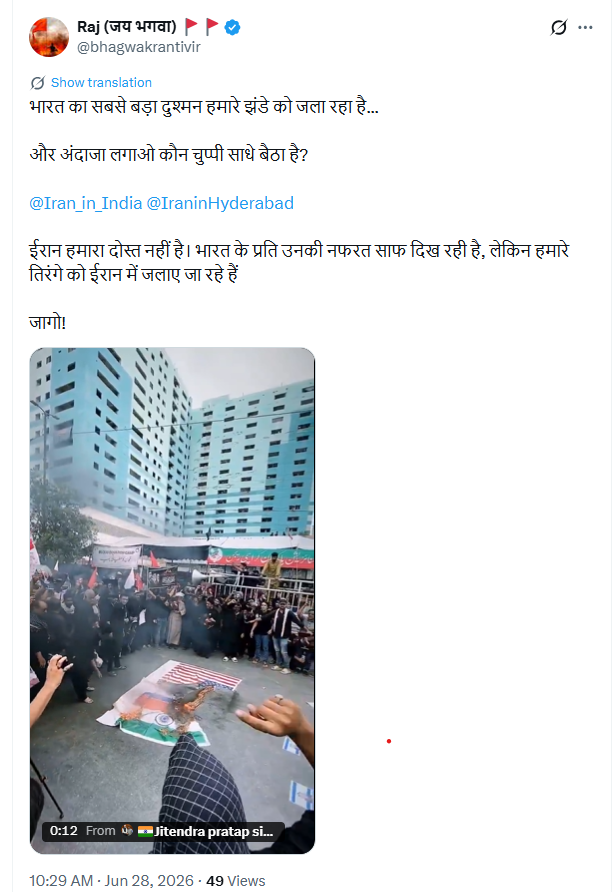
A user on the social media platform X (formerly Twitter) shared the video with the caption: "India’s biggest enemy is burning our flag and guess who is sitting silently? Iran is not our friend. Their hatred towards India is clearly visible, but our tricolor is being burnt in Iran." https://x.com/bhagwakrantivir/status/2071096021183246667 , https://archive.ph/6mGE8
Factcheck
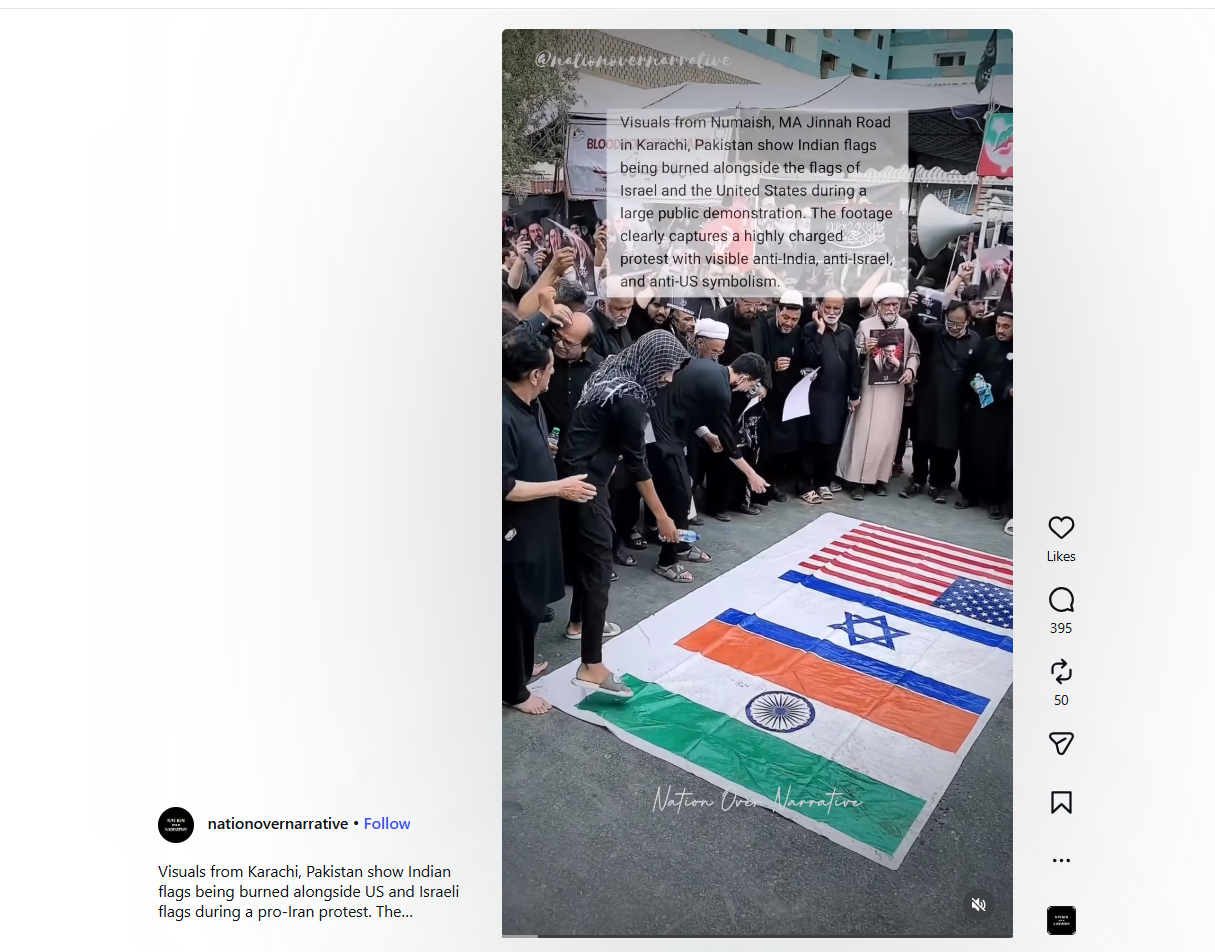
Keyframes extracted from the viral video were searched using Google Lens. This led to an Instagram post containing the exact same footage. The caption of this post identified the location as Karachi, Pakistan, noting that the demonstration was held in support of Iran, during which flags of India, the US, and Israel were burnt.
https://www.instagram.com/reels/DaDLQO6obcK/
Further keyword searches led to the official Instagram account of the 'Imamia Students Organization Karachi'. A video uploaded on June 25, 2026, showed the same event captured from a different camera angle. According to the caption, the footage is from a '9th Muharram' procession in Karachi.
https://www.instagram.com/p/DaApSBfIpNQ/

To conclusively establish the location, Google Maps Street View was used to cross-reference the physical landmarks seen in the video.The visual elements perfectly match Mohammad Ali Jinnah Road in Karachi, Pakistan.A distinct blue building named 'Mid Town', visible in the viral video, matches the Google Street View imagery of the location.

Conclusion
The research confirms that the video showing the burning and desecration of the Indian national flag is from Karachi, Pakistan, and not Tehran, Iran. The social media claims linking this incident to Iran are false and contextually misleading.

Related Blogs
Executive Summary
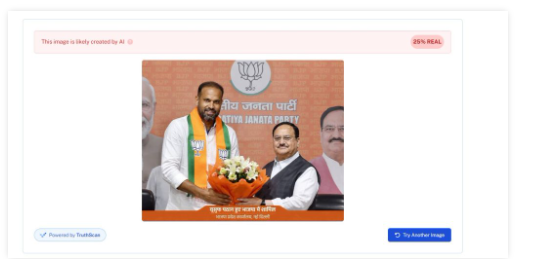
Amid political developments following the 2026 West Bengal Assembly elections, a photo is being widely circulated on social media claiming that former cricketer and Baharampur MP Yusuf Pathan has joined the Bharatiya Janata Party (BJP). The viral image shows Pathan wearing a BJP scarf and standing alongside Union Health Minister JP Nadda. CyberPeace Research Wing research found the claim to be false. The image in circulation is AI-generated and does not depict any real event.
Claim:
A Facebook user ‘Mohd Anwar Dhadoli Khurd’ shared the viral image on June 16, 2026, claiming that Yusuf Pathan has joined the BJP. The post has since been widely shared across platforms.
Post link: https://www.facebook.com/mohd.anwar.dhadoli.khurd/posts/pfbid02WAo4uXhhM1qEVTMbxTjKpTHkoeAbfEztwkX6tWLWpN8WBzNavgtJgKV8JoBGULSul
Archive link: https://perma.cc/4A3H-YTPL

Fact Check:
A reverse image search of the viral photo did not yield any credible news reports or authentic sources linking the image to any such political development. No related information was found on Yusuf Pathan’s official social media accounts either, raising suspicion about the authenticity of the image. The image was then analysed using AI detection tools. Sightengine reported a 99% probability of the image being AI-generated.
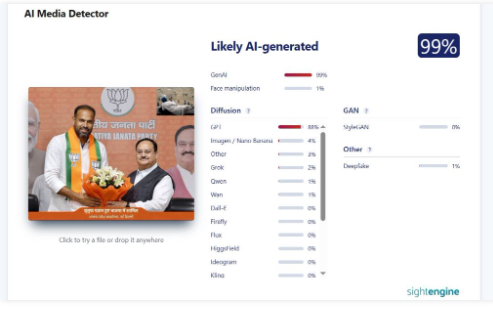
Additionally, analysis using “Undetectable.ai” also indicated a high likelihood of AI manipulation.
Conclusion:
The research confirms that the viral image claiming Yusuf Pathan’s entry into the BJP is AI-generated and does not reflect any real-world event.
Introduction
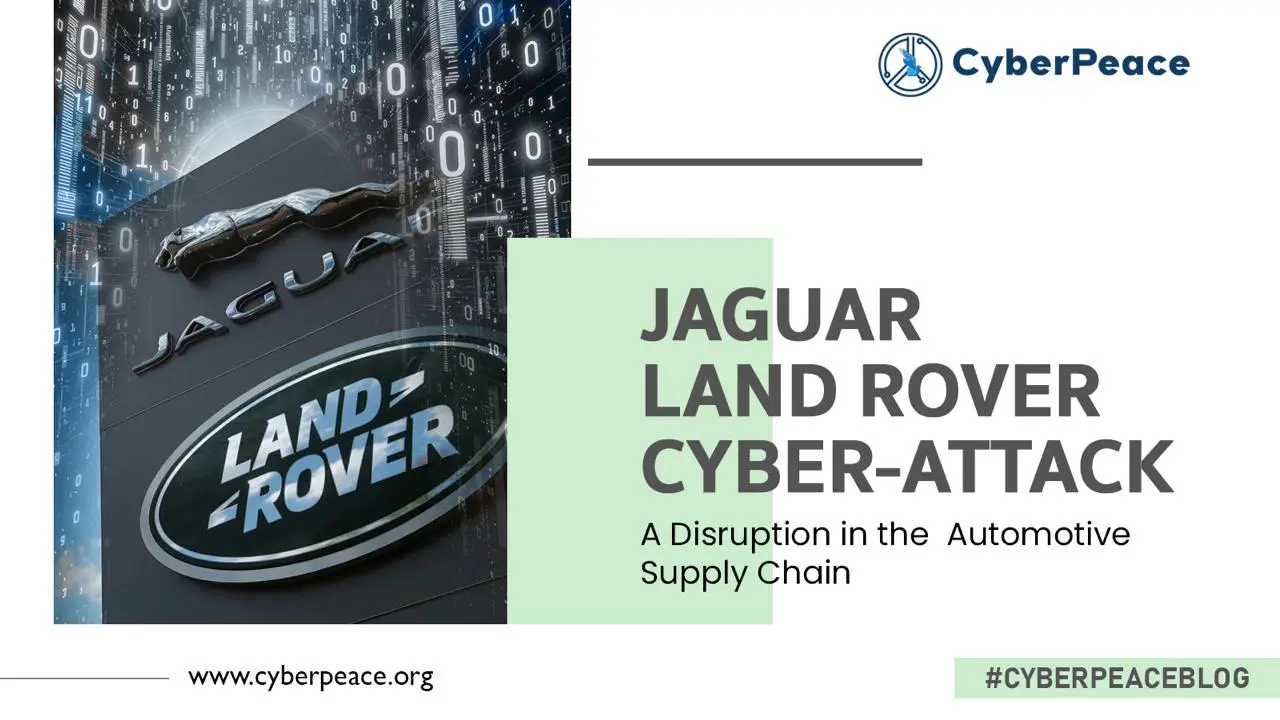
The recent cyber-attack on Jaguar Land Rover (JLR), one of the world's best-known car makers, has revealed extensive weaknesses in the interlinked character of international supply chains. The incident highlights the increasing cybersecurity issues of industries going through digital transformation. With its production stopped in several UK factories, supply chain disruptions, and service delays to its customers worldwide, this cyber-attack shows how cyber events can ripple into operation, finance, and reputation risks for large businesses.
The Anatomy of a Breakdown
Jaguar Land Rover, a Tata Motors subsidiary, was forced to disable its IT infrastructure because of a cyber-attack over the weekend. This shut down was already an emergency shut down to mitigate damage and the disruption to business was serious.
- No Production - The car plants at Halewood (Merseyside) and Solihull (West Midlands) and the engine plant (Wolverhampton) were all completely shut down.
- Sales and Distribution: Car sales were significantly impaired during a high-volume registration period in September, although certain transactions still passed through manual procedures.
- Global Effect: The breakdown did not reach only the UK, dealers and fix experts across the world, including in Australia, suffered with inaccessible parts databases.
JLR called the recovery process "extremely complex" as it involved a controlled recovery of systems and implementing alternative workarounds for offline services. The overall effects include the immediate and massive impact to their suppliers and customers, and has raised larger questions regarding the sustainability of digital ecosystems in the automobile value chain.
The Human Impact: Beyond JLR's Factories
The implications of the cyber-attack have extended beyond the production lines of JLR:
- Independent Garages: Repair centres such as Nyewood Express of West Sussex indicated that they could not use vital parts databases, which brought repair activities to a standstill and left clients waiting indefinitely.
- Global Dealers: Land Rover experts as distant as Tasmania indicated total system crashes, highlighting global dependency on centralized IT systems.
- Customer Frustration: Regular customers in need of urgent repairs were stranded by the inability to order replacement parts from original manufacturers.
This attack is an example of the cascading effect of cyber disruptions among interconnected industries, a single point of failure paralyzing complete ecosystems.
The Culprit: The Hacker Collective
The hack is justifiably claimed by a so-called hacker collective "Scattered Lapsus$ Hunters." The so-called hacking collective says that it consists of young English-speaking hackers and has previously targeted blue-chip brands like Marks & Spencer. While the attackers seem not to have publicly declared whether they exfiltrated sensitive information or deployed ransomware, they went ahead and posted screenshots of internal JLR documents-the kind of documents that probably are not supposed to see the light of day, including troubleshooting guides and system logs-implicating what can only be described as grossly unauthorized access into some of Jaguar Land Rover's core IT systems.
Jaguar Land Rover had gone on record to claim with no apropos proof or evidence that it probably did not see anyone getting into customer data; however, the very occurrence of this attack raises some very serious questions on insider threats, social engineering concepts, and how efficient cybersecurity governance architectures really are.
Cybersecurity Weaknesses and Lessons Learned
The JLR attack depicts some of the common weaknesses associated with large-scale manufacturing organizations:
- Centralized IT Dependencies: Today's auto firms are based on worldwide IT systems for operations, logistics, and customer care. Compromise can lead to broad outages.
- Supply Chain Vulnerabilities: Tier-2 and Tier-1 suppliers use OEM systems for placing and tracing components. Interrupting at the OEM level automatically stops their processes.
- Inadequate Incident Visibility: Several suppliers complained about no clear information from JLR, which increased uncertainty and financial loss.
- Rise of Youth Hacking Groups: Involvement of youth hacker groups highlight the necessity for active monitoring and community-level cybersecurity awareness initiatives.
Broader Industry Context
With ever-increasing cyber-attacks on the automotive industry, an area currently being rapidly digitalised through connected cars, IoT-based factories, and cloud-based operations, this series of incidents falls within such a context. In 2023, JLR awarded an £800 million contract to Tata Consultancy Services (TCS) for services in support of the company's digital transformation and cybersecurity enhancement. This attack shows that, no matter how much is spent, poorly conceptualised security programs can never stand up to ever-changing cyber threats.
What Can Organizations Do? – Cyberpeace Recommendations
To contain risks and develop a resilience against such events, organizations need to implement a multi-layered approach to cybersecurity:
- Adopt Zero Trust Architecture - Presume breach as the new normal. Verify each user, device, and application before access is given, even inside the internal network.
- Enhance Supply Chain Security - Perform targeted assessments on a routine basis to identify risk factors in diminishing suppliers. Include rigorous cybersecurity provisions in the agreements with suppliers, namely disclosure of vulnerabilities and the agreed period for incident response.
- Durable Backups and Their Restoration - Backward hampers are kept isolated and encrypted to continue operations in case of ransomware incidents or any other occur in system compromise.
- Periodic Red Team Exercises - Simulate cyber-attacks on IT and OT systems to examine if vulnerabilities exist and evaluate current incident response measures.
- Employee Training and Insider Threat Monitoring - Social engineering being the forefront of attack vectors, continuous training and behavioural monitoring will have to be done to avoid credential disposal.
- Public-Private Partnership - Interact with several government agencies and cybersecurity groups for sharing threat intelligence and enforcing best practices complementary to ISO/IEC 27001 and NIST Cybersecurity Framework.
Conclusion
The hacking at Jaguar Land Rover is perhaps one of a thousand reminders that cybersecurity can no longer be seen as a back-office job but rather as an issue of business continuity at the very core of the organization. In the process of digital transformation, the attack surface grows, making the entities targeted by cybercriminals. Operation security demands that cybersecurity be ensured on a proactive basis through resilient supply chains and stakeholders working together. The JLR attack is not an isolated event; it is a warning for the entire automobile sector to maintain security at every level of digitalization.
References
- https://www.bbc.com/news/articles/c1jzl1lw4y1o
- https://www.theguardian.com/business/2025/sep/07/disruption-to-jaguar-land-rover-after-cyber-attack-may-last-until-october
- https://uk.finance.yahoo.com/news/jaguar-factory-workers-told-stay-073458122.html
Executive Summary
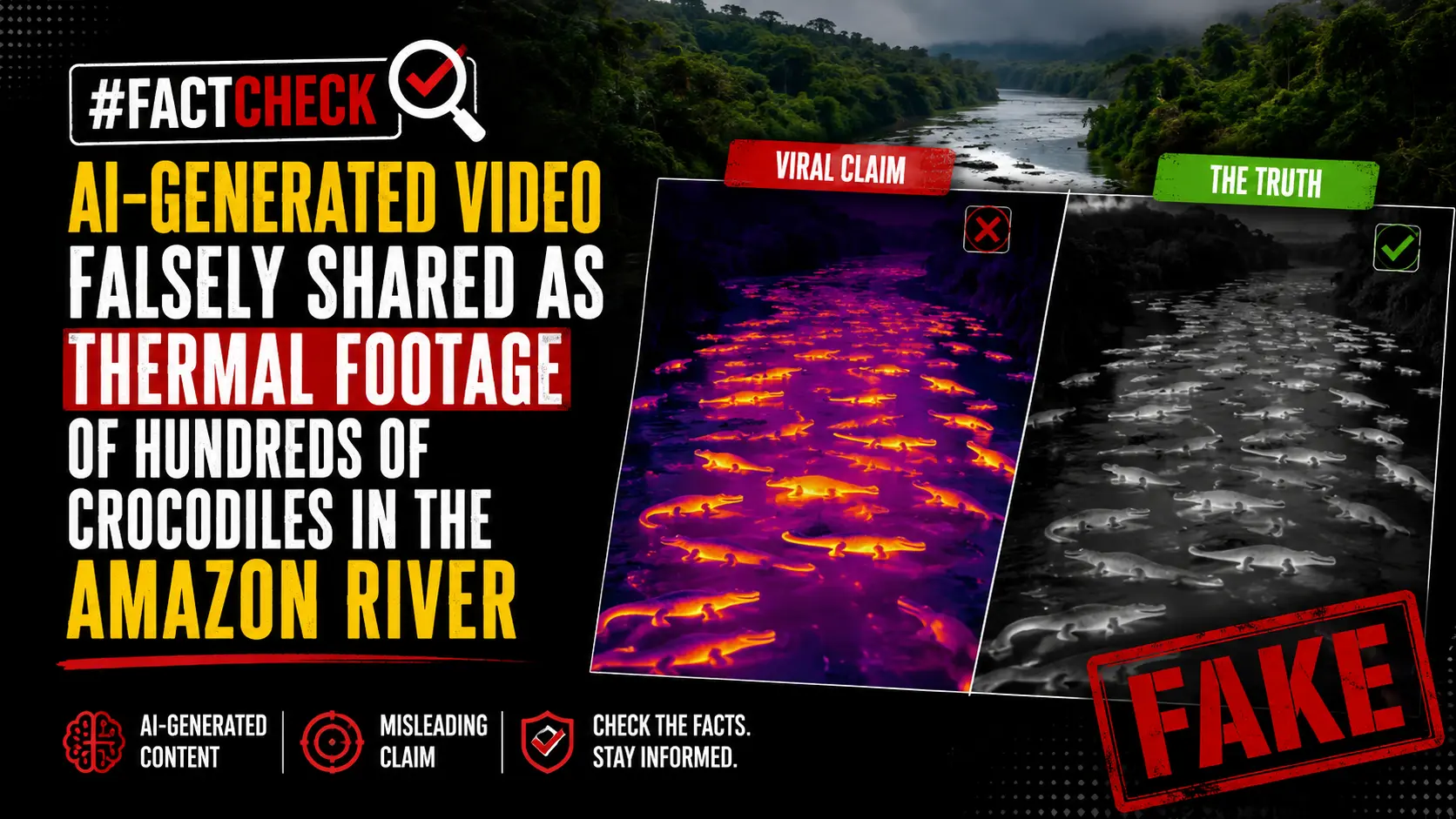
A video is being widely shared on social media claiming to show a helicopter's thermal camera capturing hundreds of crocodiles hidden along the Amazon River at night. The footage appears to show a thermal imaging view of a river and its banks, where hundreds of crocodiles can allegedly be seen. Users claim the video was recorded using night-vision/thermal imaging technology over the Amazon River. CyberPeace Research Wing’s research found the claim to be false. The research revealed that the viral video is not authentic but has been generated using artificial intelligence (AI) and is being circulated with a fabricated claim.
Claim
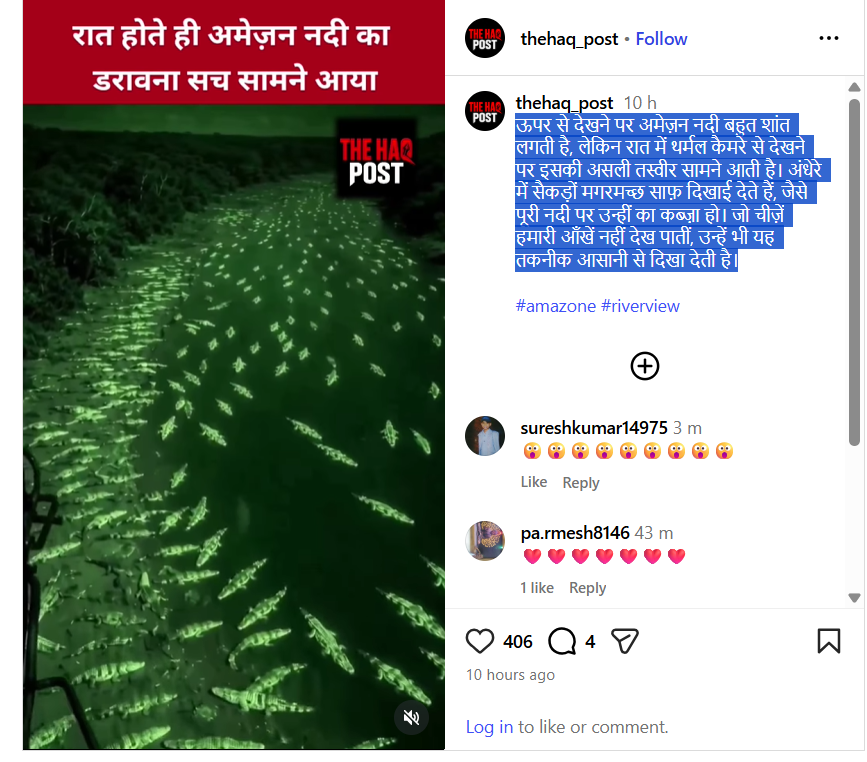
Social media users are sharing the video claiming that it shows a thermal camera recording of hundreds of crocodiles in and around the Amazon River at night. The post link and screenshot are provided below.
https://www.instagram.com/reel/DalJ41bIezV/?utm_source=ig_web_button_share_sheet
https://www.instagram.com/reel/DalJ41bIezV/?utm_source=ig_web_button_share_sheet
Fact Check
To verify the claim, we extracted several keyframes from the viral video and conducted a reverse image search using Google Lens. However, we found no credible news reports, authentic videos, or reliable sources confirming that the footage was recorded over the Amazon River.
We then conducted a detailed visual analysis of the video. The footage exclusively shows crocodile-like figures spread across the river and its banks, while no other aquatic animals or natural environmental activity—normally expected in a river ecosystem of that scale—are visible. These inconsistencies raised further doubts about the video's authenticity.
As part of our verification, we analysed the video using the AI detection tool Hive Moderation. The analysis indicated a 95.7% probability that the video was AI-generated.
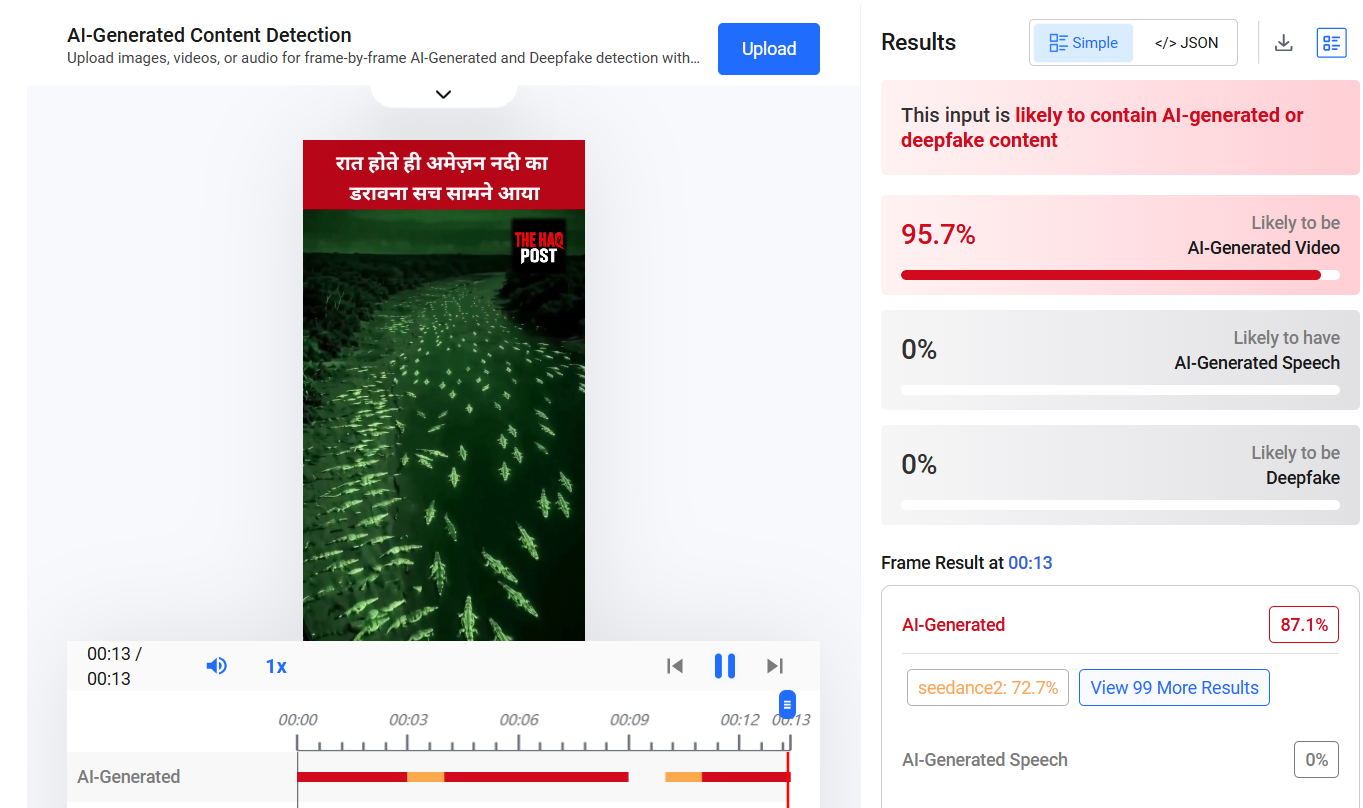
As part of our verification, we analysed the video using the AI detection tool Hive Moderation. The analysis indicated a 95.7% probability that the video was AI-generated.

Conclusion
Our research found that the viral video does not show a genuine thermal-camera recording of the Amazon River. The footage was created using artificial intelligence and is being circulated online with a false and misleading claim.
