
#FactCheck-AI-Generated Audio Falsely Attributed to Rajnath Singh in Viral Video on Student Protest
Executive Summary
A video featuring Union Defence Minister Rajnath Singh is being widely circulated on social media with the claim that he issued a strict warning against student protesters. In the viral clip, Singh is allegedly heard saying that the government would not tolerate “anarchy” and that strict action would be taken against those blocking roads, disturbing public order, or damaging government property. CyberPeace Research Wing’s research found the claim to be false. The research revealed that the original video available on Rajnath Singh’s official YouTube channel was digitally altered by adding AI-generated audio. The statement heard in the viral video is not genuine and was created using artificial intelligence.
Claim:
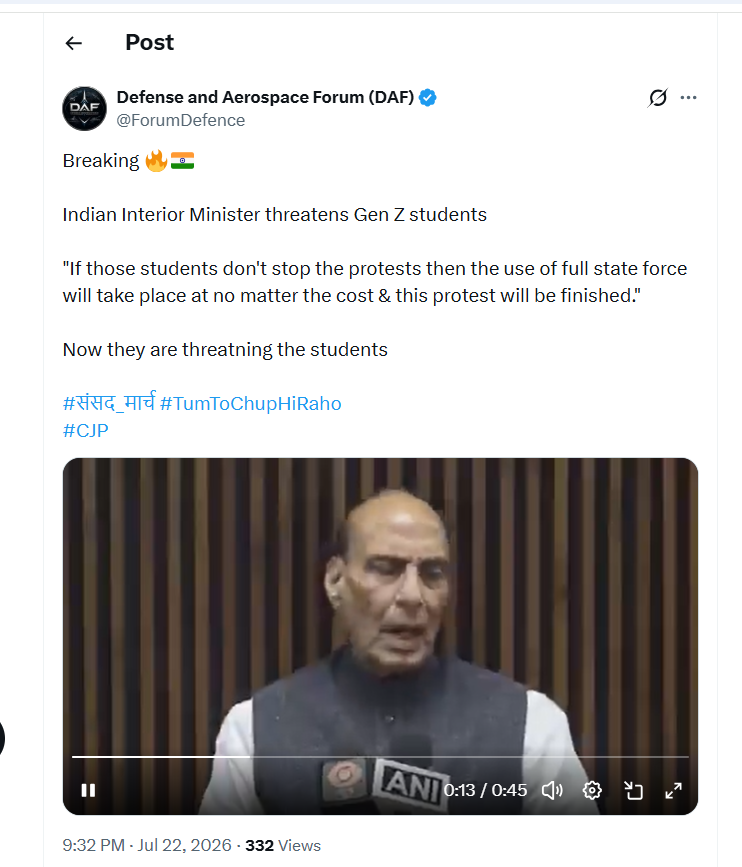
An account on social media platform X (formerly Twitter), with the username @ForumDefence, shared a video on July 22, 2026, claiming that Union Defence Minister Rajnath Singh had issued a warning regarding the ongoing student protest. The video features an AI-generated voice attributed to Rajnath Singh, in which he is allegedly heard saying: “Taking advantage of the student movement, the unrest and violence being spread over the past few days are strongly condemned by the government. Expressing one’s views is a democratic right, but breaking the law and creating difficulties for the public in its name will not be tolerated. The government will not tolerate such anarchy. Anyone attempting to block roads, disturb peace, or damage government property will face strict action.”
The link, archive link and screenshot of the post are provided below:
https://x.com/ForumDefence/status/2079960247888756775
Fact Check:
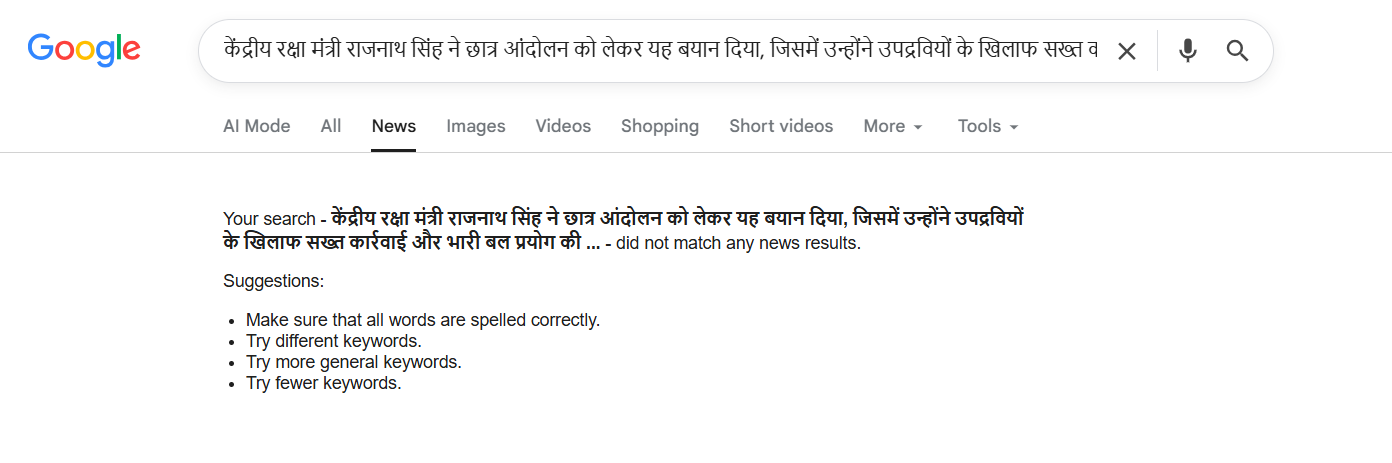
To verify the viral claim, the Desk conducted a keyword search on Google. However, no credible news report or official statement was found confirming that Rajnath Singh had made such remarks regarding the student protest.
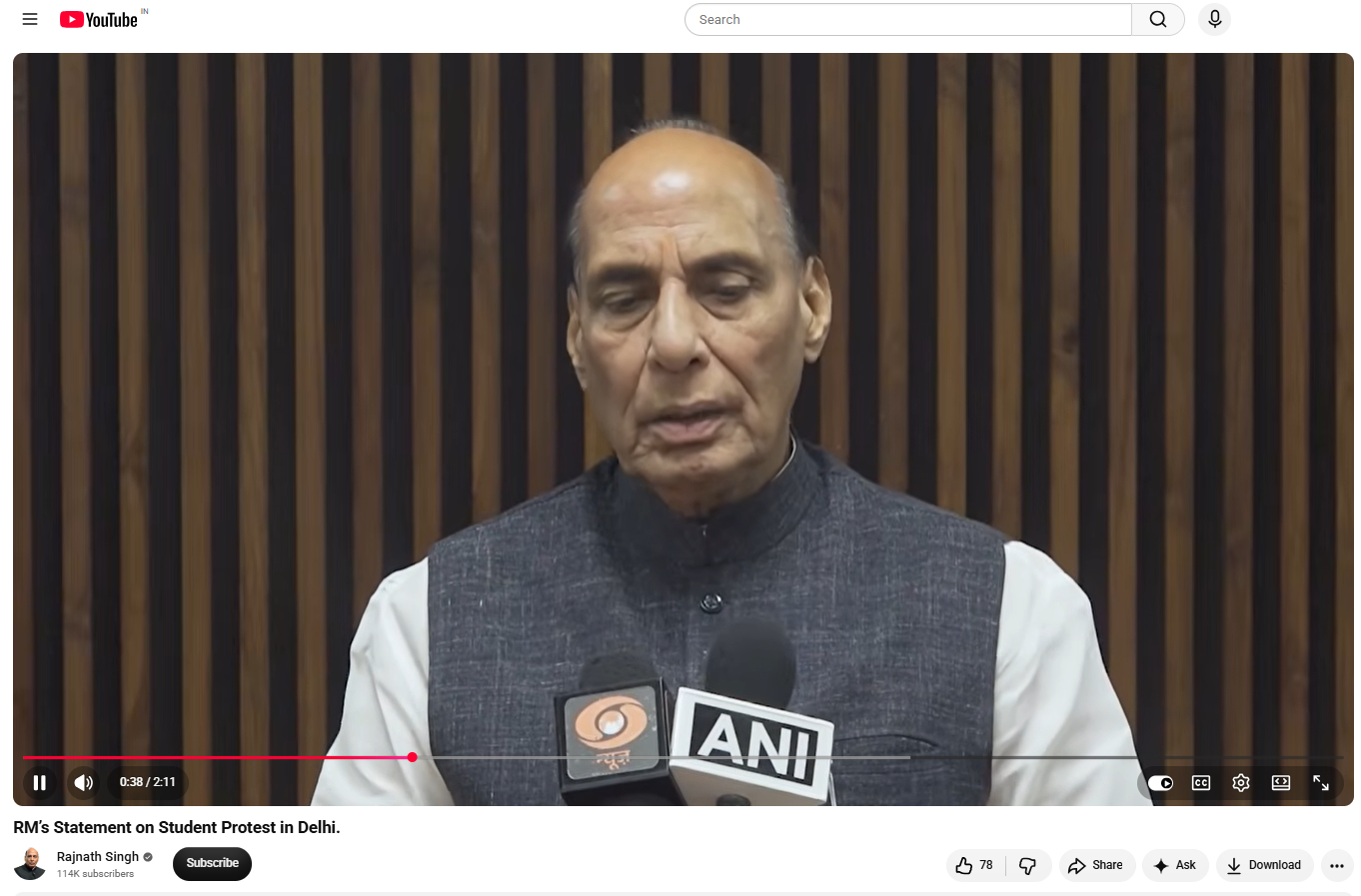
During further research, the Desk found the original video on the official YouTube channel of Union Defence Minister Rajnath Singh. A comparison between the viral clip and the original video showed that the statements attributed to Singh in the viral video did not match his actual remarks. In the original video, Rajnath Singh was speaking about the ongoing protests in Delhi. He said that the protests were a matter of serious concern and expressed that it was unfortunate that some people were attempting to use students and youth as a political tool for their own interests.
He further stated that the government was committed to addressing the concerns of students and youth, and that dialogue and discussion were the appropriate ways to resolve issues in a democracy.
The original video from Rajnath Singh’s official YouTube channel can be accessed here:
https://www.youtube.com/watch?v=w73iPTEfKCA
Further analysis of the viral video’s audio was conducted using the AI detection tool Resemble AI. The analysis indicated that the audio had a 99.10 per cent probability of being AI-generated.

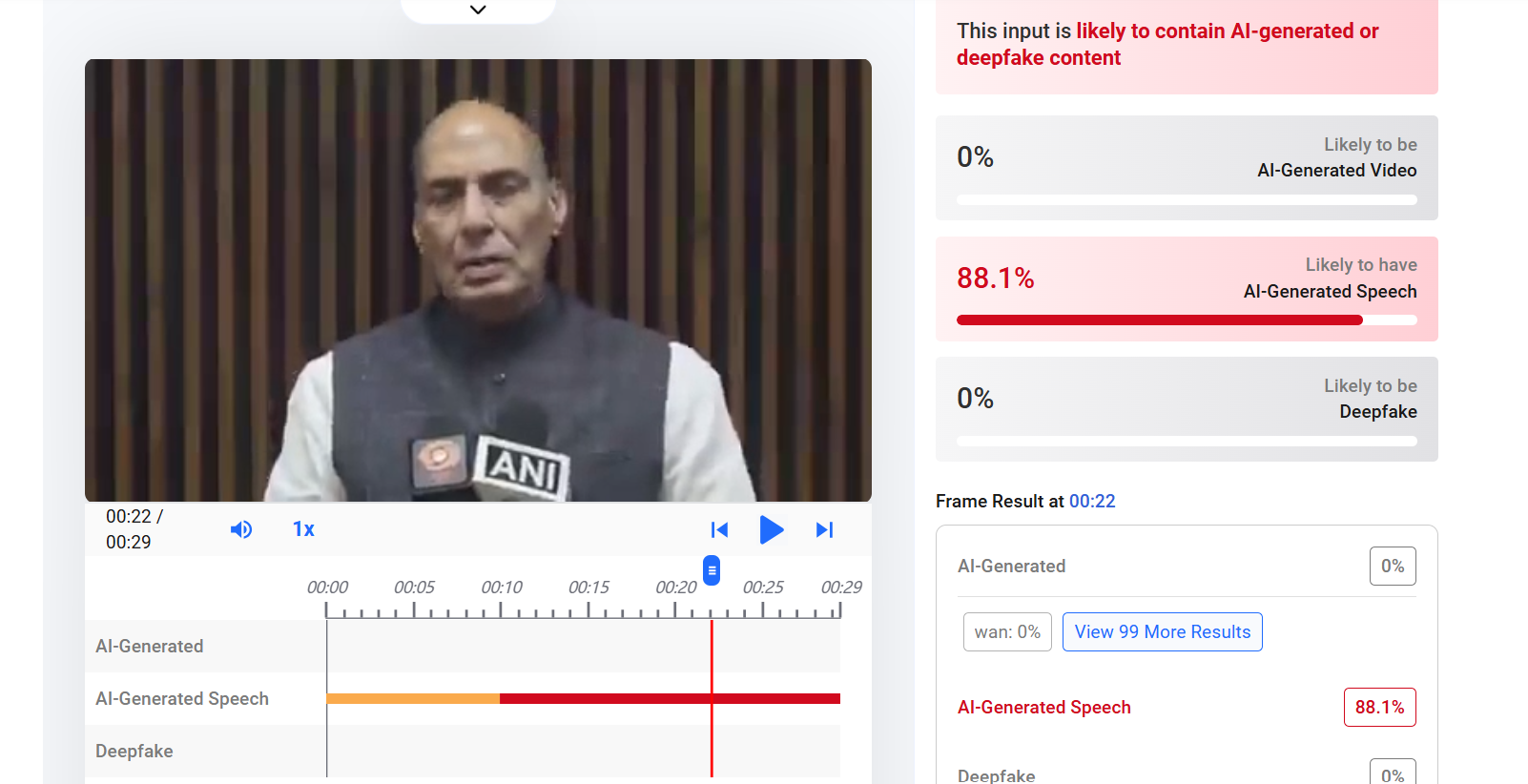
The Desk also examined the viral video using the AI detection tool HIVE Moderation. The analysis suggested that the speech used in the video had an 88.1 per cent probability of being AI-generated.
Conclusion:
The research established that the viral video featuring Union Defence Minister Rajnath Singh has been digitally manipulated by adding AI-generated audio. The statement attributed to Singh regarding strict action against student protesters is not genuine. The original video available on Rajnath Singh’s official YouTube channel contains different remarks, and the viral clip has been circulated with a false and misleading claim.

Related Blogs

Executive Summary:
An image has been spread on social media about the truck carrying money and gold coins impounded by Jharkhand Police that also during lok sabha elections in 2024. The Research Wing, CyberPeace has verified the image and found it to be generated using artificial intelligence. There are no credible news articles supporting claims about the police having made such a seizure in Jharkhand. The images were checked using AI image detection tools and proved to be AI made. It is advised to share any image or content after verifying its authenticity.

Claims:
The viral social media post depicts a truck intercepted by the Jharkhand Police during the 2024 Lok Sabha elections. It was claimed that the truck was filled with large amounts of cash and gold coins.


Fact Check:
On receiving the posts, we started with keyword-search to find any relevant news articles related to this post. If such a big incident really happened it would have been covered by most of the media houses. We found no such similar articles. We have closely analysed the image to find any anomalies that are usually found in AI generated images. And found the same.

The texture of the tree in the image is found to be blended. Also, the shadow of the people seems to be odd, which makes it more suspicious and is a common mistake in most of the AI generated images. If we closely look at the right hand of the old man wearing white attire, it is clearly visible that the thumb finger is blended with his apparel.
We then analysed the image in an AI image detection tool named ‘Hive Detector’. Hive Detector found the image to be AI-generated.

To validate the AI fabrication, we checked with another AI image detection tool named ‘ContentAtScale AI detection’ and it detected the image as 82% AI. Generated.

After validation of the viral post using AI detection tools, it is apparent that the claim is misleading and fake.
Conclusion:
The viral image of the truck impounded by Jharkhand Police is found to be fake and misleading. The viral image is found to be AI-generated. There has been no credible source that can support the claim made. Hence, the claim made is false and misleading. The Research Wing, CyberPeace previously debunked such AI-generated images with misleading claims. Netizens must verify such news that circulates in Social Media with bogus claims before sharing it further.
- Claim: The photograph shows a truck intercepted by Jharkhand Police during the 2024 Lok Sabha elections, which was allegedly loaded with huge amounts of cash and gold coins.
- Claimed on: Facebook, Instagram, X (Formerly known as Twitter)
- Fact Check: Fake & Misleading
Introduction
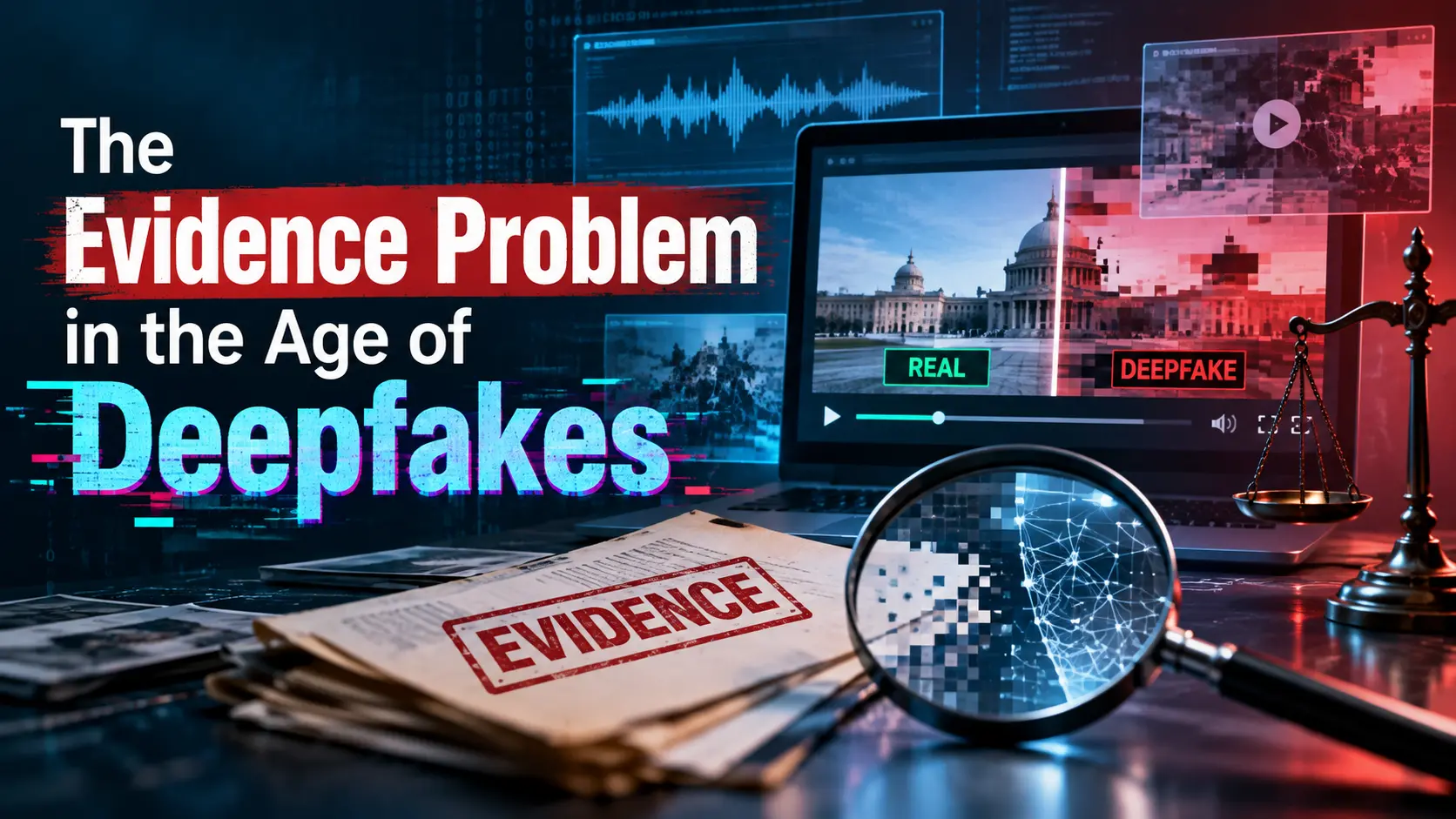
Digital evidence has become part of almost every modern investigation. A photograph can place a person at a location, an audio recording can capture a conversation, and a video can appear to show an event as it happened. For years, the main forensic concern was whether such material had been altered. The rapid growth of generative artificial intelligence has added a harder question: even when a file is preserved exactly as received, can investigators still trust what it appears to show?
Deepfakes have made this question practical rather than theoretical. Synthetic or manipulated audio, video and images can imitate real people and real events with increasing realism. CERT-In describes deepfakes as a high-risk threat because they can support disinformation, fraud, social engineering and reputational harm.[1] NIST research likewise treats AI-generated media as a digital-forensics challenge that requires systematic evaluation of detection technologies.[2]
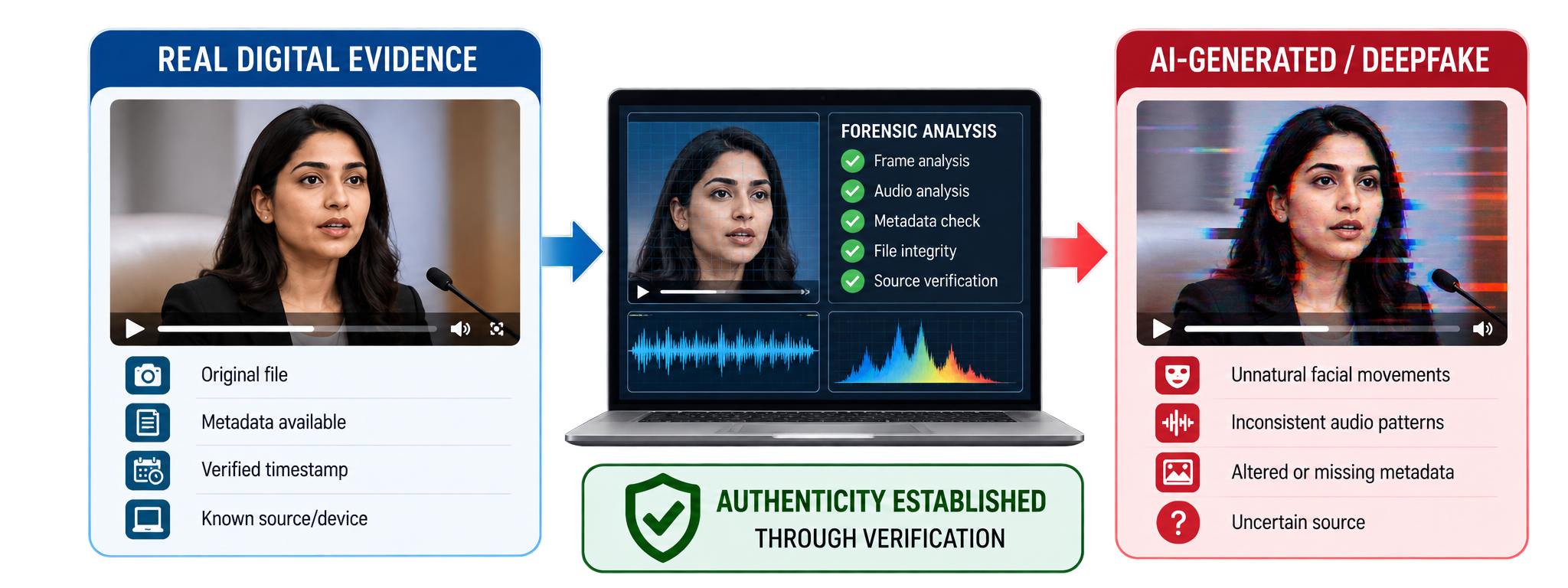
The result is an evidence problem. The answer is not to stop trusting digital evidence, but to become more disciplined about establishing its origin, integrity, context and authenticity.
The evidence problem begins before the laboratory
When a suspicious video reaches an investigator through WhatsApp, Telegram, email or social media, the file may already have passed through several transformations. It may have been compressed, re-encoded, cropped, renamed or stripped of metadata. A screenshot may preserve what is visible but lose the original file structure. A forwarded audio clip may contain no reliable information about where it was first recorded.
For that reason, forensic examination should begin with acquisition and provenance, not with a quick “deepfake detector” result. Investigators should ask: Who supplied the file? Where was it obtained? Is there an original version? What device or account produced it? What happened to the file before it reached the investigator?
Cryptographic hashing remains important because it can demonstrate that an acquired working copy has not changed during examination. But a valid hash does not prove that the underlying event was genuine. A perfectly preserved fake is still a fake.
What a professional examination should look for
A reliable assessment combines several forms of evidence rather than relying on one technical indicator.
Source and acquisition. The original artefact should be preserved whenever possible. Investigators should record the acquisition method, date and time, source account or device, and any known transformations before collection. A documented chain of custody is essential when material may later support a legal, disciplinary or regulatory decision.
Metadata and file structure. Metadata may provide useful clues about creation, encoding, editing software and timestamps. File structure, compression behaviour and related technical characteristics can also reveal inconsistencies. However, these indicators are supporting evidence, not proof on their own, because metadata can be removed or rewritten during normal processing.
Content-level examination. Forensic analysis can include frame-by-frame video review, audio waveform and spectral examination, and inspection for inconsistencies in lighting, reflections, facial movement, lip synchronisation or background elements. Such signs may help guide an investigation, but they are not a permanent checklist. Generative systems continue to improve.
Independent corroboration. This is often the strongest step. If a recording allegedly shows that a person was in a particular place at a particular time, investigators can compare it with CCTV, access-control records, device artefacts, communications, location information, eyewitness accounts or other independent records. The goal is to determine whether the wider evidence supports the event represented by the media.
A real-world lesson: the Pikesville case
The 2024 Pikesville High School incident in Maryland provides a practical example of why authenticity cannot be assumed from appearance alone. An audio recording circulated online that was presented as the principal making racist and antisemitic comments. On January 17, 2024, Baltimore County Public Schools said it could not yet confirm the recording’s veracity and opened an investigation.[3]
Several months later, the school district reported that investigators, with assistance from the FBI and other experts, had verified that the audio had been created using artificial intelligence.[4] Police subsequently arrested the school’s former athletic director in connection with the fabricated recording.[5]
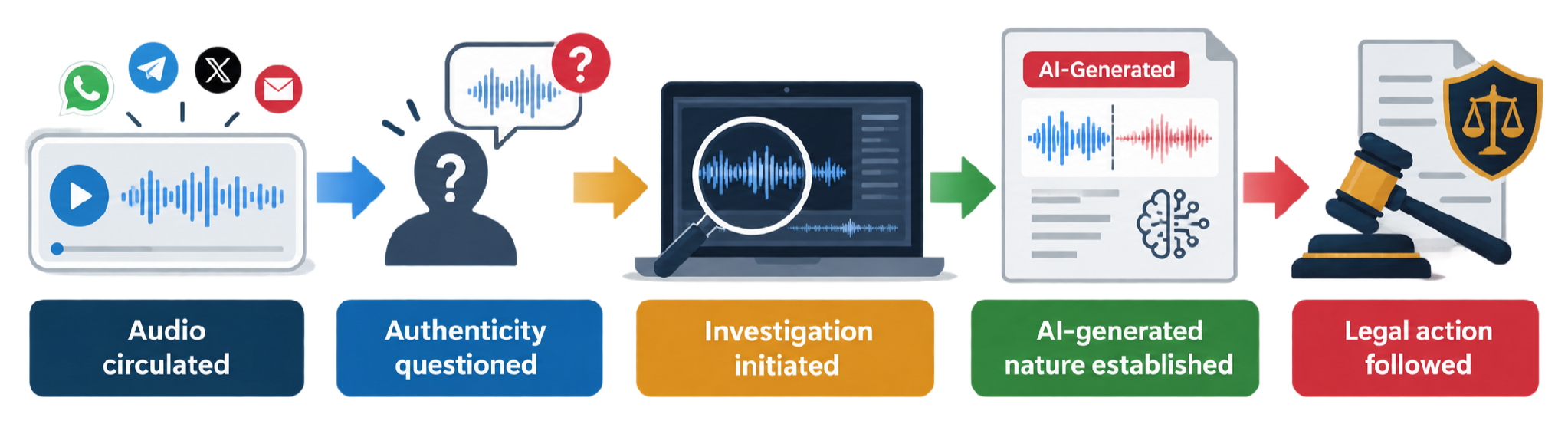
The forensic lesson is larger than the incident itself. The recording had social consequences before its authenticity was established. In a fast-moving online environment, the first version of an event can travel much further than the later correction. Deepfake investigations therefore have to consider not only whether media is authentic, but also how quickly unverified material can influence decisions.
From deepfake detection to content provenance
Detection tools will remain useful, but they should be treated as part of an examination rather than an automatic verdict. NIST’s Guardians of Forensic Evidence work reflects the need to evaluate how analytic systems perform against changing forms of AI-generated media and how well they generalise beyond controlled conditions.[2]
Another important direction is content provenance. The Coalition for Content Provenance and Authenticity (C2PA) has developed a technical framework for recording verifiable information about how digital content was created and changed. Content Credentials can bind provenance information to an asset using cryptographic techniques, allowing later users to inspect a recorded content history when that information is available.[6]
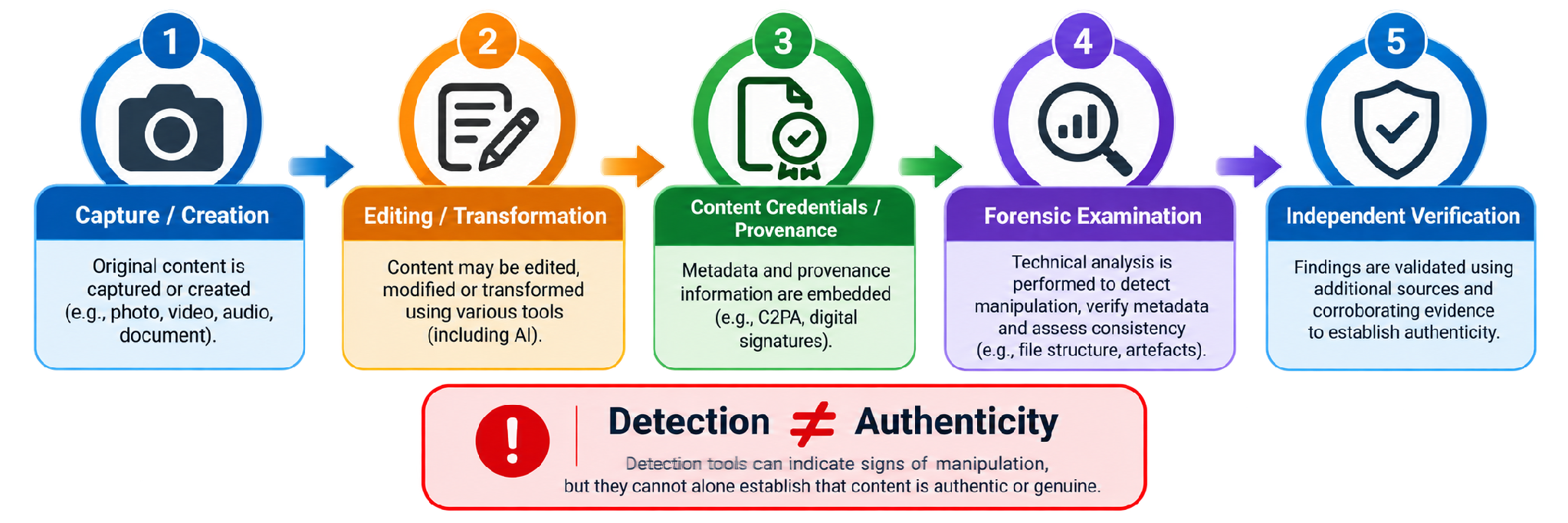
Provenance does not mean that every claim associated with a file is automatically true. It adds context: who created it, what actions were taken and how the asset changed. In a deepfake environment, that context can be as important as the content itself.
Why this matters in India
The issue is especially relevant to India’s fast-growing digital environment. CERT-In’s 2024 advisory identifies misinformation, fraud and reputational damage among the risks associated with synthetic media.[1] In August 2026, the Government of India stated that the regulatory framework addresses AI-generated deepfakes and noted amendments to the IT Rules in February 2026 concerning harms arising from synthetically generated information, including requirements related to labelling and traceable metadata for permissible AI-generated content.[7]
For organisations, deepfake response should therefore not be treated only as a media or public-relations issue. It can become an incident-response and forensic issue. A suspicious executive voice note, a manipulated employee video or a fabricated screen recording may require preservation, technical examination and independent corroboration before any action is taken.
Conclusion
Deepfakes do not make digital evidence useless. Deepfakes make handling of evidence more dangerous. The professional response is not to believe everything or to doubt everything. The professional response is to build a process around evidence: preserve the original where possible document how evidence was acquired, calculate and record hashes, examine metadata and technical characteristics use detection tools while understanding their limitations compare media with independent evidence and examine provenance information where it is available.
Importantly investigators and decision-makers should separate three questions: Is the file intact? Is the content authentic? Does the content actually prove the event being alleged? Deepfakes can pass the test while failing the other two.
In the age of AI evidence will increasingly be judged not only by how convincing it looks but, by how well its origin, integrity, context and history can be demonstrated. That is the standard that can help preserve trust when seeing and hearing're no longer enough.
References
1. CERT-In, “Deepfakes - Threats and Countermeasures,” Advisory CIAD-2024-0060, 27 November 2024. View source
2. NIST, “Guardians of Forensic Evidence: Evaluating Analytic Systems Against AI-Generated Deepfakes,” 27 January 2025. View source
3. Baltimore County Public Schools, “January 17, 2024, Community Update: Message from Superintendent Dr. Myriam Rogers Regarding Pikesville High School.” View source
4. Baltimore County Public Schools, “April 24, 2024 Staff and Community Update: Message from Superintendent Dr. Myriam Rogers Regarding Pikesville High School Investigation.” View source
5. The Baltimore Banner / WYPR, “Ex-athletic director framed principal with AI-generated voice, police say,” 25 April 2024. View source
6. Coalition for Content Provenance and Authenticity (C2PA), “Content Credentials: C2PA Technical Specification,” Version 2.1. View source
7. Government of India, Ministry of Electronics & Information Technology, “Government Strengthens Regulatory Framework to Address AI-Generated Deepfakes,” 6 August 2026. View source

Introduction
A bill requiring social media companies, providers of encrypted communications, and other online services to report drug activity on their platforms to the U.S. The Drug Enforcement Administration (DEA) advanced to the Senate floor, alarming privacy advocates who claim the legislation transforms businesses into de facto drug enforcement agents and exposes many of them to liability for providing end-to-end encryption.
Why is there a requirement for online companies to report drug activity?
The reason behind the bill is that there was a Kansas teenager died after unknowingly taking a fentanyl-laced pill he purchased on Snapchat. The bill requires social media companies and other web communication providers to provide the DEA with users’ names and other information when the companies have “actual knowledge” that illicit drugs are being distributed on their platforms.
There is an urgent need to look into this matter as platforms like Snapchat and Instagram are the constant applications that netizens use. If these kinds of apps promote the selling of drugs, then it will result in major drug-selling vehicles and become drug-selling platforms.
Threat to end to end encryption
End-to-end encryption has long been criticised by law enforcement for creating a “lawless space” that criminals, terrorists, and other bad actors can exploit for their illicit purposes. End- to end encryption is important for privacy, but it has been criticised as criminals also use it for bad purposes that result in cyber fraud and cybercrimes.
Cases of drug peddling on social media platforms
It is very easy to get drugs on social media, just like calling an Uber. It is that simple to get the drugs. The survey discovered that access to illegal drugs is “staggering” on social media applications, which has contributed to the rising number of fentanyl overdoses, which has resulted in suicide, gun violence, and accidents.
According to another survey, drug dealers use slang, emoticons, QR codes, and disappearing messages to reach customers while avoiding content monitoring measures on social networking platforms. Drug dealers are frequently active on numerous social media platforms, advertising their products on Instagram while providing their WhatApps or Snapchat names for queries, making it difficult for law officials to crack down on the transactions.
There is a need for social media platforms to report these kinds of drug-selling activity on specific platforms to the Drug enforcement administration. The bill requires online companies to report drug cases going on websites, such as the above-mentioned Snapchat case. There are so many other cases where drug dealers sell the drug through Instagram, Snapchat etc. Usually, if Instagram blocks one account, they create another account for the drug selling. Just by only blocking the account does not help to stop drug trafficking on social media platforms.
Will this put the privacy of users at risk?
It is important to report the cybercrime activities of selling drugs on social media platforms. The companies will only detect the activity regarding the drugs which are being sold through social media platforms which are able to detect bad actors and cyber criminals. The detection will be on the particular activities on the applications where it is happening because the social media platforms lack regulations to govern them, and their convenience becomes the major vehicle for the drugs sale.
Conclusion
Social media companies are required to report these kinds of activities happening on their platforms immediately to the Drugs enforcement Administration so that the DEA will take the required steps instead of just blocking the account. Because just blocking does not stop these drug markets from happening online. There must be proper reporting for that. And there is a need for social media regulations. Social media platforms mostly influence people.
