
#FactCheck -Old 2016 Madame Tussauds Wax Statue Video Misrepresented as PM Modi Being “Made Up” by Team
Executive Summary
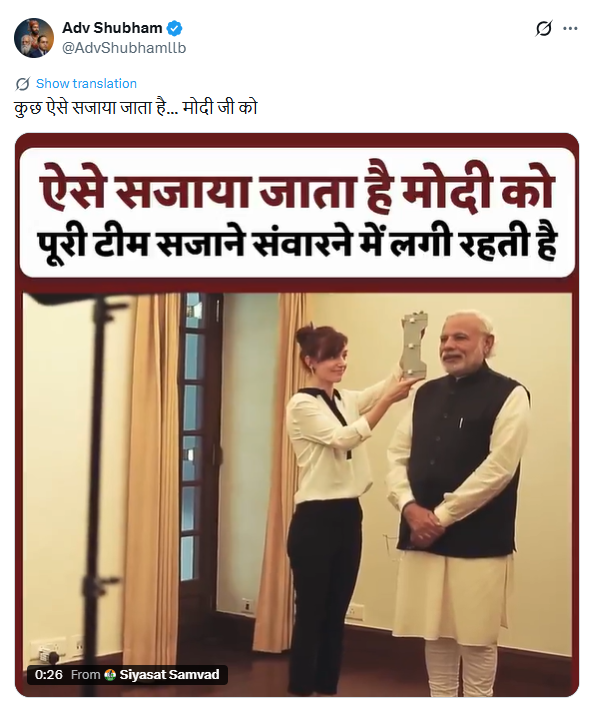
A video of Prime Minister Narendra Modi is being widely shared on social media with the claim that he is being “made up” or styled by a team, with users attempting to mock him using the footage. The clip is being circulated with misleading captions suggesting it shows the Prime Minister undergoing makeup and grooming by a dedicated team. CyberPeace Foundation Research Wing, in its research, found that the viral claim is false. In fact, the viral video is not recent, but from 2016. At that time, a statue of PM Modi was to be installed at Madame Tussauds Museum. A team of artists and experts visited the Prime Minister's residence to take measurements for the statue. This misleading claim has been circulating on social media for several years. We have previously fact-checked this claim and exposed the truth.
Claim
An X user named “Adv Shubham” shared the viral video on May 27, 2026, with the caption:“This is how Modi Ji is styled…”The post also claims that the Prime Minister is regularly “made up” by a team.
- https://x.com/AdvShubhamllb/status/2059682034289946746
- https://perma.cc/FVM9-PQBP
Fact Check
The viral video is not recent. It dates back to 2016 and is related to a completely different context. During the investigation, we found the same footage on the official YouTube channel of Madame Tussauds London, uploaded on March 16, 2016.

According to the video details, it shows the process of taking measurements for a wax statue of Prime Minister Narendra Modi for installation at Madame Tussauds. A team of artists and experts had visited the Prime Minister’s residence in Delhi for this purpose.
Conclusion
The viral claim that Prime Minister Narendra Modi is being “made up” by a team is false. The footage is from 2016 and shows a measurement session conducted for his wax statue at Madame Tussauds Museum.

Related Blogs

Introduction
The Supreme Court of India recently ruled that telecom companies cannot be debarred from reissuing the deactivated numbers to a new subscriber. Notably, such reallocation of deactivated numbers is allowed only after the expiration of the period of 90 days. The Apex Court of India also mentioned that it is the responsibility of the user to delete their associated data with their number or any WhatsApp account data to ensure privacy. The Centre has recently also blocked 22 apps which were part of unlawful operations including betting and money laundering. Meanwhile, in the digital landscape, the Intervention of legislature and judiciary is playing a key role in framing policies or coming up with guidelines advocating for a true cyber-safe India. The government initiatives are encouraging the responsible use of technologies and Internet-availed services.
Supreme Court stated that telecom companies cannot be barred from reissuing deactivated numbers
Taking note of a petition before the Supreme Court of India, seeking direction from the Telecom Regulatory Authority of India (TRAI) to instruct mobile service providers to stop issuing deactivated mobile numbers, the Apex Court dismissed it by stating that mobile service providers in India are allowed to allocate the deactivated numbers to new users or subscribers but only after 90 days from the deactivation of the number.
A concern of Breach of Confidential Data
The Court further stated, “It is for the earlier subscriber to take adequate steps to ensure that privacy is maintained.” stating that it is the responsibility of the user to delete their WhatsApp account attached to the previous phone number and erase their data. The Court further added that users need to be aware of the Supreme Court ruling that once the number is deactivated for non-use and disconnection, it can not be reallocated before the expiry of the 90-day period of such deactivation. However, after the allotted time passes, such reallocation of numbers to a new user is allowed.
MEITY issued blocking orders against 22 illegal betting apps & websites
The government of India has been very critical in safeguarding Indian cyberspace by banning and blocking various websites and apps that have been operating illegally by scamming/dupping people of huge sums of money and also committing cyber crimes like data breaches. In recent developments, the Ministry of Electronic and Information Technology (Meity), on November 5, 2023, banned 22 apps including Mahadev Book and Reddyannaprestopro. The Centre has taken this decision on recommendations from the Enforcement Directorate (ED). ED raids on the Mahadev book app in Chattisgarh also revealed unlawful operations. This investigation has been underway for the past few months by the ED.
Applicable laws to prevent money laundering and the power of government to block such websites and apps
On the other hand, the Prevention of Money Laundering Act (PMLA) 2002 is a legislation already in place which aims to prevent and prosecute cases of money laundering. The government also has the power to block or recommend shutting down websites and apps under section 69A of the Information and Technology Act, 2000, under some specific condition as enumerated in the same.
Conclusion
In the evolving digital landscape, cyberspace covers several aspects while certain regulations or guidelines are required for smooth and secure functioning. We sometimes change our phone numbers or deactivate them, hence, it is significantly important to delete the data associated with the phone number or any such social media account data attached to it. Hence, such a number is eligible for reallocation to a new or early subscriber after the expiration of a period of 90 days from such deactivation. On the other hand, the centre has also blocked the websites or apps that were found to be part of illegal operations including betting and money laundering. Users have also been advised not to misuse the Internet-availed services. Hence, trying to create a lawful and safe Internet environment for all.
References:
- https://timesofindia.indiatimes.com/india/cant-bar-telecom-companies-from-reissuing-deactivated-numbers-says-supreme-court/articleshow/104993401.cms
- https://pib.gov.in/PressReleseDetailm.aspx?PRID=1974901#:~:text=Ministry%20of%20Electronics%20and%20Information,including%20Mahadev%20Book%20and%20Reddyannaprestopro

Executive Summary
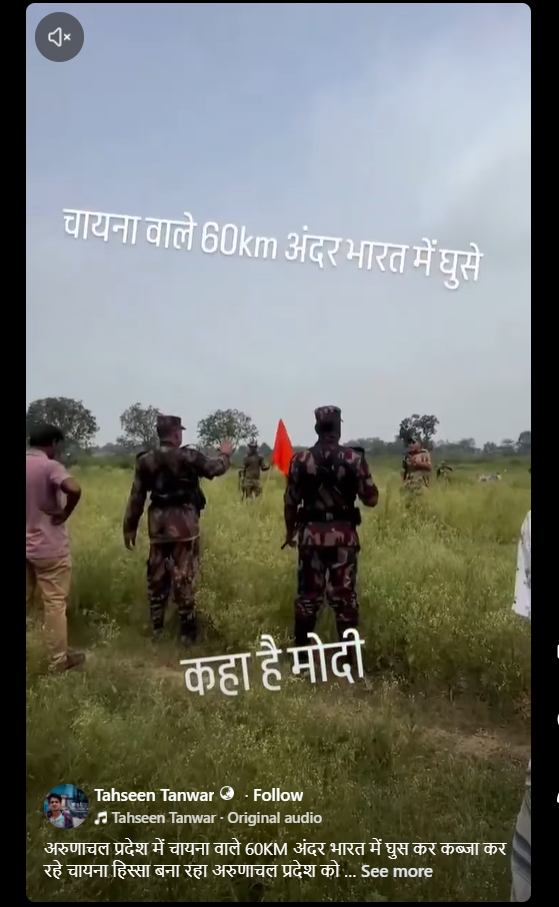
A video is being widely shared on social media with the claim that the Chinese Army has entered 60 kilometres inside Arunachal Pradesh and occupied Indian territory. In the video, a man appears to be recording the situation using his selfie camera, while soldiers can be seen standing face-to-face and arguing with each other in the background. The CyberPeace Research Wing found that the claim is false. The viral video is not from Arunachal Pradesh. It shows a confrontation between India’s Border Security Force (BSF) and Bangladesh’s Border Guard Bangladesh (BGB) along the India-Bangladesh border.
Claim
A Facebook user shared the video with the caption:
"China is entering 60 km inside India and occupying Arunachal Pradesh. China is turning Arunachal Pradesh into its territory. Where are Prime Minister Modi, Defence Minister Rajnath Singh and Home Minister Amit Shah?"
Post link:
https://www.facebook.com/reel/1736825064305394
https://www.facebook.com/reel/1736825064305394
FactCheck
Our research found no credible news report confirming that Chinese troops had entered 60 kilometres inside Arunachal Pradesh or occupied Indian territory.
The people in the viral video can be heard speaking in Bengali, suggesting that the footage could be from the India-Bangladesh border rather than Arunachal Pradesh.
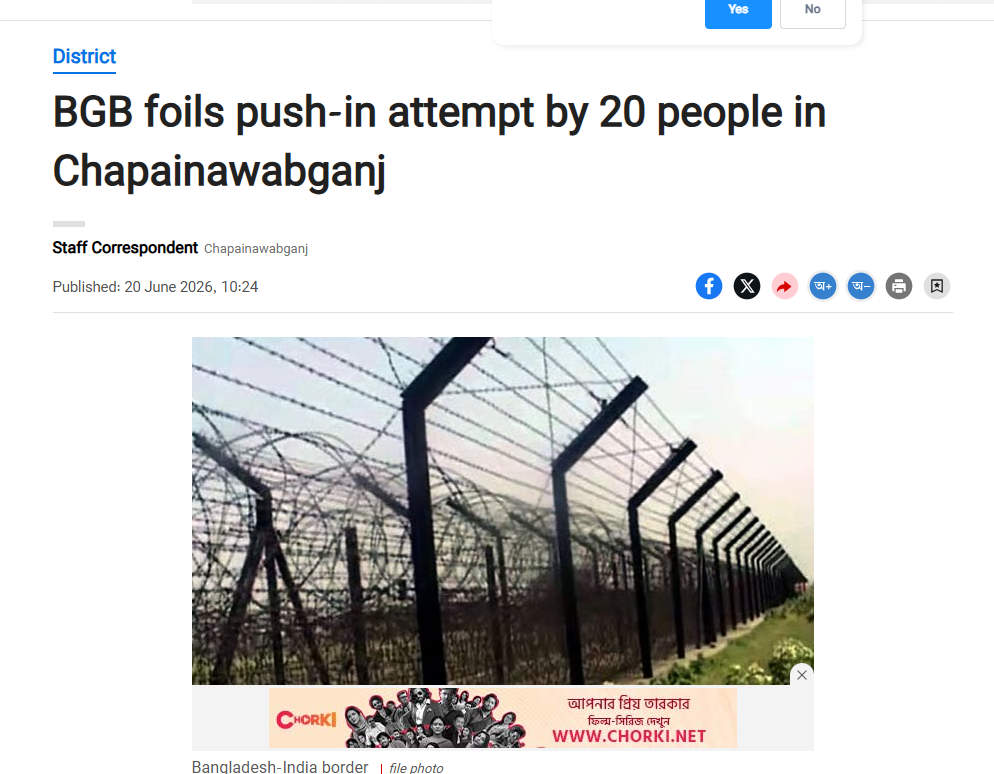
A reverse image search of keyframes from the viral video led us to an identical video posted on the Facebook page of Bangladeshi news channel Jamuna TV on June 20. According to the caption, the incident took place along the Chapainawabganj border in Bangladesh, where personnel of India’s BSF and Bangladesh’s BGB had confronted each other.
https://www.facebook.com/reel/1049262804595610

We also found reports from Bangladeshi media outlet Prothom Alo about the incident. According to the reports, Bangladeshi security personnel had stopped around 20 people who were attempting to return to Bangladesh from India, following which a verbal altercation took place between BSF and BGB personnel.
https://www.prothomalo.com/bangladesh/district/syzkfootaq
Conclusion
The viral claim is false. The video does not show Chinese troops entering or occupying 60 kilometres of territory inside Arunachal Pradesh. It actually shows a confrontation between BSF and BGB personnel along the India-Bangladesh border in the Chapainawabganj area of Bangladesh. The footage is being circulated with a false Arunachal Pradesh-related narrative.

Introduction
The Chairman of Vardhman Group, Mr SP Oswal, an India-based textile manufacturer, fell victim to a cyber fraud scheme that cost him ₹7 crore. The scam unfolded on August 28 and 29, conning Mr Oswal into transferring Rs 7 crore into multiple bank accounts. As per the recent reports, the Police have managed to freeze these accounts and recover over Rs 5 crore as of now. The fraudsters convinced Mr SP Oswal that he was a suspect in a money laundering investigation and held on a “Digital Arrest”. These are sophisticated cyber frauds where cyber-criminals impersonate law enforcement officials or other authorities and target innocent individuals with manipulative tactics. The scam targets are often contacted out of the blue, on Instant messaging apps like WhatsApp and informed that their bank accounts, digital identities, or other online assets have been compromised. Criminals play into the victims' fear by threatening them with imminent arrest, legal consequences, or public humiliation if they don't cooperate with a series of urgent demands.
Posing as Officials, Fraudsters Orchestrate ₹7 Crore Scam
The investigation revealed that the fraudsters posed as members of the Central Bureau of Investigation (CBI). They had contacted Mr Oswal and claimed that his Aadhaar had been misused in a case involving fake passports and financial fraud. The imposter conducted a video call in a police uniform using a background with the CBI logo. The fraud escalated further, Mr Oswal got a fake "arrest warrant" on WhatsApp allegedly authorised by the Supreme Court. Fraudsters convinced Mr Oswal to transfer ₹7 crores to facilitate bail proceedings, claiming he was under "digital arrest". The meticulously planned scam involved fake documents, a virtual courtroom, and relentless intimidation tactics leaving Mr Oswal effectively under "digital arrest" for two days. While the police have successfully recovered over Rs 5 crore so far, this case highlights the alarming threat of digital impersonation of law enforcement authorities.
Legal Outlook on the Validity of Digital Arrests
In India, the main laws governing cyber crimes are the Information Technology Act, of 2000 and the rules made under therein, and the newly enacted Bhartiya Nyaya Sanhita, 2023. Recently enacted new criminal laws do not provide for any provision for law enforcement agencies conducting a digital arrest. The law only provides for service of the summons and the proceedings in an electronic mode. Hence, there are no provisions for conducting 'digital arrests' as per the laws of the country.
Further, It should be noted that the Indian Cyber Crime Coordination Centre (I4C), under the Ministry of Home Affairs, coordinates the activities related to combating cybercrime in the country. MHA works closely with other ministries to counter these frauds. The I4C also provides technical support to the police authorities of states/UTs for the identification and investigation of these cases.
Best Practices to Avoid Digital Arrest Scams
- To protect yourself from scams, it is crucial to verify the identity of individuals claiming to be law enforcement or government officials and use official contact channels to confirm their credentials.
- Be cautious of pressure tactics used by fraudsters, especially demands for quick payment over unverified communication platforms like WhatsApp.
- Cross-check official documents with legal advisors or relevant authorities.
- Never share sensitive personal information, such as your Aadhaar number, over phone calls, emails, or messages without verifying the request's authenticity.
- Avoid untraceable payments, such as cryptocurrency or prepaid cards, without validating the transaction's legitimacy, especially under duress.
- Stay informed on scam techniques, particularly those involving impersonation and digital threats.
- Enable Two-Factor Authentication (2FA) for sensitive online accounts to prevent misuse.
- Consult advice from legal professionals if you receive threatening communication involving digital arrest or legal actions and do not take any action on the asks of persons posing as legitimate authorities.
- In case of any cybercrime, you can file a complaint at cybercrime.gov.in or helpline number 1930. You can also seek assistance from the CyberPeace helpline at +91 9570000066.
Conclusion
The digital arrest of Vardhman Group's CEO underscores the increasing sophistication of cyber fraud schemes, which exploit fear and urgency, leading to severe financial and reputational harm. No one is immune from cybercrime, vigilance is essential at all leadership levels. While laws like the IT Act and initiatives taken by the I4C help combat cybercrime, rapidly evolving threats demand proactive safety measures. Beyond the possibility of financial loss, incidents like this jeopardise brand reputation, investor confidence, and operational stability. Be cautious of such threats and exercise due care and caution while navigating the digital landscape. Be aware of such kinds of scams and the manipulative tactics used by fraudsters to avoid them. By staying vigilant and aware we can avoid the growing scam of digital arrests.
References
- https://www.business-standard.com/companies/news/digital-arrest-and-rs-7-crore-heist-how-vardhman-group-head-was-tricked-124100100832_1.html
- https://www.hindustantimes.com/business/vardhman-group-chairman-sp-oswal-duped-of-rs-7-crore-fraudsters-posed-as-cbi-101727666912738.html
- https://www.msspalert.com/native/digital-arrests-the-new-frontier-of-cybercrime
