
#FactCheck-Viral Video Does Not Show Lover Cutting Off Electricity to Girlfriend’s Village; It Shows Power Line Repair Work in Assam
Executive Summary:
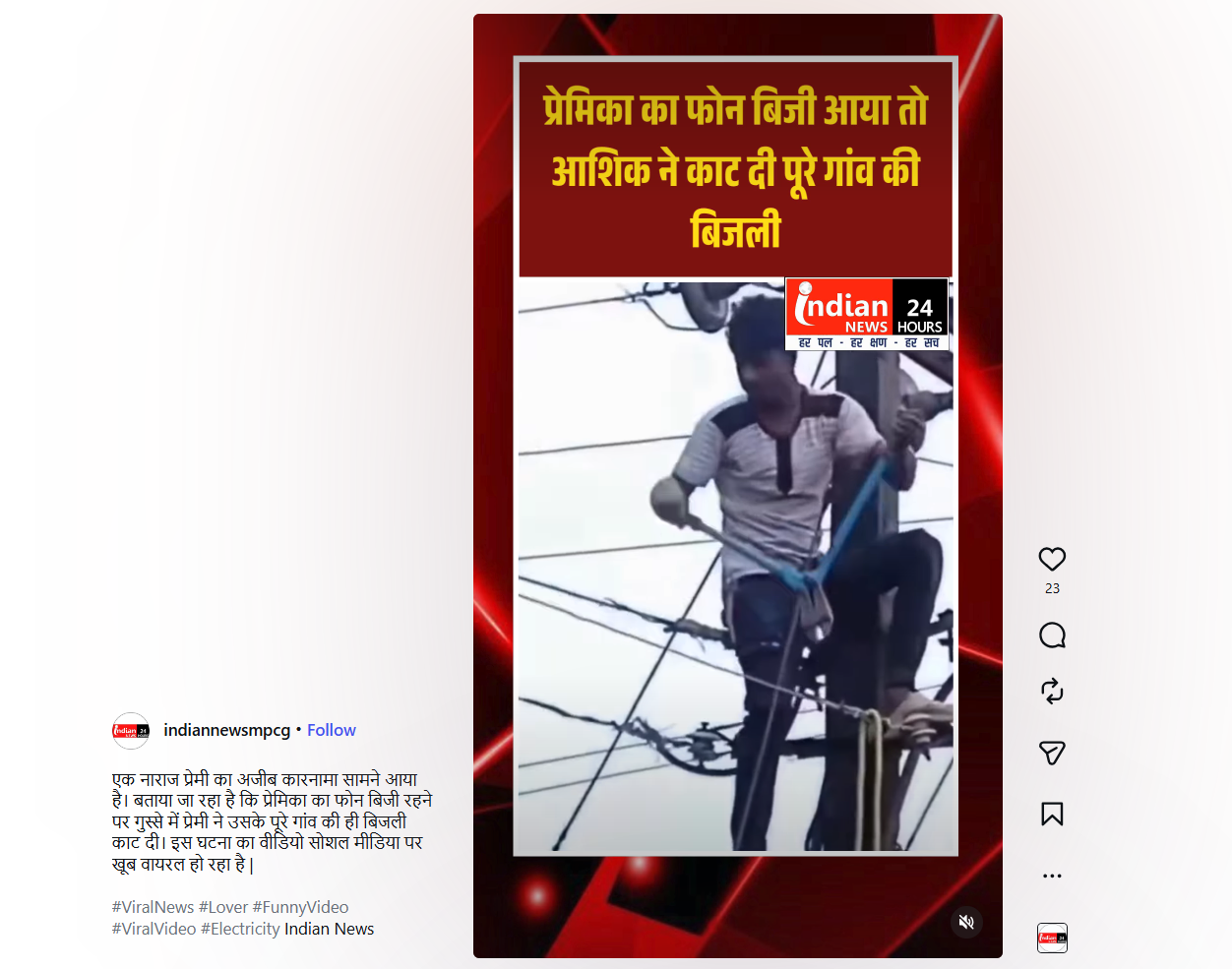
A video is being shared on social media with the claim that a man cut off the electricity supply to his girlfriend’s village after getting angry with her. A research by CyberPeace’s research wing found that the video is actually from Baksa district in Assam, where a lineman named Anwar was repairing an electric line.
Claim:
The viral video is 10 seconds long and shows a man climbing an electricity pole and cutting an electric wire. The video is being shared on social media with the claim that the man cut off the electricity supply to his girlfriend’s entire village after her phone line was busy.
https://www.instagram.com/reels/Dcamn0aGBJ-/
Fact Check:
To investigate the viral claim that a man cut off the electricity supply to his girlfriend’s village after getting angry with her, we conducted a reverse image search using keyframes from the video. During the search, we found the original video uploaded on the YouTube account named ‘Technical Work’ on July 17, 2025. According to the video description, the video is related to electrical work.
https://www.youtube.com/shorts/iHtG5xwHtKI

Additionally, we found several videos related to electrical work uploaded on the same YouTube account. We also found a Facebook page associated with this YouTube account.

Conclusion
The evidence gathered during our research makes it clear that the viral claim that a man cut off the electricity supply to his girlfriend’s village after getting angry with her is completely false. In reality, the video shows electricity workers repairing a power line in Assam.

Related Blogs

Executive Summary
After Donald Trump said that US Navy ships would soon begin escorting tankers through the Strait of Hormuz, several old images resurfaced on social media with claims that they show American sailors recently captured by Iran amid the ongoing Middle East tensions. Research by CyberPeace found that the viral posts are misleading. The images being circulated are nearly a decade old and have no connection to the ongoing situation in the Middle East.
Claim:
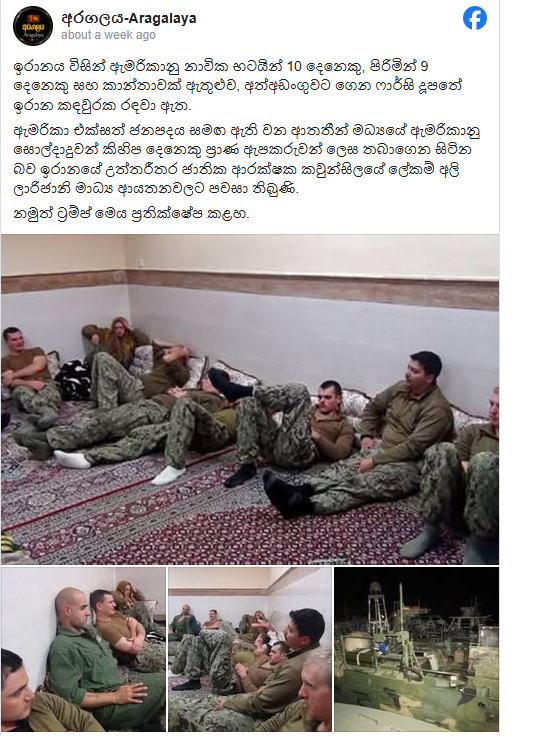
Posts circulating on Facebook alleged that Iran had captured 10 US Navy personnel — nine men and one woman — and detained them at a military base on Farsi Island. The caption further claimed that the incident was reported by Iranian official Ali Larijani and denied by Donald Trump.
https://www.facebook.com/photo/?fbid=1381610870661566&set=pcb.1381611363994850
Fact Check
A reverse image search revealed that the viral images are not recent. They were published as early as January 13, 2016, by ABC News in a report titled “Iran Releases 10 Navy Sailors Held After Drifting Into Iranian Waters.”

Further checks showed that the same images were distributed by AFP, with credits to Sepah News, the media wing of Iran’s Revolutionary Guards.

Context
The images relate to a 2016 incident in which two US Navy patrol boats accidentally entered Iranian waters. The crew was detained and taken to Farsi Island. Iran later released the sailors after determining that the intrusion was unintentional and that there was no hostile intent.
Conclusion
The viral posts are misleading. The images being shared are nearly a decade old and unrelated to the ongoing situation in the Middle East.
Introduction
In an extensive order of 144 pages passed on May 29, 2026, Justice Sachin Datta of the Delhi High Court inter alia affirmed the right of an acquitted or discharged person to reinstate their digital identity. In a batch of more than 30 petitions relating to acquittals, family dispute cases, quashed criminal cases, and parties to proceedings, the petitioners argued that court documents and accusations, having lost their purpose, have kept occupying the search engine, leading to infringement of dignity, privacy, and career and personal life of these individuals. Citing Article 21 of the Indian Constitution as its foundation, the court affirmed that a right to life and personal liberty also includes a right to privacy and to leave behind failed proceedings and adopted wide de-indexing policies, including, where necessary, global de-indexing, thereby ushering in India's "right to be forgotten."
The Constitutional Argument: Article 21 and the Digital Self
The constitutional basis of the right to be forgotten in India rests on the landmark nine-judge bench ruling in Justice K.S. Puttaswamy v. Union of India. In 2017, the Supreme Court ruled privacy to be a fundamental right under Article 21 of the Constitution and stated informational privacy is a facet of personal liberty. The Supreme Court observed that individuals have an interest in determining how the information concerning them is gathered, disseminated, and accessed.
Building upon this precedent, Justice Sachin Datta held that the right to be forgotten flows naturally from the constitutional guarantee of informational privacy. The judgment represents one of the most significant judicial applications of the Puttaswamy principles, particularly in the context of search engines and online judicial records. Noting the absence of a fully operational statutory framework despite the enactment of the Digital Personal Data Protection Act, 2023, the court exercised its constitutional jurisdiction to protect individuals from enduring digital harm caused by continued public accessibility of outdated or irrelevant personal information.
INDIAN APPLICATION OF THE GLOBAL PRECEDENT
Tracing back the genesis of this right, it lies in the worldwide jurisdiction on privacy, especially the European Court of Justice's landmark ruling of 2014 in Google Spain SL v. AEPD and Mario Costeja Gonzlez, where it ruled that it is within one's power to ask search engines to de-list links that show personal information that is found to be outdated or irrelevant. This led to a legislated right to erasure by the inclusion of Article 17 in the General Data Protection Regulation (GDPR), creating the right throughout the EU. India, on the other hand, saw a slow process of evolution when it came to this right. The Madras High Court acknowledged the right to be forgotten partially in 2021 when it directed a petitioner's name to be deleted from an acquittal judgment, which was affirmed by a Division Bench in 2024. Nevertheless, the above were merely judgments confined to the facts of a particular case. However, the decision of the Delhi High Court dated May 2026 proves to be the benchmark in laying down a comprehensive constitutional framework under Article 21 with guiding principles on when a request for de-linking would be entertained and, if warranted, would be extended throughout the world.
Anatomy of the Framework by the Delhi High Court
While Justice Sachin Datta’s ruling recognizes the right to be forgotten, its actual import lies in devising an operative framework. The Court noted that it would maintain judicial records indefinitely in keeping with open justice principles, but an individual's name may not act as a perennial search key with respect to private entities' search engines. Thus, courts will be allowed to de-index judicial records (except their legal reasoning, findings, and ratio decidendi, which will continue to be accessible) from the names appearing therein from search engines and legal databases. While personally identifying data will be obfuscated, the underlying legal reasoning will not be rendered unusable, as access to unredacted records will continue to be available to courts, parties, and authorities. Such orders are also possible to be effective internationally, rendering avoidance difficult. However, the right cannot be absolute, as it is largely unavailable for convicted individuals (particularly if convicted of offenses against women or children or crimes of breach of trust). Courts must pass a proportionality test in considering the balance between privacy and the public right to know. By stating that masking information has an impact on discoverability, not access, it achieves a reconciliation between informational privacy and open justice so that acquitted accused are not held hostage to past accusations forever in the online age.
The Road to Implementation
However, the judgment presents a thick knot of practical issues, the solution to which may take considerable time to untangle. How will petitions for masking orders be filed by those who need them? Will there be a prescribed form? How will legal database systems such as Indian Kanoon and SCC Online operationalize name-based de-indexing while keeping their vast archives usable for lawyers? More significantly, what kind of legal force will global directions for de-indexing hold over those search engines whose main servers lie outside of Indian territory?
This is not to say the judgment isn't important. It simply presents a predictable, almost mundane set of issues that all ambitious pronouncements on constitutional rights face when translated into the world of administration issues that came up even when the EU was first struggling with enforcing the GDPR in 2018. India now has its framework, and the details of its implementation will undoubtedly come through future rounds of litigation, guidelines, and perhaps even legislation.
What remains abundantly clear, though, is the message conveyed by the Delhi High Court that digital permanency is a crime, especially when it causes the most incriminating of a person's legal actions to follow them perpetually, even long after they have been given due process by the system. As Justice Datta eloquently put it, privacy in the digital age is 'not about secrecy but about an individual's control over the dissemination of personal information.' "Now an element of constitutional law in India, the verdict is a declaration that will resonate long beyond the thirty-odd petitions that called it into being.
Conclusion
The ultimate finding of the 2026 right-to-be-forgotten judgment in Delhi High Court reinforces human dignity in the digital era. The Court has acknowledged the need for acquittals and exonerations to have meaningful implications offline, ensuring an individual is not eternally punished through online searches for alleged wrongdoing. Building on the right to privacy established by K.S. Puttaswamy v. Union of India, informational privacy now stands at the core of constitutional guarantees, and India joins the nations establishing precedents to balance openness with dignity.

Executive Summary:
A video circulating on Social media has claimed that Iran has launched a missile strike destroying Ben Gurion Airport in Tel Aviv. With rising tensions in geopolitics, the video quickly became popular. However, our research has detailed inspections through digital verification tools and visual analysis showed that the video is AI-generated. No incident or damage ever occurred.

Claim:
A viral video circulating on social media platforms claims to show Tel Aviv’s Ben Gurion Airport destroyed following an Iranian missile strike. The video is being shared with captions suggesting it is the last recorded visuals from the attack, with some users asserting it as evidence of escalating conflict between Iran and Israel.

Fact Check:
After looking into the video that purported to show the destruction of Tel Aviv's Ben Gurion Airport in an Iranian missile strike, we researched the topic whether the claim is accurate or not. The video depicts a damaged airport terminal, with debris and fires, but a visual analysis determined that there were a number of suspicious characteristics: asymmetrical layout, artificial-looking smoke patterns, and the absence of activity or humans—those are all typical indications of AI generation. Our research traced the origins of the video to an Instagram post, with a date of May 27, 2025, made by what seems to be a user who frequently shares AI-generated images.


In order to verify our conclusions, we used Hive Moderation, an AI content detection tool, which produced a result of an 80% probability that the video is altered, and this level of probability strongly supports the idea that the footage is not real. Additionally, reports from popular organizations like India Today and Reuters supported these results. All findings resulting from our research established that the video is synthetic and unrelated to any event occurring at Ben Gurion Airport, and therefore debunked a false narrative propagated on social media.

To confirm, we also compared the visuals with a real aerial image of Tel Aviv’s Ben Gurion Airport available on aviation stock sites.


Fig: Google Maps image of Tel Aviv’s Ben Gurion Airport
The visuals from the viral video are not real locations or scenes of Aviv’s Ben Gurion Airport's true location and configuration therefore it is fake and misleading.
Conclusion:
After thorough research it is concluded that the viral video is fake and it is not an actual missile strike at Ben Gurion Airport. The video is made with AI, and posted by a content creator of synthetic content well before any conflict update. There is no official confirmation or credible news coverage to substantiate the claim, with a high probability of AI-detection, and it has been proven to be digitally manipulated. Therefore, the claim is untrue and misleading.
- Claim: A video shows Iran's missile strike destroying Tel Aviv’s Ben Gurion Airport.
- Claimed On: Social Media
- Fact Check: False and Misleading
