
#FactCheck-Viral Clip of Delivery Boy Beating Woman Is Scripted, Not a Real Incident
Executive Summary
A video is being widely shared on social media claiming to show a delivery boy assaulting a woman. In the viral clip, a man approaches a woman to deliver some items. An argument soon breaks out between the two, followed by pushing and shoving that escalates into a physical fight. The purported delivery boy is then seen knocking the woman to the ground and allegedly beating her. Research by CyberPeace Research Wing found that the viral video is scripted.
Claim:
“A delivery boy brings a parcel, and the customer comes outside to collect it. As soon as the delivery boy hands the parcel to the woman, it falls from her hands, following which the female customer starts assaulting the delivery boy. In anger, the delivery boy also begins hitting the woman and knocks her to the ground, brutally beating her with kicks and slaps. Although the woman was at fault, the delivery boy should not have reacted so violently.”
https://www.facebook.com/reel/2826948067671726

Fact Check
To verify the viral video claiming to show a delivery boy assaulting a woman, we conducted a reverse image search using keyframes from the clip. During the search, we found the same video posted on the Facebook account of a user named Vipin Chauhan on August 21, 2026. The viral clip appears in the 2-minute-33-second-long video. The caption accompanying the video states that it is a pre-planned (scripted) video.
https://www.facebook.com/reel/1551896343642588

During the research, we also found the same video on the same user's Instagram account, where it was described as scripted.
https://www.instagram.com/reels/DcTAF_ZsUnv/

Upon reviewing the Instagram user's account, we found several other videos featuring men and women engaged in physical altercations. The captions of all these videos clearly state that they are scripted.

Conclusion
The evidence gathered during our research clearly establishes that the video being shared with the claim that a delivery boy assaulted a woman is scripted and does not depict a genuine incident. The same video was found on the social media accounts of the creator, where it was explicitly described as scripted. We also found several other similar videos on the user's account, all of which were identified as pre-planned or scripted content.

Related Blogs

Executive Summary
Reports of differences between the Chief Election Commissioner and the two Election Commissioners over the functioning of the Election Commission have emerged, following which protests were held across the country. Protesters demanding the resignation of Chief Election Commissioner Gyanesh Kumar took out a ‘Citizens March’ to Jantar Mantar on October 4, 2026. Against this backdrop, a video is being widely shared on social media. The video purportedly shows a CRPF personnel lathi-charging protesters. It is being shared with the claim that the footage is from the protest against Chief Election Commissioner Gyanesh Kumar at Jantar Mantar in Delhi. However, CyberPeace Research found the viral claim to be false. The viral video is not recent; it dates back to July 2026. At that time, students in Delhi were protesting over the alleged NEET paper leak and demanding the resignation of then Union Education Minister Dharmendra Pradhan.
Claim:
A Facebook user, ‘Kuldeep Pandit’, shared the viral video on October 4, 2026, with the caption: “The only thing left was the last ball, when Modi ji hit a six at the Jantar Mantar stadium and broke the backsides of traitors... Jantar Mantar is now under the control of the Indian Army, and the Army is giving freedom by the trolley load... Jai Shri Ram.”The archive link to the post can be viewed here.
https://www.facebook.com/reel/1807020453964507
https://perma.cc/RN8J-XV4K?type=standard

Fact Check
To verify the authenticity of the viral video, we extracted several keyframes using the InVID tool and conducted a reverse image search on Google. During the search, we found the viral video shared on a Facebook account named ‘Jansandesh News’ on July 21, 2026. According to the information provided with the post, the video shows a protest held at Jantar Mantar over the alleged NEET paper leak.
https://www.facebook.com/watch/?v=1786356329397999

Based on the information obtained, we conducted a Google search using relevant keywords. We also found the viral video on an Instagram account named ‘datiabulletinofficial’. The video was shared on July 21, 2026, and was identified as footage from a protest held at Jantar Mantar. According to the caption, students were protesting over the alleged NEET paper leak and demanding the resignation of then Union Education Minister Dharmendra Pradhan.
https://www.instagram.com/reels/DbFXpGHzmwB/

During our research, we found a news report related to the claim on the Hindustan Times website. The report was published on July 28, 2026. According to the report, “On July 20, students led by the ‘Cockroach Janta Party’ (CJP) marched towards Parliament. During the protest, police and Rapid Action Force (RAF) personnel lathi-charged the students, drawing considerable criticism. The Delhi Police later clarified that it would review the lathi-charge on the students and the action taken by the police.”The report also contains keyframes that closely resemble the visuals seen in the viral video.

Conclusion:
Our research found that the claim being made about the viral video of protesters being lathi-charged is false. The video dates back to July 2026, when students in Delhi held protests over the alleged NEET paper leak and demanded the resignation of then Union Education Minister Dharmendra Pradhan.

Executive Summary
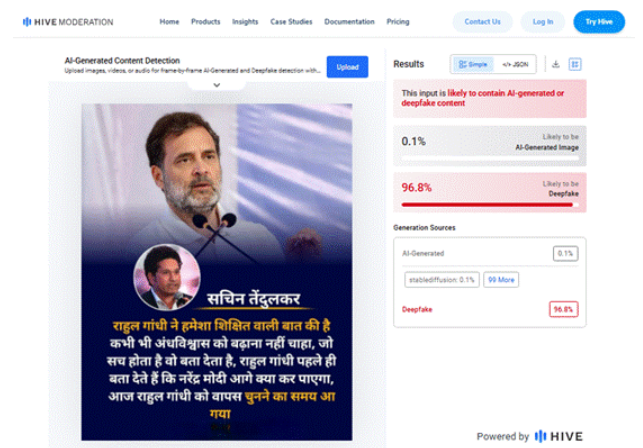
A post claiming that former Indian cricketer Sachin Tendulkar praised Congress leader Rahul Gandhi and urged people to elect him as Prime Minister is being widely circulated on social media.The viral poster falsely attributes a political statement to Sachin Tendulkar, suggesting that he has endorsed Rahul Gandhi for the post of Prime Minister. However, CyberPeace Research Wing research found the claim to be fake. Sachin Tendulkar has not made any such appeal or statement supporting Rahul Gandhi for Prime Minister.
Claim
On X (formerly Twitter), a verified user “Queen” shared a viral poster claiming:“Sachin Tendulkar has always supported education and never promoted superstition. Rahul Gandhi always predicts what Narendra Modi will do next. It is time to choose Rahul Gandhi again.”

Fact Check
To verify the claim, we first searched for any news reports, interviews, or credible references linking Sachin Tendulkar to such a political statement. However, we found no evidence in any reliable media source or public record suggesting that he made any such remark about Rahul Gandhi or the Prime Ministership. We also reviewed Sachin Tendulkar’s official social media accounts, but found no post, video, or statement endorsing any political leader in this manner.

Finally, the viral poster was analysed using the AI detection tool Hive Moderation. The analysis indicated a 96.8% probability that the poster was digitally created or manipulated, suggesting possible AI-generated or edited content.
Conclusion
CyberPeace Research Wing research found the claim to be fake. Sachin Tendulkar has not made any appeal to elect Rahul Gandhi as Prime Minister. The viral poster appears to be digitally fabricated and is being shared to spread misinformation.

Introduction
Military equipment used by elite special forces is supposed to be the most tightly secured hardware a country owns, the last place anyone would expect a hidden flaw in its parts supply chain to slip through undetected. Yet that is precisely where one surfaced this August, when The Telegraph, revealed that cameras fitted to the Royal Navy's K3 Scout surveillance drones, equipment used by Britain's Royal Marines and closely associated with the Special Boat Service, the United Kingdom's elite maritime special forces unit, had been secretly transmitting signals to an internet address inside China. The United Kingdom's Ministry of Defence stripped the affected cameras of all internet connectivity the moment the transmissions were discovered, and has spent the days since insisting no sensitive data actually left the country. That distinction, between what was taken and what was exposed, is where this incident becomes genuinely worth examining.
What was actually found, and what was not
The K3 Scout is an 8.4 metre uncrewed surface vessel built by Kraken Technology Group, a British defence manufacturer based in Fareham, Hampshire, capable of reaching 55 knots and remaining at sea for up to 30 days. The Royal Navy purchased roughly 20 of these vessels under Project Beehive, a £12 million programme designed to fold autonomous systems into frontline maritime operations quickly, and the Royal Marines' Coastal Forces Squadron and 47 Commando have operated the fleet since March 2026.
A routine cyber vulnerability assessment, not an external tip off or an adversarial intrusion, is what caught the problem. Investigators found the electro-optical and infrared cameras mounted on the vessels sending what the industry calls heartbeat communications, routine signals a connected device sends simply to confirm it is powered on and functioning, to an IP address located in China. Kraken did not manufacture the cameras in house; the company sourced them from a third party supplier that had reportedly given assurances about their security, assurances the heartbeat traffic now calls directly into question.
Every source, including the UK Ministry of Defence itself, confirms the cameras were sending signals to an IP address in China. What remains unconfirmed is which company actually manufactured the compromised camera components. Neither The Telegraph nor the Ministry of Defence has publicly named the specific camera manufacturer, and an unverified social media claim allegedly identifying a Canadian supplier has since been disputed by that company, with no confirmation from official sources tying it to the incident as of now.
Crucially, the UK Ministry of Defence has been consistent on one point across every statement it has issued: its investigation found no evidence that classified information, government systems, or mission critical data were accessed, compromised, or transmitted outside the country. That is a meaningful distinction, and one worth taking at face value rather than dismissing as reflexive reassurance, since heartbeat signals by design carry connectivity status rather than payload content. But security researchers who reviewed the case have been equally consistent in noting that even metadata this thin has value to a watching adversary. Knowing when and where a piece of specialised military hardware is powered on and actively connected can itself function as a targeting signal, revealing patterns of deployment, operational tempo, and geographic presence without a single classified file ever leaving the device.
Why this particular fleet matters
The timing sharpens the concern considerably. A defence source cited in reporting on the story indicated the K3 Scout fleet was being considered as part of a future British contribution to securing freedom of navigation in the Strait of Hormuz, where the United Kingdom has already deployed a warship amid discussions of a multinational security mission. Equipment destined for a contested, strategically sensitive waterway having any unexplained data path back to a systemic rival's territory is not a detail that stays confined to a procurement footnote. The vessels were also tested during a NATO exercise in the Baltic Sea in 2025, meaning any compromised telemetry pattern could theoretically have been observed by the very alliance partners Britain was demonstrating the technology to.
The deeper issue is structural rather than incidental. Modern military hardware, however elite the unit operating it, is rarely built end to end by a single trusted manufacturer. Cameras, sensors, chipsets, and firmware routinely pass through several tiers of suppliers before reaching a finished platform, and each tier is a potential point where the chain of custody and verification can quietly break down. Kraken's own assurances about its camera supplier illustrate exactly how that failure propagates: a manufacturer can act in good faith, rely on a vendor's word, and still end up fielding compromised hardware, because the vulnerability was never introduced at the assembly stage but several layers upstream, in components whose ultimate origin was never fully audited.
CyberPeace View | A wider principle worth naming
There is a broader ethical and legal frame worth applying here, one that extends beyond ordinary cybersecurity practice into the territory international humanitarian law occupies. The core distinction that law draws, between combatants and protected persons, between military objectives and civilian life, depends fundamentally on operators having accurate, uncompromised situational awareness. A surveillance platform is not merely a piece of hardware; it is the sensory apparatus through which decisions with real consequences for human life get made in contested environments. If the integrity of that apparatus cannot be guaranteed, the reliability of everything built on top of it, target verification, proportionality assessments, distinction between combatant and civilian, is quietly weakened at its foundation. This is not a claim that the K3 Scout breach itself caused harm; the Ministry of Defence's own findings suggest it did not. It is a reminder that supply chain integrity in military sensing equipment is not simply a procurement or cybersecurity concern sitting apart from the laws of armed conflict. It sits underneath them, because a compromised sensor is, in a very real sense, a compromised judgment further down the chain.
Where India fits into this story
India has been grappling with functionally the same problem for years, and its response offers a useful point of comparison. Reporting dating back to 2023 revealed that Indian defence officials had quietly barred domestic drone manufacturers from using components sourced from countries sharing a land border with India, an unmistakable, if unstated, reference to China, citing exactly the kind of vulnerability now playing out in Britain's fleet, compromised communication functions, cameras, and operating software capable of leaking intelligence. That policy has hardened considerably since. Earlier this year, the Ministry of Defence in New Delhi finalised a stringent framework requiring that drones procured from domestic manufacturers contain no Chinese origin components or electronics at all, and at least one major drone order was placed on hold after allegations surfaced that the supplier had used Chinese parts despite those restrictions.
The commercial consequence of that caution has been real and acknowledged openly by industry figures; sourcing components outside China raises costs, given that up to 70 percent of the global drone supply chain has historically run through Chinese manufacturing. But India appears to have concluded, well ahead of this particular British incident becoming public, that the cost of auditing and diversifying a supply chain is lower than the cost of fielding compromised sensing equipment inside sensitive military operations. Indian firms have responded by building propulsion, avionics, and camera systems in house specifically to close this gap, treating component provenance as a first order design question rather than an afterthought bolted on after a breach forces the issue. Seen from that vantage point, the K3 Scout episode reads less like a uniquely British failure and more like a case study in a risk India's own defence establishment had already priced in.
Lessons from the breach
A few conclusions follow fairly directly from how this incident unfolded. First, routine cyber vulnerability assessments work, and this case is arguably an argument for doing more of them, more often, rather than a sign that current practice failed; the breach was caught internally, before any confirmed operational harm occurred. Second, a manufacturer's own assurances about a component supplier are not a substitute for independent verification, since Kraken's good faith reliance on its camera vendor's word is precisely where this vulnerability slipped through. Third, and most durably, defence procurement increasingly needs to treat component provenance as inseparable from operational security, not as a compliance checkbox to be satisfied once at contract signing. India's multi-year pivot toward auditing and localising sensitive component supply chains, imperfect and costly as it has been, points toward the direction other defence establishments will likely be pushed in as more incidents like this one surface. The K3 Scout breach did not, on the evidence available, compromise a single mission. What it compromised was the assumption that hardware assurances alone are sufficient, and that assumption was never going to survive close scrutiny forever.
References
- LBC, "Spy cameras on Navy drones used by UK's elite special forces sending signals to China as security fears grow." https://www.lbc.co.uk/article/royal-navy-spy-drones-sending-signals-to-china-5Hjdfpm_2/
- Defence Blog, "Royal Navy naval drone cameras secretly sent data to China." https://defence-blog.com/royal-navy-naval-drone-cameras-secretly-sent-data-to-china/
- The National Interest, "The Royal Navy's Spy Drones May Have Been Spying for China, Too." https://nationalinterest.org/blog/buzz/royal-navys-spy-drones-may-have-been-spying-for-china-too-sa-081026
- Kyiv Post, "UK Navy Drone Camera Components Were Secretly Communicating With China." https://www.kyivpost.com/post/82061
- The Defense News, "UK's Royal Navy K3 Scout Drone Cameras Found Sending Data to an IP Address in China." https://www.thedefensenews.com/UKs-Royal-Navy-K3-Scout-Drone-Cameras-Found-Sending-Data-to-an-IP-Address-in-China/
- The Jerusalem Post, "UK drones sent data to China, raising US, European fears on Chinese components." https://www.jpost.com/international/article-905191
- Firstpost, "UK military drones fitted with Chinese cameras found sending data to Beijing: Report." https://www.firstpost.com/world/uk-military-drones-fitted-with-chinese-cameras-found-sending-data-to-beijing-report-14037075.html
- Firstpost, "UK deploys warship to West Asia amid plans for multinational Hormuz security mission." https://www.firstpost.com/world/uk-deploys-warship-to-west-asia-amid-plans-for-multinational-hormuz-security-mission-ws-e-14009471.html
- Reuters via Inquirer.net, "India bars makers of military drones from using Chinese parts." https://newsinfo.inquirer.net/1813810/india-bars-makers-of-military-drones-from-using-chinese-parts
- The Print, "Amid concerns about use of Chinese parts in drones, Army general urges industry to be transparent." https://theprint.in/defence/amid-concerns-about-use-of-chinese-parts-in-drones-army-general-urges-industry-to-be-transparent/2305866/
- idrw.org, "India Unveils Drone Security Framework to Eliminate Chinese Components and Strengthen UAV Cyber Defences." https://idrw.org/india-unveils-drone-security-framework-to-eliminate-chinese-components-and-strengthen-uav-cyber-defences/
- The Week, "The hidden weakness in India's military drones: Zen Technologies says it has fixed the Chinese problem." https://www.theweek.in/news/defence/2026/07/09/the-hidden-weakness-in-indias-military-drones-zen-technologies-says-it-has-fixed-the-chinese-problem.html
