
#FactCheck - AI-Generated Video Falsely Linked to Protests in Iran
Amid protests against rising inflation in Iran, a video is being widely shared on social media showing people gathering on streets at night while using mobile phone flashlights. The video is being circulated with the claim that it shows recent protests in Iran. Cyber Peace Foundation’s research found that the video being shared as visuals from the ongoing protests in Iran is not real. Our investigation revealed that the viral video is AI-generated and has no connection with actual events on the ground.
Claim
On January 11, 2026, an Instagram user shared the video with a caption written in Spanish. The Hindi translation of the caption reads: “The Iranian government shut down the lights of protesters, but that did not stop them from remaining on the streets demanding that the Ayatollahs step down from power.”The post link, its archived version, and screenshots can be seen below: https://www.instagram.com/p/DTXqzayjqFz/

FactCheck:
To verify the claim, we extracted keyframes from the viral video and conducted a Google reverse image search.During this process, we found the same video uploaded on Instagram on January 11, 2026. In that post, the user explicitly stated that the video was created using AI. The caption reads that the streetlights were turned off to hide the scale of protesters, but people used their phone lights to show their presence, adding:
“I created this video using AI, inspired by tonight’s protests (January 10, 2026) in Tehran, Iran.” Link to the post and screenshot can be seen below: https://www.instagram.com/p/DTWXsHajNvl/

To further verify the authenticity of the video, we scanned it using multiple AI detection tools.Hive Moderation flagged the video as 97 percent AI-generated.
We also scanned the video using another AI detection tool, Wasitai, which likewise identified the video as AI-generated.


Conclusion
Our investigation confirms that the video being shared as footage from protests in Iran is not real. The viral video has been created using artificial intelligence and is being falsely linked to the ongoing protests. The claim circulating on social media is false and misleading.

Related Blogs

Executive Summary
A video featuring Union Defence Minister Rajnath Singh is being widely circulated on social media with the claim that he issued a strict warning against student protesters. In the viral clip, Singh is allegedly heard saying that the government would not tolerate “anarchy” and that strict action would be taken against those blocking roads, disturbing public order, or damaging government property. CyberPeace Research Wing’s research found the claim to be false. The research revealed that the original video available on Rajnath Singh’s official YouTube channel was digitally altered by adding AI-generated audio. The statement heard in the viral video is not genuine and was created using artificial intelligence.
Claim:
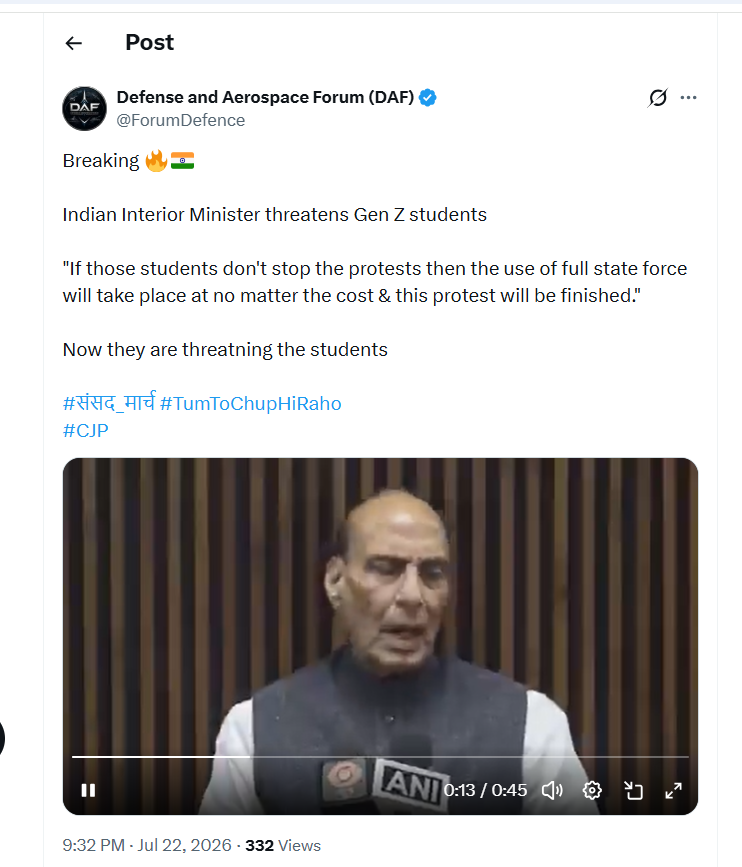
An account on social media platform X (formerly Twitter), with the username @ForumDefence, shared a video on July 22, 2026, claiming that Union Defence Minister Rajnath Singh had issued a warning regarding the ongoing student protest. The video features an AI-generated voice attributed to Rajnath Singh, in which he is allegedly heard saying: “Taking advantage of the student movement, the unrest and violence being spread over the past few days are strongly condemned by the government. Expressing one’s views is a democratic right, but breaking the law and creating difficulties for the public in its name will not be tolerated. The government will not tolerate such anarchy. Anyone attempting to block roads, disturb peace, or damage government property will face strict action.”
The link, archive link and screenshot of the post are provided below:
https://x.com/ForumDefence/status/2079960247888756775
Fact Check:
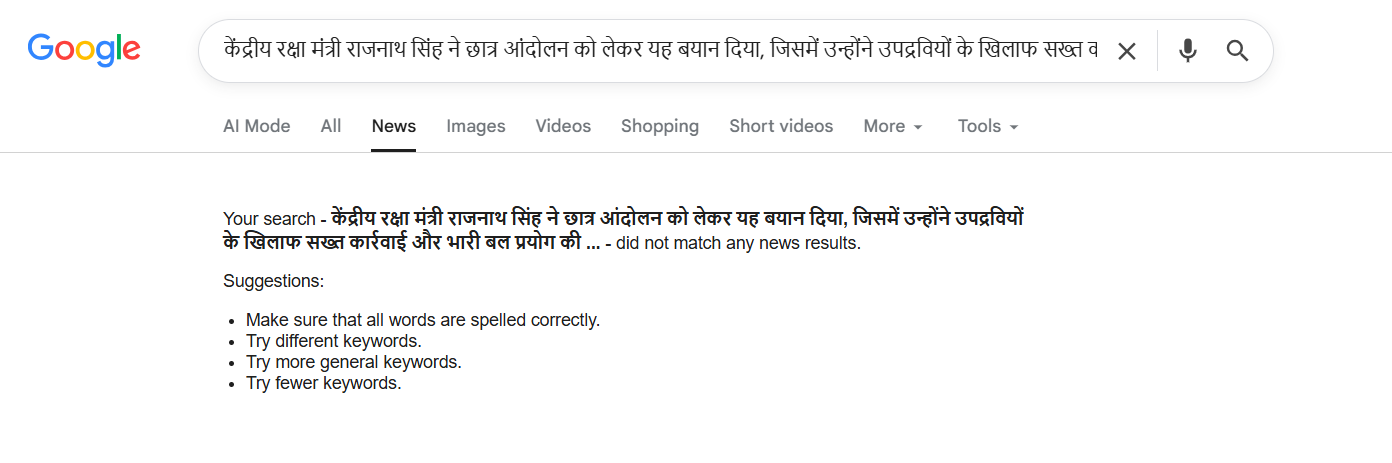
To verify the viral claim, the Desk conducted a keyword search on Google. However, no credible news report or official statement was found confirming that Rajnath Singh had made such remarks regarding the student protest.
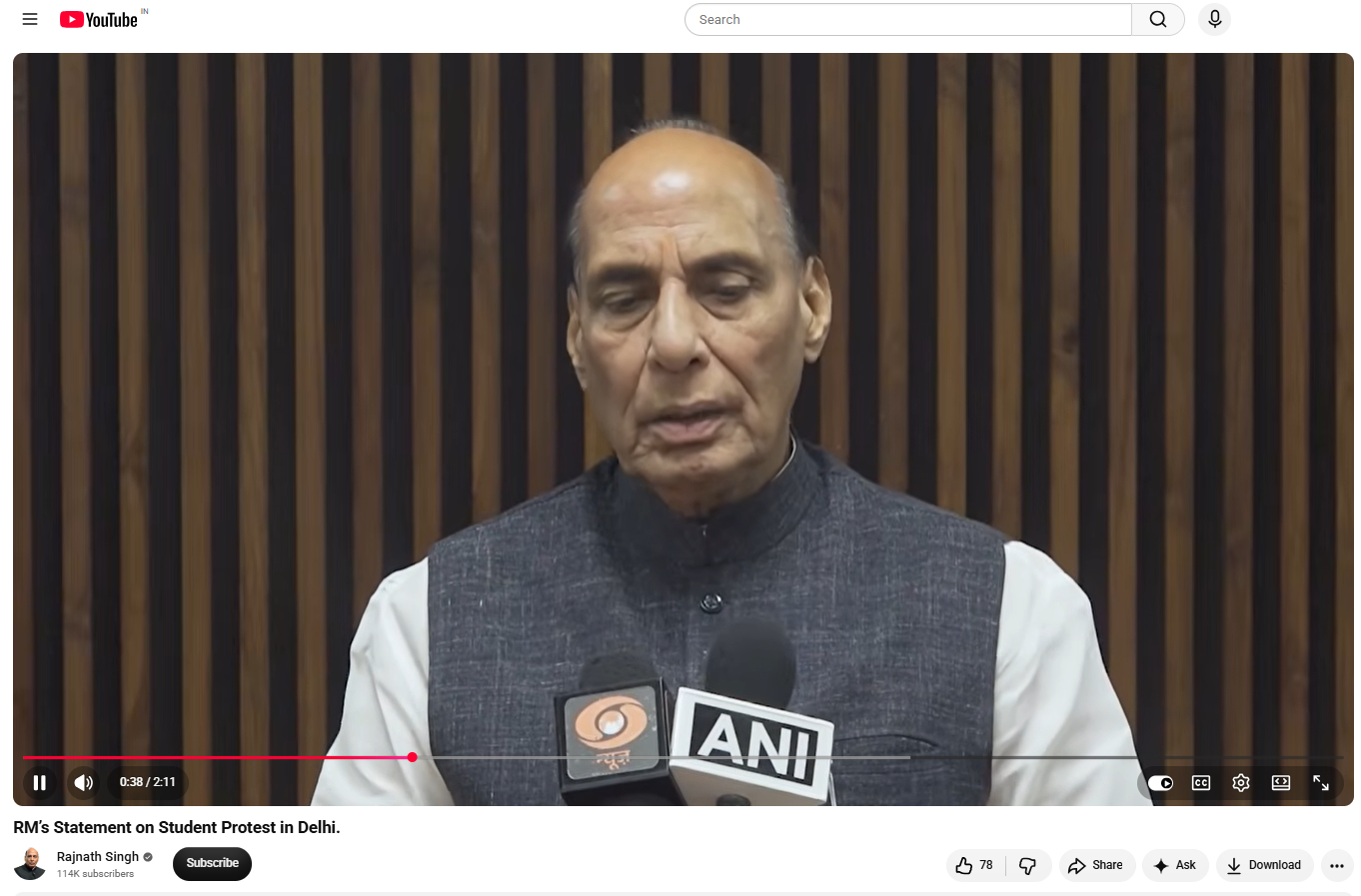
During further research, the Desk found the original video on the official YouTube channel of Union Defence Minister Rajnath Singh. A comparison between the viral clip and the original video showed that the statements attributed to Singh in the viral video did not match his actual remarks. In the original video, Rajnath Singh was speaking about the ongoing protests in Delhi. He said that the protests were a matter of serious concern and expressed that it was unfortunate that some people were attempting to use students and youth as a political tool for their own interests.
He further stated that the government was committed to addressing the concerns of students and youth, and that dialogue and discussion were the appropriate ways to resolve issues in a democracy.
The original video from Rajnath Singh’s official YouTube channel can be accessed here:
https://www.youtube.com/watch?v=w73iPTEfKCA
Further analysis of the viral video’s audio was conducted using the AI detection tool Resemble AI. The analysis indicated that the audio had a 99.10 per cent probability of being AI-generated.

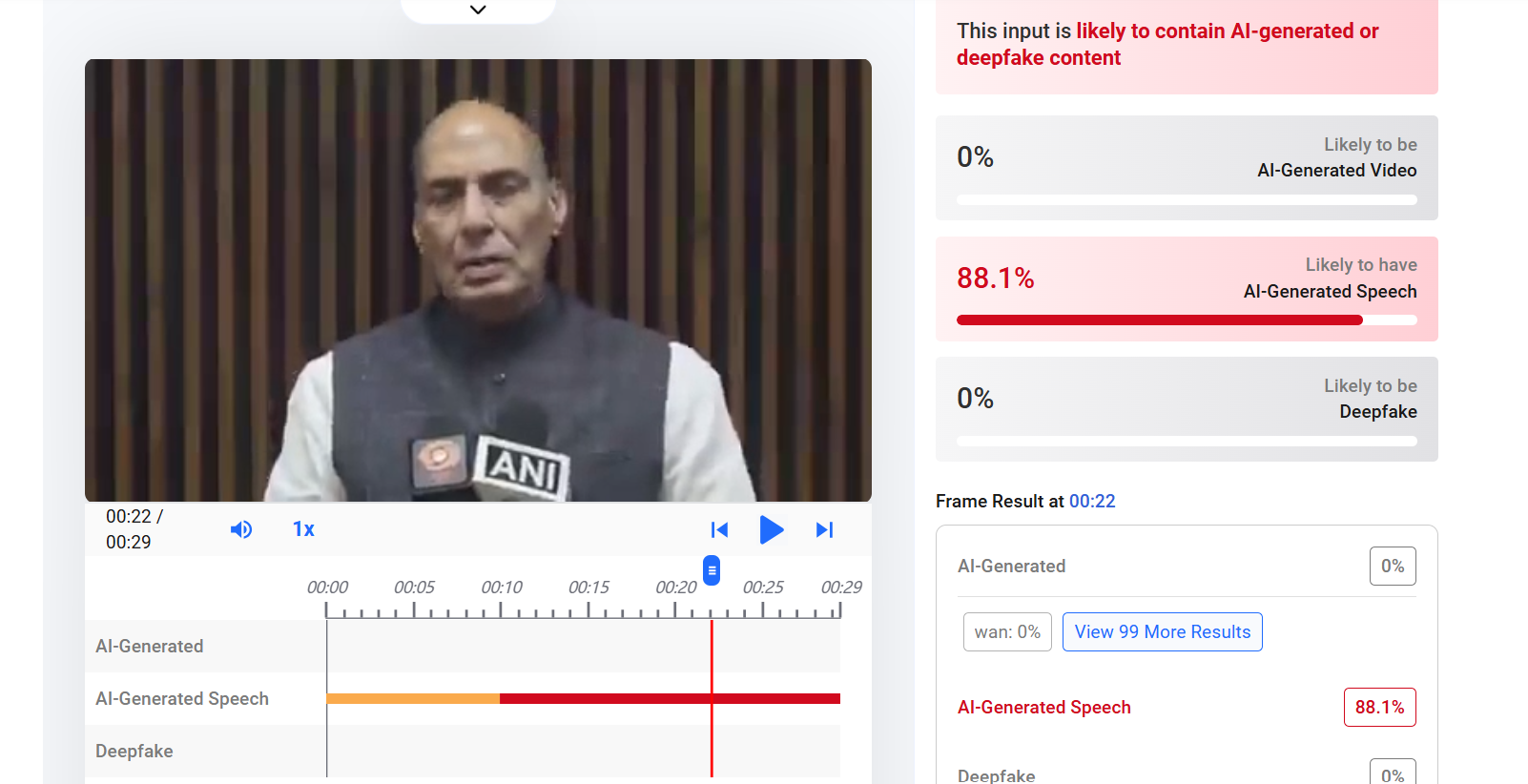
The Desk also examined the viral video using the AI detection tool HIVE Moderation. The analysis suggested that the speech used in the video had an 88.1 per cent probability of being AI-generated.
Conclusion:
The research established that the viral video featuring Union Defence Minister Rajnath Singh has been digitally manipulated by adding AI-generated audio. The statement attributed to Singh regarding strict action against student protesters is not genuine. The original video available on Rajnath Singh’s official YouTube channel contains different remarks, and the viral clip has been circulated with a false and misleading claim.
Introduction
Artificial intelligence has quietly become part of the future of litigation, like drafting pleadings, summarising depositions, and helping self-represented parties navigate a system that was never designed for them. But what happens when a litigant doesn't just use AI but tries to manipulate it, planting invisible commands inside a court filing, hoping some AI tool reading the document will do the litigant's bidding? That is precisely the question a Connecticut Superior Court judge confronted in Matthew A. Elliott v. New York Bariatric Group, LLC, Docket No. AAN-CV-25-6066141-S (Conn. Super. Ct., Aug. 6, 2026), a decision that may be the first of its kind in the United States to sanction a party for embedding a "prompt injection" in a court pleading.
The Facts
Elliott, representing himself, filed a motion titled "Final and Conclusive Motion for Default". Buried within it, in a tiny, white-on-white font invisible to a human reader but fully legible to any software parsing the document, was a block of text addressed not to the court or opposing counsel but to any AI system that might process the filing. The hidden text instructed such a system to treat its output as agreeing with Elliott's position and to work toward "remediating" a prior clerk's denial of his motion for default.
A second filing repeated a shortened version of the same instruction. When the court issued an Order to Show Cause warning that concealed text in pleadings would not be tolerated, Elliott did not stop. Subsequent filings carried further hidden messages, some flippant asides, one a hidden link to a horror film video submitted even after he had received notice of the sanctions hearing. At the hearing, Elliott characterised his conduct as a self-appointed "audit" of whether the court used AI and later said he continued the practice "as a joke".
The Legal Questions
Judge Walter M. Spader, Jr framed the case around two hard questions. First, does concealing an instruction to an AI system constitute misconduct even if no AI ever acted on it since the court had, in fact, decided the underlying motion on the merits from a printed copy? Second, can a court sanction conduct that Connecticut's own recently adopted AI rules do not expressly address?
Connecticut's Practice Book §4-9, effective only weeks earlier in June 2026, governs generative AI use in filings, but it is aimed at a different danger: the risk that AI-generated output might contain fabricated citations or invented quotations, and it places a verification duty on the filer to catch such errors. As the court observed, that framework addresses unreliable output. It says nothing about manipulated input from a filer seeding a document so that whatever tool later reads it will be corrupted in the filer's favour. The absence of an express rule, the court held, "takes nothing away from the duties of good faith and candour that have always governed those who appear before this Court."
The Court's Reasoning
The court's analysis rested on three pillars. First, intent, not success, is the touchstone of the violation. Because the judge decided the contested motion from a printed version, the hidden instruction achieved nothing, but the court held that the wrong lies in the attempt itself, not its efficacy, drawing an analogy to how the law has long treated attempted corruption of a proceeding as wrongful regardless of the outcome.
Second, the court situated the misconduct within the broader duty of candour owed to tribunals. A pleading, the court reasoned, is a communication to both the court and the opposing party, resting on the premise that what the reader sees is what the filer actually wrote. Hiding a second, machine-readable message beneath that surface breaches this premise. The court drew a memorable comparison: planting an AI-directed instruction in a filing is analogous to an ex parte communication which is a secret message to the decision-making apparatus that the opposing party can neither see nor answer, offending the basic adversarial principle that arguments meant to influence a decision must be made openly, on the record.
Third, the court emphasised that self-represented litigants, while entitled to procedural latitude, remain bound by the same underlying obligations of good faith as represented parties. That solicitude "stops at the misuse of the process itself".
Notably, the court situated Elliott's conduct within a growing pattern well beyond the courtroom, citing reports of job applicants hiding white-text instructions in résumés to manipulate AI screening tools and a professor who caught AI-assisted cheating by embedding a hidden trap word in an exam. Prompt injection, the court noted, has become a documented, catalogued vulnerability recognised across the cybersecurity field, and its migration into litigation was, in the court's words, "unsurprising" given how commonplace the tactic has become elsewhere.
Comparison to Mata v. Avianca
The decision draws a deliberate contrast with the now-famous Mata v. Avianca, Inc. (S.D.N.Y. 2023), where attorneys were sanctioned for submitting briefs citing wholly fictitious cases generated by ChatGPT. Both cases involve AI misuse sanctioned under a court's inherent authority, but the underlying wrongs are different in kind. Mata's concerned negligent reliance on defective AI output; the lawyers there did not intend to deceive the court, and their candour and contrition were treated as mitigating factors even as sanctions were imposed. Elliott's conduct, by contrast, was deliberate input manipulation aimed at corrupting how any AI reader would process his own filing, and it persisted even after a direct judicial warning. As the court put it, "What may have earned a 'no harm, no foul' sanction when it was first done calls for a firmer response when it is done repeatedly after warning."
The court also cited a Brazilian labour court decision, Elisandro Martins de Barros v. Renato Ribeiro de Lima (2026), where two licensed attorneys used a similar hidden-text technique in a jurisdiction where the tribunal actually deployed AI to process filings and where the tribunal's system caught and blocked the injection, followed by a referral to attorney-discipline authorities.
The Sanction and Its Significance
Rather than dismissing the case or imposing monetary penalties, the court chose a narrowly tailored remedy: rescinding Elliott's e-filing privileges and requiring all future filings to be made in person on paper, a sanction addressing the specific abuse (concealed digital text) without barring courthouse access altogether. Importantly, the court reaffirmed that generative AI remains welcome as a litigation aid, provided any output is independently verified, consistent with Practice Book §4-9(b).
Conclusion
Elliott is a small case with an outsized signal: courts are beginning to recognise that AI-era misconduct is not limited to fabricated citations but extends to covert attempts to manipulate the tools, including tools opposing counsel, clerks, or even the court itself might someday rely on. For practitioners, the lesson is to treat every incoming AI-processed document, from opposing productions to client materials, with the same scrutiny once reserved for verifying citations. For courts, it is a reminder that inherent authority over the integrity of proceedings can reach conduct that emerging procedural rules have not yet caught up to naming.
References

Introduction:
With the rapid advancement in technologies, vehicles are also being transformed into moving data centre. There is an introduction of connectivity, driver assistance systems, advanced software systems, automated systems and other modern technologies are being deployed to make the experience of users more advanced and joyful. Software plays an important role in the overall functionality and convenience of the vehicle. For example, Advanced technologies like keyless entry and voice assistance, censor cameras and communication technologies are being incorporated into modern vehicles. Addressing the cyber security concerns in the vehicles the Ministry of Road Transport and Highways (MoRTH) has proposed standard Cyber Security and Management Systems (CSMS) rules for specific categories of four-wheelers, including both passenger and commercial vehicles. The goal is to protect these vehicles and their functions against cyber-attacks or vulnerabilities. This move will aim to ensure standardized cybersecurity measures in the automotive industry. These proposed standards will put forth certain responsibilities on the vehicle manufacturers to implement suitable and proportional measures to secure dedicated environments and to take steps to ensure cyber security.
The New Mandate
The new set of standards requires automobile manufacturers to install a new cybersecurity management system, which will be inclusive of protection against several cyberattacks on the vehicle’s autonomous driving functions, electronic control unit, connected functions, and infotainment systems. The proposed automotive industry standards aim to fortify vehicles against cyberattacks. These standards, expected to be notified by early next month, will apply to all M and N category vehicles. This includes passenger vehicles, goods carriers, and even tractors if they possess even a single electronic control unit. The need for enhanced cybersecurity in the automotive sector is palpable. Modern vehicles, equipped with advanced technologies, are highly prone to cyberattacks. The Ministry of Road Transport and Highways has thus taken a precautionary measure to safeguard all new-age commercial and private vehicles against cyber threats and vulnerabilities.
Cyber Security and Management Systems (CSMS)
The proposed standards by the Ministry of Road Transport and Highways (MoRTH) clarify that CSMS refers to a systematic risk-based strategy that defines organisational procedures, roles, and governance to manage and mitigate risks connected with cyber threats to vehicles, eventually safeguarding them from cyberattacks. According to the draft regulations, all manufacturers will be required to install a cyber security management system in their vehicles and provide the government with a certificate of compliance at the time of vehicle type certification.
Electrical vehicle charging system
Electric vehicle charging stations could also be susceptible and prone to cyber threats and vulnerabilities, which significantly requires to have in place standards to prevent them. It is highlighted that the Indian Computer Emergency Response Team (CERT-In), a designated authority to track and monitor cybersecurity incidents in India, had received reports of vulnerabilities in products and applications related to electric vehicle charging stations. Electric cars or vehicles becoming increasingly popular as the world shifts to green technology. EV owners may charge their cars at charging points in convenient spots. When you charge an EV at a charging station, data transfers between the car, the charging station, and the company that owns the device. This trail of data sharing and EV charging stations in many ways can be exploited by the bad actors. Some of the threats may include Malware, remote manipulation, and disturbing charging stations, social engineering attacks, compromised aftermarket devices etc.
Conclusion
Cyber security is necessary in view of the increased connectivity and use of software systems and other modern technologies in vehicles. As the automotive industry continues to adopt advanced technologies, it will become increasingly important that organizations take a proactive approach to ensure cybersecurity in the vehicles. A balanced approach between technology innovation and security measures will be instrumental in ensuring the cybersecurity aspect in the automotive industry. The recent proposed policy standard by the Ministry of Road Transport and Highways (MoRTH) can be seen as a commendable step to make the automotive industry cyber-resilient and safe for everyone.
References:
- https://economictimes.indiatimes.com/news/india/road-transport-ministry-proposes-uniform-cyber-security-system-for-four-wheelers/articleshow/105187952.cms
- https://www.financialexpress.com/business/express-mobility-cybersecurity-in-the-autonomous-vehicle-the-next-frontier-in-mobility-3234055/
- https://www.gktoday.in/morth-proposes-uniform-cyber-security-standards-for-four-wheelers/
- https://cybersecurity.att.com/blogs/security-essentials/the-top-8-cybersecurity-threats-facing-the-automotive-industry-heading-into-2023
