
#FactCheck-Deepfake Video Falsely Shows DRDO Chief Claiming ‘Agni-6 Was Washed with Cow Urine’
Executive Summary
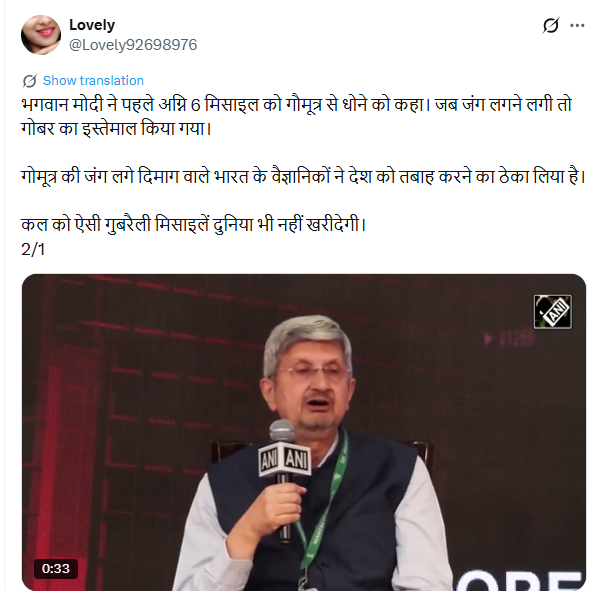
A video of Dr. Samir V. Kamat, Chairman of the Defence Research and Development Organisation (DRDO), is going viral on social media. In the clip, he appears to claim that Prime Minister Narendra Modi instructed scientists to wash the Agni-6 missile with cow urine, and later use a mixture of cow dung and urine to prevent rusting. Research by CyberPeace Research Wing found that the video is a deepfake, created by manipulating original footage using AI tools. It was also shared by an account previously known for posting anti-India misinformation and is reportedly banned in India.
Claim
An X user named “Lovely” shared the video on May 1, 2026, alleging that Indian scientists were using cow urine and dung in missile development under government direction. The post used derogatory language and criticized India’s scientific community.
Fact Check
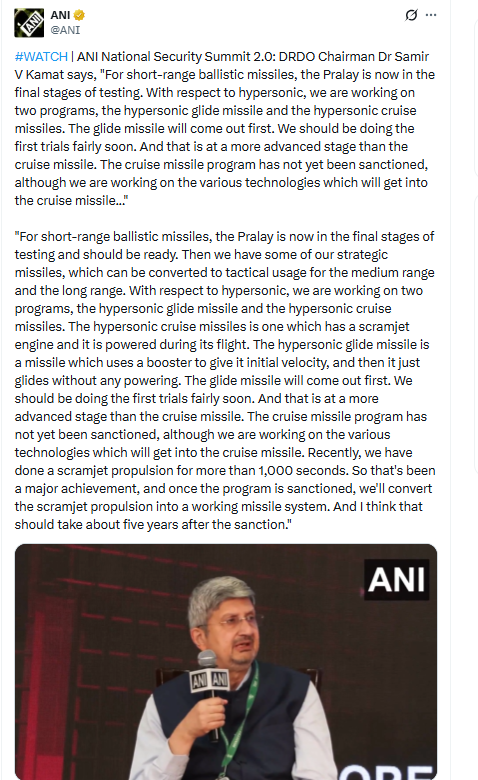
To verify the claim, we searched relevant keywords on Google but found no credible media reports supporting such statements by the DRDO chief. We then extracted keyframes from the viral clip and conducted a reverse image search using Google Lens. This led us to the original video posted by ANI on April 30, 2026. The footage is from the National Security Summit 2.0, where Dr. Kamat spoke about India’s missile development programs.
In the authentic video, Dr. Kamat discusses short-range ballistic missiles like ‘Pralay’, and advancements in hypersonic glide and cruise missile technologies, including scramjet propulsion. There is no mention of cow urine, cow dung, or any such practices.
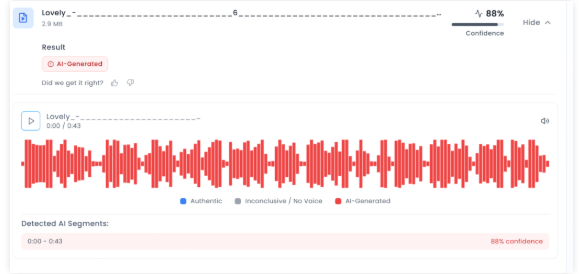
Further analysis using AI detection tool Aurigin indicated an 88% probability that the viral video was AI-generated or manipulated.
Conclusion
Our research confirms that the viral video is fake and AI-manipulated. Dr. Samir V. Kamat never made any statement about washing missiles with cow urine. The clip is a deepfake created to spread misinformation and mislead viewers.

Related Blogs

Introduction
Rajeev Chandrasekhar, Minister of State at the Ministry of Electronics and Information Technology, has emphasised the need for an open internet. He stated that no platform can deny content creators access to distribute and monetise content and that large technology companies have begun to play a significant role in the digital evolution. Chandrasekhar emphasised that the government does not want the internet or monetisation to be in the purview of just one or two companies and does not want 120 crore Indians on the internet in 2025 to be catered to by big islands on the internet.
The Voice for Open Internet
India's Minister of State for IT, Rajeev Chandrasekhar, has stated that no technology company or social media platform can deny content creators access to distribute and monetise their content. Speaking at the Digital News Publishers Association Conference in Delhi, Chandrasekhar emphasized that the government does not want the internet or monetization of the internet to be in the hands of just one or two companies. He argued that the government does not like monopoly or duopoly and does not want 120 crore Indians on the Internet in 2025 to be catered to by big islands on the internet.
Chandrasekhar highlighted that large technology companies have begun to exert influence when it comes to the dissemination of content, which has become an area of concern for publishers and content creators. He stated that if any platform finds it necessary to block any content, they need to give reasons or grounds to the creators, stating that the content is violating norms.
As India tries to establish itself as an innovator in the technology sector, a recent corpus of Rs 1 lakh crore was announced by the government in the interim Budget of 2024-25. As big companies continue to tighten their stronghold on the sector, content moderation has become crucial. Under the IT Rules Act, 11 types of categories are unlawful under IT Act and criminal law. Platforms must ensure no user posts content that falls under these categories, take down any such content, and gateway users to either de-platforming or prosecuting. Chandrasekhar believes that the government has to protect the fundamental rights of people and emphasises legislative guardrails to ensure platforms are accountable for the correctness of the content.
Monetizing Content on the Platform
No platform can deny a content creator access to the platform to distribute and monetise it,' Chandrasekhar declared, boldly laying down a gauntlet that defies the prevailing norms. This tenet signals a nascent dawn where creators may envision reaping the rewards borne of their creative endeavours unfettered by platform restrictions.
An increasingly contentious issue that shadows this debate is the moderation of content within the digital realm. In this vast uncharted expanse, the powers that be within these monolithic platforms assume the mantle of vigilance—policing the digital avenues for transgressions against a conscribed code of conduct. Under the stipulations of India's IT Rules Act, for example, platforms are duty-bound to interdict user content that strays into territories encompassing a spectrum of 11 delineated unlawful categories. Violations span the gamut from the infringement of intellectual property rights to the propagation of misinformation—each category necessitating swift and decisive intervention. He raised the alarm against misinformation—a malignant growth fed by the fertile soils of innovation—a phenomenon wherein media reports chillingly suggest that up to half of the information circulating on the internet might be a mere fabrication, a misleading simulacrum of authenticity.
The government's stance, as expounded by Chandrasekhar, pivots on an axis of safeguarding citizens' fundamental rights, compelling digital platforms to shoulder the responsibility of arbiters of truth. 'We are a nation of over 90 crores today, a nation progressing with vigour, yet we find ourselves beset by those who wish us ill,'
Upcoming Digital India Act
Awaiting upon the horizon, India's proposed Digital India Act (DIA), still in its embryonic stage of pre-consultation deliberation, seeks to sculpt these asymmetries into a more balanced form. Chandrasekhar hinted at the potential inclusion within the DIA of regulatory measures that would sculpt the interactions between platforms and the mosaic of content creators who inhabit them. Although specifics await the crucible of public discourse and the formalities of consultation, indications of a maturing framework are palpable.
Conclusion
It is essential that the fable of digital transformation reverberates with the voices of individual creators, the very lifeblood propelling the vibrant heartbeat of the internet's culture. These are the voices that must echo at the centre stage of policy deliberations and legislative assembly halls; these are the visions that must guide us, and these are the rights that we must uphold. As we stand upon the precipice of a nascent digital age, the decisions we forge at this moment will cascade into the morrow and define the internet of our future. This internet must eternally stand as a bastion of freedom, of ceaseless innovation and as a realm of boundless opportunity for every soul that ventures into its infinite expanse with responsible use.
References
- https://www.financialexpress.com/business/brandwagon-no-platform-can-deny-a-content-creator-access-to-distribute-and-monetise-content-says-mos-it-rajeev-chandrasekhar-3386388/
- https://indianexpress.com/article/india/meta-content-monetisation-social-media-it-rules-rajeev-chandrasekhar-9147334/
- https://www.medianama.com/2024/02/223-rajeev-chandrasekhar-content-creators-publishers/
.webp)
Introduction
It might seem too good to be true: free movies, live TV and sports without any subscription plan are deals that no one in India could actually refuse, and that’s precisely the explanation as to why applications such as Pikashow have gained tremendous traction in India and all over the world as well. However, cybersecurity authorities have a strong cause of concern: the threat that this type of application poses towards lakhs of Indians with malicious software, stealing information and even money. Pikashow may be a perfect case study to establish this problem, but in fact, it all ties down to how downloading anything without the recognised applications has certain risks attached to it.
The Pikashow Warning
With no monthly subscription fees, Pikashow is a popular free app for streaming movies, web series, live TV channels and sports programmes. Since its development, Pikashow has had a reputation for never being found on the Google Play Store or Apple’s App Store, which necessitates a process of side-loading. A side load, in this case, entails downloading the Pikashow APK file from an unofficial third-party source and manually installing the app, circumventing the security measures of official download channels.
The latter is significant because security experts who have analysed Pikashow argue that it acts as an informal content aggregator; movies and TV series are illegally scooped up from online streaming services, then shared via various third-party links and streamed without a content licence or any agreement with legitimate providers.
Without going through the rigorous checks conducted by Google or Apple, security researchers discovered that even while the app appeared to be working fine with its promised streams, hidden malware within the installer can run silently, leading to potentially significant security risks such as data theft of user logins, one-time passwords, and private files, including banking credentials. This has been cited to be so problematic for India that law enforcement agencies like the Indian Cyber Crime Coordination Centre under the Ministry of Home Affairs and the Cyber Dost platform are expected to have issued public advisories linking Pikashow to a proliferation of cases of cybercrime. Users should take into account the legal implications alongside security concerns, as using piracy apps may not only lead to device-compromising issues but can also be against the Copyright Act of India as well, thus increasing the risk of legal prosecution.
Why This Isn't Just a "Pikashow Problem"
This should not be viewed as a single warning concerning one app. Pikashow is merely an illustration of one app from millions that exists outside official app stores and is built with the same mechanics that make Pikashow dangerous and applicable to virtually any app, game, or "modded" file which is downloaded from a random website, third-party app store, or Telegram channel.
Some issues that persist are-
- Official app stores are like a filter that is not perfect, but it is still critical to the security on a user's device. Both Google and Apple's App stores run automatic and manual malware scanners, screen permissions for legitimate use, and have the ability to remove malicious developers as necessary. Empirical research has estimated just how important this is: more than fifty-times more malware exists on sideloaded, "unofficial" apps versus official. Mobile security firm Zimperium claims nearly 40% of all devices tested with malware were infected due to downloading an app from outside the official app stores; furthermore, nearly 80% of malicious, sideloaded apps contained riskware or trojans.
- Informational channels can also be used to gain the trust of users by mimicking familiar brands One frequently mentioned scheme is one where malicious actors repackage popular apps with a malignant intent to syphon the app, disguised as a free, trustworthy app. Often when these apps are available, they work exactly the same as the legitimate app, as a matter of fact, but quietly in the background steal passwords or log keystrokes; this was discovered to be occurring with a financial trojan called TeaBot, where bank details and login info were intercepted through the device's Accessibility Service.
- There is generally no recourse or legal liability that applies once something has gone wrong. While official app stores are official developers that can be identified to submit complaints against them, if a third-party download leads to damages, that developer generally cannot be located to establish liability or legal standing.
- Excessive app permissions will often go undetected This occurs for the similar reasons that a malicious actor can include such a clause as explained above. There's really nothing to stop the developer from asking to utilise one's SMS, call log, camera, microphone, storage or location when there's not one reason for one application to need access to everything on the device.
- Expired software has the same or more risk It's actually very common to see apps that receive security updates out in the wild that either don't have the appropriate update sent over to third-party app stores or third-party stores don't have the capacity to update the affected applications. That's why most official third-party app downloads should be of fairly new versions; for example, outdated versions of a banking app, which is being patched as well as receiving other updates from Google or Apple still, will continue to persist on third-party download sites for some time after patching, which could then be malicious.
- Even legitimate, globally recognised apps can and have been compromised The same vulnerability was noted for TikTok in 2023, which, when found on unofficial APK download sites, contained hidden data-tracking malware yet looked identical to the official app version.
How to Protect Yourself
The reassuring thing is that the vast majority of this risk can be eliminated through simple, repeatable habits. Use trusted sources like Google Play and Apple's App Store, which are not faultless, of course, but they remove many infected apps from circulation following review.
- Be sceptical of "free" premium-paid apps.
- If something in a file from a site you don't recognise offers content or features that are normally behind a paywall and they want nothing to do with it, that is a bad sign, not a good deal. Review app permissions when you go to install anything. A flashlight doesn't need access to your SMS messages or contacts, as one recently downloaded on a colleague's Android allegedly attempted to acquire them from the Google Play store. After sideloading any app that you do not fully trust, it's always a wise idea to uninstall it and scan the handset to ensure malicious files aren't still lingering around.
- Choose legitimate services to avoid malware.
- In entertainment terms this will apply most clearly to piracy but applies similarly elsewhere in many senses. Trusted sources that are licensed include YouTube, JioCinema, Hotstar, Netflix, Amazon Prime Video, and MX Player, among others, which will offer content similar to illegally acquired or pirated versions without the security, as well as the legal risks. If you have recently used the file installation route to any degree of caution on a sensitive device, then also monitor banking and payment apps.
- That is not least because the most reported consequence of infection from an illicit or unknown source is the theft of financial account login details.
Conclusion
Free entertainment can look tempting, but as cybersecurity experts keep pointing out, "free" often just means the cost has been shifted from your wallet to your data, your device, and potentially your bank account. The safest rule of thumb remains simple: if an app isn't on an official store, ask why and think twice before installing it.
Sources
- Pikashow app risky, may expose users to malware and data theft: Experts — Times of India
- Free OTT Hack or Cyber Trap? Pikashow Flagged for Serious Security Risks — The420.in
- Pikashow Warning: Free Movies Could Empty Your Bank Account, Government Issues Strong Alert — The420.in
- Is Pikashow Safe or Risky to Use in 2025? Expert's Advice — AiPlex AntiPiracy
- Why Pikashow May Not Be Safe for Your Device — AiPlex AntiPiracy
- Concerns Rise Over the Safety of Popular Streaming App Pikashow — openPR
- Beyond the App Store: The Hidden Risks of Sideloading Apps — Zimperium
- App Sideloading: Risks, Rules, and How IT Admins Respond — Trio
- What Are the Risks of Sideloading Apps on Your Smartphone? — Bitdefender
- Sideloading Risk: Alternative App Stores and Brand Protection — Allure Security
- Building a Trusted Ecosystem for Millions of Apps: A Threat Analysis of Sideloading — Apple
Introduction
The trajectory of India's digital economy is growing at an unprecedented rate, and so is India's cybercrime ecosystem. Parliamentary data tabled before the Rajya Sabha in May 2024 by the MHA suggests an overwhelming 900% growth in cybercrime complaints from 2021 to '25, while annual losses crossed 22,800 crore in 2024. The structural issues like the low victim restitution rate, the lack of forensic infrastructure, issues of jurisdiction related to offshore fraud factories targeting Indian citizens, and the huge disparity in awareness levels amongst India's youngest online citizens continue to exist. This brief brings out the clear trends in cybercrime, the role of institutional mechanisms in its prevention and response, failure points, and recommends appropriate policy interventions from the perspective of CyberPeace.
The Data Imperative
Since its operationalisation in 2019 by the Indian Cyber Crime Coordination Centre (I4C), the NCRP serves as India's most significant institutional apparatus for cybercrime reporting and response. Data placed before the Rajya Sabha by the Ministry of Home Affairs on 30 July 2025 show that, with almost no exception, complaints of cybercrime have increased far more quickly than most traditional indicators of public safety. Between 2021 and June 2025, the NCRP received 6.59 million complaints, evidence of both a sustained and escalating expansion of India's cyber threat profile. Complaints per year more than quadrupled from 4.52 lakh in 2021 to 19.18 lakh in 2024 (324% over the period); by 2025, the NCRP had received 28.15 lakh complaints, a 523 percent rise compared with the 2021 baseline:
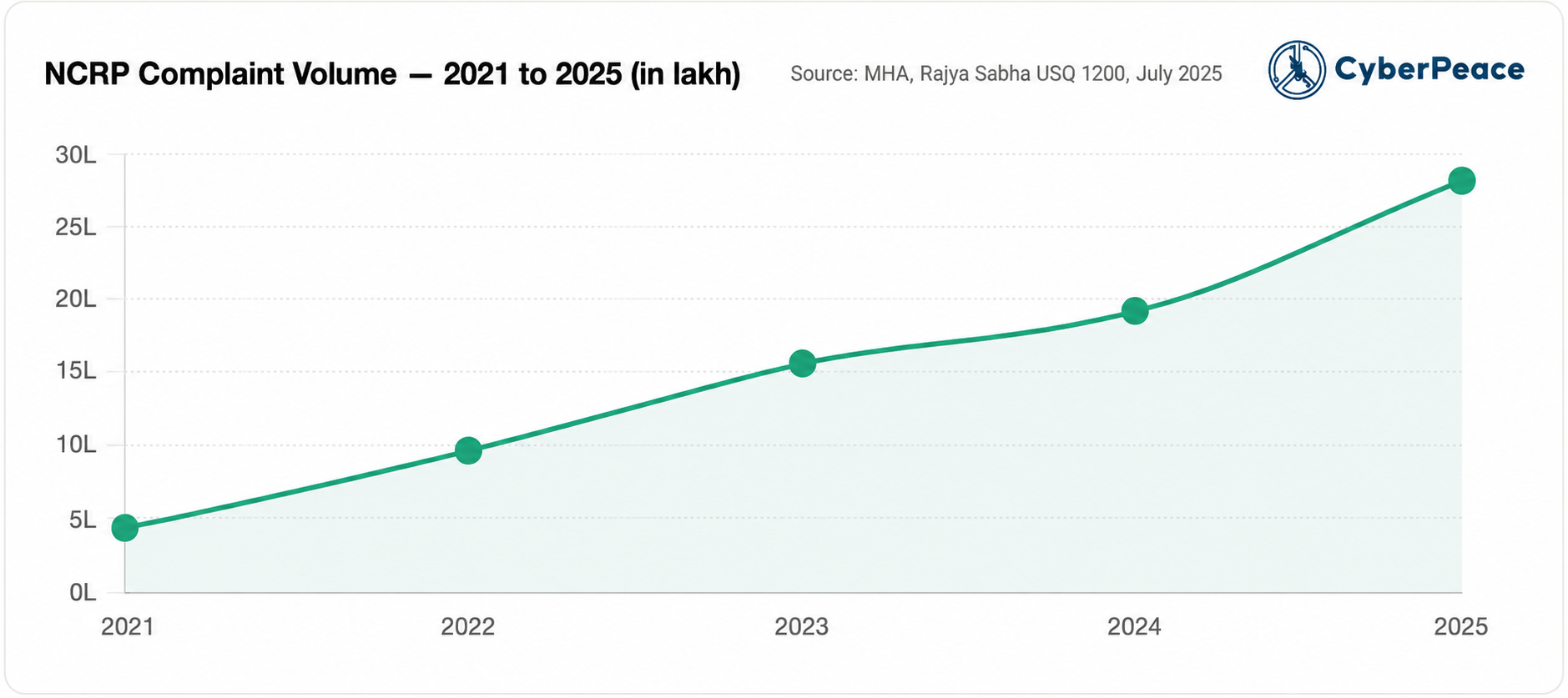
Clearly, cyber-enabled crime is no longer an occasional crisis but a systemic governance issue requiring consistent regulation and institution-building.
The financial fallout has also accelerated dramatically. Figures indicate that reported financial losses due to cybercrime jumped from 2,290 crore in 2022 to 22,812 crore in 2024 a 895% leap in two years:
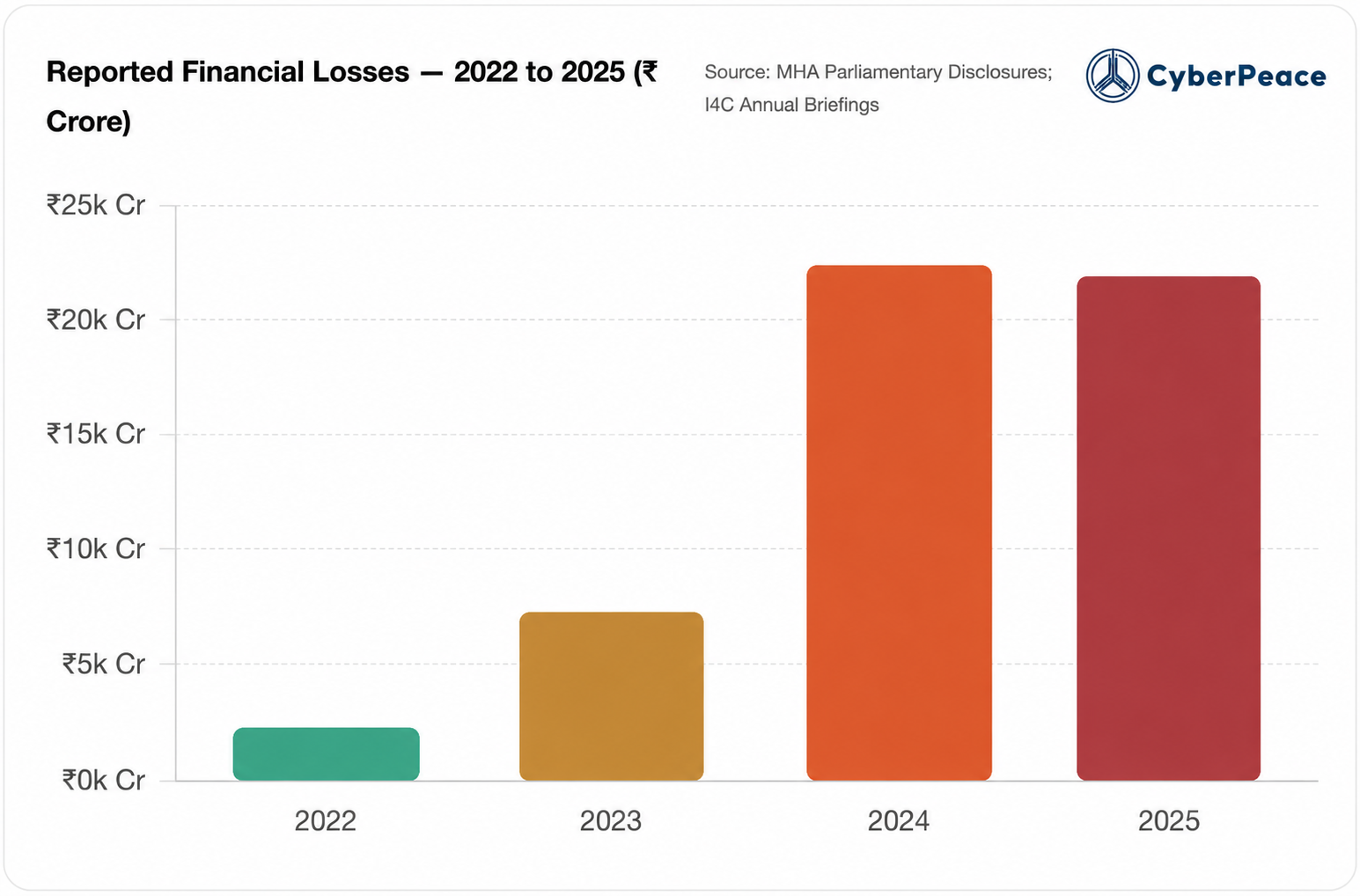
Though response mechanisms such as the Citizen Financial Cyber Fraud Reporting and Management System (CFCFRMS) successfully blocked or recovered close to 8,690 crore as of January 2026, victims appear to get back only about 2.18 percent of the losses they report.
In most areas, reporting and response have expanded greatly, but both the rate and scale of cyber-enabled financial fraud continue to outstrip India's remediation and law enforcement capacity.
Threat Typology of India’s Fraud Ecosystem
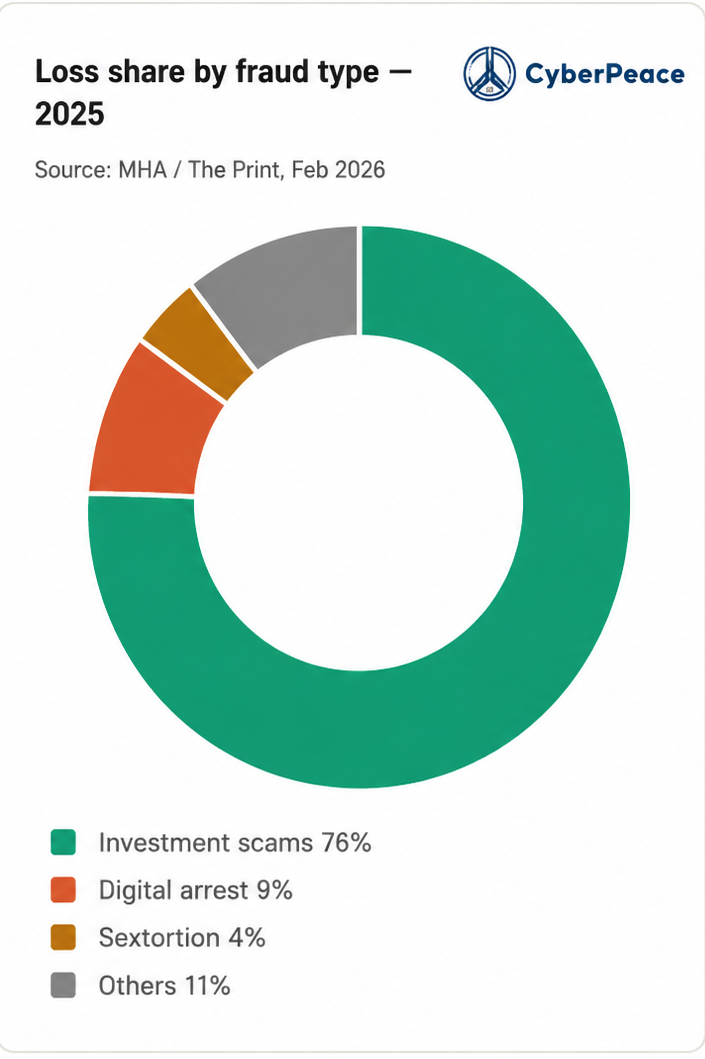
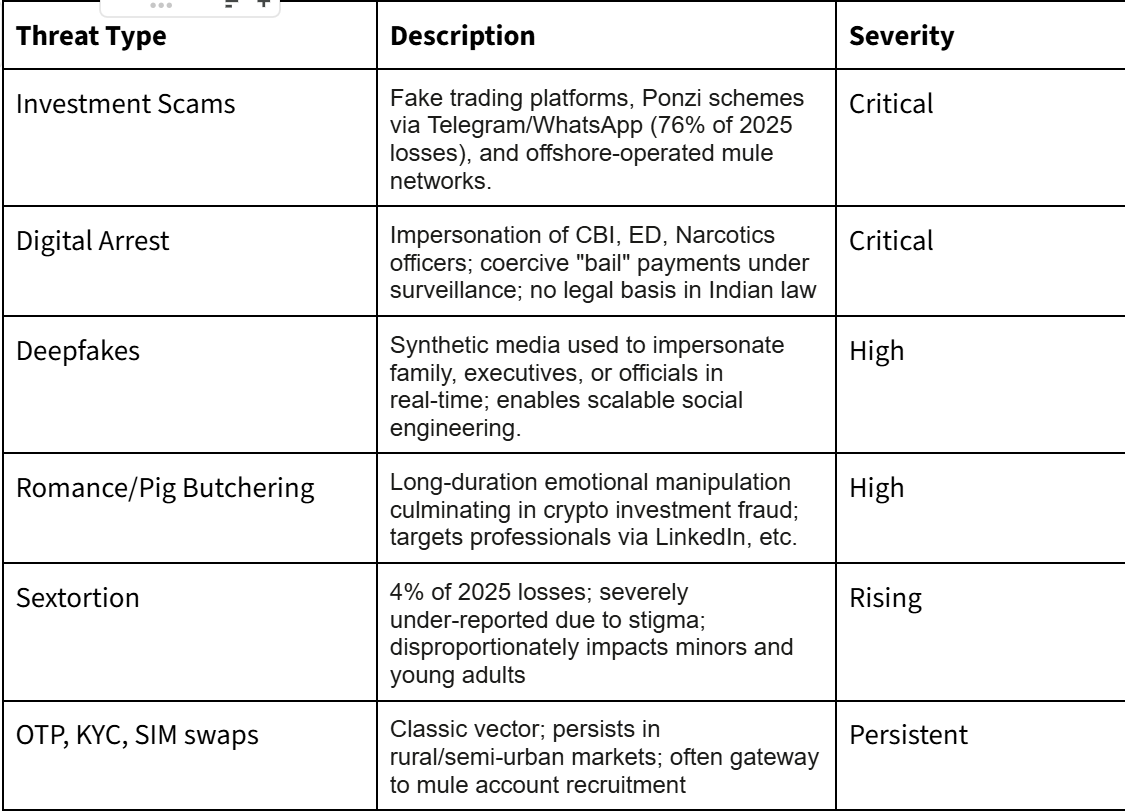
The nature of cyber crime in India has evolved from an opportunistic volume-based activity to a layered transnational criminal environment. I4C intelligence as tabled in Parliament reveals investment scams as the biggest threat: they accounted for 76% of the financial fraud lost in 2025 (although only 35% of complaints were filed, thus, a very high value per case was lost).
Digital arrest frauds, which tap on citizens' unawareness that "digital arrest" is not permissible under Indian law, rose from 39,925 cases (91 crore) in 2022 to 123,672 cases (1,935crore) in 2024.
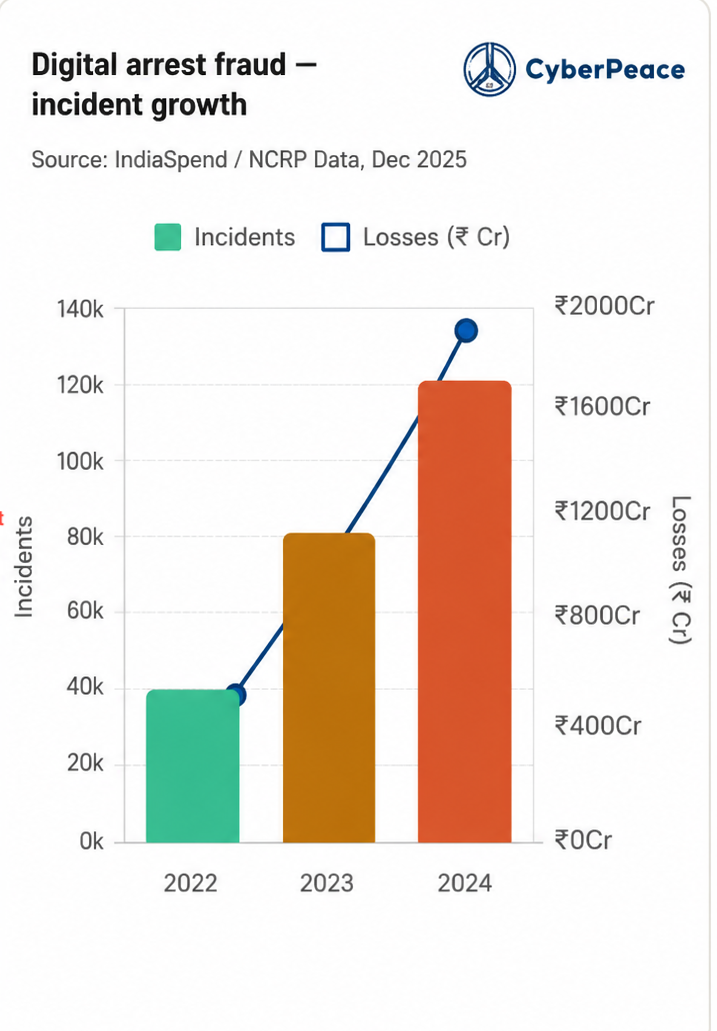
The fast rise in the number of incidents as well as in the volume of fraud clearly points out that digital arrest fraud has moved away from the phase of novel scam typology to a formidable cyber-extortion landscape. The main orchestrators of investment, trading, dating, and digital arrest scams targeting Indian citizens were recently identified by the I4C CEO Rajesh Kumar as transnational criminal scam networks in Cambodia, Myanmar, and Laos. Hence, this issue does not only fall within the domain of domestic law enforcement but constitutes a transnational cybercrime requiring parallel financial intelligence, diplomatic initiative, platform responsibility, and international investigative collaboration.
Geographic Concentration
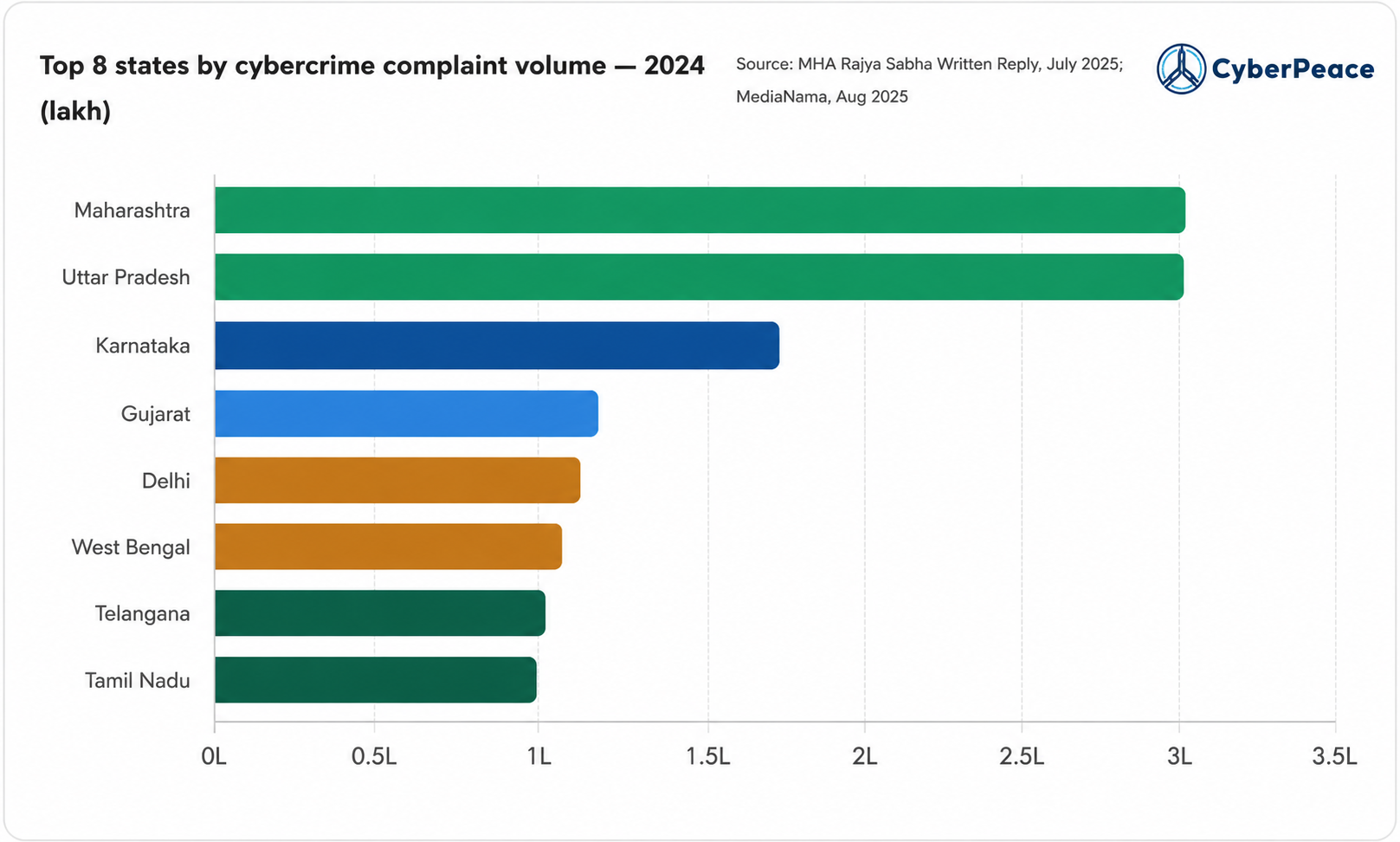
Maharashtra and UP register the highest volumes in total complaints at 3.03 lakh and 3.01 lakh, owing to them being the financial capital and most populous state, respectively. Karnataka, Gujarat, Delhi, WB, Telangana, TN, Rajasthan, and Haryana register above 1 lakh complaints each. However, the critical information that is being missed is that while complaint rate growth is the fastest in Tier 2 and 3 geographies (Haryana leads per-capita complaint rate with 381/100k people in 2023; Telangana (261); Uttarakhand (243)), this signifies rural digital growth as a risk multiplier.
Institutional Architecture: Mechanisms and Performances
India's institutional response to cybercrime, led by the Ministry of Home Affairs' Indian Cyber Crime Coordination Centre (I4C), is one of the world's largest real-time fraud detection and prevention ecosystems. The backbone of this is the Citizen Financial Cyber Fraud Reporting and Management System (CFCFRMS), which has onboarded over 700 banks, payment service providers, e-commerce portals, digital wallets, and, since the Standard Operating Procedure was issued on 2nd January 2026, virtual asset service providers and crypto exchanges. This interconnected network allows for prompt freezing of funds and timely fraud intervention during the 'golden hour' of a cybercrime report.
Institutional capacity is robust, with approximately 8,690 crore saved via the CFCFRMS since its inception for over 24.65 lakh complaints. The national cybercrime helpline (1930) receives close to 10,000 calls daily, while the Suspect Registry has enabled the rejection of 9,519 crore via the detection of 23.05 lakh suspect entities and 27.37 lakh mule accounts. In parallel, the CyTrain platform has expanded training by registering 151,081 police and judicial officers and issuing 142,025 certificates. Cyberforensic labs in all 33 States and Union Territories have received central assistance totalling 132.93 crore, and data-driven interstate crime analytics and offender linkages through the Samanvaya and Pratibimb platforms have led to 21,857 arrests.
Ecosystem Gaps
Through I4C, CFCFRMS, CyTrain, and the establishment of forensic infrastructure in states, India’s cybercrime ecosystem has greatly grown. But due to the rapid proliferation of cybercrime, systemic shortcomings are revealed regarding the restoration of victims, investigation, forensic capacity, cross-border enforcement, awareness, and stakeholder coordination:
- Victim Restitution Deficit: Although the total of ₹ 8,690 crore frozen has increased, the refund for victim compensation is limited to only ₹ 167 crore (2.18%) due to lengthy restoration processes relying on court orders.
- Forensic Capacity Limitations: 2 national, state-level, unevenly equipped cyber forensic labs can’t match the needs of over 10 million cybercrime complaints per year.
- Low conviction rate: The investigations of cybercrimes suffer from evidence collection and criminal proceedings, leading to limited conviction rates.
- Cross-border enforcement challenges: Many of the investment and digital arrest scams, in fact, are originating from Cambodia, Myanmar, and Laos, rendering the cybercrime response mechanisms of India helpless.
- Lack of Awareness: First-time digital users are quite prone to online scams and fraud, and many of the victims continue not reporting due to social stigma and lack of confidence.
- Partial Stakeholder Integration: Banks and small financial institutions, small companies, and emerging virtual asset providers not yet on board allow the money to slip through without being tracked.
CyberPeace Insights: Strategic Way Forward
India has already built a relatively mature response structure for cybercrime with I4C, CFCFRMS, and CyTrain and is coordinating the financial sector on it. The way ahead lies in outcome-oriented improvements and not just in the ability to report and intercept more. Here are the priority interventions that address the most important institutional shortcomings identified in the current ecosystem:
- Fast-track victim restoration: Introduce time-bound victim restoration mechanisms for low-value incidents through simplified processes and mandate national-level roll-out of successful Lok Adalat-based settlement mechanisms.
- District-level cyber forensics: Establish cyber forensic support units at the district level and enhance access to mobile, cloud, and blockchain forensic capabilities.
- AI-powered fraud prevention: Mandate deep-fake and voice-clone detection mechanisms across all financial institutions and telecom networks; embed predictive risk analytics into transaction screening frameworks.
- Cyber Suraksha Gram initiative: Increase digital fraud awareness across all common service centres, Jan Dhan enrollment schemes, and rural banking channels, and tackle the awareness asymmetry.
- Regional cybercrime coordination: Establish real-time, operational intelligence-sharing mechanisms with Southeast Asian economies, which have become home to large scam networks preying on Indian citizens.
- Specialised cyber prosecution ecosystem: Develop exclusive cyber courts, standardise digital evidence procedures, and broaden the scope of CyTrain to include the development of specialised cadres of investigators and prosecutors capable of handling increasingly complex cybercrime cases.
Conclusion
The 22,812 crore lost due to cybercrime in 2024 was more than a mere figure; it signifies a serious concern regarding citizen trust, economic security, and digital inclusion. Though India's institutional response to cybercrime is one of the largest, with an operational I4C and a CFCFRMS functioning in real time, the victim compensation and prosecution mechanism falls short. It's time for implementation: faster recovery of resources, increased enforcement, a larger scale of awareness, and finally, translating the institutional innovations into concrete justice for victims nationwide.
References
- https://sansad.in/getFile/annex/270/AU1341_tmaxdx.pdf?source=pqars
- https://www.mha.gov.in/MHA1/Par2017/pdfs/par2025-pdfs/LS02122025/452.pdf
- https://www.pib.gov.in/PressReleasePage.aspx?PRID=2244504®=3&lang=2
- https://static.pib.gov.in/WriteReadData/specificdocs/documents/2025/oct/doc2025107659501.pdf
- https://www.medianama.com/2025/08/223-india-cybercrime-500-percent-increase-2021-2024/
- https://theprint.in/india/cybercrime-saw-24-spike-in-2025-indians-lost-rs-22495-crore-mainly-in-investment-scams/2859930/
