
#FactCheck: Scripted Video of Assault on Female Delivery Agent Shared as Real Incident
Executive Summary
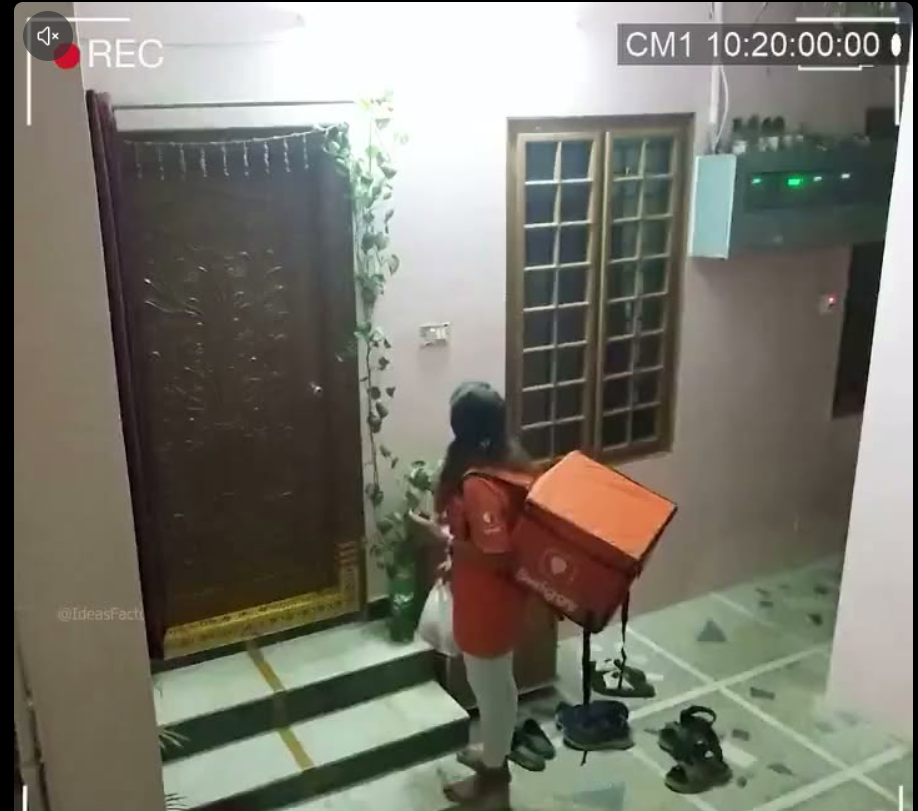
A video was shared on social media showing a woman food delivery agent allegedly being assaulted by a customer. The video showed the woman ringing a house’s doorbell to deliver an order. A man, who appeared to be in an inebriated state, came out, collected the order and left without paying. When the woman rang the doorbell again and asked him to pay for the order, another man, who appeared to be his friend, came out. The two men then appeared to forcibly pull the woman inside the house. She was later seen emerging from the house visibly injured and distressed, suggesting that she may have been assaulted. CyberPeace Research Wing reviewed the viral media and confirmed that the footage is staged. It bears no connection to any actual event and has been circulated on social networks with a misleading context.
Claim
On August 21, Facebook user D.K. Sharma shared a video clip asserting that it captures a real instance of a female food delivery partner being assaulted by customers. In the viral footage, a delivery woman knocks on a house door to drop off an order. An apparently intoxicated man receives the package and leaves without making the payment. When she rings the doorbell again to request the payment, a second man joins him. The duo is then seen forcibly dragging the woman inside the residence. Moments later, she emerges from the house visibly distressed and injured, suggesting physical assault.
https://www.facebook.com/reel/1326466852646458/
Fact Check
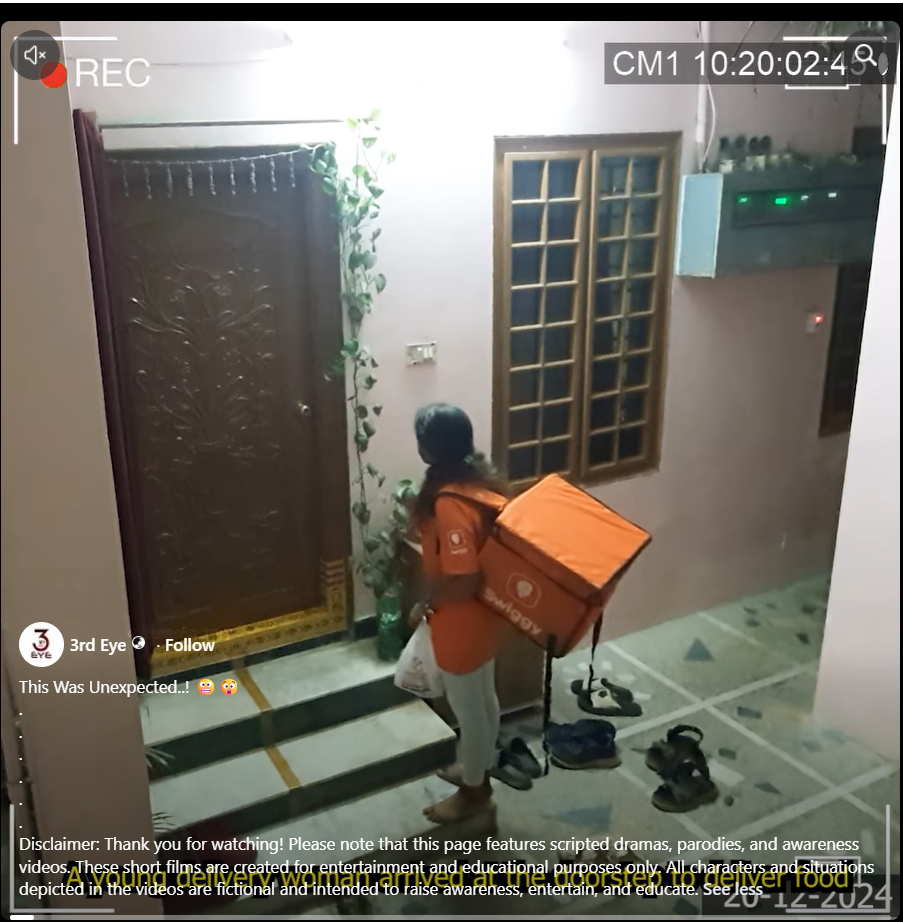
A Google Reverse Image Search led the Desk to a video posted on a Facebook page named 3RD EYE, which had over 1.1 million followers at the time of publication of this story. The page had shared the same video on June 21, showing a food delivery agent being assaulted, as seen in the viral social media posts. However, upon carefully reviewing the disclaimer accompanying the video, the Desk found that it was scripted and not based on any real-life incident.
The disclaimer clearly stated that the video was intended to raise awareness, entertain and educate viewers. The page caption read: “Thank you for watching! Please note that this page features scripted dramas, parodies, and awareness videos. These short films are created for entertainment and educational purposes only. All characters and situations depicted in the videos are fictional and intended to raise awareness, entertain and educate.”
https://www.facebook.com/reel/764475639236044
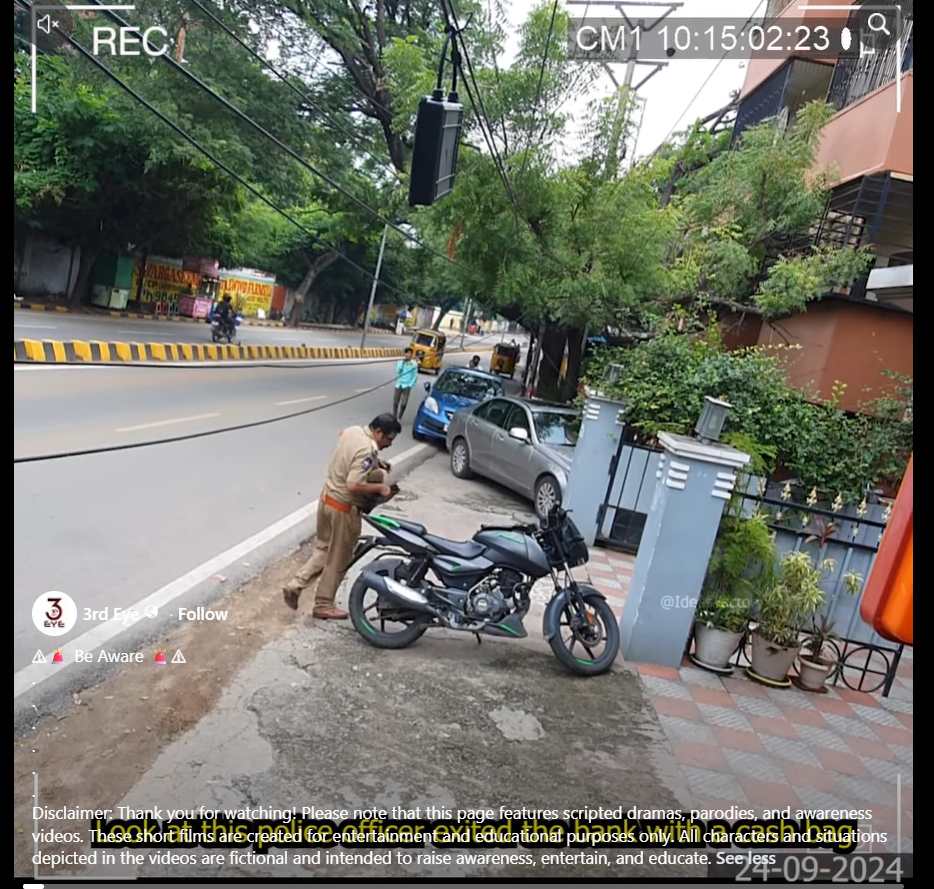
Further inspection of the '3RD EYE' Facebook channel confirmed a routine pattern of posting scripted awareness clips and fictional dramatizations.
https://www.facebook.com/reel/824802854039405
Conclusion
The claim that a female food delivery partner was assaulted by customers in a real-life incident is FALSE. The video in question is a fictional, scripted short drama created for educational/entertainment purposes and has been falsely shared as a genuine occurrence.

Related Blogs

Introduction
February marks the beginning of Valentine’s Week, the time when we transcend from the season of smog to the season of love. This is a time when young people are more active on social media and dating apps with the hope of finding a partner to celebrate the occasion. Dating Apps, in order to capitalise on this occasion, launch special offers and campaigns to attract new users and string on the current users with the aspiration of finding their ideal partner. However, with the growing popularity of online dating, the tactics of cybercriminals have also penetrated this sphere. Scammers are now becoming increasingly sophisticated in manipulating individuals on digital platforms, often engaging in scams, identity theft, and financial fraud under the guise of romance. As love fills the air, netizens must stay vigilant and cautious while searching for a connection online and not fall into a scammer’s trap.
Here Are Some CyberPeace Tips To Avoid Romance Scams
- Recognize Red Flags of Romance Scams:- Online dating has made it easier to connect with people, but it has also become a tool for scammers to exploit the emotions of netizens for financial gain. They create fake profiles, build trust quickly, and then manipulate victims into sending money. Understanding their tactics can help you stay safe.
- Warning Signs of a Romance Scam:- If someone expresses strong feelings too soon, it’s a red flag. Scammers often claim to have fallen in love within days or weeks, despite never meeting in person. They use emotional pressure to create a false sense of connection. Their messages might seem off. Scammers often copy-paste scripted responses, making conversations feel unnatural. Poor grammar, inconsistencies in their stories, or vague answers are warning signs. Asking for money is the biggest red flag. They might have an emergency, a visa issue, or an investment opportunity they want you to help with. No legitimate relationship starts with financial requests.
- Manipulative Tactics Used by Scammers:- Scammers use love bombing to gain trust. They flood you with compliments, calling you their soulmate or destiny. This is meant to make you emotionally attached. They often share fake sob stories. It could be anything ranging from losing a loved one, facing a medical emergency, or even being stuck in a foreign country. These are designed to make you feel sorry for them and more willing to help. Some of these scammers might even pretend to be wealthy, being investors or successful business owners, showing off their fabricated luxury lifestyle in order to appear credible. Eventually, they’ll try to lure you into a fake investment. They create a sense of urgency. Whether it’s sending money, investing, or sharing personal details, scammers will push you to act fast. This prevents you from thinking critically or verifying your claims.
- Financial Frauds Linked to Romance Scams:- Romance scams have often led to financial fraud. Victims may be tricked into sending money directly or get roped into elaborate schemes. One common scam is the disappearing date, where someone insists on dining at an expensive restaurant, only to vanish before the bill arrives. Crypto scams are another major concern. Scammers convince victims to invest in fake cryptocurrency platforms, promising huge returns. Once the money is sent, the scammer disappears, leaving the victim with nothing.
- AI & Deepfake Risks in Online Dating:- Advancements in AI have made scams even more convincing. Scammers use AI-generated photos to create flawless, yet fake, profile pictures. These images often lack natural imperfections, making them hard to spot. Deepfake technology is also being used for video calls. Some scammers use pre-recorded AI-generated videos to fake live interactions. If a person’s expressions don’t match their words or their screen glitches oddly, it could be a deepfake.
- How to Stay Safe:-
- Always verify the identities of those who contact you on these sites. A simple reverse image search can reveal if someone’s profile picture is stolen.
- Avoid clicking suspicious links or downloading unknown apps sent by strangers. These can be used to steal your personal information.
- Trust your instincts. If something feels off, it probably is. Stay alert and protect yourself from online romance scams.
Best Online Safety Practices
- Prioritize Social Media Privacy:- Review and update your privacy settings regularly. Think before you share and be mindful of who can see your posts/stories. Avoid oversharing personal details.
- Report Suspicious Activities:- Even if a scam attempt doesn’t succeed, report it. Indian Cyber Crime Coordination Centre (I4C) 'Report Suspect' feature allow users to flag potential threats, helping prevent cybercrimes.
- Think Before You Click or Download:- Avoid clicking on unknown links or downloading attachments from unverified sources. These can be traps leading to phishing scams or malware attacks.
- Protect Your Personal Information:- Be cautious with whom and how you share your sensitive details online. Cybercriminals exploit even the smallest data points to orchestrate fraud.
Introduction
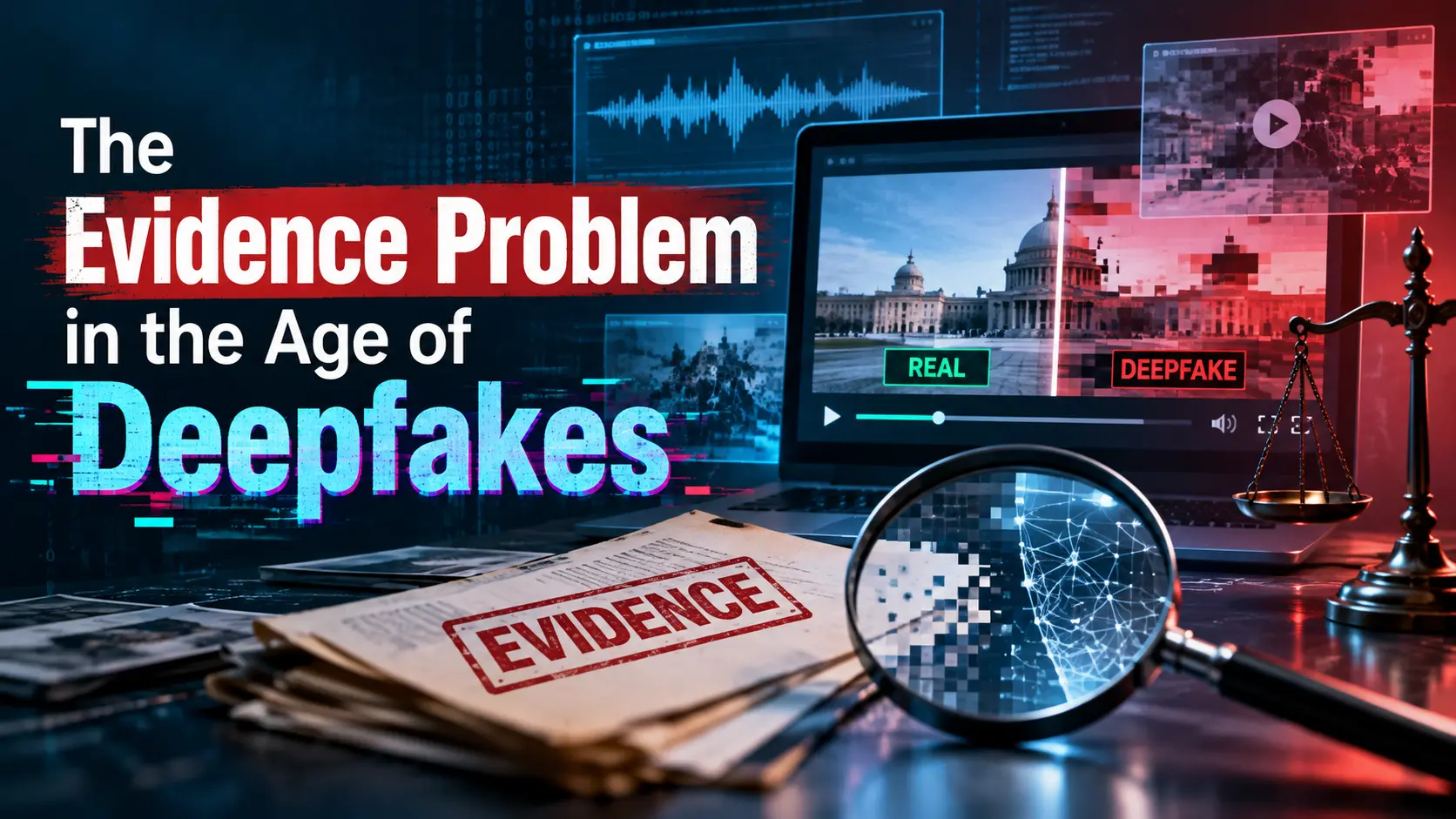
Digital evidence has become part of almost every modern investigation. A photograph can place a person at a location, an audio recording can capture a conversation, and a video can appear to show an event as it happened. For years, the main forensic concern was whether such material had been altered. The rapid growth of generative artificial intelligence has added a harder question: even when a file is preserved exactly as received, can investigators still trust what it appears to show?
Deepfakes have made this question practical rather than theoretical. Synthetic or manipulated audio, video and images can imitate real people and real events with increasing realism. CERT-In describes deepfakes as a high-risk threat because they can support disinformation, fraud, social engineering and reputational harm.[1] NIST research likewise treats AI-generated media as a digital-forensics challenge that requires systematic evaluation of detection technologies.[2]
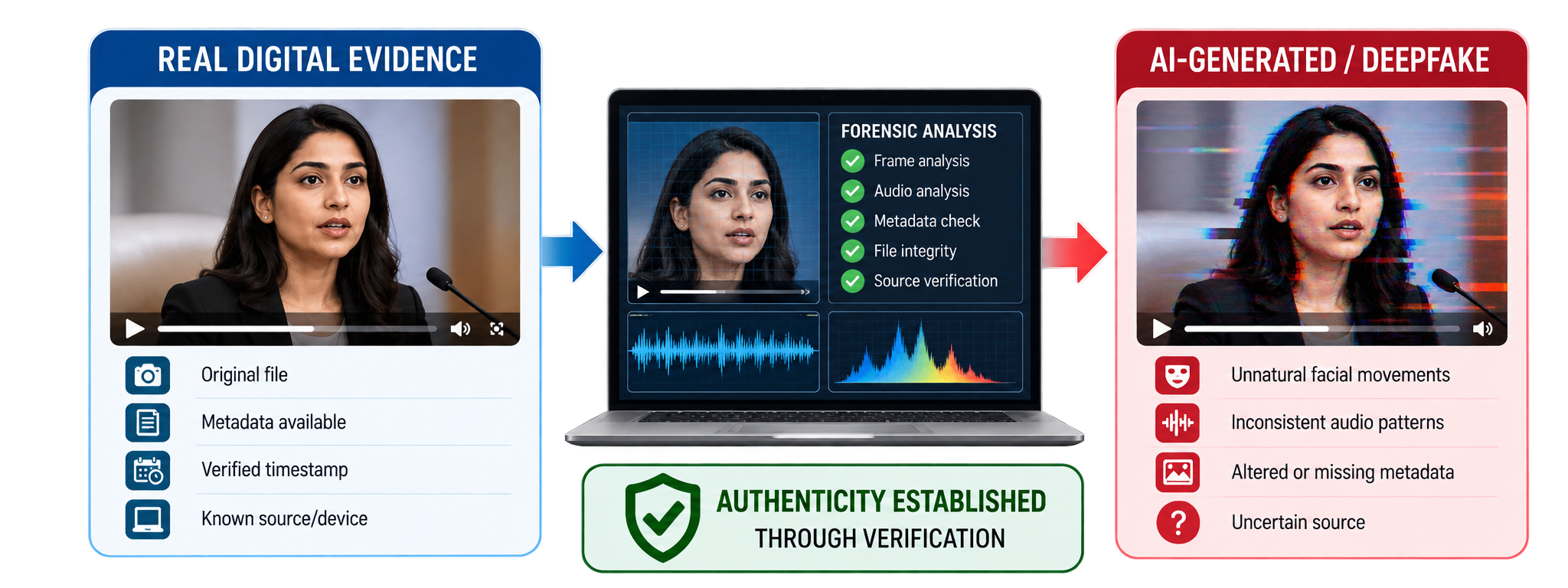
The result is an evidence problem. The answer is not to stop trusting digital evidence, but to become more disciplined about establishing its origin, integrity, context and authenticity.
The evidence problem begins before the laboratory
When a suspicious video reaches an investigator through WhatsApp, Telegram, email or social media, the file may already have passed through several transformations. It may have been compressed, re-encoded, cropped, renamed or stripped of metadata. A screenshot may preserve what is visible but lose the original file structure. A forwarded audio clip may contain no reliable information about where it was first recorded.
For that reason, forensic examination should begin with acquisition and provenance, not with a quick “deepfake detector” result. Investigators should ask: Who supplied the file? Where was it obtained? Is there an original version? What device or account produced it? What happened to the file before it reached the investigator?
Cryptographic hashing remains important because it can demonstrate that an acquired working copy has not changed during examination. But a valid hash does not prove that the underlying event was genuine. A perfectly preserved fake is still a fake.
What a professional examination should look for
A reliable assessment combines several forms of evidence rather than relying on one technical indicator.
Source and acquisition. The original artefact should be preserved whenever possible. Investigators should record the acquisition method, date and time, source account or device, and any known transformations before collection. A documented chain of custody is essential when material may later support a legal, disciplinary or regulatory decision.
Metadata and file structure. Metadata may provide useful clues about creation, encoding, editing software and timestamps. File structure, compression behaviour and related technical characteristics can also reveal inconsistencies. However, these indicators are supporting evidence, not proof on their own, because metadata can be removed or rewritten during normal processing.
Content-level examination. Forensic analysis can include frame-by-frame video review, audio waveform and spectral examination, and inspection for inconsistencies in lighting, reflections, facial movement, lip synchronisation or background elements. Such signs may help guide an investigation, but they are not a permanent checklist. Generative systems continue to improve.
Independent corroboration. This is often the strongest step. If a recording allegedly shows that a person was in a particular place at a particular time, investigators can compare it with CCTV, access-control records, device artefacts, communications, location information, eyewitness accounts or other independent records. The goal is to determine whether the wider evidence supports the event represented by the media.
A real-world lesson: the Pikesville case
The 2024 Pikesville High School incident in Maryland provides a practical example of why authenticity cannot be assumed from appearance alone. An audio recording circulated online that was presented as the principal making racist and antisemitic comments. On January 17, 2024, Baltimore County Public Schools said it could not yet confirm the recording’s veracity and opened an investigation.[3]
Several months later, the school district reported that investigators, with assistance from the FBI and other experts, had verified that the audio had been created using artificial intelligence.[4] Police subsequently arrested the school’s former athletic director in connection with the fabricated recording.[5]
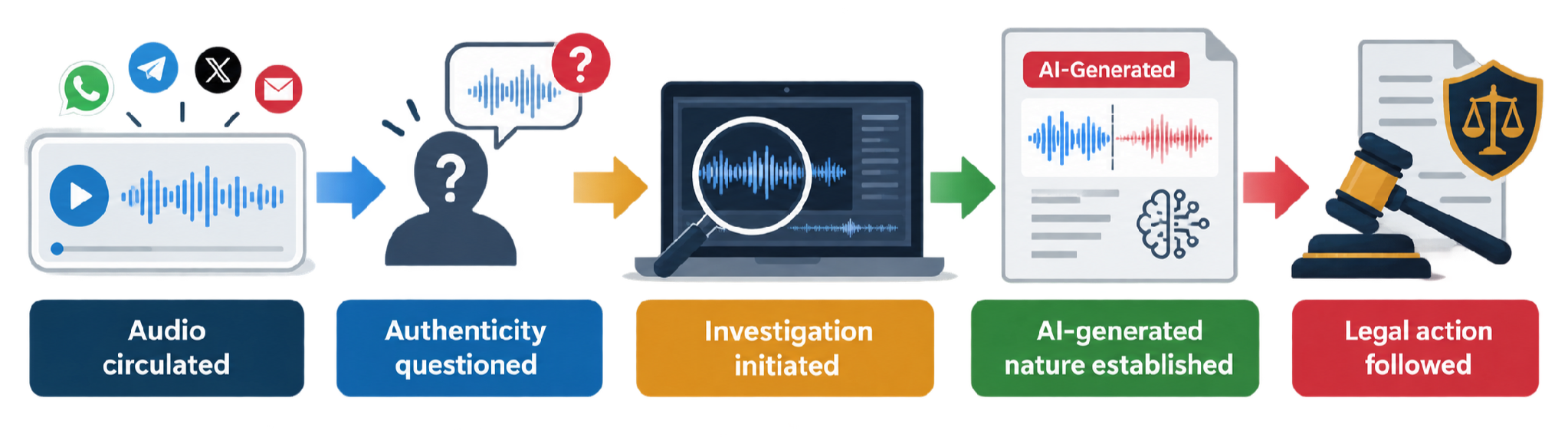
The forensic lesson is larger than the incident itself. The recording had social consequences before its authenticity was established. In a fast-moving online environment, the first version of an event can travel much further than the later correction. Deepfake investigations therefore have to consider not only whether media is authentic, but also how quickly unverified material can influence decisions.
From deepfake detection to content provenance
Detection tools will remain useful, but they should be treated as part of an examination rather than an automatic verdict. NIST’s Guardians of Forensic Evidence work reflects the need to evaluate how analytic systems perform against changing forms of AI-generated media and how well they generalise beyond controlled conditions.[2]
Another important direction is content provenance. The Coalition for Content Provenance and Authenticity (C2PA) has developed a technical framework for recording verifiable information about how digital content was created and changed. Content Credentials can bind provenance information to an asset using cryptographic techniques, allowing later users to inspect a recorded content history when that information is available.[6]
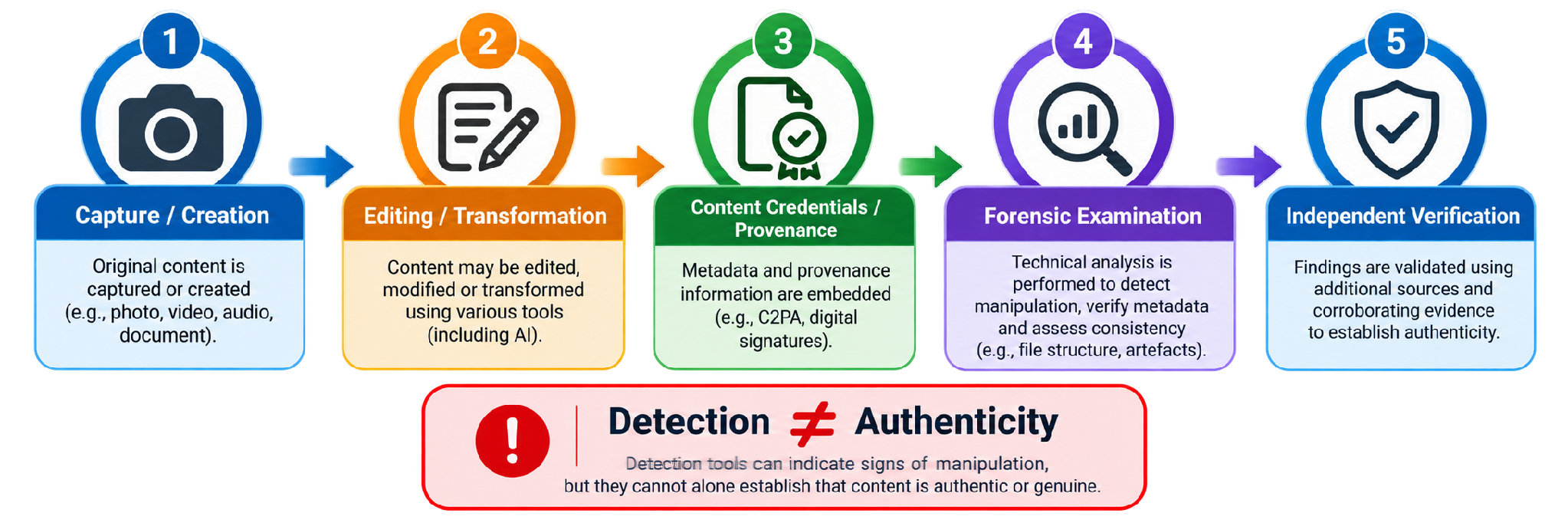
Provenance does not mean that every claim associated with a file is automatically true. It adds context: who created it, what actions were taken and how the asset changed. In a deepfake environment, that context can be as important as the content itself.
Why this matters in India
The issue is especially relevant to India’s fast-growing digital environment. CERT-In’s 2024 advisory identifies misinformation, fraud and reputational damage among the risks associated with synthetic media.[1] In August 2026, the Government of India stated that the regulatory framework addresses AI-generated deepfakes and noted amendments to the IT Rules in February 2026 concerning harms arising from synthetically generated information, including requirements related to labelling and traceable metadata for permissible AI-generated content.[7]
For organisations, deepfake response should therefore not be treated only as a media or public-relations issue. It can become an incident-response and forensic issue. A suspicious executive voice note, a manipulated employee video or a fabricated screen recording may require preservation, technical examination and independent corroboration before any action is taken.
Conclusion
Deepfakes do not make digital evidence useless. Deepfakes make handling of evidence more dangerous. The professional response is not to believe everything or to doubt everything. The professional response is to build a process around evidence: preserve the original where possible document how evidence was acquired, calculate and record hashes, examine metadata and technical characteristics use detection tools while understanding their limitations compare media with independent evidence and examine provenance information where it is available.
Importantly investigators and decision-makers should separate three questions: Is the file intact? Is the content authentic? Does the content actually prove the event being alleged? Deepfakes can pass the test while failing the other two.
In the age of AI evidence will increasingly be judged not only by how convincing it looks but, by how well its origin, integrity, context and history can be demonstrated. That is the standard that can help preserve trust when seeing and hearing're no longer enough.
References
1. CERT-In, “Deepfakes - Threats and Countermeasures,” Advisory CIAD-2024-0060, 27 November 2024. View source
2. NIST, “Guardians of Forensic Evidence: Evaluating Analytic Systems Against AI-Generated Deepfakes,” 27 January 2025. View source
3. Baltimore County Public Schools, “January 17, 2024, Community Update: Message from Superintendent Dr. Myriam Rogers Regarding Pikesville High School.” View source
4. Baltimore County Public Schools, “April 24, 2024 Staff and Community Update: Message from Superintendent Dr. Myriam Rogers Regarding Pikesville High School Investigation.” View source
5. The Baltimore Banner / WYPR, “Ex-athletic director framed principal with AI-generated voice, police say,” 25 April 2024. View source
6. Coalition for Content Provenance and Authenticity (C2PA), “Content Credentials: C2PA Technical Specification,” Version 2.1. View source
7. Government of India, Ministry of Electronics & Information Technology, “Government Strengthens Regulatory Framework to Address AI-Generated Deepfakes,” 6 August 2026. View source

The Illusion of Digital Serenity
In the age of technology, our email accounts have turned into overcrowded spaces, full of newsletters, special offers, and unwanted updates. To most, the presence of an "unsubscribe" link brings a minor feeling of empowerment, a chance to declutter and restore digital serenity. Yet behind this harmless-seeming tool lurks a developing cybersecurity threat. Recent research and expert discussions indicate that the "unsubscribe" button is being used by cybercriminals to carry out phishing campaigns, confirm active email accounts, and distribute malware. This new threat not only undermines individual users but also has wider implications for trust, behaviour, and governance in cyberspace.
Exploiting User Behaviour
The main challenge is the manipulation of user behaviour. Cyber thieves have learned to analyse typical user habits, most notably the instinctive process of unsubscribing from spam mail. Taking advantage of this, they now place criminal codes in emails that pose as real subscription programs. These codes may redirect traffic to fake websites that attempt to steal credentials, force the installation of malicious code, or merely count the click as verification that the recipient's email address is valid. Once confirmed, these addresses tend to be resold on the dark web or included in additional spam lists, further elevating the threat of subsequent attacks.
A Social Engineering Trap
This type of cyber deception is a prime example of social engineering, where the weakest link in the security chain ends up being the human factor. In the same way, misinformation campaigns take advantage of cognitive biases such as confirmation or familiarity, and these unsubscribe traps exploit user convenience and habits. The bait is so simple, and that is exactly what makes it work. Someone attempting to combat spam may unknowingly walk into a sophisticated cyber threat. Unlike phishing messages impersonating banks or government agencies, which tend to elicit suspicion, spoofed unsubscribe links are integrated into regular digital habits, making them more difficult to recognise and resist.
Professional Disguise, Malicious Intent
Technical analysis determines that most of these messages come from suspicious domains or spoofed versions of valid ones, like "@offers-zomato.ru" in place of the authentic "@zomato.com." The appearance of the email looks professional, complete with logos and styling copied from reputable businesses. But behind the HTML styling lies redirection code and obfuscated scripts with a very different agenda. At times, users are redirected to sites that mimic login pages or questionnaire forms, capturing sensitive information under the guise of email preference management.
Beyond the Inbox: Broader Consequences
The consequences of this attack go beyond the individual user. The compromise of a personal email account can be used to carry out more extensive spamming campaigns, engage in botnets, or even execute identity theft. Furthermore, the compromised devices may become entry points for ransomware attacks or espionage campaigns, particularly if the individual works within sensitive sectors such as finance, defence, or healthcare. In this context, what appears to be a personal lapse becomes a national security risk. This is why the issue posed by the weaponised unsubscribe button must be considered not just as a cybersecurity risk but also as a policy and public awareness issue.
Platform Responsibility
Platform responsibility is yet another important aspect. Email service providers such as Gmail, Outlook, and ProtonMail do have native unsubscribe capabilities, under the List-Unsubscribe header mechanism. These tools enable users to remove themselves from valid mailing lists safely without engaging with the original email content. Yet many users do not know about these safer options and instead resort to in-body unsubscribe links that are easier to find but risky. To that extent, email platforms need to do more not only to enhance backend security but also to steer user actions through simple interfaces, safety messages, and digital hygiene alerts.
Education as a Defence
Education plays a central role in mitigation. Just as cyber hygiene campaigns have been launched to teach users not to click on suspicious links or download unknown attachments, similar efforts are needed to highlight the risks associated with casual unsubscribing. Cybersecurity literacy must evolve to match changing threat patterns. Rather than only targeting clearly malicious activity, awareness campaigns should start tackling deceptive tactics that disguise themselves as beneficial, including unsubscribe traps or simulated customer support conversations. Partnerships between public and private institutions might be vital in helping with this by leveraging their resources for mass digital education.
Practical Safeguards for Users
Users are advised to always check the sender's domain before clicking any link, avoid unknown promotional emails, and hover over any link to preview its true destination. Rather than clicking "unsubscribe," users can simply mark such emails as spam or junk so that their email providers can automatically filter similar messages in the future. For enhanced security, embracing mechanisms such as mail client sandboxing, two-factor authentication (2FA) support, and alias email addresses for sign-ups can also help create layered defences.
Policy and Regulatory Implications
Policy implications are also significant. Governments and data protection regulators must study the increasing misuse of misleading unsubscribe hyperlinks under electronic communication and consent laws. In India, the new Digital Personal Data Protection Act, 2023 (DPDPA), provides a legislative framework to counter such deceptive practices, especially under the principles of legitimate processing and purpose limitation. The law requires that the processing of data should be transparent and fair, a requirement that malicious emails obviously breach. Regulatory agencies like CERT-In can also release periodic notifications warning users against such trends as part of their charter to encourage secure digital practices.
The Trust Deficit
The vulnerability also relates to broader issues of trust in digital infrastructure. When widely used tools such as an unsubscribe feature become points of exploitation, user trust in digital platforms erodes. Such a trust deficit can lead to generalised distrust of email systems, digital communication, and even legitimate marketing. Restoring and maintaining such trust demands a unified response that includes technical measures, user education, and regulatory action.
Conclusion: Inbox Hygiene with Caution
The "unsubscribe button trap" is a parable of the modern age. It illustrates how mundane digital interactions, when manipulated, can do great damage not only to individual users but also to the larger ecosystem of online security and trust. As cyber-attacks grow increasingly psychologically advanced and behaviorally focused, our response must similarly become more sophisticated, interdisciplinary, and user-driven. Getting your inbox in order should never involve putting yourself in cyber danger. But as things stand, even that basic task requires caution, context, and clear thinking.
