
#FactCheck: Old Protest Video Misleadingly Shared as Police Action During BRICS Summit
Executive Summary
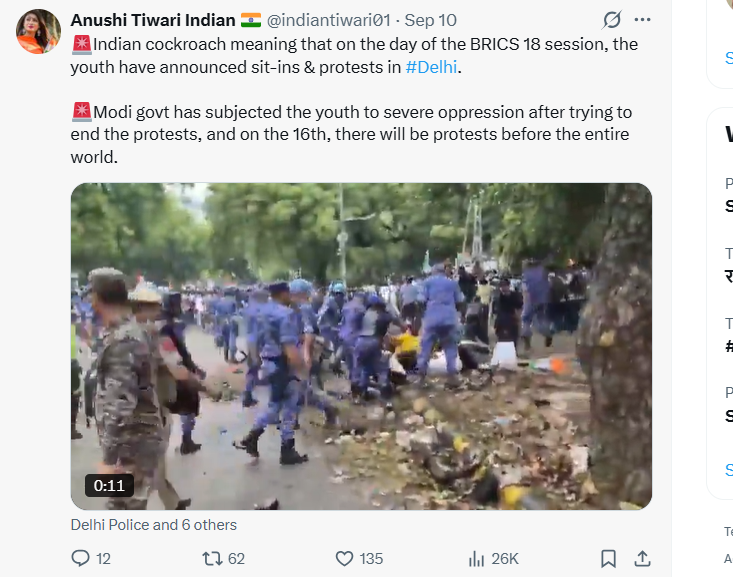
A video is being shared on social media with the claim that youths have announced sit-ins and protests in Delhi during the 18th BRICS Summit. The video is being shared with allegations that the Modi government attempted to suppress the protests and subjected the youth to severe oppression. It also claims that a large-scale protest would be held in Delhi on September 16. The video shows a large gathering of people, with police personnel seen taking action against them.
Research by CyberPeace found that the video is old and has been available online since at least July 20, 2026. According to earlier sources, the video shows police action against CJP protesters who were marching towards Parliament on July 20, 2026. Meanwhile, the 18th BRICS Summit is being held in New Delhi on September 12 and 13, 2026. Therefore, the old video is being misleadingly linked to police action during the BRICS Summit.
Claim:
A video is being shared on social media with the claim that youths have announced sit-ins and protests in Delhi during the 18th BRICS Summit and that the Modi government subjected them to severe oppression while attempting to suppress the protests.
https://x.com/indiantiwari01/status/2098058633825411110?s=20
FactCheck:
To verify the authenticity of the viral claim, we conducted a reverse image search of the keyframes from the video. During the search, we found the same video on the YouTube channel ANKIT'S PEACEFUL MIND, where it was published on July 20, 2026.
https://www.youtube.com/watch?v=uPsm9jueugY
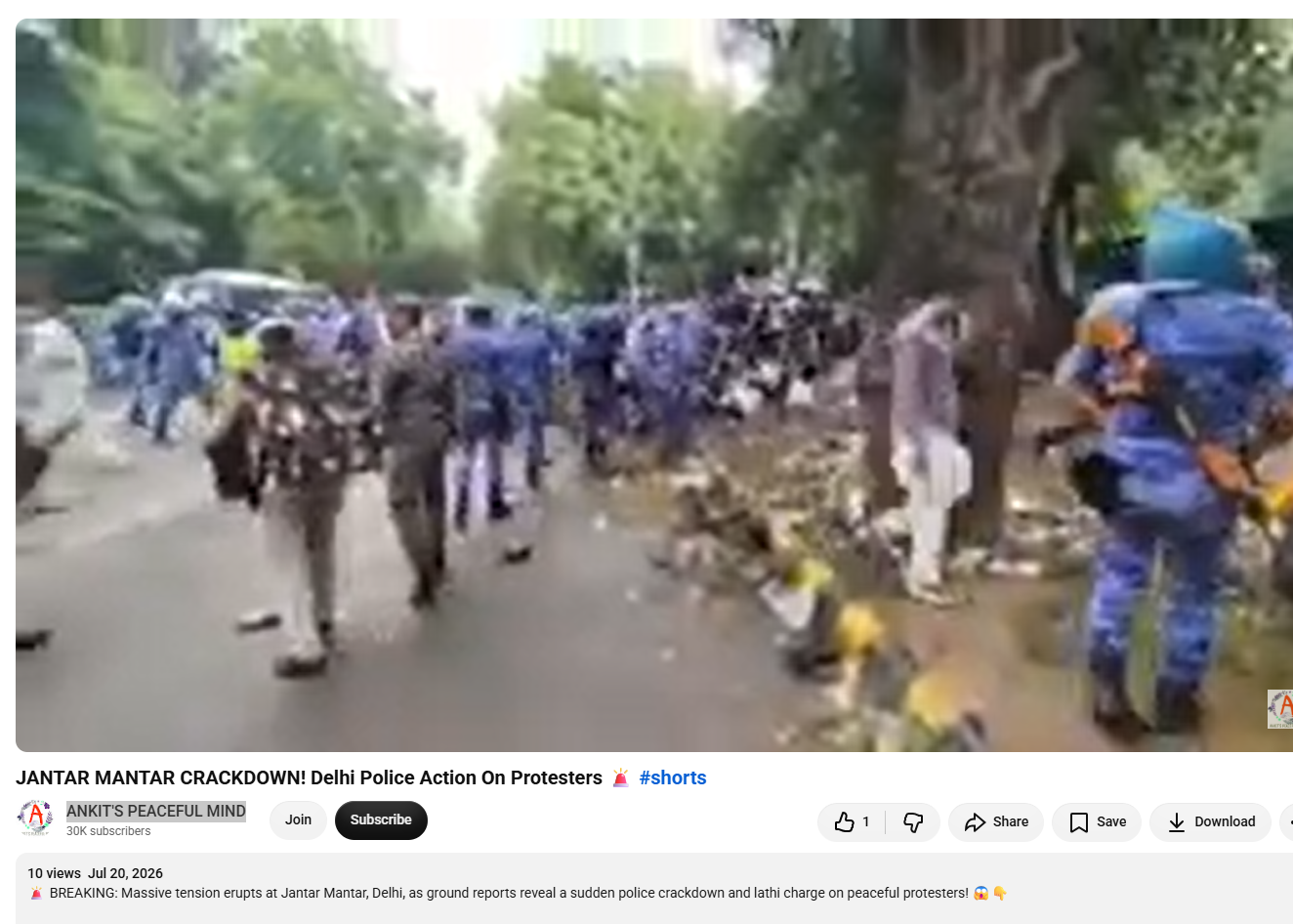
According to the video description, a tense situation unfolded at Jantar Mantar in Delhi, where police took action against people holding a peaceful protest and resorted to a lathi charge. The post claimed that thousands of youths, students and others had gathered in Delhi in support of environmental activist Sonam Wangchuk and the ongoing Ladakh movement. The situation reportedly escalated, leading to clashes between the protesters and the large number of security personnel deployed at the site.
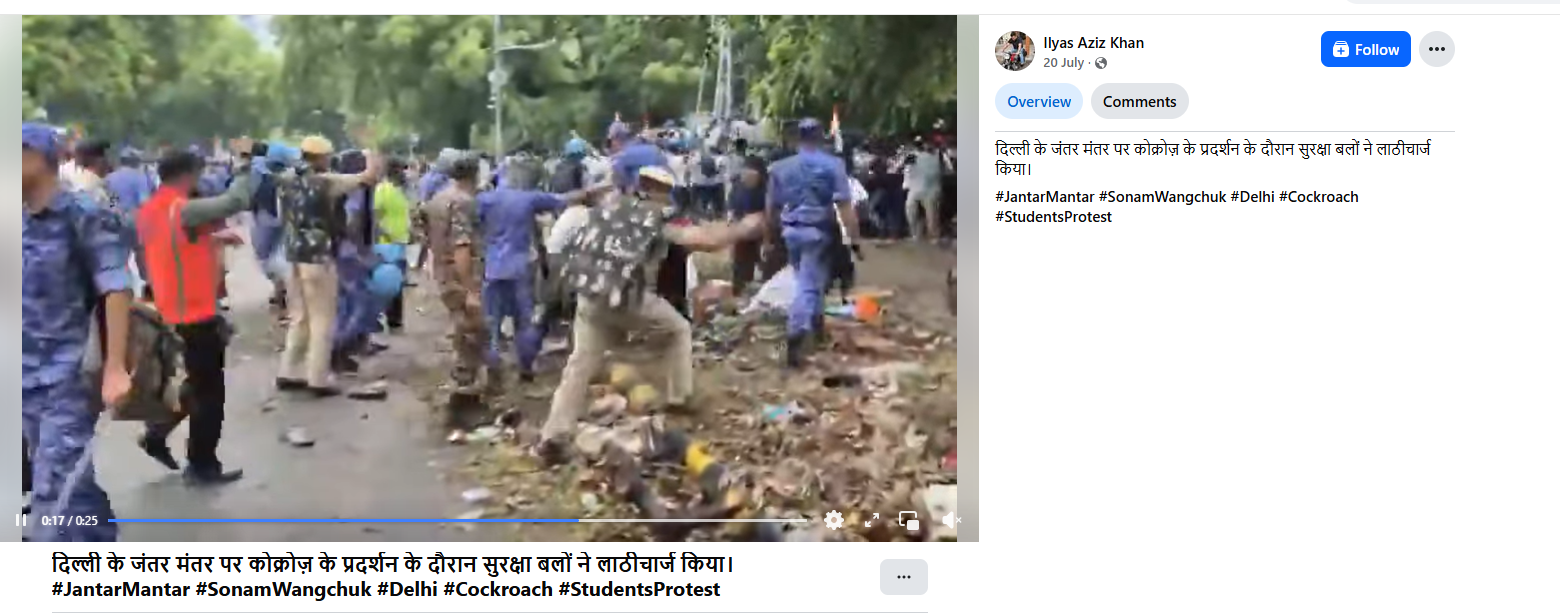
As part of the next step in our research, we found the same video on a Facebook page, where it was published on July 20. The video was also shared with the claim that security forces had resorted to a lathi charge against protesters during a CJP demonstration at Jantar Mantar in Delhi.
https://www.facebook.com/watch/?v=1583508539869113
Conclusion:
Our research found that the video being shared on social media is not related to any incident during the BRICS Summit. The video is old and has been available online since at least July 20, 2026. According to earlier sources, the video shows police action against CJP protesters who were marching towards Parliament on July 20. Meanwhile, the 18th BRICS Summit is being held in New Delhi on September 12 and 13, 2026. Therefore, sharing the old video as footage of police action against protesters during the BRICS Summit is misleading.

Related Blogs

Executive Summary
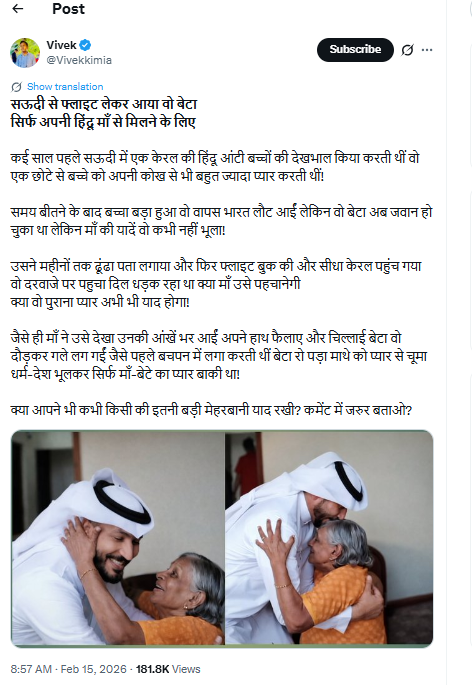
A photo is going viral on social media showing a young man dressed in traditional Arab attire warmly embracing an elderly woman. The post claims that the man flew in from Saudi Arabia to Kerala just to meet his “Hindu mother,” portraying the image as a heartwarming example of communal harmony. However, research by the CyberPeace found that the claim being shared with the image is misleading.
Claim
The viral post narrates an emotional story, alleging that years ago a Hindu woman from Kerala worked in Saudi Arabia caring for children and loved a young boy like her own son. After she returned to India, the boy—now grown up—reportedly searched for her for months, booked a flight, and finally reached Kerala to reunite with her. The post describes an emotional reunion filled with tears, affection, and a bond beyond religion and nationality.
Fact Check
A reverse image search of the viral picture led us to a video uploaded on August 18, 2023, on the YouTube channel of social media influencer Hashim Abbas. In the video, he is seen meeting and hugging the elderly woman while extending Onam greetings.
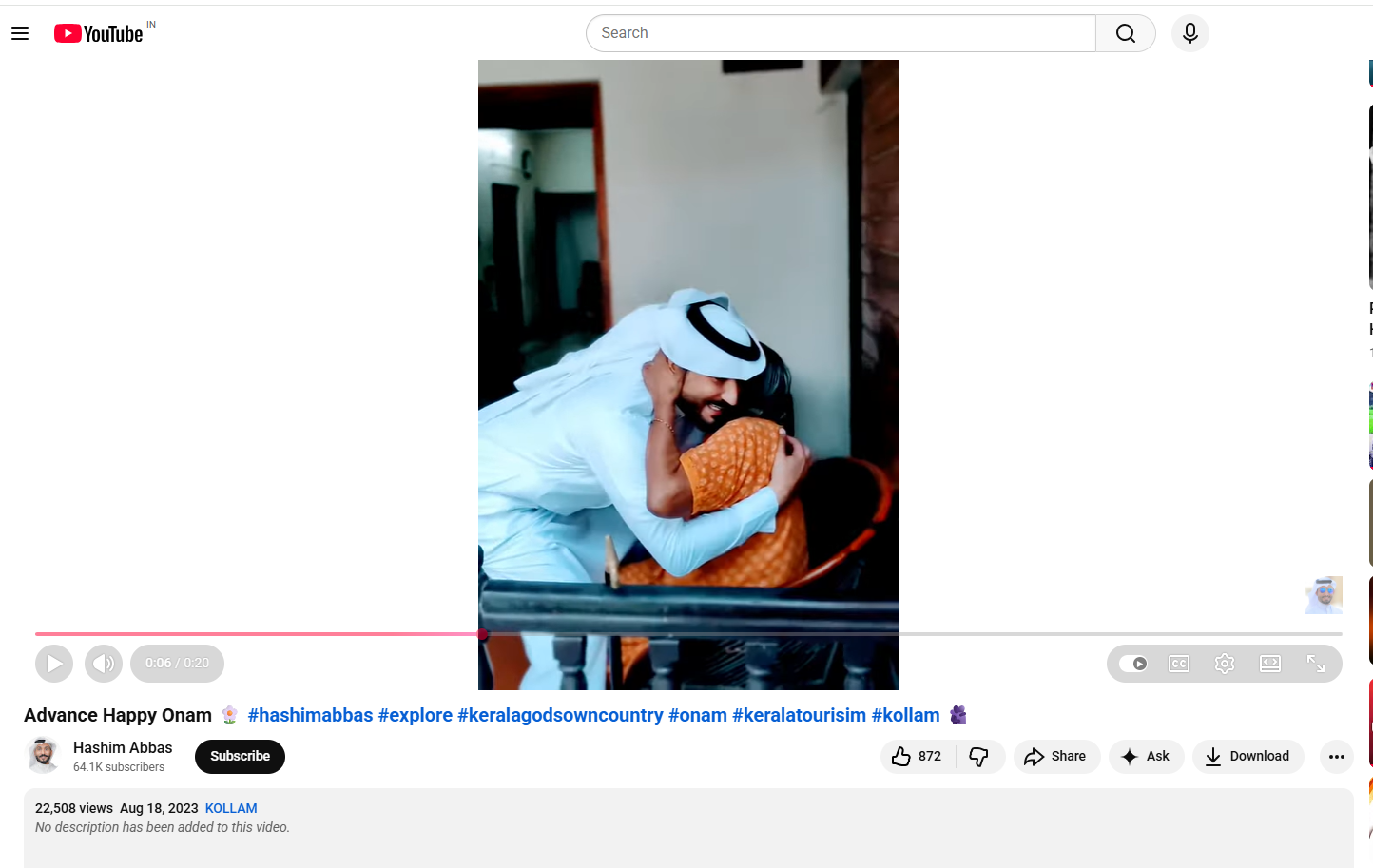
Further examination of Hashim Abbas’ social media accounts revealed several other videos from his Kerala visit. Our research also found that Abbas played a significant role in the Malayalam film Kondotty Pooram.

Additionally, we found a video posted on August 13, 2023, by actress and theatre artist Sandhya Rajendran, daughter of veteran Malayalam actress Vijayakumari. The video shows Vijayakumari teaching Onam songs to Hashim Abbas.

Conclusion
The evidence clearly establishes that the viral claim is misleading. The man seen in the image is Hashim Abbas, who was meeting senior Malayalam actress Vijayakumari to extend Onam greetings. The emotional story about a son flying from Saudi Arabia to reunite with his Hindu mother is fictional and not connected to the viral image.

Introduction
When Tamil Nadu Police arrested a man from Vellore in May 2026 on suspicion of being the point person helping Indian youth to be smuggled into cyber scam compounds in Cambodia, the papers led with the accused. They shouldn't have led with the accused but with the system. The arrest, one in a long string of them in Tamil Nadu, Madurai, and other states, is not simply another one-off policing victory. Rather, the arrest gives us an insight into a larger, darker world: an international criminal organisation that has successfully combined human trafficking and cybercrime, a new trend in criminality that specialists are calling 'cyber slavery.'
What Is Cyber Slavery?
“Cyber slavery” involves trafficking persons under the pretence of employment, forcing them into committing online fraud to serve criminal enterprises. Victims are not merely victims of the work they are forced to do; they are often turned into culprits as they become complicit in victimising others. Trafficked victims are compelled to participate in frauds targeted at unsuspecting victims all around the globe. These activities, organised into robust criminal schemes, involve victims of sex or labour trafficking who are forced into operating romance scams or the so-called "pig butchering" scams that defraud people of their investment in cryptocurrency, all in heavily secured complexes guarded with threats of violence and torture. The extent of the problem is enormous, with the UN Office of the High Commissioner for Human Rights estimating in a 2023 report that there are over 100,000 victims of cyber scam compounds in Cambodia and another 120,000 in Myanmar. Schemes throughout Southeast Asia were projected to commit as much as $39.9 billion in fraudulent schemes a year.
Why Southeast Asia? The Geography of Organised Crime
In order to answer why Cambodia, Myanmar, Laos, and the surrounding regions have developed into the cyber slavery hub of the world, we can draw together an array of structural reasons:
- Casino clampdown and crime diversification: Cambodia's ban on online gambling in 2019 broke down established casino-related criminal networks. This saw old casinos and Special Economic Zones turn into cyber scam compound operations.
- Corruption and state complicity: A pre-existing environment of corruption and involvement of politically linked figures permitted scamming networks to flourish, and the armed groups in the border areas of Myanmar are reportedly complicit in these operations through supplying land and protection for the networks to operate in.
- Poor governance in the border areas: The lack of state control in the frontier areas of Myanmar provided the criminal networks with a secure sanctuary in which they could operate with impunity and cross borders to escape crackdowns and move their operations.
- Post-pandemic growth: The economic stress associated with the COVID-19 pandemic led to an increase in the supply of vulnerable individuals available to fill the scam networks, as well as unprecedented profit margins on scams.
The Recruitment Pipeline: How Are Indian Youth Trapped?
The typical journey from an Indian town or village to a locked compound in Southeast Asia follows the same narrative:
- The bait: On platforms like Facebook, WhatsApp, and Telegram, gangs lure with posts of lucrative overseas employment for IT work, customer service, data entry, and digital marketing with attractive, albeit feasible, pay packages (Rs. 80,000 to Rs. 1.5 lakh per month) and destinations such as Thailand and Singapore added for a veneer of genuineness.
- The recruiters: Local agents who gain trust, arrange visas and flight tickets, and collect the application fees are key intermediaries. Cases registered in Vellore and Madurai hint at recruitment agents receiving a commission for each person successfully smuggled into a trap, linked to larger travel and immigration networks.
- The lie: Victims are assured that they will be working legitimately in Thailand, but on reaching the border and crossing over, they find themselves pushed into scam compounds in neighbouring countries and have their passports, mobile phones and devices confiscated, thus rendering any escape attempt futile.
- The trap: In the interim, fake interviews, false job promises and convincing flight tickets serve to maintain the facade until the victims are forced to participate in cyber-fraud schemes.
The Architecture of Coercion: Life Inside the Scam Compounds
It is in these compounds that the fates of the victims become known. Survivor accounts, investigations and UN human rights reports provide evidence of these circumstances. These compounds are often surrounded by barbed wire fences, monitored with cameras and heavily guarded. Once a potential victim is captured, they are stripped of their passports and any other electronic devices, preventing them from being able to contact the outside world or to escape. Workers are allocated stringent targets, ranging from the number of potential victims they must solicit for scams and the amount of money they must acquire through such scams. Failure to do so, or perceived disobedience, may lead to beatings, electroshock treatment, starvation and long periods in confinement. These beatings are supplemented with psychological torture, with scammers assuring their victims that they owe money for their journey, stay and training. This method of debt bondage keeps people at the compound even when the opportunity for escape is presented to them. The victims are then forced to take part in more complex online scams, which involve romance scams, fake investment scams, and impersonation scams using scripts and with supervision. In some cases, families will be encouraged to pay for their captive relatives' release by ransom, whereas those who refuse to comply or meet performance requirements may be sold and transferred to another compound as a piece of property within a transnational criminal network.
Cybercrime Is No Longer Just About Hacking
This emergency challenges the existing notion of cybercrime. The scam compound of Southeast Asia is not about a lonely hacker or a standalone breach; it is a form of organised cyber slavery in which trafficked individuals are made to commit financial fraud on an industrial level.
The probe of India's NIA found that recruitment is done in the Indian states of Bihar and Uttar Pradesh. Transport agents in Chennai and Madurai provide logistics, and Dubai and Bangkok act as transit points on the way to Cambodia, Laos, and Vietnam. It makes use of cryptocurrency wallets, shadow banking, and shell companies for the movement of funds across international borders. Companies such as the Huione Group has been accused of facilitating billions of dollars in financial transactions for scam infrastructure before receiving sanctions from the U.S.
To illustrate the threat landscape, the U.S. Treasury imposed sanctions on 19 entities spread across Myanmar and Cambodia and said that cyber scam operations looted $10 billion worth last year. Also, cryptocurrency transactions related to trafficking crimes jumped by 85% last year, which speaks to the expanding nature of the global criminal infrastructure.
India's Exposure: A National Vulnerability
The scale of exposure for India is large and expanding. The most likely victims are educated, and aspirational young men and women from Tier 2 and Tier 3 cities, seeking work abroad, which perfectly aligns with the primary target of such human trafficking networks.
Repeated incidents of people from Tamil Nadu falling victim to these networks have come to light. As far back as 2022, the chief minister wrote to the prime minister that close to 300 Indians, roughly 50 Tamils included, were being held in Myanmar. The Madurai-Cambodia case that came to light in 2026 revealed an entire network spanning Cambodia, Laos, and Vietnam, with authorities believing that thousands of Indians might have been trafficked there over the past three years. Such cases from Kerala, Karnataka, Andhra Pradesh, and some northern Indian states have been reported. Last year, India had to charter Air Force flights to rescue over 549 Indians from cyber scam centres along the Myanmar-Thailand border.
The Indian embassy in Phnom Penh assisted the Indian nationals along with the CBI, MEA, and NIA in the rescue of 67 Indians in September 2024; however, these operations are largely reactive in the face of the vast and evolving transboundary crisis.
Prevention
The best solution is awareness. The following are tangible signs that a job offer might be a lead to trafficking:
Red Flags within the job offer:
- Receiving unsolicited recruitment messages on WhatsApp, Telegram or Instagram from unknown numbers/contacts.
- Offer of unbelievably high salaries in undefined roles like ‘data entry,’ ‘online marketing’ or ‘customer service’ outside India.
- Request for upfront money to cover costs of visas, travel, accommodation, and training.
- Job offers to places in Thailand or Singapore involving complex transit routes through other countries.
- An interview process entirely through messaging apps, where the company has no real office address or registration number.
- Urgency and/or confidentiality required.
Verification:
- Check if the recruiter is registered on MEA's e-Migrate portal-this is a portal where MEA lists authorised overseas recruiters.
- Verify the authenticity of the company through its business registration with official registries in the foreign country.
- Contact the Indian Embassy/Consulate in that foreign country if something doesn't add up about the offer.
- Do not hand over your passport to your employer on arrival; it is standard practice for recruiters working as traffickers to confiscate it.
What to do if trapped:
- Contact the closest Indian embassy or consulate immediately.
- Call the MEA overseas helpline: 1800-11-3090.
- Lodge a report on the National Cybercrime Reporting Portal (cybercrime.gov.in).
Policy Imperatives
On their own, individual consciousness cannot undo such a massive criminal infrastructure. India has to enforce the Emigration Act rigorously, implement mandatory licensing of recruitment agents and create a specialised task force consisting of NIA, CBI, MEA and the states’ cybercrime units. Pre-departure orientations should also become mandatory for migrant workers who go to Southeast Asia. Globally, India needs to work more closely with Cambodia, Myanmar, Thailand and Laos via intel sharing protocols, victim repatriations and action against scam compounds. Financial probes must be on par with enforcement investigations to catch up with the perpetrators’ network, the cryptocurrency and hawala channels that facilitate money laundering and finance trafficking operations, as that would severely hit these networks.
Conclusion
This arrest of the recruiter in Vellore is just a small piece of a larger network. What we see in these instances is the marriage of cybercrime, trafficking, and financial fraud into a larger transnational ecosystem that systematically preys on the economic vulnerability of individuals. These young Indians are not simply falling for scams; they are being systematically targeted, recruited, trafficked, and forced into these criminal operations by a networked structure. The scam compounds in Cambodia and along the border of Myanmar and Thailand are only the end of a process that very likely starts with a convincing job offer on social media. Fighting cyber slavery will not be as simple as more arrests; we need education and international efforts, as well as policy responses that match the scope and scale of the problem.
References
- https://the420.in/78415-2vellore-man-cambodia-cyber-slavery-trafficking-case/
- https://the420.in/madhan-vadivel-cambodia-cyber-slavery-trafficking-racket-investigation/
- https://www.newsonair.gov.in/tamil-nadu-police-arrest-key-recruiter-in-cambodia-cyber-slavery-racket/
- https://kashmirdotcom.in/2026/05/16/cambodia-linked-human-trafficking-cyber-slavery-racket-nia-chargesheets-five-including-absconding-kingpin/
- https://www.aljazeera.com/news/2025/7/16/more-than-1000-arrested-in-cambodian-cyber-scam-raids
- https://www.pbs.org/newshour/world/why-southeast-asias-online-scam-industry-is-so-hard-to-shut-down
- https://www.cfr.org/articles/how-myanmar-became-global-center-cyber-scams
- https://www.amlrightsource.com/resources/scam-states-the-cybercrime-corruption-complex-in-southeast-asia-and-the-collapse-of-anti-money-laundering-enforcement
- https://newlinesinstitute.org/global-security-mil-priorities/cybercrimes-human-trafficking-and-cryptocurrency-in-southeast-asias-special-economic-zones/
- https://www.theweek.in/news/india/2026/03/21/lured-by-jobs-sold-into-slavery-indias-crackdown-on-cyber-trafficking-continues.html

Introduction
Digitalisation presents both opportunities and challenges for micro, small, and medium enterprises (MSMEs) in emerging markets. Digital tools can increase business efficiency and reach but also increase exposure to misinformation, fraud, and cyber attacks. Such cyber threats can lead to financial losses, reputational damage, loss of customer trust, and other challenges hindering MSMEs' ability and desire to participate in the digital economy.
The current information dump is a major component of misinformation. Misinformation spreads or emerges from online sources, causing controversy and confusion in various fields including politics, science, medicine, and business. One obvious adverse effect of misinformation is that MSMEs might lose trust in the digital market. Misinformation can even result in the devaluation of a product, sow mistrust among customers, and negatively impact the companies’ revenue. The reach of and speed with which misinformation can spread and ruin companies’ brands, as well as the overall difficulty businesses face in seeking recourse, may discourage MSMEs from fully embracing the digital ecosystem.
MSMEs are essential for innovation, job development, and economic growth. They contribute considerably to the GDP and account for a sizable share of enterprises. They serve as engines of economic resilience in many nations, including India. Hence, a developing economy’s prosperity and sustainability depend on the MSMEs' growth and such digital threats might hinder this process of growth.
There are widespread incidents of misinformation on social media, and these affect brand and product promotion. MSMEs also rely on online platforms for business activities, and threats such as misinformation and other digital risks can result in reputational damage and financial losses. A company's reputation being tarnished due to inaccurate information or a product or service being incorrectly represented are just some examples and these incidents can cause MSMSs to lose clients and revenue.
In the digital era, MSMEs need to be vigilant against false information in order to preserve their brand name, clientele, and financial standing. In the interconnected world of today, these organisations must develop digital literacy and resistance against misinformation in order to succeed in the long run. Information resilience is crucial for protecting and preserving their reputation in the online market.
The Impact of Misinformation on MSMEs
Misinformation can have serious financial repercussions, such as lost sales, higher expenses, legal fees, harm to the company's reputation, diminished consumer trust, bad press, and a long-lasting unfavourable impact on image. A company's products may lose value as a result of rumours, which might affect both sales and client loyalty.
Inaccurate information can also result in operational mistakes, which can interrupt regular corporate operations and cost the enterprise a lot of money. When inaccurate information on a product's safety causes demand to decline and stockpiling problems to rise, supply chain disruptions may occur. Misinformation can also lead to operational and reputational issues, which can cause psychological stress and anxiety at work. The peace of the workplace and general productivity may suffer as a result. For MSMEs, false information has serious repercussions that impact their capacity to operate profitably, retain employees, and maintain a sustainable business. Companies need to make investments in cybersecurity defence, legal costs, and restoring consumer confidence and brand image in order to lessen the effects of false information and ensure smooth operations.
When we refer to the financial implications caused by misinformation spread in the market, be it about the product or the enterprise, the cost is two-fold in all scenarios: there is loss of revenue and then the organisation has to contend with the costs of countering the impact of the misinformation. Stock Price Volatility is one financial consequence for publicly-traded MSMEs, as misinformation can cause stock price fluctuations. Potential investors might be discouraged due to false negative information.
Further, the reputational damage consequences of misinformation on MSMEs is also a serious concern as a loss of their reputation can have long-term damages for a carefully-cultivated brand image.
There are also operational disruptions caused by misinformation: for instance, false product recalls can take place and supplier mistrust or false claims about supplier reliability can disrupt procurement leading to disruptions in the operations of MSMEs.
Misinformation can negatively impact employee morale and productivity due to its physiological effects. This leads to psychological stress and workplace tensions. Staff confidence is also affected due to the misinformation about the brand. Internal operational stability is a core component of any organisation’s success.
Misinformation: Key Risk Areas for MSMEs
- Product and Service Misinformation
For MSMEs, misinformation about products and services poses a serious danger since it undermines their credibility and the confidence clients place in the enterprise and its products or services. Because this misleading material might mix in with everyday activities and newsfeeds, viewers may find it challenging to identify fraudulent content. For example, falsehoods and rumours about a company or its goods may travel quickly through social media, impacting the confidence and attitude of customers. Algorithms that favour sensational material have the potential to magnify disinformation, resulting in the broad distribution of erroneous information that can harm a company's brand.
- False Customer Reviews and Testimonials
False testimonies and evaluations pose a serious risk to MSMEs. These might be abused to damage a company's brand or lead to unfair competition. False testimonials, for instance, might mislead prospective customers about the calibre or quality of a company’s offerings, while phony reviews can cause consumers to mistrust a company's goods or services. These actions frequently form a part of larger plans by rival companies or bad individuals to weaken a company's position in the market.
- Misleading Information about Business Practices
False statements or distortions regarding a company's operations constitute misleading information about business practices. This might involve dishonest marketing, fabrications regarding the efficacy or legitimacy of goods, and inaccurate claims on a company's compliance with laws or moral principles. Such incorrect information can result in a decline in consumer confidence, harm to one's reputation, and even legal issues if consumers or rival businesses act upon it. Even before the truth is confirmed, for example, allegations of wrongdoing or criminal activity pertaining can inflict a great deal of harm, even if they are disproven later.
- Fake News Related to Industry and Market Conditions
By skewing consumer views and company actions, fake news about market and industry circumstances can have a significant effect on MSMEs. For instance, false information about market trends, regulations, or economic situations might make consumers lose faith in particular industries or force corporations to make poor strategic decisions. The rapid dissemination of misinformation on online platforms intensifies its effects on enterprises that significantly depend on digital engagement for their operations.
Factors Contributing to the Vulnerability of MSMEs
- Limited Resources for Verification
MSMEs have a small resource pool. Information verification is typically not a top priority for most. MSMEs usually lack the resources needed to verify the information and given their limited resources, they usually tend to deploy the same towards other, more seemingly-critical functions. They are more susceptible to misleading information because they lack the capacity to do thorough fact-checking or validate the authenticity of digital content. Technology tools, human capital, and financial resources are all in low supply but they are essential requirements for effective verification processes.
- Inadequate Digital Literacy
Digital literacy is required for effective day-to-day operations. Fake reviews, rumours, or fake images commonly used by malicious actors can result in increased scrutiny or backlash against the targeted business. The lack of awareness combined with limited resources usually spells out a pale redressal plan on part of the affected MSME. Due to their low digital literacy in this domain, a large number of MSMEs are more susceptible to false information and other online threats. Inadequate knowledge and abilities to use digital platforms securely and effectively can result in making bad decisions and raising one's vulnerability to fraud, deception, and online scams.
- Lack of Crisis Management Plans
MSMEs frequently function without clear-cut procedures for handling crises. They lack the strategic preparation necessary to deal with the fallout from disinformation and cyberattacks. Proactive crisis management plans usually incorporate procedures for detecting, addressing, and lessening the impact of digital harms, which are frequently absent from MSMEs.
- High Dependence on Social Media and Online Platforms
The marketing strategy for most MSMEs is heavily reliant on social media and online platforms. While the digital-first nature of operations reduces the need for a large capital to set up in the form of stores or outlets, it also gives them a higher need to stay relevant to the trends of the online community and make their products attractive to the customer base. However, MSMEs are depending more and more on social media and other online channels for marketing, customer interaction, and company operations. These platforms are really beneficial, but they also put organisations at a higher risk of false information and online fraud. Heavy reliance on these platforms coupled with the absence of proper security measures and awareness can result in serious interruptions to operations and monetary losses.
CyberPeace Policy Recommendations to Enhance Information Resilience for MSMEs
CyberPeace advocates for establishing stronger legal frameworks to protect MSMEs from misinformation. Governments should establish regulations to build trust in online business activities and mitigate fraud and misinformation risks. Mandatory training programs should be implemented to cover online safety and misinformation awareness for MSME businesses. Enhanced reporting mechanisms should be developed to address digital harm incidents promptly. Governments should establish strict penalties for deliberate inaccurate misinformation spreaders, similar to those for copyright or intellectual property violations. Community-based approaches should be encouraged to help MSMEs navigate digital challenges effectively. Donor communities and development agencies should invest in digital literacy and cybersecurity training for MSMEs, focusing on misinformation mitigation and safe online practices. Platform accountability should be increased, with social media and online platforms playing a more active role in removing content from known scam networks and responding to fraudulent activity reports. There should be investment in comprehensive digital literacy solutions for MSMEs that incorporate cyber hygiene and discernment skills to combat misinformation.
Conclusion
Misinformation poses a serious risk to MSME’s digital resilience, operational effectiveness, and financial stability. MSMEs are susceptible to false information because of limited technical resources, lack of crisis management strategies, and insufficient digital literacy. They are also more vulnerable to false information and online fraud because of their heavy reliance on social media and other online platforms. To address these challenges it is significant to strengthen their cyber hygiene and information resilience. Robust policy and regulatory frameworks are encouraged, promoting and mandating online safety training programmes, and improved reporting procedures, are required to overall enhance the information landscape.
References:
- https://www.dai.com/uploads/digital-downsides.pdf
- https://www.indiacode.nic.in/bitstream/123456789/2013/3/A2006-27.pdf
- https://pib.gov.in/PressReleaseIframePage.aspx?PRID=1946375
- https://dai-global-digital.com/digital-downsides-the-economic-impact-of-misinformation-and-other-digital-harms-on-msmes-in-kenya-india-and-cambodia.html
- https://www.dai.com/uploads/digital-downsides.pdf
