
#FactCheck-Old Video of Dangerous Auto-Rickshaw Stunt on Delhi’s Signature Bridge Falsely Linked to Prayagraj
Executive Summary
A picture is rapidly going viral on social media, showing Indian cricketer Virat Kohli and actor Anushka Sharma having breakfast together. Users are sharing this photo, presenting it as a "candid" (real) moment.
Research by the CyberPeace Research Wing revealed that the photo of Virat Kohli and Anushka Sharma having breakfast is completely fake. This image does not depict a real moment, but has been created using Artificial Intelligence (AI).
Claim
A picture is rapidly going viral on social media, showing Indian cricketer Virat Kohli and actor Anushka Sharma having breakfast together. Users are sharing this photo, presenting it as a "candid" (real) moment.
https://www.facebook.com/reel/951138134598230
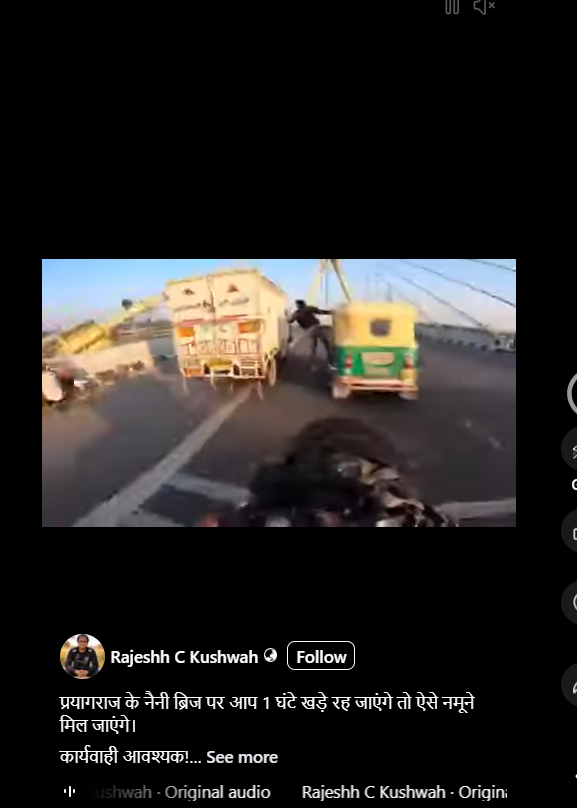
Fact Check
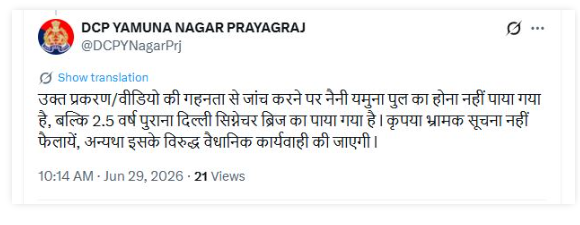
We extracted several keyframes from the viral video and searched them using the Google Lens tool. We found that this video was also quite viral on X (formerly Twitter). Responding to users, the official X handle of DCP Yamuna Nagar, Prayagraj, stated, “Upon a detailed research of the said matter/video, it has been found that it is not from the Naini Yamuna Bridge, but is a 2.5-year-old video from Delhi’s Signature Bridge. Please do not spread misleading information, otherwise legal action will be initiated against it.”
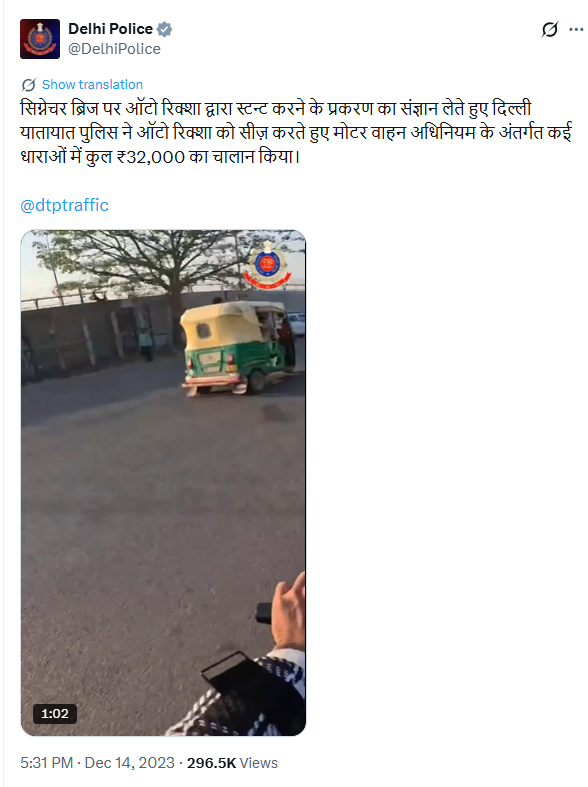
During our search, we found a post on the official X handle of the Delhi Police. Sharing the viral video, they wrote that taking cognizance of the auto-rickshaw stunt incident on the Signature Bridge, the Delhi Traffic Police seized the auto-rickshaw and issued a challan totaling ₹32,000 under various sections of the Motor Vehicles Act.
https://x.com/DelhiPolice/status/1735268792434057352?s=20
Conclusion
In our research, the viral post turned out to be fake. A video of an incident that took place on Delhi's Signature Bridge in 2023 is now being falsely circulated to spread misinformation as an incident from a bridge in Prayagraj. No such incident has taken place on the Naini Bridge in Prayagraj.

Related Blogs
Artificial intelligence is growing at a rapid pace, with startups promising breakthroughs in industries and attracting billions in investment. Among these was Builder.ai, a London-based company founded in 2016 by an Indian entrepreneur. Once valued at over $1.5 billion, it was known for its game-changing platform that could let anyone build custom apps quickly and affordably with the help of AI.
Yet in 2025, Builder.ai collapsed dramatically, filing for bankruptcy across multiple countries and laying off nearly 80% of its workforce. What was once a celebrated unicorn has become a cautionary tale, exposing not only the risks of hype-driven growth in AI but also inflicting reputational damage on Indian founders in the global startup ecosystem.
The Rise: Big Promises, Big Investors
Builder.ai branded itself as a no-code/low-code app development platform, where its AI assistant “Natasha” would guide customers in creating apps without technical expertise. The pitch was simple and attractive: app development was made “as easy as ordering pizza.” The story resonated with major investors. Backed by SoftBank, Microsoft, and Qatar’s sovereign wealth fund, Builder.ai raised more than $450 million. It scaled rapidly, positioning itself as one of Europe’s most promising AI startups.
The Cracks Appear
Behind the glamour, the first cracks appeared as early as 2019, when The Wall Street Journal reported that Builder.ai’s platform depended far more on human engineers than on the AI automation it advertised. In reality, the much-hyped AI assistant “Natasha” was often just “a guy instead”, i.e., skilled developers in India manually writing code behind the scenes on whose backs the company expanded aggressively.
The real blow came from Builder.ai’s finances. The company was accused of inflating revenue figures by 300%, with alleged use of round-tripping tactics involving fake invoices that inflated financials. While it publicly projected revenues of $220 million in 2024, its actual figure was closer to $55 million. When this reality surfaced, investor confidence was lost quickly, and the company’s liabilities ballooned to nearly $100 million, with less than $ 10 million in assets remaining.
Collapse and Legal Scrutiny
By 2025, the company’s foundations had crumbled. The founder stepped down as CEO but retained the unusual title of “Chief Wizard.” Massive debts to AWS, Microsoft, and other partners mounted into the hundreds of millions. Assets were seized, and the company filed for bankruptcy in the U.S., UK, India, and the UAE.
For clients, the collapse meant abandoned projects. For employees, around 1,000 of them, it meant sudden unemployment. And for investors, it was a devastating loss. The Securities and Exchange Commission and U.S. Attorney’s Office in New York have since launched investigations into potential fraud and investor misrepresentation.
Reputational Damage: Impact on Indian Founders
Perhaps the most enduring consequence of Builder.ai’s downfall is the hit to the credibility of Indian founders on the global stage.
For years, Indian entrepreneurs have earned trust in global tech circles, with leaders heading companies from Google to Microsoft. Indian-led startups abroad were viewed as reliable, innovative, and growth-driven. Builder.ai’s collapse disrupts this narrative.
The allegations of inflated revenue, AI exaggeration, and questionable governance risk reinforcing skepticism among global investors regarding Indian organisational ethics. For other Indian founders seeking international capital, the road has now become tougher: stricter due diligence, harsher scrutiny of claims, and slower trust-building.
This reputational damage arrives at a critical time when India is positioning itself as a global hub for AI and leads the world in AI skill penetration. Rather than highlighting the strength of India’s entrepreneurial and talent ecosystem, the fall of Builder.ai has drawn attention to the risks of overpromising and underdelivering.
Conclusion
The fall of Builder.ai is more than the bankruptcy of one AI unicorn. It is a warning to companies against chasing hyper growth fueled by the riding of the AI wave. While the company’s downfall exposed flaws in governance and accountability, its deeper impact lies in how it dented trust. To drive AI and technology innovation, startups must move beyond flashy valuations and commit to authentic innovation, transparency, and financial integrity.
References
- https://www.moodys.com/web/en/us/insights/lending/moodys-early-warning-in-action-builder-ai.html#:~:text=Despite%20marketing%20itself%20as%20an,fake%20invoices%20that%20inflated%20financials.
- https://today-innovation.webflow.io/unveiling-the-power-of-natasha-an-ai-assistant-of-builder-ai-to-revolutionize-app-generation
- https://finance.yahoo.com/news/builder-ais-shocking-450m-fall-170009323.html
- https://www.pib.gov.in/PressReleasePage.aspx?PRID=2108810
- https://www.cnbctv18.com/technology/how-a-london-based-startups-artificial-ai-gambit-backfired-ws-l-19613692.htm#
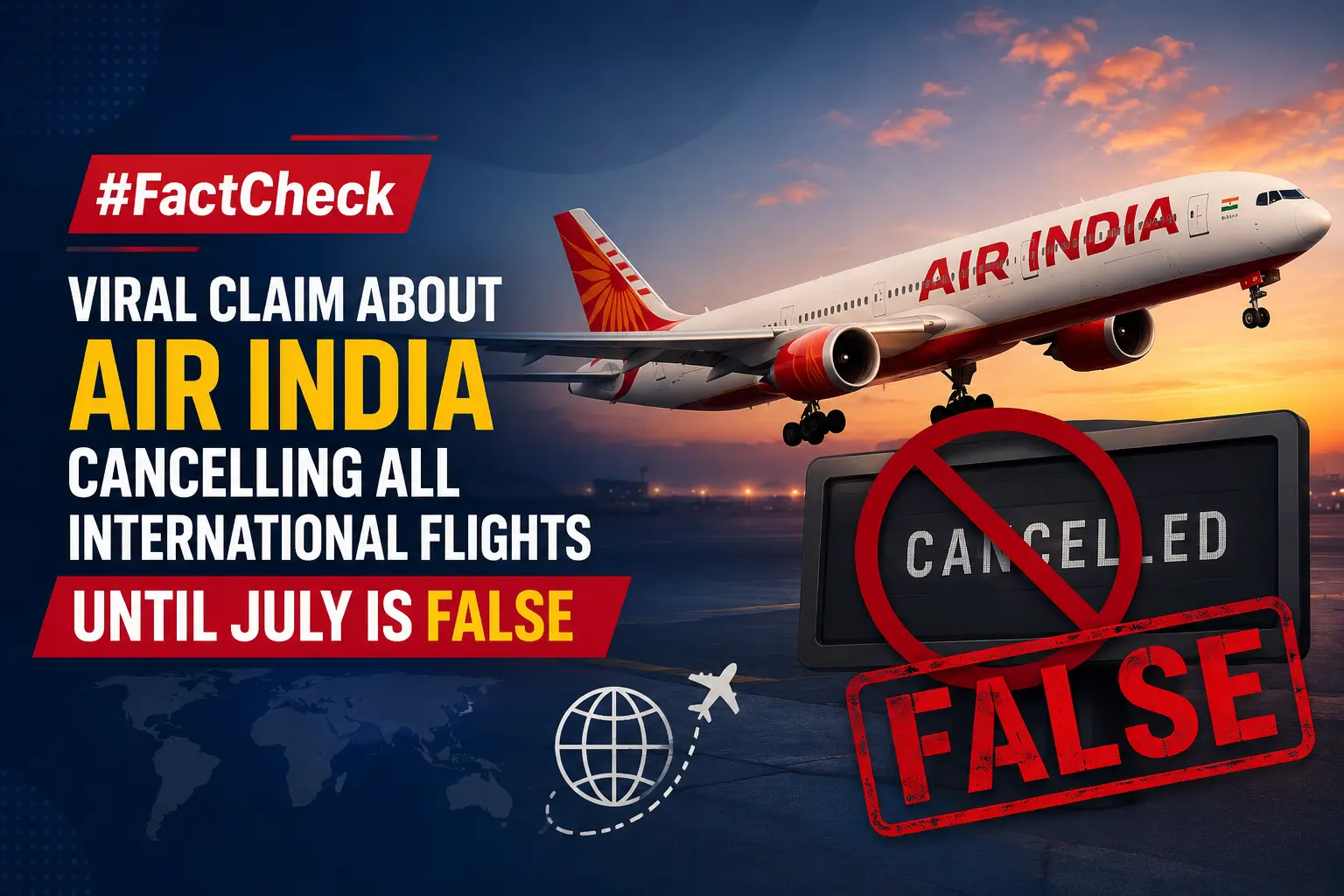
Executive Summary
A video circulating on social media falsely claims that Air India has cancelled all of its international flights until July due to a fuel shortage. However, research conducted by CyberPeace Research Wing found the claim to be misleading and false. Our research revealed that Air India has made no announcement regarding the cancellation of all international flights. In reality, the airline has only made temporary reductions and adjustments on select international routes due to increasing operational pressure and the impact on profitability.
Claim
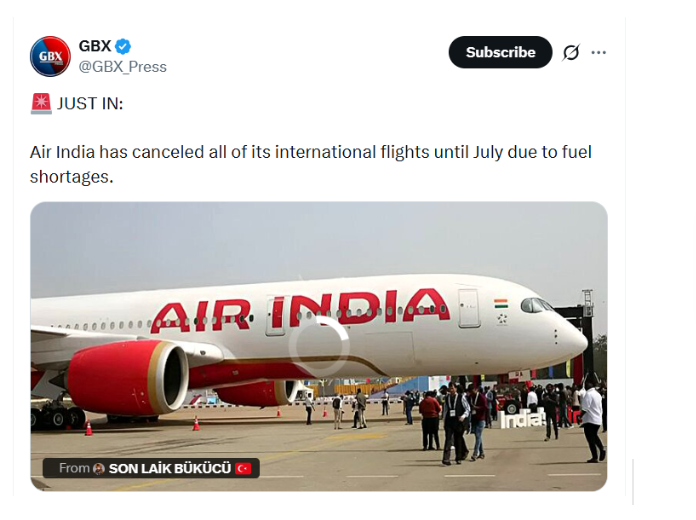
An X (formerly Twitter) user shared the viral video on May 3, 2026, claiming: “Due to a fuel shortage, Air India has cancelled all its international flights until July.”he post quickly gained attention and was widely shared on social media platforms.
Fact Check
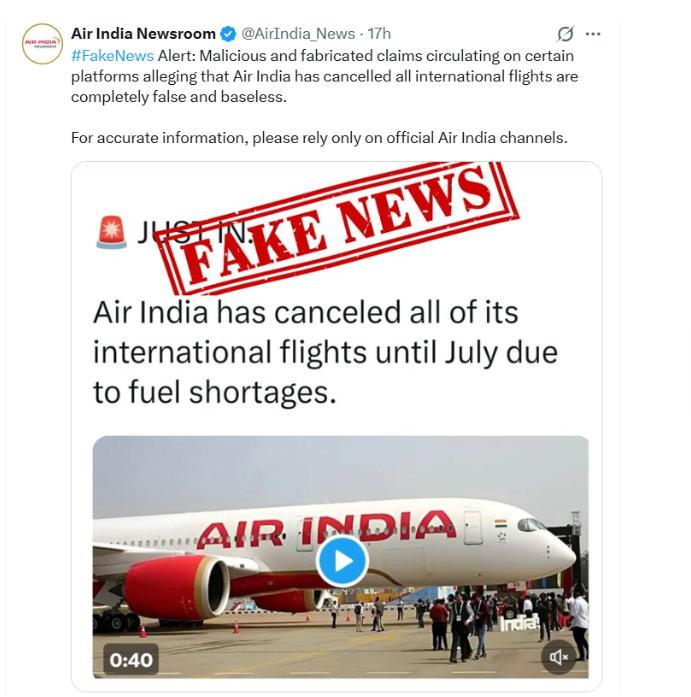
To verify the claim, we examined the official social media accounts of Air India. During the research, we found a post on X in which the airline itself described the viral claim as fake and misleading.
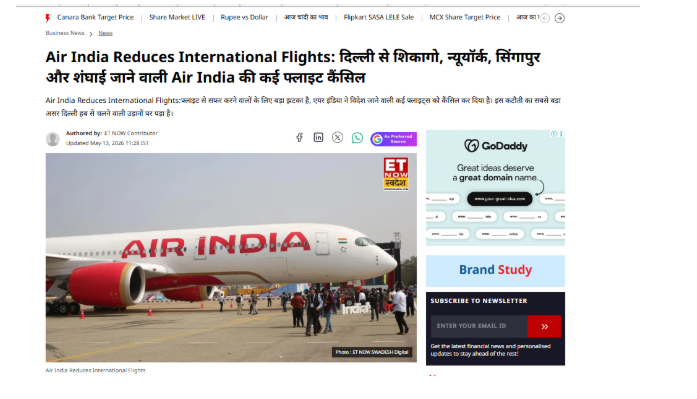
Taking the research further, we searched using relevant keywords and found a report published by ETNOW Swadesh on May 13, 2026. According to the report, Air India has not cancelled all international flights. Instead, due to mounting operational costs and pressure on profitability, the airline has temporarily reduced or modified services on a few select international routes.
Conclusion
Our research found that Air India has not announced the cancellation of all international flights until July. The viral claim circulating on social media is false and misleading. The airline has only implemented temporary adjustments and reductions on certain international routes, not a complete suspension of global operations.

In 2023, PIB reported that up to 22% of young women in India are affected by Polycystic Ovarian Syndrome (PCOS). However, access to reliable information regarding the condition and its treatment remains a challenge. A study by the PGIMER Chandigarh conducted in 2021 revealed that approximately 37% of affected women rely on the internet as their primary source of information for PCOS. However, it can be difficult to distinguish credible medical advice from misleading or inaccurate information online since the internet and social media are rife with misinformation. The uptake of misinformation can significantly delay the diagnosis and treatment of medical conditions, jeopardizing health outcomes for all.
The PCOS Misinformation Ecosystem Online
PCOS is one of the most common disorders diagnosed in the female endocrine system, characterized by the swelling of ovaries and the formation of small cysts on their outer edges. This may lead to irregular menstruation, weight gain, hirsutism, possible infertility, poor mental health, and other symptoms. However, there is limited research on its causes, leaving most medical practitioners in India ill-equipped to manage the issue effectively and pushing women to seek alternate remedies from various sources.
This creates space for the proliferation of rumours, unverified cures and superstitions, on social media, For example, content on YouTube, Facebook, and Instagram may promote “miracle cures” like detox teas or restrictive diets, or viral myths claiming PCOS can be “cured” through extreme weight loss or herbal remedies. Such misinformation not only creates false hope for women but also delays treatment, or may worsen symptoms.
How Tech Platforms Amplify Misinformation
- Engagement vs. Accuracy: Social media algorithms are designed to reward viral content, even if it’s misleading or incendiary since it generates advertisement revenue. Further, non-medical health influencers often dominate health conversations online and offer advice with promises of curing the condition.
- Lack of Verification: Although platforms like YouTube try to provide verified health-related videos through content shelves, and label unverified content, the sheer volume of content online means that a significant chunk of content escapes the net of content moderation.
- Cultural Context: In India, discussions around women’s health, especially reproductive health, are stigmatized, making social media the go-to source for private, albeit unreliable, information.
Way Forward
a. Regulating Health Content on Tech Platforms: Social media is a significant source of health information to millions who may otherwise lack access to affordable healthcare. Rather than rolling back content moderation practices as seen recently, platforms must dedicate more resources to identify and debunk misinformation, particularly health misinformation.
b. Public Awareness Campaigns: Governments and NGOs should run nationwide campaigns in digital literacy to educate on women’s health issues in vernacular languages and utilize online platforms for culturally sensitive messaging to reach rural and semi-urban populations. This is vital for countering the stigma and lack of awareness which enables misinformation to proliferate.
c. Empowering Healthcare Communication: Several studies suggest a widespread dissatisfaction among women in many parts of the world regarding the information and care they receive for PCOS. This is what drives them to social media for answers. Training PCOS specialists and healthcare workers to provide accurate details and counter misinformation during patient consultations can improve the communication gaps between healthcare professionals and patients.
d. Strengthening the Research for PCOS: The allocation of funding for research in PCOS is vital, especially in the face of its growing prevalence amongst Indian women. Academic and healthcare institutions must collaborate to produce culturally relevant, evidence-based interventions for PCOS. Information regarding this must be made available online since the internet is most often a primary source of information. An improvement in the research will inform improved communication, which will help reduce the trust deficit between women and healthcare professionals when it comes to women’s health concerns.
Conclusion
In India, the PCOS misinformation ecosystem is shaped by a mix of local and global factors such as health communication failures, cultural stigma, and tech platform design prioritizing engagement over accuracy. With millions of women turning to the internet for guidance regarding their conditions, they are increasingly vulnerable to unverified claims and pseudoscientific remedies which can lead to delayed diagnoses, ineffective treatments, and worsened health outcomes. The rising number of PCOS cases in the country warrants the bridging of health research and communications gaps so that women can be empowered with accurate, actionable information to make the best decisions regarding their health and well-being.
Sources
- https://pib.gov.in/PressReleasePage.aspx?PRID=1893279#:~:text=It%20is%20the%20most%20prevailing%20female%20endocrine,neuroendocrine%20system%2C%20sedentary%20lifestyle%2C%20diet%2C%20and%20obesity.
- https://www.thinkglobalhealth.org/article/india-unprepared-pcos-crisis?utm_source=chatgpt.com
- https://www.bbc.com/news/articles/ckgz2p0999yo
- https://pmc.ncbi.nlm.nih.gov/articles/PMC9092874/
