
#FactCheck: Old Farmers' Protest Video Falsely Shared as Delhi Police Firing on Sikh Protesters Demanding Kartarpur Corridor Reopening
Executive Summary
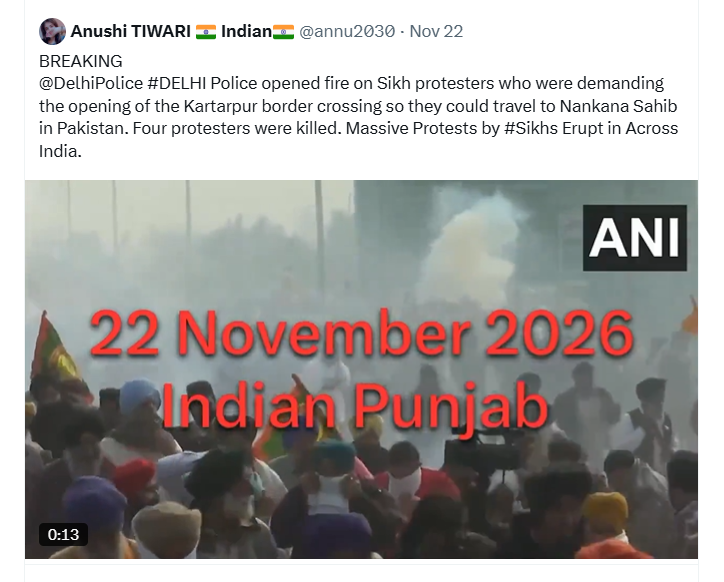
A social media post is being widely shared, claiming that Delhi Police opened fire on Sikh protesters demanding the reopening of the Kartarpur Corridor, killing four people. The post further claims that members of the Sikh community have launched protests across the country in response to the incident. CyberPeace Research found the claims made in the social media post to be misleading and false. In reality, the viral video dates back to the farmers' protest at the Shambhu border between Punjab and Haryana in February 2024. It shows police firing tear gas shells to disperse protesting farmers. Delhi Police has also clarified that no such firing incident took place in the national capital. Furthermore, no credible information has emerged confirming the alleged deaths of four people or large-scale protests across the country in response to the purported incident.
Claim:
It is being claimed that Delhi Police opened fire on Sikh protesters demanding the reopening of the Kartarpur Corridor. The protesters were reportedly demanding the reopening of the corridor to visit Nankana Sahib in Pakistan. The post claims that four protesters were killed in the police firing. It further alleges that members of the Sikh community have launched large-scale protests across the country in response to the incident.
https://x.com/i/birdwatch/t/2124399465092297030?source=6
Fact Check
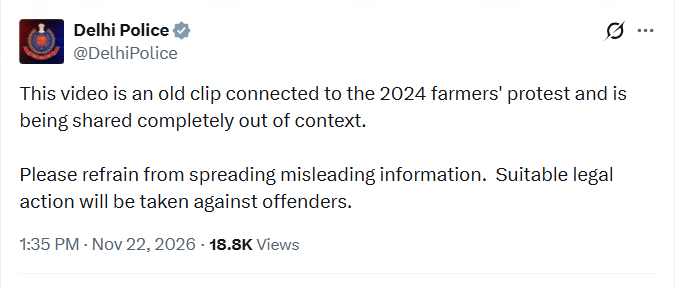
To verify the authenticity of the viral claim, we conducted a Google search using relevant keywords. During the search, we came across a post shared by Delhi Police on X. In the post, the police clarified that the viral video is an old video from the 2024 farmers' protest and is being shared with a false context.Delhi Police also urged people to refrain from spreading misleading information and warned that appropriate legal action would be taken against those responsible.
https://x.com/DelhiPolice/status/2124413976310419881?a=H5CS8WMlfLUElTjOpqY&s=20
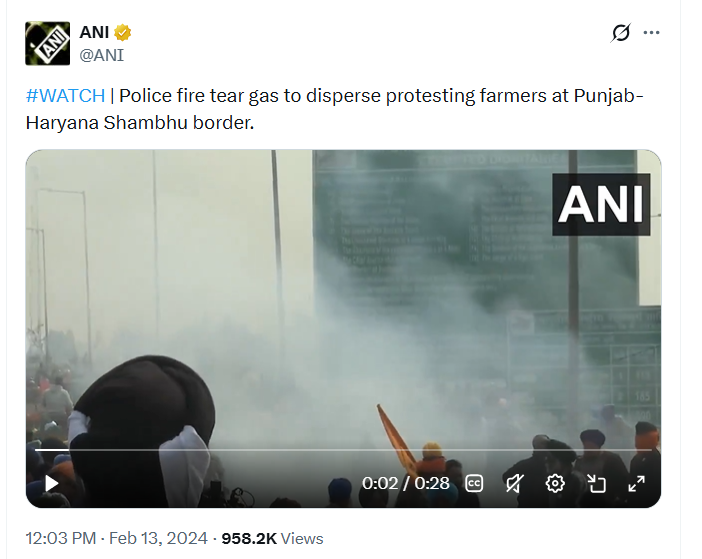
In the next step of our research, we conducted a reverse image search of the keyframes from the viral video. During the search, we found the same video on ANI's official X handle, where it was posted in February 2024. According to the post, police had fired tear gas shells to disperse protesting farmers at the Shambhu border between Punjab and Haryana.
https://x.com/ANI/status/1757291923696476601?a=61ZEIoI52KtvBu5I64c&s=20
Conclusion
Our research found the claims made in the social media post to be misleading and false. The viral video is actually from the farmers' protest at the Shambhu border between Punjab and Haryana in February 2024. It shows police firing tear gas shells to disperse protesting farmers. The video has no connection to the alleged Delhi Police firing on Sikh protesters demanding the reopening of the Kartarpur Corridor.

Related Blogs

Executive Summary:
A viral image circulating on social media claims to show a Hindu Sadhvi marrying a Muslim man; however, this claim is false. A thorough investigation by the Cyberpeace Research team found that the image has been digitally manipulated. The original photo, which was posted by Balmukund Acharya, a BJP MLA from Jaipur, on his official Facebook account in December 2023, he was posing with a Muslim man in his election office. The man wearing the Muslim skullcap is featured in several other photos on Acharya's Instagram account, where he expressed gratitude for the support from the Muslim community. Thus, the claimed image of a marriage between a Hindu Sadhvi and a Muslim man is digitally altered.

Claims:
An image circulating on social media claims to show a Hindu Sadhvi marrying a Muslim man.


Fact Check:
Upon receiving the posts, we reverse searched the image to find any credible sources. We found a photo posted by Balmukund Acharya Hathoj Dham on his facebook page on 6 December 2023.

This photo is digitally altered and posted on social media to mislead. We also found several different photos with the skullcap man where he was featured.

We also checked for any AI fabrication in the viral image. We checked using a detection tool named, “content@scale” AI Image detection. This tool found the image to be 95% AI Manipulated.

We also checked with another detection tool for further validation named, “isitai” image detection tool. It found the image to be 38.50% of AI content, which concludes to the fact that the image is manipulated and doesn’t support the claim made. Hence, the viral image is fake and misleading.

Conclusion:
The lack of credible source and the detection of AI manipulation in the image explains that the viral image claiming to show a Hindu Sadhvi marrying a Muslim man is false. It has been digitally altered. The original image features BJP MLA Balmukund Acharya posing with a Muslim man, and there is no evidence of the claimed marriage.
- Claim: An image circulating on social media claims to show a Hindu Sadhvi marrying a Muslim man.
- Claimed on: X (Formerly known as Twitter)
- Fact Check: Fake & Misleading
Introduction
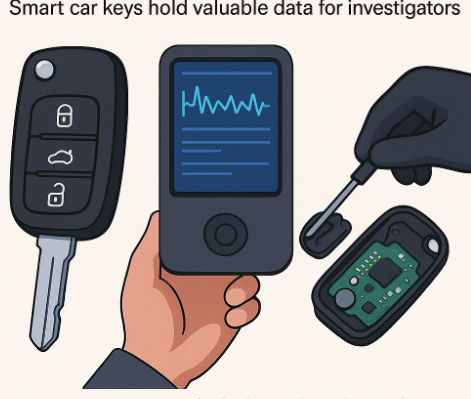
With the modernization of automobiles, so have the methods employed by criminals who seek to commit thefts. The old method of smashing a car window or bypassing an engine lock is no longer prevalent. Modern car thieves employ cloning techniques for keys and digital signals, and sophisticated methods to commit crimes without any traces left behind. In an era where intelligence is crucial, the forensic examination of car keys has become an indispensable tool for investigations, providing clues buried within ordinary car keys.
The Need for Car Key Forensics Today
Daily, thousands of cars worth millions are being hacked or stolen around the globe. The shocking thing is that most of these hacks do not have any sign of breakage or forced entry. It is because the thieves use vulnerabilities in the wireless key systems to unlock the vehicles without leaving any trace behind. Therefore, car-key forensics has now become more important than ever before.
Forensic Value of Smart Key
The smart key is not just comprised of locking and unlocking features for vehicles. Actually, it operates as a miniature computer within the key itself. Information such as pairing records, frequency of use, or the last instance that the key was used to unlock something could be contained in smart keys, thus offering evidence of any criminal activity conducted using these items.
Patterns of Vehicle Theft
Through the examination of the chip in a key, one will be able to establish whether the key was legally programmed or had been tampered with by some other means. Such forensics become more important when trying to detect and monitor any car theft rings, which employ cloning machines or software.
Confirming Ownership and Authenticity
In cases involving insurance claims or fraud, smart key data can help confirm whether the person making a claim actually owned or used the car during the incident. It’s digital proof that goes beyond what paperwork or statements can show.
Strengthening Legal Cases
When brought to court, data doesn’t lie. A properly handled forensic examination of a car key can provide hard evidence — the kind that holds up under questioning and supports or disproves claims with complete accuracy. In many cases, this small device becomes the most reliable witness in the investigation.
A Real-Life Example
Consider the following scenario: An expensive SUV is stolen from a parking lot secured with security surveillance. No one is captured on camera and there is no sign of forced entry. After days of investigation, the police end up arresting a suspect with a smart key.
During forensic analysis of the smart key, it is revealed that:
- The transponder has an ID number which can be matched against the immobilizer installed in the vehicle.
- The rolling code counter has been incremented in such a way that the date corresponds with the report of theft of the vehicle.
- The extracted information helps match the pair timestamp of the key with the particular make and model of the vehicle.
All this from a single piece of evidence – the smart key.
Inside a Smart Key: Where the Data Lives
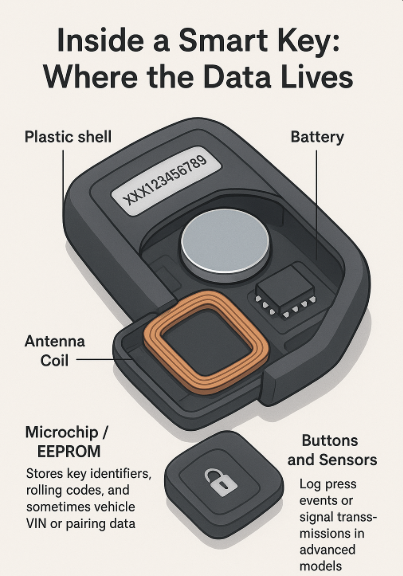
An average smart key is not only a remote but also a multi-level set of data carriers:
- Plastic Shell– could include serial numbers and information on the manufacture.
- Battery – helps calculate the time of using the key or detect any modifications.
- Antenna Coil – sends encrypted information to the immobilizer of a car. Draw the picture of this element.
- Microchip / EEPROM – holds key identification code, rolling code, VIN number, and/or other information of the vehicle.
- Buttons / sensors – could record any pressing or transmission actions in some cases.
All the little devices above, once properly studied via forensics software, provide valuable information.
How the Investigator Uncovers the Truth
In relation to investigating the true story about a vehicle, it is no different than handling other forms of digital evidence, as forensic analysts treat the car key in the same way. It is nothing more than an encrypted device in your hands, and using special techniques, they are able to reveal the information contained within the device.
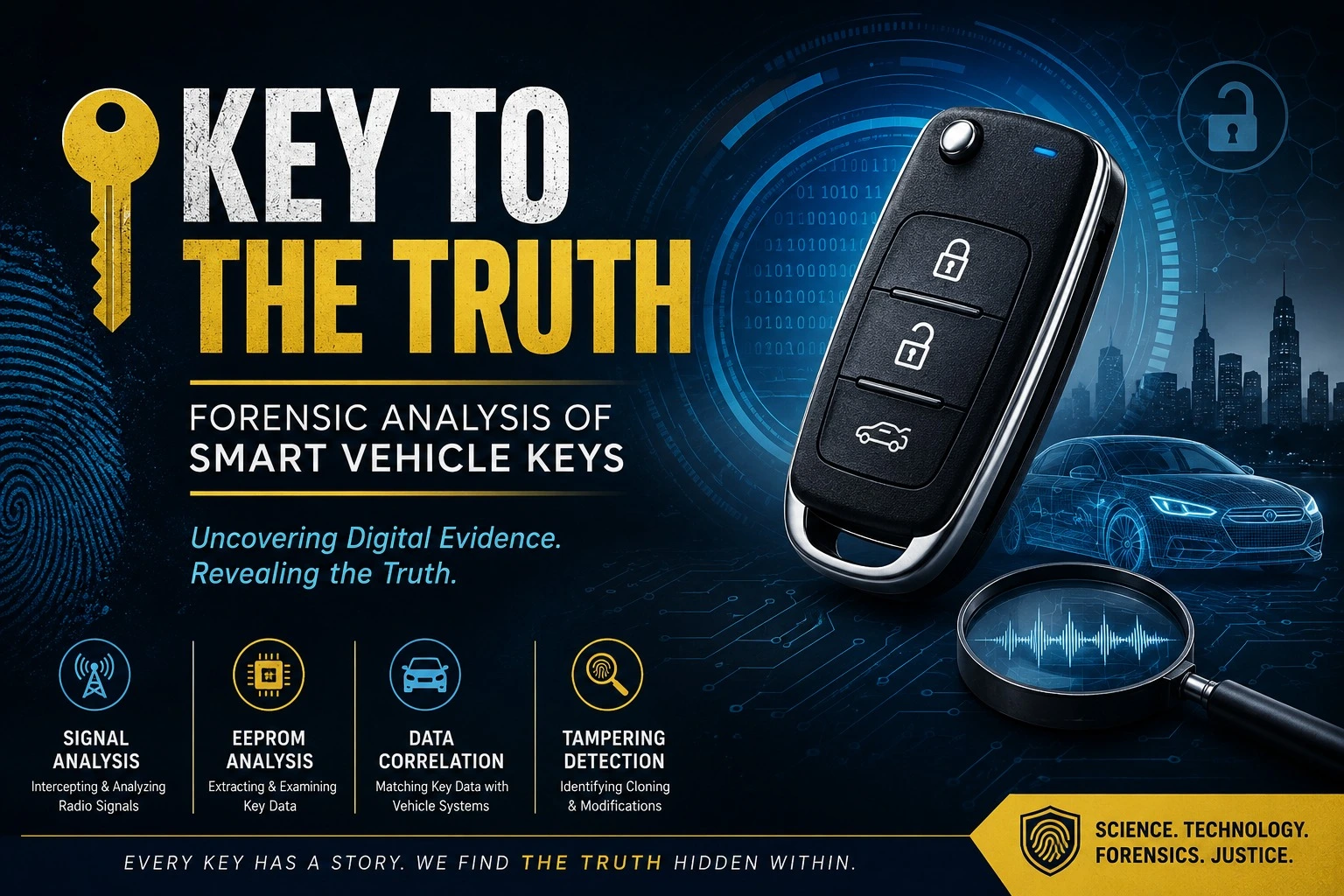
Some of the methods used by modern forensic laboratories include:
1. Intercepting Radio Signals
Any intelligent key transmits radio signals to communicate with a car. Specialists employ advanced antennas and radio frequency (RF) analysers to catch and analyse them. This way, it is possible to understand the interaction between the key and the car – how often was it used, what kind of authentication procedure takes place, and if the signal matches the car’s one or has been forged somehow.
2. Checking Out the Key’s Brain (Analysis of EEPROM)
There is always a special chip on the key that is responsible for its activity. The chip contains an important memory module (EEPROM – Electrically Erasable Programmable Read-Only Memory), which holds various data, including key IDs and rolling codes. It can be carefully retrieved via advanced tools. Thus, it is possible to determine whether somebody tried to tamper with the key.
3. The Correlation between the Key and Car’s Information
The information stored inside the key will not be used separately since investigators will correlate the key's data with that of the vehicle itself (ECU and immobilizer). If the two kinds of information coincide, the investigation may conclude that the key belongs to the vehicle. Otherwise, this may mean either cloning or tampering.
4. Identifying the Tampering and Cloning Evidence
As was mentioned above, thieves sometimes resort to using unlawful programming devices for duplicating smart car keys. In order to detect possible cloning, experts examine the key using various diagnostic devices to find out whether the keys were modified by changing the encryption code, frequencies, and hardware itself.
At the end of the process, some kind of miracle occurs because of the following: all actions committed with this particular key become documented, recorded inside the device itself. Even if someone tries to hide anything or remove any information concerning this particular incident, there will always remain some data.
Car Key Forensics in the Future
The evolution of cars to connect with other devices and adopt self-driving technologies requires new investigative methods to be used for vehicle-related crimes. Advanced car keys or smartphone apps that replace physical keys will likely incorporate biometric authentication, cloud integration, or blockchain records of key activity in the near future.
Such improvements will pose several threats and offer many benefits:
- Artificial intelligence tools can determine if the car key is cloned based on its behaviour pattern.
- Blockchain validation ensures all key-related activities are recorded and cannot be altered.
- Cyber-forensic protocols will become increasingly necessary for investigating criminal activity related to vehicles.
Car key forensics technology will not only allow solving crimes but may become instrumental in crime prevention.
Conclusion
A car key in this era is more than just an unlocking mechanism; it is a miniature data storage facility, which can yield information about the user, intentions, and access rights. The more cars become technologically advanced, the more the examination of smart keys becomes necessary as part of correlating physical evidence with digital investigation. It clearly indicates how small objects such as keys can play pivotal roles in cracking cases.
Executive Summary
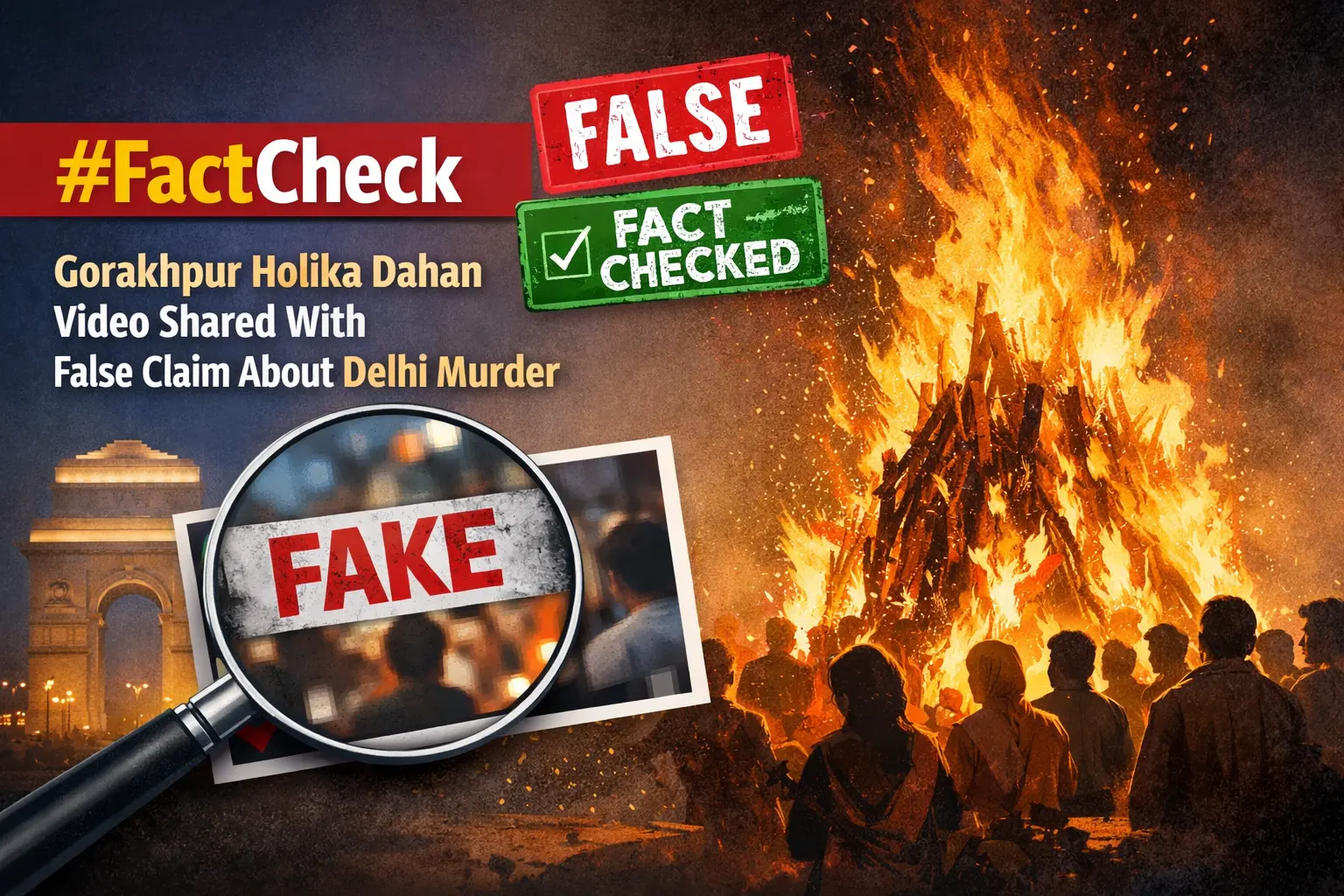
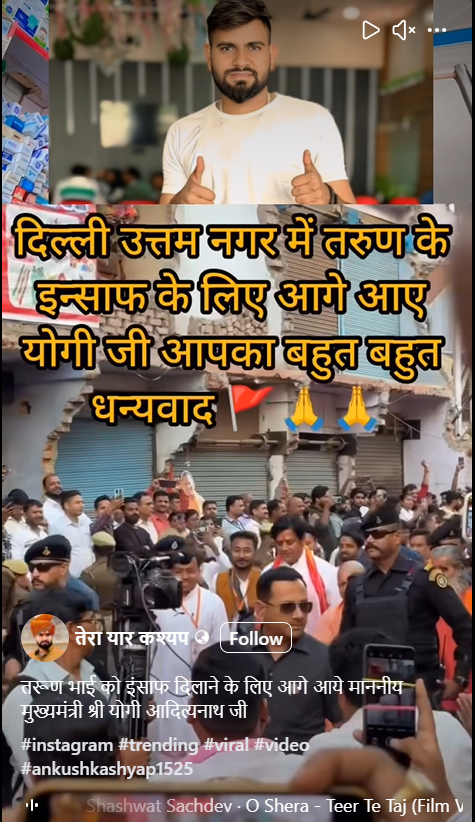
A dispute over water balloons on the day of Holi in the Uttam Nagar area of Delhi reportedly turned violent, resulting in the brutal murder of a young man named Tarun Khatik. Following the incident, a video is being widely shared on social media and linked to the murder case. In the viral video, Yogi Adityanath, Chief Minister of Uttar Pradesh, can be seen walking alongside Ravi Kishan, Member of Parliament from Gorakhpur. People standing along the route are seen showering flowers on them. Several users claim that the video shows the chief minister visiting the house of Tarun Khatik to meet his family.
However, research by CyberPeace found the viral claim to be misleading. Our research revealed that the video has no connection to the Tarun Khatik murder case. In fact, the video is from a Holika Dahan celebration held in Gorakhpur, which is now being shared on social media with a misleading claim.
Claim Post:
An Instagram user shared the viral video on March 10, 2026, writing: “Tarun bhai ko insaaf dilane ke liye aage aaye maananiya mukhyamantri Shri Yogi Adityanath ji.”
Fact Check:
To verify the claim, we extracted several key frames from the viral video and conducted a reverse image search using Google Lens. During the search, we found the same video posted on a Facebook account on March 2, 2026.
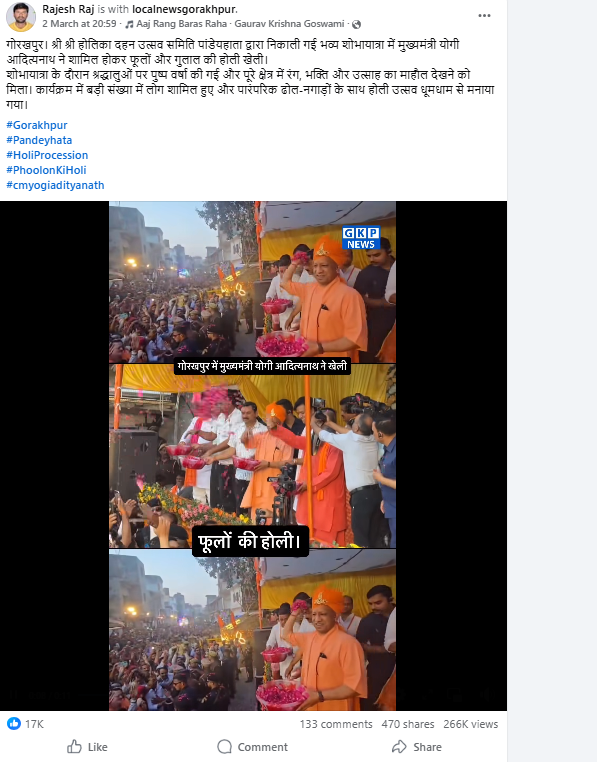
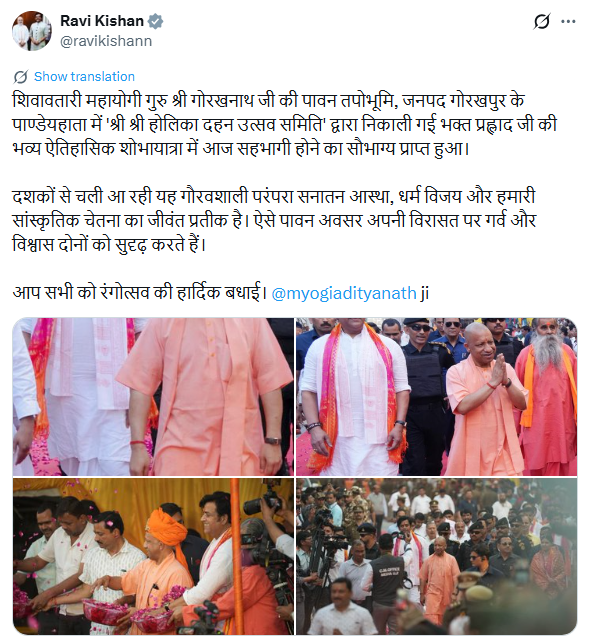
According to the caption of the Facebook post, the video shows a grand procession organised by the Shri Shri Holika Dahan Utsav Samiti, Pandeyhata in Gorakhpur. Yogi Adityanath attended the procession and was seen celebrating Holi with people by playing with flowers and coloured powder. During the procession, flower petals were showered on devotees, and the entire area witnessed a festive atmosphere filled with colours, devotion, and enthusiasm. A large number of people participated in the celebration, and the festival was celebrated with traditional drums and music. During further research, we also found images related to the viral video on the official X (formerly Twitter) account of Ravi Kishan. These images were shared on March 2, 2026, and the caption confirmed that they were taken during the Holika Dahan celebration in Gorakhpur.
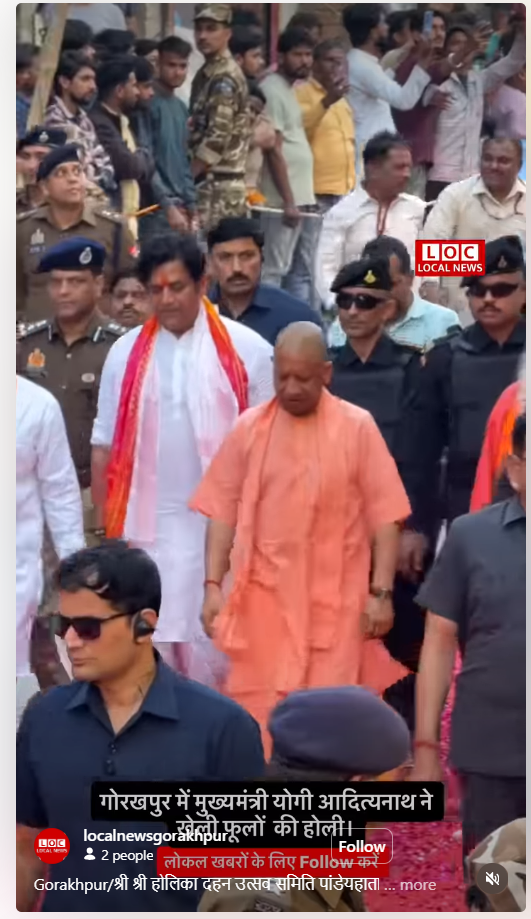
At the end of the research, we also found the same video uploaded on March 3, 2026 on the Instagram page Local News Gorakhpur. According to the information in the post, Yogi Adityanath and several other leaders participated in the grand procession organised by the Shri Shri Holika Dahan Utsav Samiti, Pandeyhata. People celebrated Holi with flowers and coloured powder during the event.
Conclusion:
Our research found that the viral video has no connection with the Tarun Khatik murder case in Uttam Nagar, Delhi. The video actually shows Yogi Adityanath participating in a Holika Dahan celebration in Gorakhpur. Therefore, the video is being shared on social media with a misleading claim.
