
Key to the Truth: Forensic Analysis of Smart Vehicle Keys.
Introduction
With the modernization of automobiles, so have the methods employed by criminals who seek to commit thefts. The old method of smashing a car window or bypassing an engine lock is no longer prevalent. Modern car thieves employ cloning techniques for keys and digital signals, and sophisticated methods to commit crimes without any traces left behind. In an era where intelligence is crucial, the forensic examination of car keys has become an indispensable tool for investigations, providing clues buried within ordinary car keys.
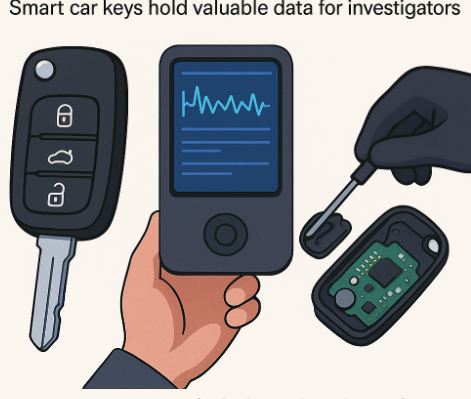
The Need for Car Key Forensics Today
Daily, thousands of cars worth millions are being hacked or stolen around the globe. The shocking thing is that most of these hacks do not have any sign of breakage or forced entry. It is because the thieves use vulnerabilities in the wireless key systems to unlock the vehicles without leaving any trace behind. Therefore, car-key forensics has now become more important than ever before.
Forensic Value of Smart Key
The smart key is not just comprised of locking and unlocking features for vehicles. Actually, it operates as a miniature computer within the key itself. Information such as pairing records, frequency of use, or the last instance that the key was used to unlock something could be contained in smart keys, thus offering evidence of any criminal activity conducted using these items.
Patterns of Vehicle Theft
Through the examination of the chip in a key, one will be able to establish whether the key was legally programmed or had been tampered with by some other means. Such forensics become more important when trying to detect and monitor any car theft rings, which employ cloning machines or software.
Confirming Ownership and Authenticity
In cases involving insurance claims or fraud, smart key data can help confirm whether the person making a claim actually owned or used the car during the incident. It’s digital proof that goes beyond what paperwork or statements can show.
Strengthening Legal Cases
When brought to court, data doesn’t lie. A properly handled forensic examination of a car key can provide hard evidence — the kind that holds up under questioning and supports or disproves claims with complete accuracy. In many cases, this small device becomes the most reliable witness in the investigation.
A Real-Life Example
Consider the following scenario: An expensive SUV is stolen from a parking lot secured with security surveillance. No one is captured on camera and there is no sign of forced entry. After days of investigation, the police end up arresting a suspect with a smart key.
During forensic analysis of the smart key, it is revealed that:
- The transponder has an ID number which can be matched against the immobilizer installed in the vehicle.
- The rolling code counter has been incremented in such a way that the date corresponds with the report of theft of the vehicle.
- The extracted information helps match the pair timestamp of the key with the particular make and model of the vehicle.
All this from a single piece of evidence – the smart key.
Inside a Smart Key: Where the Data Lives
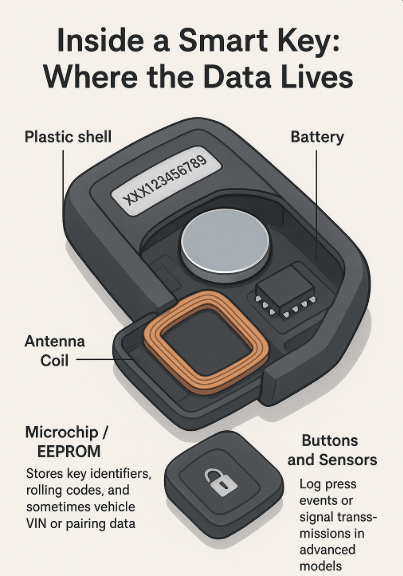
An average smart key is not only a remote but also a multi-level set of data carriers:
- Plastic Shell– could include serial numbers and information on the manufacture.
- Battery – helps calculate the time of using the key or detect any modifications.
- Antenna Coil – sends encrypted information to the immobilizer of a car. Draw the picture of this element.
- Microchip / EEPROM – holds key identification code, rolling code, VIN number, and/or other information of the vehicle.
- Buttons / sensors – could record any pressing or transmission actions in some cases.
All the little devices above, once properly studied via forensics software, provide valuable information.
How the Investigator Uncovers the Truth
In relation to investigating the true story about a vehicle, it is no different than handling other forms of digital evidence, as forensic analysts treat the car key in the same way. It is nothing more than an encrypted device in your hands, and using special techniques, they are able to reveal the information contained within the device.
Some of the methods used by modern forensic laboratories include:
1. Intercepting Radio Signals
Any intelligent key transmits radio signals to communicate with a car. Specialists employ advanced antennas and radio frequency (RF) analysers to catch and analyse them. This way, it is possible to understand the interaction between the key and the car – how often was it used, what kind of authentication procedure takes place, and if the signal matches the car’s one or has been forged somehow.
2. Checking Out the Key’s Brain (Analysis of EEPROM)
There is always a special chip on the key that is responsible for its activity. The chip contains an important memory module (EEPROM – Electrically Erasable Programmable Read-Only Memory), which holds various data, including key IDs and rolling codes. It can be carefully retrieved via advanced tools. Thus, it is possible to determine whether somebody tried to tamper with the key.
3. The Correlation between the Key and Car’s Information
The information stored inside the key will not be used separately since investigators will correlate the key's data with that of the vehicle itself (ECU and immobilizer). If the two kinds of information coincide, the investigation may conclude that the key belongs to the vehicle. Otherwise, this may mean either cloning or tampering.
4. Identifying the Tampering and Cloning Evidence
As was mentioned above, thieves sometimes resort to using unlawful programming devices for duplicating smart car keys. In order to detect possible cloning, experts examine the key using various diagnostic devices to find out whether the keys were modified by changing the encryption code, frequencies, and hardware itself.
At the end of the process, some kind of miracle occurs because of the following: all actions committed with this particular key become documented, recorded inside the device itself. Even if someone tries to hide anything or remove any information concerning this particular incident, there will always remain some data.
Car Key Forensics in the Future
The evolution of cars to connect with other devices and adopt self-driving technologies requires new investigative methods to be used for vehicle-related crimes. Advanced car keys or smartphone apps that replace physical keys will likely incorporate biometric authentication, cloud integration, or blockchain records of key activity in the near future.
Such improvements will pose several threats and offer many benefits:
- Artificial intelligence tools can determine if the car key is cloned based on its behaviour pattern.
- Blockchain validation ensures all key-related activities are recorded and cannot be altered.
- Cyber-forensic protocols will become increasingly necessary for investigating criminal activity related to vehicles.
Car key forensics technology will not only allow solving crimes but may become instrumental in crime prevention.
Conclusion
A car key in this era is more than just an unlocking mechanism; it is a miniature data storage facility, which can yield information about the user, intentions, and access rights. The more cars become technologically advanced, the more the examination of smart keys becomes necessary as part of correlating physical evidence with digital investigation. It clearly indicates how small objects such as keys can play pivotal roles in cracking cases.

Related Blogs

Executive Summary
A video is being widely shared on social media showing a delivery boy risking his life by jumping in front of a speeding truck to save a small child. The dramatic footage has drawn widespread praise, with many users calling the delivery worker a "real hero," "Superman," and even "an angel." Several social media users have claimed that the incident took place in Mumbai, alleging that the delivery boy's quick thinking prevented a fatal accident. CyberPeace Research Wing ’s research found the viral claim to be false. Our research revealed that the video is not real but AI-generated, and is being circulated with a misleading claim.
Claim
An X (formerly Twitter) user shared the viral video on July 12, 2026, with the caption: "This cannot be called a human, but an angel. Such an incredible feat by a delivery boy from Mumbai is hard to believe. At first glance, it seemed like he had sacrificed his life to save the child, but in the next moment, he saved not only himself but also the child's life. Watch this incredible video."
https://x.com/virjust18/status/2076270467569320072

Fact Check
To verify the viral claim, we conducted a keyword search on Google. However, we found no credible media reports or authentic sources confirming that such an incident had occurred in Mumbai or anywhere else. During the research, we found the same video uploaded on the Instagram account 'ai_nature_of_beauty_01' on July 12, 2026. Although the post's caption did not provide any details about the incident, a review of the account revealed that it regularly uploads AI-generated videos featuring fictional and digitally created scenarios. This strongly indicates that the viral clip is not footage of an actual event but content created using Artificial Intelligence.
https://www.instagram.com/reels/Das5IJ9FFF5/

We further analysed the video using the AI detection tool Hive Moderation, which indicated a 96.1% probability that the footage was AI-generated. The analysis strongly suggests that the video was created using artificial intelligence rather than recorded in the real world.

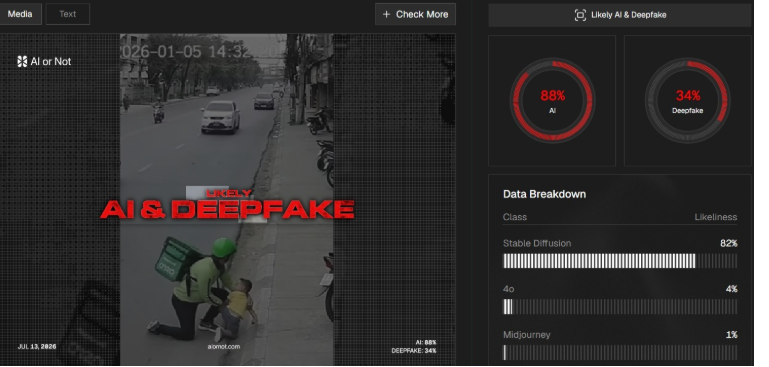
For additional verification, we also examined the video using another AI detection platform, AI or Not. The tool likewise identified the scenes in the viral clip as likely AI-generated, reinforcing our findings.
Conclusion
Our research found that the viral video does not depict a real rescue. It is AI-generated content that has been falsely circulated as footage of a delivery boy saving a child from a speeding truck in Mumbai. There is no credible evidence to support the claim that such an incident actually occurred.
.webp)
Think about the difference between a video game and gambling the way most people were taught to understand it. A video game is something you play, maybe you spend money on it upfront, maybe you buy an expansion pack, but what you get in return is fixed and known. Gambling is different: you put money in, and what comes back is uncertain, decided by chance, with real financial stakes attached to the outcome. For decades, that distinction was reasonably clear. It no longer is.
Across a growing number of mobile games and gaming platforms, the two have started to blend into each other. Games increasingly include features where a player pays real money for a randomised reward, a mechanic structurally identical to a slot machine or a scratch card, just wrapped in animation, sound effects, and gaming language that makes it feel like part of the game rather than a bet. Because this trend targets an audience that skews young, and because it deliberately makes gambling like behaviour feel like ordinary play, the UN Office on Drugs and Crime recently flagged it as a serious and growing concern. Understanding exactly what is happening, and why it matters, starts with their warning.
What UNODC is actually warning about
The claim traces back to UNODC's July 2026 report, An Interconnected Criminal Ecosystem: Transnational Organised Crime Threat Assessment for Southeast Asia 2026. Delphine Schantz, UNODC's regional representative for South-East Asia and the Pacific, put the core problem plainly: the line between online gaming and online gambling is becoming increasingly blurred, and platforms have converged through design features that deliberately exploit that ambiguity. Online gaming, by definition, never required money changing hands. What the report documents is a shift where mobile accessibility, deliberately addictive design, and the introduction of real monetary stakes are pulling younger users into something that looks and feels like gaming but functions, mechanically, like gambling.
The report's most striking finding is not really about the games themselves. It is about what happens after. UNODC found that illegal online gambling platforms operating across the region do not simply extract money from young users; they generate a secondary population of indebted, criminally exposed young people who become vulnerable to recruitment into broader criminal networks, including debt collection operations, money mule schemes, and the scam compounds the report documents elsewhere. In other words, the gambling loss is often only the first harm. The debt it creates becomes the entry point into something considerably worse.
The mechanics of the convergence
This is not a vague, impressionistic claim. Academic researchers have spent close to a decade documenting the specific design features responsible for blurring gaming and gambling, and loot boxes sit at the centre of that research. A loot box is a purchasable in game item containing randomised rewards, structurally similar to a scratch card or a slot pull, wrapped in gaming aesthetics, animated reveal sequences, anticipation building sound design, that make the underlying mechanic easy to overlook. Researchers writing in Nature Human Behaviour as early as 2018 argued loot boxes are psychologically akin to gambling, and subsequent studies have consistently found meaningful associations between loot box engagement and problem gambling severity in young people. One widely cited cross sectional study estimated that between 16 and 21 percent of surveyed young people had engaged in gambling like video game practices at least once in the preceding year, and found that people who engaged in one such practice were highly likely to engage in several more, suggesting these mechanics function less as isolated features and more as an interconnected ecosystem designed to normalise wagering behaviour early.
What makes this genuinely difficult to regulate is precisely the ambiguity Schantz pointed to. A loot box does not always pay out in real currency; often the reward is a cosmetic item, a weapon skin, or in game currency that can then be resold or traded on secondary markets, creating real monetary value once removed from the platform that generated it. That one extra step, converting a virtual reward into tradeable value outside the game itself, has repeatedly let gambling like mechanics avoid classification under gambling law, even as researchers increasingly argue the psychological experience for the user is functionally identical. Regulators in several countries, including the UK, South Korea, and parts of Europe, have wrestled with exactly this classification problem for years, generally landing on disclosure requirements, probability labelling, and age restrictions rather than outright bans, an approach critics argue leaves the core mechanic intact while addressing only its edges.
The mobile phone has made all of this considerably harder to contain. Where gambling once required a physical location, an ID check, or at minimum a desktop browser, mobile gaming apps put the same monetised, chance based mechanics directly into a pocket, often accessible without any meaningful age verification beyond a self reported birth date a user can simply falsify. UNODC's own framing of "mobile access" as a driving factor is not incidental; it is arguably the single structural change that turned what was once a manageable regulatory grey zone into a rapidly scaling public health concern.
Why age matters so much here
Financial literacy research is fairly consistent on this point: the capacity to reason clearly about risk, probability, and long term financial consequence continues developing well into a person's twenties. Marketing a mechanic engineered around variable reward schedules, the same principle behind slot machine design, to an audience whose risk judgment is still forming is not an accident of overlapping demographics. It is, as UNODC's own language suggests, closer to a deliberate exploitation of that gap.
Where India fits into this picture
India has arguably moved further and faster on this exact concern than most jurisdictions. The Promotion and Regulation of Online Gaming Act, 2025, alongside its accompanying 2026 Rules that came into force on 1 May 2026, drew a hard statutory line most countries have avoided: real money online games, including fantasy sports, rummy, poker, and online casino style platforms, are now categorically prohibited in India, not merely regulated. A newly created central regulator, the Online Gaming Authority of India, oversees a separate, permitted category for e-sports and social games, requiring registration, age gating, and grievance redressal mechanisms, while offshore and unregistered real money platforms are now explicitly illegal to operate or use, backed by bank freeze powers and potential prosecution of platform directors.
The government's own stated rationale mirrors UNODC's warning almost exactly. Lawmakers cited addiction and social harm linked to real money games, reports that Indian users lose close to 20,000 crore rupees annually on these platforms, concerns about money laundering and potential terror financing routed through gaming networks, and specifically flagged the vulnerability of teenagers increasingly drawn into fantasy leagues and online poker as a driving justification. India's approach, an outright prohibition on monetary stakes rather than a licensed regulatory model similar to the UK's Gambling Commission or Malta's Gaming Authority, is distinctive by global standards, and reflects a judgement that the gaming gambling boundary has already become too difficult to police through disclosure and age verification alone.
The larger question this leaves open
Whether prohibition succeeds where lighter touch regulation elsewhere has struggled remains genuinely unresolved, and enforcement against offshore platforms determined to evade an Indian ban is likely to be an ongoing challenge rather than a solved problem. What UNODC's warning underscores, and what India's own legislative response implicitly concedes, is that voluntary industry self regulation was never going to be sufficient on its own. Platforms have commercial incentive to keep the gaming gambling boundary blurry, not to clarify it, because that ambiguity is precisely what lets monetised, addictive design features reach audiences who would otherwise be walled off from gambling entirely. Closing that gap convincingly will likely require the kind of cross sector coordination, spanning gaming regulators, financial authorities, and platform accountability, that UNODC's own statement called for, rather than any single fix applied in isolation.
References
- UNODC, "An Interconnected Criminal Ecosystem: Transnational Organised Crime Threat Assessment for Southeast Asia 2026," July 2026.
- The Hawk, "UNODC warns young gamers lured into online gambling." https://www.thehawk.in/news/india/unodc-warns-young-gamers-lured-into-online-gambling
- IAG, "UNODC report says Southeast Asian illegal online gambling creating cycle of crime that targets youth." https://asgam.com/2026/07/22/unodc-report-says-southeast-asian-illegal-online-gambling-creating-cycle-of-crime-that-targets-the-youth/
- GambleAware, "Lifting the Lid on Loot Boxes: Chance-based purchases in videogames and the convergence of gaming and gambling." https://www.gambleaware.org/media/aswow4lr/gaming_and_gambling_report_final_0.pdf Drummond
- A, Sauer JD, "Video game loot boxes are psychologically akin to gambling," Nature Human Behaviour, 2018. PubMed, "Loot Boxes, Gambling, and Problem Gambling Among Young People: Results from a Cross-Sectional Online Survey." https://pubmed.ncbi.nlm.nih.gov/33103911/
- Mondaq, "Play By The New Rules: India's 2026 Online Gaming Law Decoded." https://www.mondaq.com/india/gaming/1785180/play-by-the-new-rules-indias-2026-online-gaming-law-decoded
- CAclubindia, "India's Online Gaming Revolution: A Complete Guide to the Promotion and Regulation of Online Gaming w.e.f 1st May, 2026." https://www.caclubindia.com/articles/indias-online-gaming-revolution-a-complete-guide-to-the-promotion-and-regulation-of-online-gaming-wef-1st-may-2026-55118.asp
- https://www.meity.gov.in/static/uploads/2025/10/8a7f103cefc68ed8aaa2ebc9a2ed7c13.pdf
- https://x.com/UNODC/status/2100560453319467298?s=48&t=3CXE-95D2WFgsLsKDkX_Jg
.webp)
Introduction
We were all stunned and taken aback when multiple photos of streets in the U.S. surfaced with heavily drugged individuals loosely sitting on the streets, victims of a systematically led drug operation that has recently become a target of the Trump-led “tariff” war, which he terms as a war on drug cartels. The drug is a synthetic opioid, fentanyl, which is highly powerful and addictive. The menace of this drug is found in a country that has Wall Street and the largest and most powerful economy globally. The serious implications of drug abuse are not about a certain economy; instead, it has huge costs to society in general. The estimated cost of substance misuse to society is more than $820 billion each year and is expected to continue rising.
On June 26, the International Day against Drug Abuse and Illicit Trafficking is observed globally. However, this war is waged daily for millions of people, not on streets or borders, but in bloodstreams, behind locked doors, and inside broken homes. Drug abuse is no longer a health crisis; it is a developmental crisis. The United Nations Office on Drugs and Crime has launched a campaign against this organised crime that says, “Break the Cycle’ attributing to the fact that de-addiction is hard for individuals.
The Evolving Drug Crisis: From Alleyways to Algorithms
The menace of Drug abuse and illicit trafficking has also taken strides in advancement, and what was once considered a street-side vice has made its way online in a faceless, encrypted, and algorithmically optimised sense. The online drug cartels operate in the shadows and often hide in plain sight, taking advantage of the privacy designed to benefit individuals. With the help of darknet markets, cryptocurrency, and anonymised logistics, the drug trade has transformed into a transnational, tech-enabled industry on a global scale. In an operation led by the U.S. Department of Justice’s Joint Criminal Opiod and Darknet Enforcement (JCODE) and related to Operation RapTor, an LA apartment was only to find an organised business centre that operated as a hub of one of the most prolific methamphetamine and cocaine distributors in the market. Aaron Pinder, Unit Chief of the FBI Hi-Tech Organised Crime Unit, said in his interview, “The darknet vendors that we investigate, they truly operate on a global scale.” On January 11, 2025, during the Regional Conference on “Drug Trafficking and National Security,” it was acknowledged how cryptocurrency, the dark web, online marketplaces, and drones have made drug trafficking a faceless crime. Reportedly, there has been a seven-fold increase in the drugs seized from 2004-14 to 2014-24.
India’s Response: Bridging Borders, Policing Bytes
India has been historically vulnerable due to its geostrategic placement between the Golden Crescent (Afghanistan-Iran-Pakistan) and Golden Triangle (Myanmar-Laos-Thailand), and confronts a fresh danger from “click-to-consume’ narcotics. Although India has always adopted a highly sensitised approach, it holds an optimistic future outlook for the youth. Last year, to commemorate the occasion of International Day against Drug Abuse and Illicit Trafficking, the Department of Social Justice & Empowerment organised a programme to engage individuals for the cause. The Indian authorities are often seen coming down heavily on the drug peddlers and cartels, and to aid the cause, the Home Minister Amit Shah inaugurated the new office complex of the NCB’s Bhopal zonal unit and extension of the MANAS-2 helpline to all 36 states and UTs. The primary objectives of this step are to evaluate the effectiveness of the Narcotics Coordination Mechanism (NCORD), assess the progress of states in fighting drug trafficking, and share real-time information from the National Narcotics Helpline ‘MANAS’ portal with the Anti-Narcotics Task Force (ANTF) of states and UTs.
The United Nation’s War on Narcotics: From Treaties to Technology
The United Nations Office on Drugs and Crime (UNODC) is leading the international response. It offers vital data, early warning systems, and technical support to the states fighting the drug problem. The UNODC incorporates cooperation in cross-border intelligence, overseeing the darknet activities, encouraging the treatment and harm reduction, and using anti-money laundering mechanisms to stop financial flows. India has always pledged its support to the UN led activities, and as per reports dated 26th March, 2025, India chaired the prestigious UN-backed Commission on Narcotic Drugs (CND) meeting held in vienna, wherein India highlighted the importance of opioids for medical purposes as well as the nation’s notable advancements in the field.
Resolution on June 26: From Commemoration to Commitment
Let June 26 be more than a date on the calendar- let it echo as a call to action, a day when awareness transforms into action, and resolve becomes resistance. On this day, CyberPeace resolves the following:
- To treat addicts as victims rather than criminals and to pitch for reforms to provide access to reasonably priced, stigma-free rehabilitation.
- To integrate anti-drug awareness into digital literacy initiatives and school curricula in order to teach frequently and early.
- To demand responsibility and accountability from online marketplaces and delivery services that unwittingly aid traffickers
- To tackle the demand side through employment, mental health services, and social protection, particularly for at-risk youth.
References
- https://www.gatewayfoundation.org/blog/cost-of-drug-addiction/#:~:text=The%20estimated%20cost%20for%20substance,Alcohol%3A%20%24249%20billion
- https://www.unodc.org/unodc/en/drugs/index-new.html
- https://www.fbi.gov/news/stories/global-operation-targets-darknet-drug-trafficking
- https://www.thehindu.com/news/national/dark-web-crypto-drones-emerge-as-challenges-in-fight-against-drug-trafficking-amit-shah/article69088383.ece
- https://www.pib.gov.in/PressReleaseIframePage.aspx?PRID=2028704
- https://www.newindianexpress.com/nation/2025/Mar/26/in-a-first-india-chairs-un-forum-on-narcotics-pledges-to-improve-access-to-pain-relief-and-palliative-care
