
#FactCheck: Kazakhstan Military Training Video Falsely Shared as India-China Clash in Arunachal Pradesh
Executive Summary
A video is going viral on social media with the claim that it shows an exchange of fire between Indian and Chinese troops in Arunachal Pradesh. In the video, amid the firing, one soldier can be seen holding another soldier and taking him to a safe location. Several soldiers are also seen continuously firing between the mountains. The post claims that the country’s media is not showing these visuals. CyberPeace Research found that the video was actually filmed during a military training exercise in Kazakhstan.
Claim
A Facebook user shared the viral video with the caption: “The anti-national media will not show this.”
https://www.facebook.com/reel/2210190566198227

Fact Check
To verify the authenticity of the video being shared as footage of an exchange of fire between Indian and Chinese troops in Arunachal Pradesh, we first conducted a Google search using relevant keywords. However, we did not find any credible media reports mentioning any recent incident of firing between the two sides. We also did not find the video in any media report describing it as footage of firing along the India-China border.
We then conducted a reverse search of the video’s keyframes and found the same video uploaded on the Instagram account of the Tactical Training Federation of Kazakhstan. The video was uploaded on July 28, 2026. According to the caption, “Training sessions were conducted by the Federation of Tactical Training with soldiers of the Special Operations Forces (SSO) of the Ministry of Defence of the Republic of Kazakhstan at the Koktal training ground in the city of Zharkent. The main objective of these sessions was to bring training conditions as close as possible to the realities of modern warfare, thereby improving the soldiers’ practical skills, tactical thinking and readiness to operate in complex situations.”
https://www.instagram.com/reels/DbTcbswsRdS/
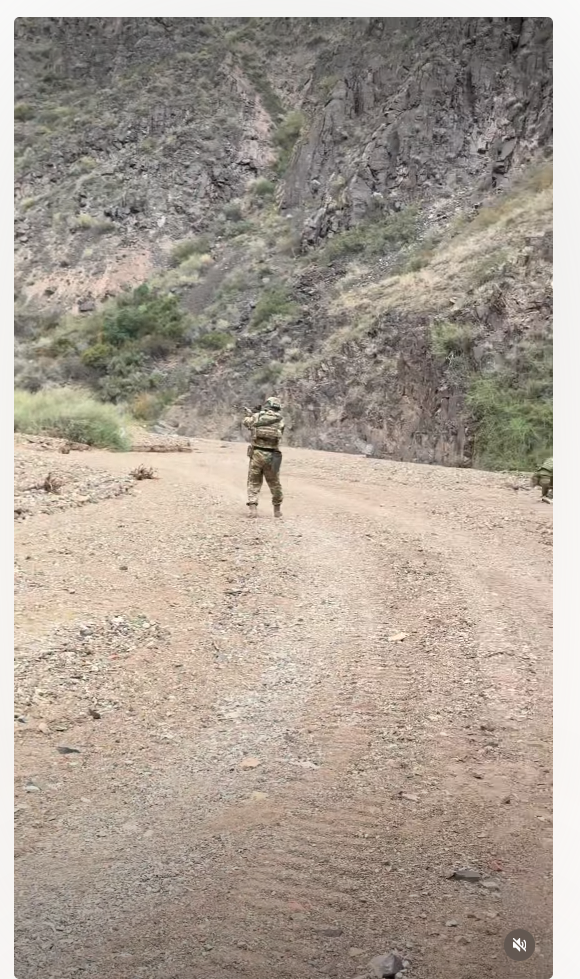
Additionally, several other videos related to military training are available on the account. According to the bio, the organisation is involved in defence activities and the training of military personnel.
https://www.instagram.com/p/Dci49EiMjje/

Conclusion
Our research found that the video being shared as footage of an exchange of fire between Indian and Chinese troops in Arunachal Pradesh is actually from Kazakhstan. The video was filmed during a military training exercise organised by Kazakhstan’s Federation of Tactical Training.

Related Blogs

Introduction
The whole world is shifting towards a cashless economy, with innovative payment transaction systems such as UPI payments, card payments, etc. These payment systems require processing, storage, and movement of millions of cardholders data which is crucial for any successful transaction.
And therefore to maintain the credibility of this payment ecosystem, security or secure movement and processing of cardholders data becomes paramount. Entities involved in a payment ecosystem are responsible for the security of cardholders data. Security is also important because if breaches happen in cardholders data it would amount to financial loss. Fraudsters are attempting smart ways to leverage any kind of security loopholes in the payment system.
So these entities which are involved in the payment ecosystem need to maintain some security standards set by one council of network providers in the payment industry popularly known as the Payment Card Industry Security Standard Council.
Overview of what is PCI and PCI DSS Compliance
Earlier every network providers in the payment industry have their own set of security standards but later they all together i.e., Visa, Mastercard, American Express, Discover, and JCB constituted an independent body to come up with comprehensive security standards like PCI DSS, PA DSS, PCI-PTS, etc. And these network providers ensure the enforcement of the security standards by putting conditions on services being provided to the merchant or acquirer bank.
In other words, PCI DSS particularly is the global standard that provides a baseline of technical and operational requirements designed to protect account data. PCI DSS is a security standard specially designed for merchants and service providers in the payment ecosystem to protect the cardholders data against any fraud or theft.
It applies to all the entities including third-party vendors which are involved in processing storing and transmitting cardholders data. In organization, even all CDE (Card Holder Data Environment) including system components or network component that stores and process cardholders data, has to comply with all the requirements of PCI compliance. Recently PCI has released a new version of PCI DSS v4.0 a few months ago with certain changes from the previous version after three years of the review cycle.
12 Requirements of PCI DSS
This is the most important part of PCI DSS as following these requirements can make any organization to some extent PCI compliant. So what are these requirements:
- Installing firewalls or maintaining security controls in the networks
- Use strong password in order to secure the CDE( Card holders data environment)
- Protection of cardholder data
- Encrypting the cardholder data during transmission over an open and public network.
- Timely detection and protection of the cardholders data environment from any malicious activity or software.
- Regular updating the software thereby maintaining a secure system.
- Rule of business need to know should apply to access the cardholders data
- Identification and authentication of the user are important to access the system components.
- Physical access to cardholders data should be restricted.
- Monitoring or screening of system components to know the malicious activity internally in real-time.
- Regular auditing of security control and finding any vulnerabilities available in the systems.
- Make policies and programs accordingly in order to support information security.
How organization can become PCI compliant
- Scope: First step is to determine all the system components or networks storing and processing cardholders data i.e., Cardholders Data Environment.
- Assess: Then test whether these systems or networks are complying with all the requirements of PCI DSS COMPLIANCE.
- Report: Documenting all the assessment through self assessment questionnaire by answering following questions like whether the requirements are met or not? Whether the requirements are met with customized approach.
- Attest: Then the next step is to complete the attestation process available on the website of PCI SSC.
- Submit: Then organization can submit all the documents including reports and other supporting documents if it is requested by other entities such as payment brands, merchant or acquirer.
- Remediate: Then the organisation should take remedial action for the requirements which are not in place on the system components or networks.
Conclusion
One of the most important issues facing those involved in the digital payment ecosystem is cybersecurity. The likelihood of being exposed to cybersecurity hazards including online fraud, information theft, and virus assaults is rising as more and more users prefer using digital payments.
And thus complying and adopting with these security standards is the need of the hour. And moreover RBI has also mandated all the regulated entities ( NBFCs Banks etc) under one recent notification to comply with these standards.

Introduction
A digital forensic investigation can start with a question: what really happened? The tricky part is that the answer might be hidden in thousands of files, system logs, browser records, messages, application artefacts and timestamps. Traditional forensic practice gives a method to find, collect, check and report such evidence yet the amount of digital data keeps growing. NIST’s forensic guidance says that evidence must be kept safe its integrity checked and investigative steps written down so that results can be examined and repeated.[4] This is where Large Language Models (LLMs) draw interest. LLMs can. Summarise large amounts of text, spot connections between pieces of information and help an examiner move through evidence faster. However, an important question remains: can an LLM truly become an investigator or should it stay an assistant to one?
Understanding the basic idea: What is an LLM?
A Large Language Model is an AI system trained on collections of text so that it can learn language patterns and produce answers. In terms an LLM does not think like a human investigator. An LLM creates language from patterns it learned during training and from the details it receives. This makes an LLM handy for summarisation, classification, question answering and pulling information from text.
Where LLMs can actually help a forensic examiner
Finding relevant evidence faster
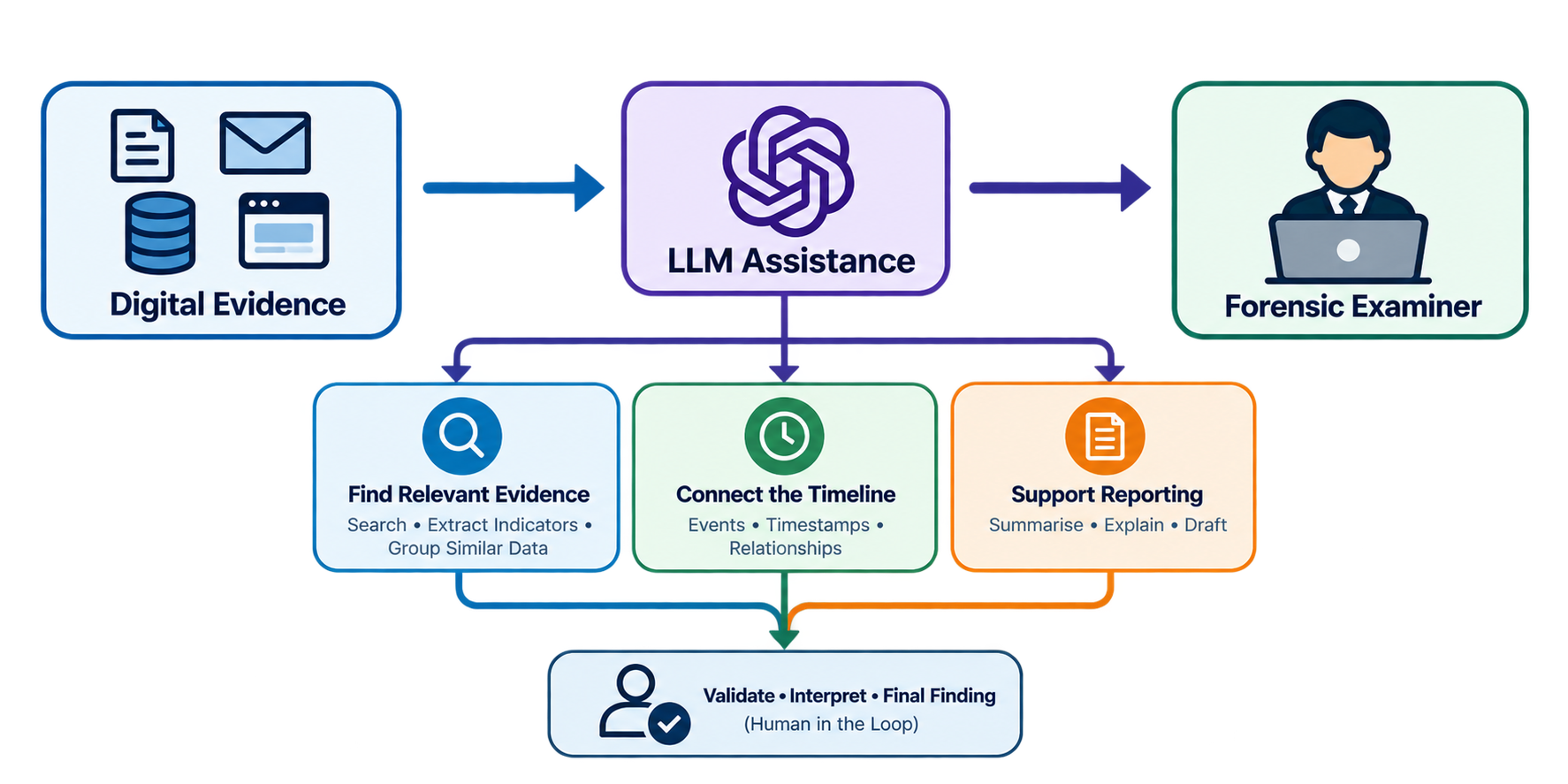
Consider a case involving a suspected phishing incident. A forensic examiner may have email headers, message bodies, attachments, browser history, DNS records and system logs. An LLM can help organize text-based evidence, spot repeated terms pull out indicators such as domains or IP addresses and cluster related events for review. Research on LLM-assisted forensics says that pattern recognition and early evidence analysis are promising use cases.[1][3]
Connecting the timeline
Investigations often rely on order: what happened first what followed and which artefacts back that order. An LLM can turn amounts of timestamped data into a clear timeline or point out records that seem related. The key point is that the LLM helps an examiner see relationships; it does not independently prove that one event caused another.
Making forensic reporting easier to understand
A good forensic report should be understandable to technical and non-technical readers. LLMs can help turn examiner notes or structured findings into clearer draft language, summaries or executive explanations. This is particularly useful when an investigation contains technical terms that need to be explained without losing their meaning. Research also identifies evidence presentation and reporting as a potential area for LLM assistance.[1]
A realistic example
Imagine an organisation reports that an employee account may have been compromised. The examiner collects the relevant disk image, authentication logs, browser history and email data using established procedures. After preservation and examination with validated tools, a controlled set of extracted text or structured artefacts could be given to an LLM. It might identify unusual login patterns, highlight a suspicious domain appearing in multiple sources, and draft questions for further examination.
The examiner then checks those observations against the original evidence and forensic tool outputs. If the model says a login occurred at 10:14, that timestamp must be verified in the source log. If it suggests that two events are linked, the relationship must be supported by evidence. The model can accelerate the search, but the evidence remains the foundation of the conclusion.
Why an LLM cannot simply replace the investigator
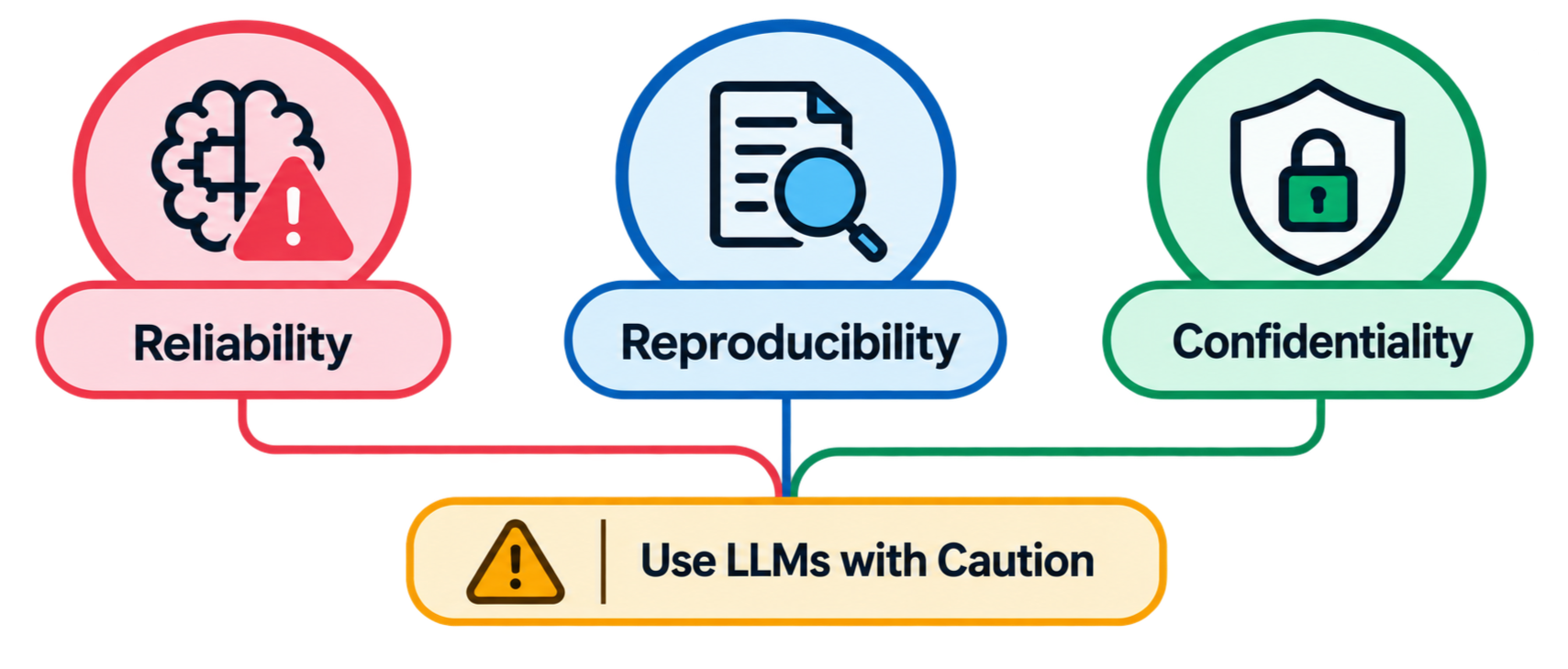
The biggest challenge is reliability. LLMs can produce fluent answers that sound convincing even when the answer is wrong. The 2026 systematic review of 33 peer-reviewed works on LLMs in digital forensics highlights hallucination, explainability, reproducibility and legal admissibility as major concerns.[1] In forensic work, an incorrect sentence is not just a minor inconvenience; it can change how a case is understood.
There is also a reproducibility problem. Traditional forensic practice depends on validated processes, integrity checks and documentation. NIST recommends verifying acquired data and recording actions and tools so work can be repeated.[4] LLM output can vary with the model, settings, context and system version. That makes raw model output unsuitable as forensic proof on its own.
Another concern is confidentiality. Evidence may contain personal information, credentials, private communications or sensitive organisational data. Sending it to an external AI service without proper controls can create a privacy and governance risk. NIST’s Generative AI Profile stresses managing risks across the AI lifecycle.[5]
What responsible LLM-assisted forensics could look like
A practical approach is to keep the examiner in control. The LLM should receive only the information needed for the task, preferably through a controlled environment with access restrictions and logging. Critical findings should always link back to the source artefact rather than being accepted because the model sounds confident.
A simple operational principle is: -
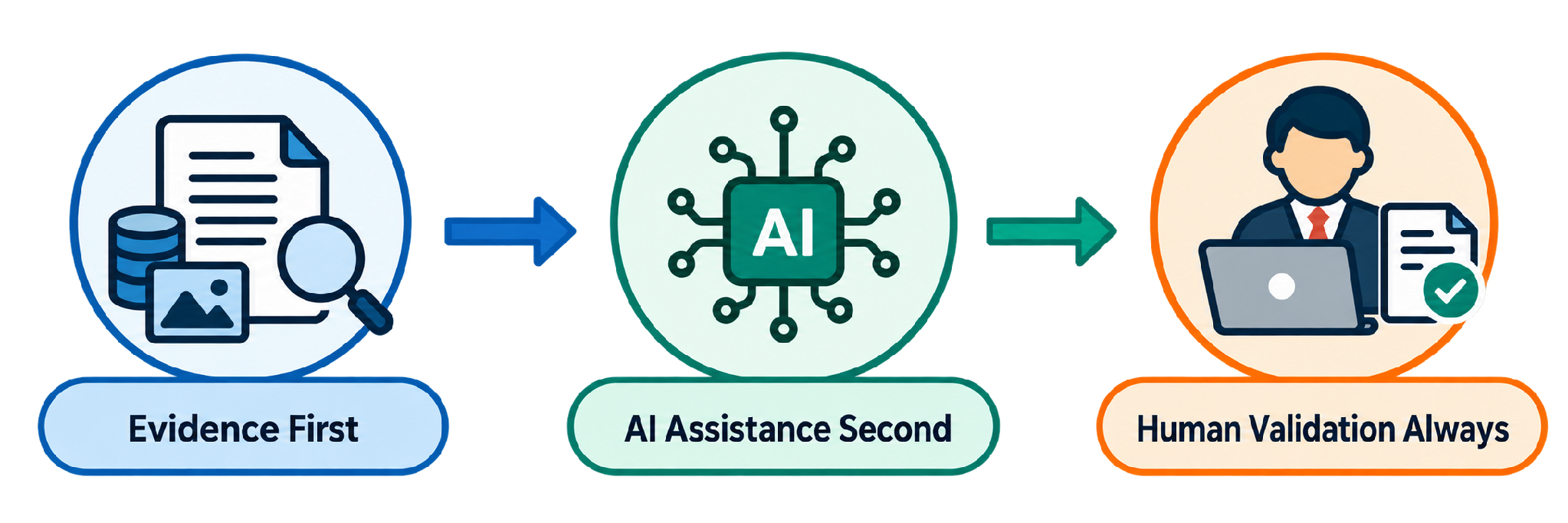
In practice, this means preserving and hashing evidence, using validated forensic tools for acquisition and examination, recording what data was supplied to the AI system, retaining relevant prompts and outputs in working notes, and independently verifying material claims. SWGDE guidance likewise emphasises protecting the integrity of evidence and documenting handling throughout the evidence lifecycle.[6]
A further possibility is a local or specialised forensic model. Research on “ForensicLLM” demonstrates this direction, including source attribution and retrieval-augmented approaches.[2] Such designs may provide a more controlled environment, but they still require testing and validation before operational use.
Conclusion
LLMs are unlikely to make the forensic examiner irrelevant. Their more realistic value is in helping the examiner deal with the scale and complexity of modern evidence. They can search, summarise, classify, correlate and help communicate findings, but these capabilities come with limitations that matter deeply in forensic work. A forensic conclusion must remain traceable to evidence, repeatable through a documented process and open to independent verification.[1][4]
The future of AI-assisted digital forensics is therefore less about replacing investigators and more about designing a disciplined partnership between human expertise and machine assistance. The strongest model is one in which AI speeds up the routine parts of an investigation while the examiner remains responsible for validation, interpretation and final conclusions. As research develops, the real question will not simply be whether an LLM is intelligent enough to analyse evidence, but whether the complete system around it is controlled, explainable and trustworthy enough for forensic use.
References / Endnotes
[1] Chernyshev, M., Baig, Z., Syed, N., Doss, R., & Shore, M. (2026). “Large language models in digital forensics: capabilities, challenges and future directions.” Forensic Science International: Digital Investigation, 56, 302043. https://doi.org/10.1016/j.fsidi.2025.302043
[2] “ForensicLLM: A local large language model for digital forensics.” Forensic Science International: Digital Investigation, 52, Supplement, 301872 (2025). https://doi.org/10.1016/j.fsidi.2025.301872
[3] Wickramasekara, A., Breitinger, F., & Scanlon, M. (2025). “Exploring the Potential of Large Language Models for Improving Digital Forensic Investigation Efficiency.” Forensic Science International: Digital Investigation, 52, 301859. https://doi.org/10.1016/j.fsidi.2024.301859
[4] Kent, K., Chevalier, S., Grance, T., & Dang, H. (2006). Guide to Integrating Forensic Techniques into Incident Response, NIST Special Publication 800-86. National Institute of Standards and Technology. https://doi.org/10.6028/NIST.SP.800-86
[5] Autio, C., Schwartz, R., Dunietz, J., Jain, S., Stanley, M., Tabassi, E., Hall, P., & Roberts, K. (2024). Artificial Intelligence Risk Management Framework: Generative Artificial Intelligence Profile, NIST AI 600-1. National Institute of Standards and Technology. https://doi.org/10.6028/NIST.AI.600-1
[6] Scientific Working Group on Digital Evidence (SWGDE). Best Practices for Digital Evidence Collection, 18-F-002-2.0. https://www.swgde.org/documents/published-complete-listing/18-f-002-2-0/

Introduction
A zero-click cyber attack solely relies on software and hardware flaws, bypassing any human factor to infect a device and take control over its data. It is almost impossible to discover the attack and know that the device is hacked unless someone on your side is closely monitoring your network traffic data.
At Kaspersky, security analysts used their SIEM solution KUMA to monitor their corporate WiFi network traffic and discovered this mysterious attack. They took necessary actions to investigate it and even went a step further to dive right into the action and uncover the entire attack chain.
A few months ago, Kaspersky shared their findings about this attack on iOS devices. They shared how these zero-click vulnerabilities were being exploited by the attackers and called this attack ‘Operation Triangulation’.
A zero-click exploit in the network
Kaspersky detected a zero-click attack on the iPhones of their colleagues while monitoring their corporate WiFi network traffic. They managed to get detailed information on all the stages of the attack by simply identifying a pattern in the domain names flowing through their network. Although the attackers were quite experienced, their mistakes helped Kaspersky detect critical vulnerabilities in all iOS devices.
The name-pattern
These previously unsuspected domains had a similar name-style which consisted of two names and ended with ‘.com’, such as ‘backuprabbit.com’ and ‘cloudsponcer.com’. They were used in pairs, one for an exportation process and the other served as a command and control server. These domains showed high outbound traffic, they were registered with NameCheap and protected with Cloudflare.
The network pattern
Each time a connection to these suspicious domains was made, it was preceded by an iMessage connection which indicated these domains are being accessed by iOS devices. It was observed that the devices connected to these domains, downloaded attachments, performed a few requests to a first level domain which was an exploitation framework server, then made regular connections with the second level domain which was a command and control server controlled by the attackers.
Getting more information
To get more information about the attack all the infected devices were collected and backed up after carefully informing the device owners. Although the attackers had managed to clean their artefacts, the backed up data was used to perform digital forensic procedures and find traces of the attacks. This helped Kaspersky to figure out how the infection might be taking place.
The attacker’s mistakes
The attackers deleted all the attachment files and exploits but did not delete the modified SMS attachment folder. That folder had no files left inside it. The attackers removed evidence from other databases as well, like the ‘SMS.db’ database, however another database called ‘datausage.sqlite’ was not sanitised.
The ‘datausage.sqlite’ database is the most important database when it comes to iOS forensics as its contents can be used to track applications and network usage. Upon examination of this database, a process logged as ‘BackupAgent’ was found to be making network connections at the same time the device was making connections to the suspicious domains.
The indicator of compromise
‘BackupAgent’ stood out in this scenario because although it is a legitimate binary, it has been deprecated since iOS4 and it should not have been making any network connections. This identified the ‘BackupAgent’ process as the first solid indicator of compromise in Operation Triangulation. The indicator is termed as- ‘Data usage by process BackupAgent’, and was used to determine if any specific device was infected.
Taking it a step ahead
The team at Kaspersky successfully identified the indicator of compromise and determined which devices were infected, but as the attackers were experienced enough to delete their payloads, they decided to set a trap and perform a man-in-the-middle attack. When they did, the attackers were unable to detect it.
The man-in the-middle attack
Kaspersky prepared a server with ‘WireGuard’ and ‘mitmproxy’. They installed root certificates on devices that could be used as targets for the attackers and routed all the network traffic to that server. They also developed a ‘Telegram’ bot to notify them about new infections as they decrypted the network traffic.
Setting up a bot proved to be an effective way of real time monitoring while modifying all the network packets on-the-fly with ‘mitmproxy’, this gave them unlimited power! Their trap was successful in capturing a payload sent by the attackers and it was analysed in detail.
The name was in the payload
The payload was an HTML page with obfuscator javascript which performed various code checks and canvas footprinting. It rendered a yellow triangle and calculated its hash value. This is why the operation was named Operation Triangulation.
The team at Kaspersky started cracking various layers of asymmetric cryptography with regular expressions. They patched the stages one-by-one on the fly to move the logic from each stage to ‘mitmproxy’ and finally implemented a 400 line ‘mitmproxy’ add-on. This add-on decrypted all the validators, exploits, spyware and additional modules.
The mystery
It is remarkable how Kaspersky detected the attack and identified multiple vulnerabilities, set up a trap to capture a payload and decrypted it completely. They shared all their findings with the device manufacturer and Apple responded by sending out a security patch update addressing four zero-day vulnerabilities.
A zero-click vulnerability
Traditionally any spyware relies on the user to to click on a compromised link or file to initiate the infection. However a zero-click vulnerability is a specific flaw in the device software or hardware that the attacker can use to infect the device without the need for a click or tap from the user.
The vulnerabilities identified
- Tricky Font Flaw (CVE-2023-41990): A clandestine method involving the manipulation of font rendering on iPhones, akin to a secret code deciphered by the attackers.Apple swiftly addressed this vulnerability in versions iOS 15.7.8 and iOS 16.3.
- Kernel Trick (CVE-2023-32434): Exploiting a hidden language understood only by the iPhone's core, the attackers successfully compromised the kernel's integrity.Apple responded with fixes implemented in iOS 15.7.7, iOS 15.8, and iOS 16.5.1.
- Web Sneakiness (CVE-2023-32435): Leveraging a clever ploy in the interpretation of web content by iPhones, the attackers manipulated the device's behaviour.Apple addressed this vulnerability in iOS 15.7.7 and iOS 16.5.1.
- Kernel Key (CVE-2023-38606): The pinnacle of the operation, the attackers discovered a covert method to tamper with the iPhone's core, the kernel.Apple responded with a fix introduced in iOS 16.6, thwarting the intrusion into the most secure facets of the iPhone
Still, how these attackers were able to find this critical vulnerability in a device which stands out for it’s security features is still unknown.
CyberPeace Advisory
Zero-click attacks are a real threat, but you can defend yourself. Being aware of the risks and taking proactive steps can significantly reduce vulnerability. Regularly installing the latest updates for your operating system, apps, and firmware helps patch vulnerabilities before attackers can exploit them.
- Keep your software updated as they contain crucial security patches that plug vulnerabilities before attackers can exploit them.
- Use security software to actively scan for suspicious activity and malicious code, acting as a first line of defence against zero-click intrusions.
- Be cautious with unsolicited messages if the offer seems too good to be true or the link appears suspicious as it can contain malware that can infect your device.
- Disable automatic previews as it can potentially trigger malicious code hidden within the content.
- Be mindful of what you install and avoid unverified apps and pirated software, as they can be Trojan horses laden with malware.
- Stay informed about the latest threats and updates by following reliable news sources and security blogs to stay ahead of the curve, recognize potential zero-click scams and adjust your behaviour accordingly.
Check out our (advisory report)[add report link] to get in depth information.
Conclusion
Operation Triangulation stands as a testament to the continuous cat-and-mouse game between cybercriminals and tech giants. While the covert spy mission showcased the vulnerabilities present in earlier iPhone versions, Apple's prompt response underscores the commitment to user security. As the digital landscape evolves, vigilance, timely updates, and collaborative efforts remain essential in safeguarding against unforeseen cyber threats.
References:
- Operation Triangulation: iOS devices targeted with previously unknown malware | Securelist, 1 June, 2023
- Operation Triangulation: The last (hardware) mystery | Securelist, 27 December, 2023.
- 37C3 - Operation Triangulation: What You Get When Attack iPhones of Researchers (youtube.com), 29 December,2023
