
AI-Assisted Digital Forensics: Can LLMs Become Forensic Investigators?
Introduction
A digital forensic investigation can start with a question: what really happened? The tricky part is that the answer might be hidden in thousands of files, system logs, browser records, messages, application artefacts and timestamps. Traditional forensic practice gives a method to find, collect, check and report such evidence yet the amount of digital data keeps growing. NIST’s forensic guidance says that evidence must be kept safe its integrity checked and investigative steps written down so that results can be examined and repeated.[4] This is where Large Language Models (LLMs) draw interest. LLMs can. Summarise large amounts of text, spot connections between pieces of information and help an examiner move through evidence faster. However, an important question remains: can an LLM truly become an investigator or should it stay an assistant to one?
Understanding the basic idea: What is an LLM?
A Large Language Model is an AI system trained on collections of text so that it can learn language patterns and produce answers. In terms an LLM does not think like a human investigator. An LLM creates language from patterns it learned during training and from the details it receives. This makes an LLM handy for summarisation, classification, question answering and pulling information from text.
Where LLMs can actually help a forensic examiner
Finding relevant evidence faster
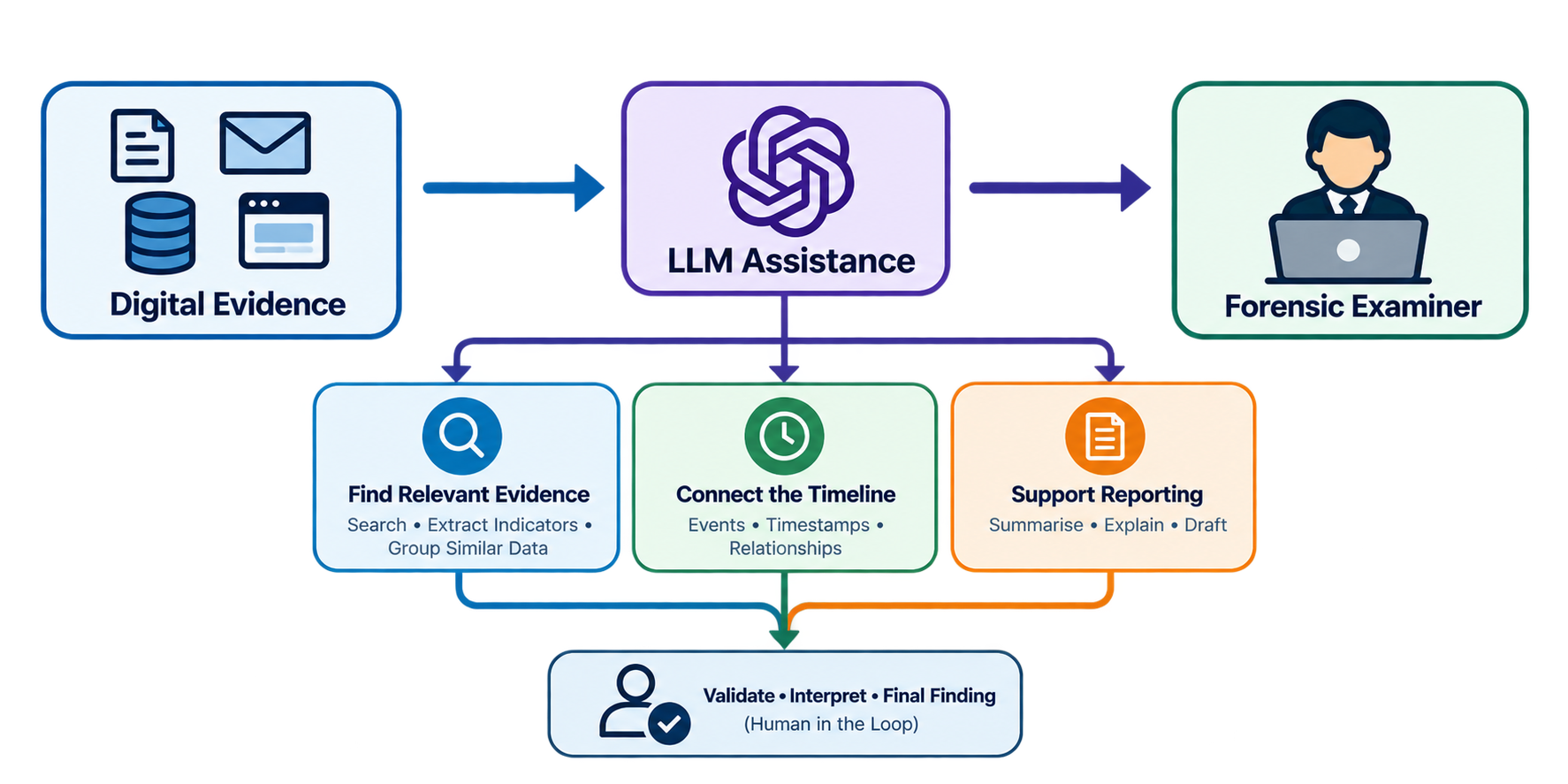
Consider a case involving a suspected phishing incident. A forensic examiner may have email headers, message bodies, attachments, browser history, DNS records and system logs. An LLM can help organize text-based evidence, spot repeated terms pull out indicators such as domains or IP addresses and cluster related events for review. Research on LLM-assisted forensics says that pattern recognition and early evidence analysis are promising use cases.[1][3]
Connecting the timeline
Investigations often rely on order: what happened first what followed and which artefacts back that order. An LLM can turn amounts of timestamped data into a clear timeline or point out records that seem related. The key point is that the LLM helps an examiner see relationships; it does not independently prove that one event caused another.
Making forensic reporting easier to understand
A good forensic report should be understandable to technical and non-technical readers. LLMs can help turn examiner notes or structured findings into clearer draft language, summaries or executive explanations. This is particularly useful when an investigation contains technical terms that need to be explained without losing their meaning. Research also identifies evidence presentation and reporting as a potential area for LLM assistance.[1]
A realistic example
Imagine an organisation reports that an employee account may have been compromised. The examiner collects the relevant disk image, authentication logs, browser history and email data using established procedures. After preservation and examination with validated tools, a controlled set of extracted text or structured artefacts could be given to an LLM. It might identify unusual login patterns, highlight a suspicious domain appearing in multiple sources, and draft questions for further examination.
The examiner then checks those observations against the original evidence and forensic tool outputs. If the model says a login occurred at 10:14, that timestamp must be verified in the source log. If it suggests that two events are linked, the relationship must be supported by evidence. The model can accelerate the search, but the evidence remains the foundation of the conclusion.
Why an LLM cannot simply replace the investigator
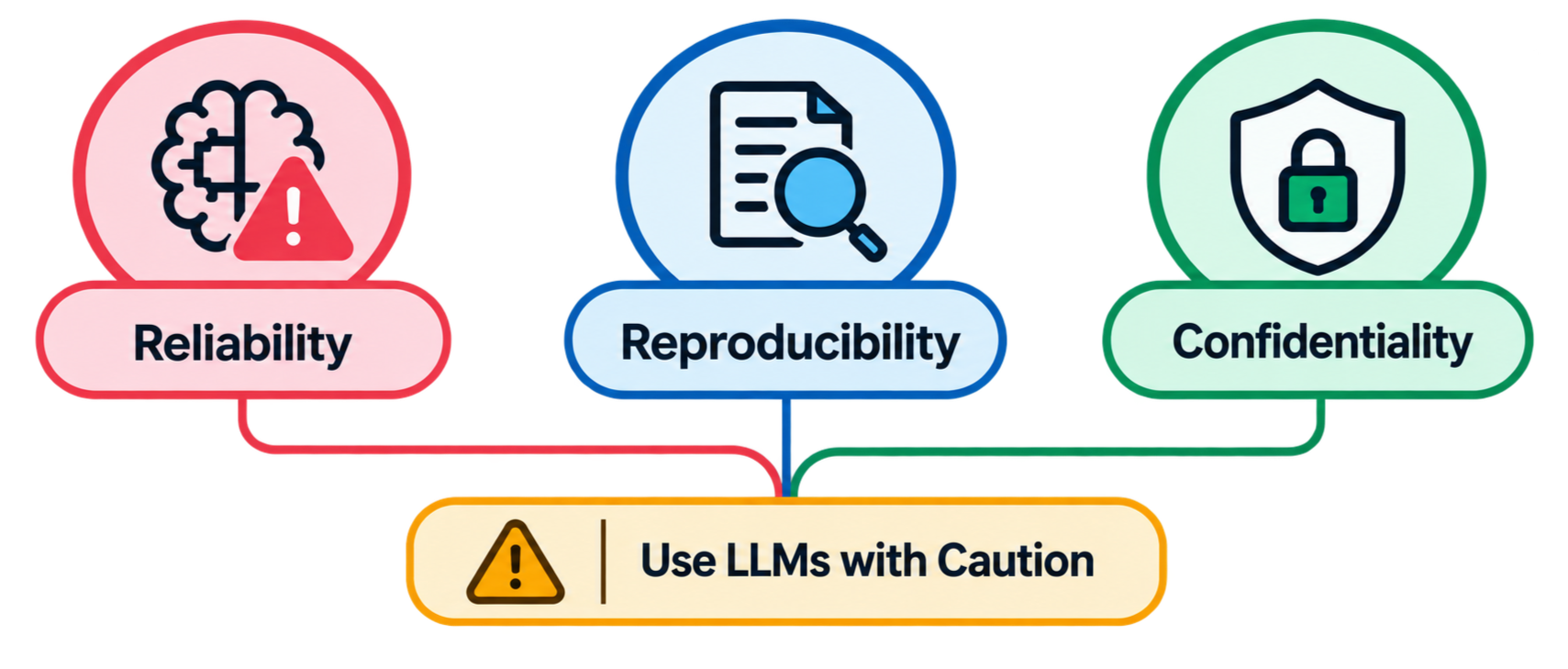
The biggest challenge is reliability. LLMs can produce fluent answers that sound convincing even when the answer is wrong. The 2026 systematic review of 33 peer-reviewed works on LLMs in digital forensics highlights hallucination, explainability, reproducibility and legal admissibility as major concerns.[1] In forensic work, an incorrect sentence is not just a minor inconvenience; it can change how a case is understood.
There is also a reproducibility problem. Traditional forensic practice depends on validated processes, integrity checks and documentation. NIST recommends verifying acquired data and recording actions and tools so work can be repeated.[4] LLM output can vary with the model, settings, context and system version. That makes raw model output unsuitable as forensic proof on its own.
Another concern is confidentiality. Evidence may contain personal information, credentials, private communications or sensitive organisational data. Sending it to an external AI service without proper controls can create a privacy and governance risk. NIST’s Generative AI Profile stresses managing risks across the AI lifecycle.[5]
What responsible LLM-assisted forensics could look like
A practical approach is to keep the examiner in control. The LLM should receive only the information needed for the task, preferably through a controlled environment with access restrictions and logging. Critical findings should always link back to the source artefact rather than being accepted because the model sounds confident.
A simple operational principle is: -
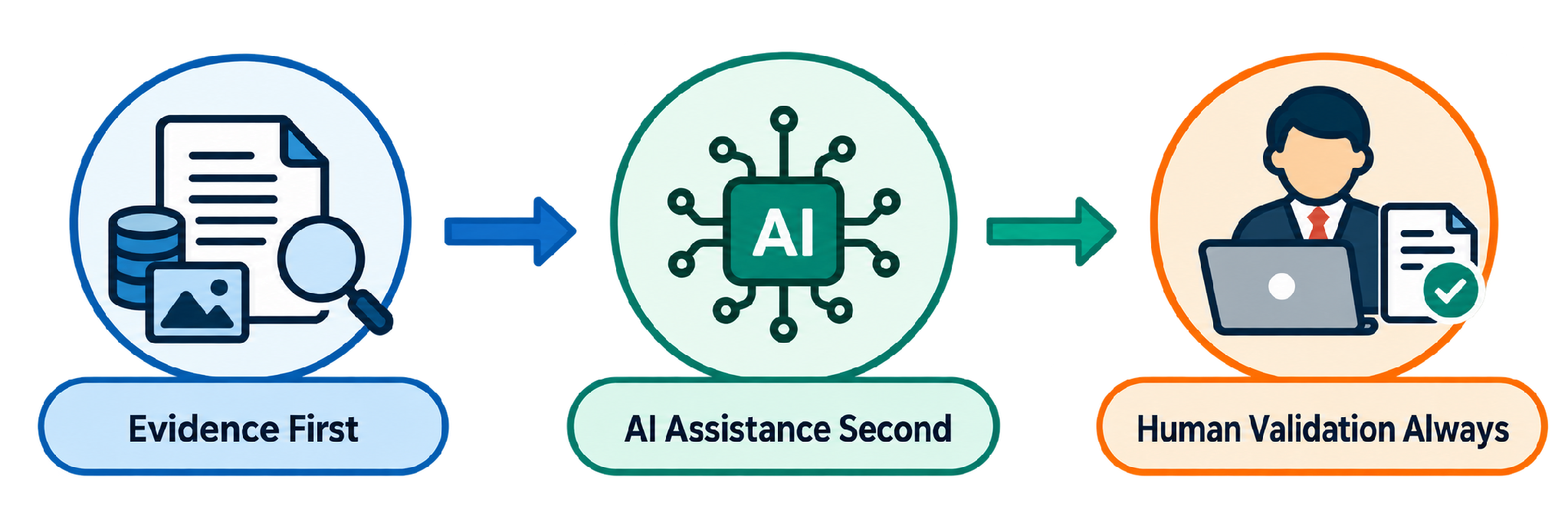
In practice, this means preserving and hashing evidence, using validated forensic tools for acquisition and examination, recording what data was supplied to the AI system, retaining relevant prompts and outputs in working notes, and independently verifying material claims. SWGDE guidance likewise emphasises protecting the integrity of evidence and documenting handling throughout the evidence lifecycle.[6]
A further possibility is a local or specialised forensic model. Research on “ForensicLLM” demonstrates this direction, including source attribution and retrieval-augmented approaches.[2] Such designs may provide a more controlled environment, but they still require testing and validation before operational use.
Conclusion
LLMs are unlikely to make the forensic examiner irrelevant. Their more realistic value is in helping the examiner deal with the scale and complexity of modern evidence. They can search, summarise, classify, correlate and help communicate findings, but these capabilities come with limitations that matter deeply in forensic work. A forensic conclusion must remain traceable to evidence, repeatable through a documented process and open to independent verification.[1][4]
The future of AI-assisted digital forensics is therefore less about replacing investigators and more about designing a disciplined partnership between human expertise and machine assistance. The strongest model is one in which AI speeds up the routine parts of an investigation while the examiner remains responsible for validation, interpretation and final conclusions. As research develops, the real question will not simply be whether an LLM is intelligent enough to analyse evidence, but whether the complete system around it is controlled, explainable and trustworthy enough for forensic use.
References / Endnotes
[1] Chernyshev, M., Baig, Z., Syed, N., Doss, R., & Shore, M. (2026). “Large language models in digital forensics: capabilities, challenges and future directions.” Forensic Science International: Digital Investigation, 56, 302043. https://doi.org/10.1016/j.fsidi.2025.302043
[2] “ForensicLLM: A local large language model for digital forensics.” Forensic Science International: Digital Investigation, 52, Supplement, 301872 (2025). https://doi.org/10.1016/j.fsidi.2025.301872
[3] Wickramasekara, A., Breitinger, F., & Scanlon, M. (2025). “Exploring the Potential of Large Language Models for Improving Digital Forensic Investigation Efficiency.” Forensic Science International: Digital Investigation, 52, 301859. https://doi.org/10.1016/j.fsidi.2024.301859
[4] Kent, K., Chevalier, S., Grance, T., & Dang, H. (2006). Guide to Integrating Forensic Techniques into Incident Response, NIST Special Publication 800-86. National Institute of Standards and Technology. https://doi.org/10.6028/NIST.SP.800-86
[5] Autio, C., Schwartz, R., Dunietz, J., Jain, S., Stanley, M., Tabassi, E., Hall, P., & Roberts, K. (2024). Artificial Intelligence Risk Management Framework: Generative Artificial Intelligence Profile, NIST AI 600-1. National Institute of Standards and Technology. https://doi.org/10.6028/NIST.AI.600-1
[6] Scientific Working Group on Digital Evidence (SWGDE). Best Practices for Digital Evidence Collection, 18-F-002-2.0. https://www.swgde.org/documents/published-complete-listing/18-f-002-2-0/

Related Blogs

Introduction
Assisted Reproductive Technology (“ART”) refers to a diverse set of medical procedures designed to aid individuals or couples in achieving pregnancy when conventional methods are unsuccessful. This umbrella term encompasses various fertility treatments, including in vitro fertilization (IVF), intrauterine insemination (IUI), and gamete and embryo manipulation. ART procedures involve the manipulation of both male and female reproductive components to facilitate conception.
The dynamic landscape of data flows within the healthcare sector, notably in the realm of ART, demands a nuanced understanding of the complex interplay between privacy regulations and medical practices. In this context, the Information Technology (Reasonable Security Practices And Procedures And Sensitive Personal Data Or Information) Rules, 2011, play a pivotal role, designating health information as "sensitive personal data or information" and underscoring the importance of safeguarding individuals' privacy. This sensitivity is particularly pronounced in the ART sector, where an array of personal data, ranging from medical records to genetic information, is collected and processed. The recent Assisted Reproductive Technology (Regulation) Act, 2021, in conjunction with the Digital Personal Data Protection Act, 2023, establishes a framework for the regulation of ART clinics and banks, presenting a layered approach to data protection.
A note on data generated by ART
Data flows in any sector are scarcely uniform and often not easily classified under straight-jacket categories. Consequently, mapping and identifying data and its types become pivotal. It is believed that most data flows in the healthcare sector are highly sensitive and personal in nature, which may severely compromise the privacy and safety of an individual if breached. The Information Technology (Reasonable Security Practices And Procedures And Sensitive Personal Data Or Information) Rules, 2011 (“SPDI Rules”) categorizes any information pertaining to physical, physiological, mental conditions or medical records and history as “sensitive personal data or information”; this definition is broad enough to encompass any data collected by any ART facility or equipment. These include any information collected during the screening of patients, pertaining to ovulation and menstrual cycles, follicle and sperm count, ultrasound results, blood work etc. It also includes pre-implantation genetic testing on embryos to detect any genetic abnormality.
But data flows extend beyond mere medical procedures and technology. Health data also involves any medical procedures undertaken, the amount of medicine and drugs administered during any procedure, its resultant side effects, recovery etc. Any processing of the above-mentioned information, in turn, may generate more personal data points relating to an individual’s political affiliations, race, ethnicity, genetic data such as biometrics and DNA etc.; It is seen that different ethnicities and races react differently to the same/similar medication and have different propensities to genetic diseases. Further, it is to be noted that data is not only collected by professionals but also by intelligent equipment like AI which may be employed by any facility to render their service. Additionally, dissemination of information under exceptional circumstances (e.g. medical emergency) also affects how data may be classified. Considerations are further nuanced when the fundamental right to identity of a child conceived and born via ART may be in conflict with the fundamental right to privacy of a donor to remain anonymous.
Intersection of Privacy laws and ART laws:
In India, ART technology is regulated by the Assisted Reproductive Technology (Regulation) Act, 2021 (“ART Act”). With this, the Union aims to regulate and supervise assisted reproductive technology clinics and ART banks, prevent misuse and ensure safe and ethical practice of assisted reproductive technology services. When read with the Digital Personal Data Protection Act, 2023 (“DPDP Act”) and other ancillary guidelines, the two legislations provide some framework regulations for the digital privacy of health-based apps.
The ART Act establishes a National Assisted Reproductive Technology and Surrogacy Registry (“National Registry”) which acts as a central database for all clinics and banks and their nature of services. The Act also establishes a National Assisted Reproductive Technology and Surrogacy Board (“National Board”) under the Surrogacy Act to monitor the implementation of the act and advise the central government on policy matters. It also supervises the functioning of the National Registry, liaises with State Boards and curates a code of conduct for professionals working in ART clinics and banks. Under the DPDP Act, these bodies (i.e. National Board, State Board, ART clinics and banks) are most likely classified as data fiduciaries (primarily clinics and banks), data processors (these may include National Board and State boards) or an amalgamation of both (these include any appropriate authority established under the ART Act for investigation of complaints, suspend or cancellation of registration of clinics etc.) depending on the nature of work undertaken by them. If so classified, then the duties and liabilities of data fiduciaries and processors would necessarily apply to these bodies. As a result, all bodies would necessarily have to adopt Privacy Enhancing Technologies (PETs) and other organizational measures to ensure compliance with privacy laws in place. This may be considered one of the most critical considerations of any ART facility since any data collected by them would be sensitive personal data pertaining to health, regulated by the Information Technology (Reasonable Security Practices And Procedures And Sensitive Personal Data Or Information) Rules, 2011 (“SPDI Rules 2011”). These rules provide for how sensitive personal data or information are to be collected, handled and processed by anyone.
The ART Act independently also provides for the duties of ART clinics and banks in the country. ART clinics and banks are required to inform the commissioning couple/woman of all procedures undertaken and all costs, risks, advantages, and side effects of their selected procedure. It mandatorily ensures that all information collected by such clinics and banks to not informed to anyone except the database established by the National Registry or in cases of medical emergency or on order of court. Data collected by clinics and banks (these include details on donor oocytes, sperm or embryos used or unused) are required to be detailed and must be submitted to the National Registry online. ART banks are also required to collect personal information of donors including name, Aadhar number, address and any other details. By mandating online submission, the ART Act is harmonized with the DPDP Act, which regulates all digital personal data and emphasises free, informed consent.
Conclusion
With the increase in active opt-ins for ART, data privacy becomes a vital consideration for all healthcare facilities and professionals. Safeguard measures are not only required on a corporate level but also on a governmental level. It is to be noted that in the 262 Session of the Rajya Sabha, the Ministry of Electronics and Information Technology reported 165 data breach incidents involving citizen data from January 2018 to October 2023 from the Central Identities Data Repository despite publicly denying. This discovery puts into question the safety and integrity of data that may be submitted to the National Registry database, especially given the type of data (both personal and sensitive information) it aims to collate. At present the ART Act is well supported by the DPDP Act. However, further judicial and legislative deliberations are required to effectively regulate and balance the interests of all stakeholders.
References
- The Information Technology (Reasonable Security Practices And Procedures And Sensitive Personal Data Or Information) Rules, 2011
- Caring for Intimate Data in Fertility Technologies https://dl.acm.org/doi/pdf/10.1145/3411764.3445132
- Digital Personal Data Protection Act, 2023
- https://www.wolterskluwer.com/en/expert-insights/pharmacogenomics-and-race-can-heritage-affect-drug-disposition

On 22nd October 2024, Jyotiraditya Scindia, Union Minister for Communications, launched the (DoT) Department of Telecoms’ International Incoming Spoofed Calls Prevention System. This was introduced in light of efforts toward preventing international fraudulent calls that enable cyber crimes. A recent report as per PIB claims for the system to have been effective and played a role in a 90% reduction in the number of spoofed international calls, its instances falling from 1.35 Crore to 6 Lakhs within two months of the launch of the system.
International spoof calls are calls that masquerade as numbers originating from within the country when displayed on the target's mobile screen. This is done by manipulating the calling line identity or the CLI, commonly known as the phone number. Previous cases reported mention that such spoof calls have been used for conducting financial scams, impersonating government officials to carry out digital arrests, and inducing panic. Instances of threats of disconnecting numbers by TRAI officials, and narcotics officials on finding drugs or even contraband through couriers are also rampant.
International Incoming Spoofed Calls Prevention System
As was addressed in the Budget in 2024, the system was previously called the Centralised International Out Roamer (CIOR), and the DoT was allocated Rs.38.76 crore for the same. The Digital Intelligence Unit (DIU) under the DoT is another project that aims to investigate and research fraudulent use of telecom resources, including messages, scams, and spam - the budget for which has been increased from 50 to 85 crores.
The International Incoming Spoofed Calls Prevention System was implemented in two phases, the first one was at the level of the telephone companies (telcos). Telcos can verify their subscribers and Indian SIMs based on the Indian Telecom Service Providers (TSPs) international long-distance (ILD) network. When a user with an Indian number travels abroad, the roaming feature gets activated, and all calls hit the ILD network of the TSP. This allows the TSP to verify whether the numbers starting with +91 are genuinely making calls from abroad or from India. However, a TSP can only verify numbers that are issued with their TSP ILD network and not those of other TSPs. This issue was addressed in the second phase, as the DIU of DoT and the TSPs built an integrated system so that a centralised database could be used to check for genuine subscribers.
CyberPeace Outlook
A press release on 23rd December 2024 encouraged the TSPs to label incoming International calls as International calls on the mobile screen of the receiver. Some of them have already started adding labels and are sending awareness messages informing their subscribers of tips on staying safe from scams. Apart from these, there are also applications available online that help in identifying callers and their location, however, these are at the behest of the users' efforts and have moderate trust value. At the level of the public, the practice of blocking unknown international numbers and not calling back, along with awareness regarding country codes is encouraged. Coordinated and updated efforts on the part of the Government and the TSPs are much appreciated in today's time as scammers continue to find new ways to commit cyber crimes using telecommunication resources.
References
- https://www.hindustantimes.com/india-news/jyotiraditya-scindia-launches-dot-system-to-block-spam-international-calls-101729615441509.html
- https://www.business-standard.com/india-news/centre-launches-system-to-block-international-spoofed-calls-curb-fraud-124102300449_1.html
- https://www.opindia.com/2024/12/number-of-spoofed-international-calls-used-in-cyber-crimes-goes-down-by-90-in-2-months/
- https://www.cnbctv18.com/technology/telecom/telecom-department-anti-spoofed-international-calls-19529459.htm
- https://pib.gov.in/PressReleaseIframePage.aspx?PRID=2067113
- https://pib.gov.in/PressReleasePage.aspx?PRID=2087644
- https://www.hindustantimes.com/india-news/display-international-call-for-calls-from-abroad-to-curb-scams-dot-to-telecos-101735050551449.html

Introduction
In a world where social media dictates public perception and content created by AI dilutes the difference between fact and fiction, mis/disinformation has become a national cybersecurity threat. Today, disinformation campaigns are designed for their effect, with political manipulation, interference in public health, financial fraud, and even community violence. India, with its 900+ million internet users, is especially susceptible to this distortion online. The advent of deep fakes, AI-text, and hyper-personalised propaganda has made disinformation more plausible and more difficult to identify than ever.
What is Misinformation?
Misinformation is false or inaccurate information provided without intent to deceive. Disinformation, on the other hand, is content intentionally designed to mislead and created and disseminated to harm or manipulate. Both are responsible for what experts have termed an "infodemic", overwhelming people with a deluge of false information that hinders their ability to make decisions.
Examples of impactful mis/disinformation are:
- COVID-19 vaccine conspiracy theories (e.g., infertility or microchips)
- Election-related false news (e.g., EVM hacking so-called)
- Social disinformation (e.g., manipulated videos of riots)
- Financial scams (e.g., bogus UPI cashbacks or RBI refund plans)
How Misinformation Spreads
Misinformation goes viral because of both technology design and human psychology. Social media sites such as Facebook, X (formerly Twitter), Instagram, and WhatsApp are designed to amplify messages that elicit high levels of emotional reactions are usually polarising, sensationalistic, or fear-mongering posts. This causes falsehoods or misinformation to get much more attention and activity than authentic facts, and therefore prioritises virality over truth.
Another major consideration is the misuse of generative AI and deep fakes. Applications like ChatGPT, Midjourney, and ElevenLabs can be used to generate highly convincing fake news stories, audio recordings, or videos imitating public figures. These synthetic media assets are increasingly being misused by bad actors for political impersonation, propagating fabricated news reports, and even carrying out voice-based scams.
To this danger are added coordinated disinformation efforts that are commonly operated by foreign or domestic players with certain political or ideological objectives. These efforts employ networks of bot networks on social media, deceptive hashtags, and fabricated images to sway public opinion, especially during politically sensitive events such as elections, protests, or foreign wars. Such efforts are usually automated with the help of bots and meme-driven propaganda, which makes them scalable and traceless.
Why Misinformation is Dangerous
Mis/disinformation is a significant threat to democratic stability, public health, and personal security. Perhaps one of the most pernicious threats is that it undermines public trust. If it goes unchecked, then it destroys trust in core institutions like the media, judiciary, and electoral system. This erosion of public trust has the potential to destabilise democracies and heighten political polarisation.
In India, false information has had terrible real-world outcomes, especially in terms of creating violence. Misleading messages regarding child kidnappers on WhatsApp have resulted in rural mob lynching. As well, communal riots have been sparked due to manipulated religious videos, and false terrorist warnings have created public panic.
The pandemic of COVID-19 also showed us how misinformation can be lethal. Misinformation regarding vaccine safety, miracle cures, and the source of viruses resulted in mass vaccine hesitancy, utilisation of dangerous treatments, and even avoidable deaths.
Aside from health and safety, mis/disinformation has also been used in financial scams. Cybercriminals take advantage of the fear and curiosity of the people by promoting false investment opportunities, phishing URLs, and impersonation cons. Victims get tricked into sharing confidential information or remitting money using seemingly official government or bank websites, leading to losses in crypto Ponzi schemes, UPI scams, and others.
India’s Response to Misinformation
- PIB Fact Check Unit
The Press Information Bureau (PIB) operates a fact-checking service to debunk viral false information, particularly on government policies. In 3 years, the unit identified more than 1,500 misinformation posts across media.
- Indian Cybercrime Coordination Centre (I4C)
Working under MHA, I4C has collaborated with social media platforms to identify sources of viral misinformation. Through the Cyber Tipline, citizens can report misleading content through 1930 or cybercrime.gov.in.
- IT Rules (The Information Technology (Intermediary Guidelines and Digital Media Ethics Code) Rules, 2021 [updated as on 6.4.2023]
The Information Technology (Intermediary Guidelines) Rules were updated to enable the government to following aspects:
- Removal of unlawful content
- Platform accountability
- Detection Tools
There are certain detection tool that works as shields in assisting fact-checkers and enforcement bodies to:
- Identify synthetic voice and video scams through technical measures.
- Track misinformation networks.
- Label manipulated media in real-time.
CyberPeace View: Solutions for a Misinformation-Resilient Bharat
- Scale Digital Literacy
"Think Before You Share" programs for rural schools to teach students to check sources, identify clickbait, and not reshare fake news.
- Platform Accountability
Technology platforms need to:
- Flag manipulated media.
- Offer algorithmic transparency.
- Mark AI-created media.
- Provide localised fact-checking across diverse Indian languages.
- Community-Led Verification
Establish WhatsApp and Telegram "Fact Check Hubs" headed by expert organisations, industry experts, journalists, and digital volunteers who can report at the grassroots level fake content.
- Legal Framework for Deepfakes
Formulate targeted legislation under the Bhartiya Nyaya Sanhita (BNS) and other relevant laws to make malicious deepfake and synthetic media use a criminal offense for:
- Electoral manipulation.
- Defamation.
- Financial scams.
- AI Counter-Misinformation Infrastructure
Invest in public sector AI models trained specifically to identify:
- Coordinated disinformation patterns.
- Botnet-driven hashtag campaigns.
- Real-time viral fake news bursts.
Conclusion
Mis/disinformation is more than just a content issue, it's a public health, cybersecurity, and democratic stability challenge. As India enters the digitally empowered world, making a secure, informed, and resilient information ecosystem is no longer a choice; now, it's imperative. Fighting misinformation demands a whole-of-society effort with AI innovation, public education, regulatory overhaul, and tech responsibility. The danger is there, but so is the opportunity to guide the world toward a fact-first, trust-based digital age. It's time to act.
References
- https://www.pib.gov.in/factcheck.aspx
- https://www.meity.gov.in/static/uploads/2024/02/Information-Technology-Intermediary-Guidelines-and-Digital-Media-Ethics-Code-Rules-2021-updated-06.04.2023-.pdf
- https://www.cyberpeace.org
- https://www.bbc.com/news/topics/cezwr3d2085t
- https://www.logically.ai
- https://www.altnews.in
