
#FactCheck - Deepfake Video Falsely Claims Indian Defence Secretary Admitted Pakistan ‘Jammed Indian Systems’
Executive Summary
A video allegedly showing India’s Defence Secretary Rajesh Kumar Singh making remarks about Pakistan’s cyber capabilities is being widely shared on social media. The clip claims that Singh admitted Pakistan had “jammed Indian systems” on May 10 and described Pakistan’s cyber and electronic warfare capabilities as a major challenge for India. Research by CyberPeace Research Wing found that the viral clip is an AI-generated deepfake being circulated to spread misinformation. Rajesh Kumar Singh never made any such statement.
Claim
An X user shared the viral video claiming that India’s Defence Secretary had acknowledged Pakistan’s technological superiority. The post alleged that Singh admitted Pakistan successfully jammed Indian systems and claimed that India was lagging behind in cyber and electronic warfare technology.

Fact Check
To verify the claim, we searched relevant keywords on Google but found no credible media reports carrying such a statement from the Defence Secretary. We then extracted keyframes from the viral clip and conducted a reverse image search. During the research, we found the original video uploaded on the YouTube channel of ANI on April 30, 2026.

A review of the full video confirmed that Rajesh Kumar Singh never made the remarks heard in the viral clip. The original footage had been manipulated and altered using AI-generated audio techniques.
Conclusion
Our research confirms that the viral video is fake and AI-manipulated. The statement attributed to India’s Defence Secretary Rajesh Kumar Singh is fabricated, and the deepfake clip is being shared with misleading claims to spread disinformation.

Related Blogs

Brief Overview of the EU AI Act
The EU AI Act, Regulation (EU) 2024/1689, was officially published in the EU Official Journal on 12 July 2024. This landmark legislation on Artificial Intelligence (AI) will come into force just 20 days after publication, setting harmonized rules across the EU. It amends key regulations and directives to ensure a robust framework for AI technologies. The AI Act, a set of EU rules governing AI, has been in development for two years and now, the EU AI Act enters into force across all 27 EU Member States on 1 August 2024, with certain future deadlines tied up and the enforcement of the majority of its provisions will commence on 2 August 2026. The law prohibits certain uses of AI tools, including those that threaten citizens' rights, such as biometric categorization, untargeted scraping of faces, and systems that try to read emotions are banned in the workplace and schools, as are social scoring systems. It also prohibits the use of predictive policing tools in some instances. The law takes a phased approach to implementing the EU's AI rulebook, meaning there are various deadlines between now and then as different legal provisions will start to apply.
The framework puts different obligations on AI developers, depending on use cases and perceived risk. The bulk of AI uses will not be regulated as they are considered low-risk, but a small number of potential AI use cases are banned under the law. High-risk use cases, such as biometric uses of AI or AI used in law enforcement, employment, education, and critical infrastructure, are allowed under the law but developers of such apps face obligations in areas like data quality and anti-bias considerations. A third risk tier also applies some lighter transparency requirements for makers of tools like AI chatbots.
In case of failure to comply with the Act, the companies in the EU providing, distributing, importing, and using AI systems and GPAI models, are subject to fines of up to EUR 35 million or seven per cent of the total worldwide annual turnover, whichever is higher.
Key highlights of EU AI Act Provisions
- The AI Act classifies AI according to its risk. It prohibits Unacceptable risks such as social scoring systems and manipulative AI. The regulation mostly addresses high-risk AI systems.
- Limited-risk AI systems are subject to lighter transparency obligations and according to the act, the developers and deployers must ensure that the end-users are aware that the interaction they are having is with AI such as Chatbots and Deepfakes. The AI Act allows the free use of minimal-risk AI. This includes the majority of AI applications currently available in the EU single market like AI-enabled video games, and spam filters, but with the advancement of Gen AI changes with regards to this might be done. The majority of obligations fall on providers (developers) of high-risk AI systems that intend to place on the market or put into service high-risk AI systems in the EU, regardless of whether they are based in the EU or a third country. And also, a third-country provider where the high-risk AI system’s output is used in the EU.
- Users are natural or legal persons who deploy an AI system in a professional capacity, not affected end-users. Users (deployers) of high-risk AI systems have some obligations, though less than providers (developers). This applies to users located in the EU, and third-country users where the AI system’s output is used in the EU.
- General purpose AI or GPAI model providers must provide technical documentation, and instructions for use, comply with the Copyright Directive, and publish a summary of the content used for training. Free and open license GPAI model providers only need to comply with copyright and publish the training data summary, unless they present a systemic risk. All providers of GPAI models that present a systemic risk – open or closed – must also conduct model evaluations, and adversarial testing, and track and report serious incidents and ensure cybersecurity protections.
- The Codes of Practice will account for international approaches. It will cover but not necessarily be limited to the obligations, particularly the relevant information to include in technical documentation for authorities and downstream providers, identification of the type and nature of systemic risks and their sources, and the modalities of risk management accounting for specific challenges in addressing risks due to the way they may emerge and materialize throughout the value chain. The AI Office may invite GPAI model providers, and relevant national competent authorities to participate in drawing up the codes, while civil society, industry, academia, downstream providers and independent experts may support the process.
Application & Timeline of Act
The EU AI Act will be fully applicable 24 months after entry into force, but some parts will be applicable sooner, for instance the ban on AI systems posing unacceptable risks will apply six months after the entry into force. The Codes of Practice will apply nine months after entry into force. Rules on general-purpose AI systems that need to comply with transparency requirements will apply 12 months after the entry into force. High-risk systems will have more time to comply with the requirements as the obligations concerning them will become applicable 36 months after the entry into force. The expected timeline for the same is:
- August 1st, 2024: The AI Act will enter into force.
- February 2025: Prohibition of certain AI systems - Chapters I (general provisions) & II (prohibited AI systems) will apply; Prohibition of certain AI systems.
- August 2025: Chapter III Section 4 (notifying authorities), Chapter V (general purpose AI models), Chapter VII (governance), Chapter XII (confidentiality and penalties), and Article 78 (confidentiality) will apply, except for Article 101 (fines for General Purpose AI providers); Requirements for new GPAI models.
- August 2026: The whole AI Act applies, except for Article 6(1) & corresponding obligations (one of the categories of high-risk AI systems);
- August 2027: Article 6(1) & corresponding obligations apply.
The AI Act sets out clear definitions for the different actors involved in AI, such as the providers, deployers, importers, distributors, and product manufacturers. This means all parties involved in the development, usage, import, distribution, or manufacturing of AI systems will be held accountable. Along with this, the AI Act also applies to providers and deployers of AI systems located outside of the EU, e.g., in Switzerland, if output produced by the system is intended to be used in the EU. The Act applies to any AI system within the EU that is on the market, in service, or in use, covering both AI providers (the companies selling AI systems) and AI deployers (the organizations using those systems).
In short, the AI Act will apply to different companies across the AI distribution chain, including providers, deployers, importers, and distributors (collectively referred to as “Operators”). The EU AI Act also has extraterritorial application and can also apply to companies not established in the EU, or providers outside the EU if they -make an AI system or GPAI model available on the EU market. Even if only the output generated by the AI system is used in the EU, the Act still applies to such providers and deployers.
CyberPeace Outlook
The EU AI Act, approved by EU lawmakers in 2024, is a landmark legislation designed to protect citizens' health, safety, and fundamental rights from potential harm caused by AI systems. The AI Act will apply to AI systems and GPAI models. The Act creates a tiered risk categorization system with various regulations and stiff penalties for noncompliance. The Act adopts a risk-based approach to AI governance, categorizing potential risks into four tiers: unacceptable, high, limited, and low. Violations of banned systems carry the highest fine: €35 million, or 7 percent of global annual revenue. It establishes transparency requirements for general-purpose AI systems. The regulation also provides specific rules for general-purpose AI (GPAI) models and lays down more stringent requirements for GPAI models with 'high-impact capabilities' that could pose a systemic risk and have a significant impact on the internal market. For high-risk AI systems, the AI Act addresses the issues of fundamental rights impact assessment and data protection impact assessment.
The EU AI Act aims to enhance trust in AI technologies by establishing clear regulatory standards governing AI. We encourage regulatory frameworks that strive to balance the desire to foster innovation with the critical need to prevent unethical practices that may cause user harm. The legislation can be seen as strengthening the EU's position as a global leader in AI innovation and developing regulatory frameworks for emerging technologies. It sets a global benchmark for regulating AI. The companies to which the act applies will need to make sure their practices align with the same. The act may inspire other nations to develop their own legislation contributing to global AI governance. The world of AI is complex and challenging, the implementation of regulatory checks, and compliance by the concerned companies, all pose a conundrum. However, in the end, balancing innovation with ethical considerations is paramount.
At the same hand, the tech sector welcomes regulatory progress but warns that overly-rigid regulations could stifle innovation. Hence flexibility and adaptability are key to effective AI governance. The journey towards robust AI regulation has begun in major countries, and it is important that we find the right balance between safety and innovation and also take into consideration the industry reactions.
References:
- https://eur-lex.europa.eu/legal-content/EN/TXT/PDF/?uri=OJ:L_202401689
- https://www.theverge.com/2024/7/12/24197058/eu-ai-act-regulations-bans-deadline
- https://techcrunch.com/2024/07/12/eus-ai-act-gets-published-in-blocs-official-journal-starting-clock-on-legal-deadlines/
- https://www.wsgr.com/en/insights/eu-ai-act-to-enter-into-force-in-august.html
- https://www.techtarget.com/searchenterpriseai/tip/Is-your-business-ready-for-the-EU-AI-Act
- https://www.simmons-simmons.com/en/publications/clyimpowh000ouxgkw1oidakk/the-eu-ai-act-a-quick-guide

Introduction
Discussions took place focused on cybersecurity measures, specifically addressing cybercrime in the context of emerging technologies such as Non-Fungible Tokens (NFTs), Artificial Intelligence (AI), and the Metaverse. Session 5 of the conference focused on the interconnectedness between the darknet and cryptocurrency and the challenges it poses for law enforcement agencies and regulators. They discussed that Understanding AI is necessary for enterprises. AI models have difficulties, but we are looking forward to trustworthy AIs. and AI technology must be transparent.
Darknet and Cryptocurrency
The darknet refers to the hidden part of the internet where illicit activities have proliferated in recent years. It was initially developed to provide anonymity, privacy, and protection to specific individuals such as journalists, activists, and whistleblowers. However, it has now become a playground for criminal activities. Cryptocurrency, particularly Bitcoin, has been widely adopted on the darknet due to its anonymous nature, enabling anti-money laundering and unlawful transactions.
Three major points emerge from this relationship: the integrated nature of the darknet and cryptocurrency, the need for regulations to prevent darknet-based crimes, and the importance of striking a balance between privacy and security.
Key Challenges:
- Integrated Relations: The darknet and cryptocurrency have evolved independently, with different motives and purposes. It is crucial to understand the integrated relationship between them and how criminals exploit this connection.
- Regulatory Frameworks: There is a need for effective regulations to prevent crimes facilitated through the darknet and cryptocurrency while striking a balance between privacy and security.
- Privacy and Security: Privacy is a fundamental right, and any measures taken to enhance security should not infringe upon individual privacy. A multistakeholder approach involving tech companies and regulators is necessary to find this delicate balance.
Challenges Associated with Cryptocurrency Use:
The use of cryptocurrency on the darknet poses several challenges. The risks associated with darknet-based cryptocurrency crimes are a significant concern. Additionally, regulatory challenges arise due to the decentralised and borderless nature of cryptocurrencies. Mitigating these challenges requires innovative approaches utilising emerging technologies.
Preventing Misuse of Technologies:
The discussion emphasised that we can step ahead of the people who wish to use these beautiful technologies meant and developed for a different purpose, to prevent from using them for crime.
Monitoring the Darknet:
The darknet, as explained, is an elusive part of the internet that necessitates the use of a special browser for access. Initially designed for secure communication by the US government, its purpose has drastically changed over time. The darknet’s evolution has given rise to significant challenges for law enforcement agencies striving to monitor its activities.
Around 95% of the activities carried out on the dark net are associated with criminal acts. Estimates suggest that over 50% of the global cybercrime revenue originates from the dark net. This implies that approximately half of all cybercrimes are facilitated through the darknet.
The exploitation of the darknet has raised concerns regarding the need for effective regulation. Monitoring the darknet is crucial for law enforcement, national agencies, and cybersecurity companies. The challenges associated with the darknet’s exploitation and the criminal activities facilitated by cryptocurrency emphasise the pressing need for regulations to ensure a secure digital landscape.
Use of Cryptocurrency on the Darknet
Cryptocurrency plays a central role in the activities taking place on the darknet. The discussion highlighted its involvement in various illicit practices, including ransomware attacks, terrorist financing, extortion, theft, and the operation of darknet marketplaces. These applications leverage cryptocurrency’s anonymous features to enable illegal transactions and maintain anonymity.
AI's Role in De-Anonymizing the Darknet and Monitoring Challenges:
- 1.AI’s Potential in De-Anonymizing the Darknet
During the discussion, it was highlighted how AI could be utilised to help in de-anonymizing the darknet. AI’s pattern recognition capabilities can aid in identifying and analysing patterns of behaviour within the darknet, enabling law enforcement agencies and cybersecurity experts to gain insights into its operations. However, there are limitations to what AI can accomplish in this context. AI cannot break encryption or directly associate patterns with specific users, but it can assist in identifying illegal marketplaces and facilitating their takedown. The dynamic nature of the darknet, with new marketplaces quickly emerging, adds further complexity to monitoring efforts.
- 2.Challenges in Darknet Monitoring
Monitoring the darknet poses various challenges due to its vast amount of data, anonymous and encrypted nature, dynamically evolving landscape, and the need for specialised access. These challenges make it difficult for law enforcement agencies and cybersecurity professionals to effectively track and prevent illicit activities.
- 3.Possible Ways Forward
To address the challenges, several potential avenues were discussed. Ethical considerations, striking a balance between privacy and security, must be taken into account. Cross-border collaboration, involving the development of relevant laws and policies, can enhance efforts to combat darknet-related crimes. Additionally, education and awareness initiatives, driven by collaboration among law enforcement, government entities, and academia, can play a crucial role in combating darknet activities.
The panel also addressed the questions from the audience
- How law enforcement agencies and regulators can use AI to detect and prevent crimes on the darknet and cryptocurrency? The panel answered that- Law enforcement officers should also be AI and technology ready, and that kind of upskilling program should be there in place.
- How should lawyers and the judiciary understand the problem and regulate it? The panel answered that AI should only be applied by looking at the outcomes. And Law has to be clear as to what is acceptable and what is not.
- Aligning AI with human intention? Whether it’s possible? Whether can we create an ethical AI instead of talking about using AI ethically? The panel answered that we have to understand how to behave ethically. AI can beat any human. We have to learn AI. Step one is to focus on our ethical behaviour. And step two is bringing the ethical aspect to the software and technologies. Aligning AI with human intention and creating ethical AI is a challenge. The focus should be on ethical behaviour both in humans and in the development of AI technologies.
Conclusion
The G20 Conference on Crime and Security shed light on the intertwined relationship between the darknet and cryptocurrency and the challenges it presents to cybersecurity. The discussions emphasised the need for effective regulations, privacy-security balance, AI integration, and cross-border collaboration to tackle the rising cybercrime activities associated with the darknet and cryptocurrency. Addressing these challenges will require the combined efforts of governments, law enforcement agencies, technology companies, and individuals committed to building a safer digital landscape.

Executive Summary
A video featuring Uttar Pradesh Chief Minister Yogi Adityanath is being widely shared on social media. In the video, Adityanath can be heard saying, “Let me become the Prime Minister, and Pakistan-occupied Kashmir will also become a part of India.” The video also carries an on-screen text that reads “Next PM 2029.” By sharing this clip, social media users are claiming that Yogi Adityanath is set to become India’s Prime Minister in 2029.
However, CyberPeace research found the viral claim to be misleading. Our research revealed that the video circulating online has been edited and is being shared out of context. The original video dates back to May 2024. In the original footage, Yogi Adityanath is not speaking about himself. Instead, he is referring to Prime Minister Narendra Modi.
In the original statement, Adityanath says:
“Let Modi ji become Prime Minister for the third time, and within the next six months, Pakistan-occupied Kashmir will also become a part of India.”
It is evident that the video has been trimmed and misleading text has been added to falsely portray the statement as a declaration about Yogi Adityanath becoming Prime Minister in 2029.
Claim
A YouTube user shared the viral video on January 29, 2026, claiming that Yogi Adityanath said, “Let me become Prime Minister, and Pakistan-occupied Kashmir will be part of India.” The video carries the caption “Next PM 2029,” suggesting that Adityanath is set to become the Prime Minister in 2029.
Link to the post n archive

Fact Check:
To verify the viral claim, we first conducted a keyword search on Google. During this process, we found a report published by Aaj Tak on May 18, 2024. According to the report, Yogi Adityanath stated that if Narendra Modi becomes Prime Minister for the third time, Pakistan-occupied Kashmir would become part of India within six months.
Report link:
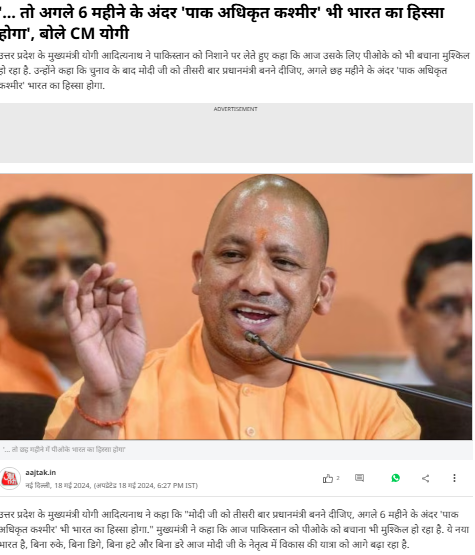
Next, we extracted keyframes from the viral video and ran them through Google Lens. This led us to the official YouTube channel of Yogi Adityanath, where the same video was uploaded on May 18, 2024.
Original video link:

In the original video, Yogi Adityanath clearly makes the statement in reference to Prime Minister Narendra Modi, not himself.Finally, we compared the viral clip with the original footage. The visuals in both videos are identical; however, the viral version has been edited and overlaid with misleading text to change the meaning of the statement.
Conclusion
Our research confirms that the viral video is edited and misleading. The original video is from May 2024, in which Yogi Adityanath was speaking about Prime Minister Narendra Modi, not about himself becoming Prime Minister in 2029. The video has been falsely altered and shared with a deceptive claim on social media.
