
#FactCheck-June 2026 Video of Kangana Ranaut Praying for PM Modi’s Long Life Falsely Shared as Karwa Chauth Fast
Executive Summary
A video of actress Kangana Ranaut is being shared on social media with the claim that she observed the Karwa Chauth fast for Prime Minister Narendra Modi. CyberPeace Research found the viral claim to be false. Our research revealed that the video dates back to June 2026, when MP Kangana Ranaut performed a puja in Jodhpur to mark 12 years of the Modi government and prayed for Prime Minister Narendra Modi’s long life.
Claim:
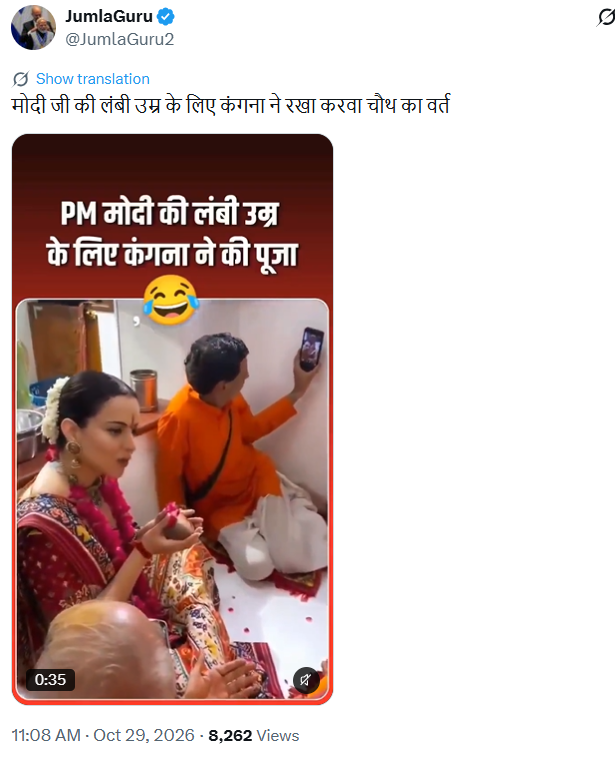
A user on social media platform X shared the viral video on October 29, 2026, with the caption: “Kangana observed the Karwa Chauth fast for Modi ji’s long life.” The post link, archive link and screenshot are provided below.
https://x.com/JumlaGuru2/status/2115679529742295307?a=msomkzvR3AP6rXIKj44&s=20
Fact Check
To verify the viral claim, we first searched Google using relevant keywords. However, we did not find any credible media reports supporting the claim.
We then conducted a reverse image search using keyframes from the viral video. During this process, we found the same video on the Facebook page of TV9 Bharatvarsh, where it was published on June 12, 2026. According to the post’s caption, BJP MP and actress Kangana Ranaut performed a puja at a Ganesh temple to mark 12 years of the central government and prayed for Prime Minister Narendra Modi’s long life and good health. The post link and screenshot are provided below.
https://www.facebook.com/reel/1334827725455458

As the research progressed, we also found the video on the YouTube channel of Times Now Navbharat, where it was published on June 12, 2026, with a neutral caption. The post link and screenshot are provided below.
https://www.youtube.com/watch?v=V971aT2e98Y

Conculsion
Our research found that the video dates back to June 2026, when MP Kangana Ranaut performed a puja in Jodhpur to mark 12 years of the Modi government and prayed for Prime Minister Narendra Modi’s long life.

Related Blogs

Think about the difference between a video game and gambling the way most people were taught to understand it. A video game is something you play, maybe you spend money on it upfront, maybe you buy an expansion pack, but what you get in return is fixed and known. Gambling is different: you put money in, and what comes back is uncertain, decided by chance, with real financial stakes attached to the outcome. For decades, that distinction was reasonably clear. It no longer is.
Across a growing number of mobile games and gaming platforms, the two have started to blend into each other. Games increasingly include features where a player pays real money for a randomised reward, a mechanic structurally identical to a slot machine or a scratch card, just wrapped in animation, sound effects, and gaming language that makes it feel like part of the game rather than a bet. Because this trend targets an audience that skews young, and because it deliberately makes gambling like behaviour feel like ordinary play, the UN Office on Drugs and Crime recently flagged it as a serious and growing concern. Understanding exactly what is happening, and why it matters, starts with their warning.
What UNODC is actually warning about
The claim traces back to UNODC's July 2026 report, An Interconnected Criminal Ecosystem: Transnational Organised Crime Threat Assessment for Southeast Asia 2026. Delphine Schantz, UNODC's regional representative for South-East Asia and the Pacific, put the core problem plainly: the line between online gaming and online gambling is becoming increasingly blurred, and platforms have converged through design features that deliberately exploit that ambiguity. Online gaming, by definition, never required money changing hands. What the report documents is a shift where mobile accessibility, deliberately addictive design, and the introduction of real monetary stakes are pulling younger users into something that looks and feels like gaming but functions, mechanically, like gambling.
The report's most striking finding is not really about the games themselves. It is about what happens after. UNODC found that illegal online gambling platforms operating across the region do not simply extract money from young users; they generate a secondary population of indebted, criminally exposed young people who become vulnerable to recruitment into broader criminal networks, including debt collection operations, money mule schemes, and the scam compounds the report documents elsewhere. In other words, the gambling loss is often only the first harm. The debt it creates becomes the entry point into something considerably worse.
The mechanics of the convergence
This is not a vague, impressionistic claim. Academic researchers have spent close to a decade documenting the specific design features responsible for blurring gaming and gambling, and loot boxes sit at the centre of that research. A loot box is a purchasable in game item containing randomised rewards, structurally similar to a scratch card or a slot pull, wrapped in gaming aesthetics, animated reveal sequences, anticipation building sound design, that make the underlying mechanic easy to overlook. Researchers writing in Nature Human Behaviour as early as 2018 argued loot boxes are psychologically akin to gambling, and subsequent studies have consistently found meaningful associations between loot box engagement and problem gambling severity in young people. One widely cited cross sectional study estimated that between 16 and 21 percent of surveyed young people had engaged in gambling like video game practices at least once in the preceding year, and found that people who engaged in one such practice were highly likely to engage in several more, suggesting these mechanics function less as isolated features and more as an interconnected ecosystem designed to normalise wagering behaviour early.
What makes this genuinely difficult to regulate is precisely the ambiguity Schantz pointed to. A loot box does not always pay out in real currency; often the reward is a cosmetic item, a weapon skin, or in game currency that can then be resold or traded on secondary markets, creating real monetary value once removed from the platform that generated it. That one extra step, converting a virtual reward into tradeable value outside the game itself, has repeatedly let gambling like mechanics avoid classification under gambling law, even as researchers increasingly argue the psychological experience for the user is functionally identical. Regulators in several countries, including the UK, South Korea, and parts of Europe, have wrestled with exactly this classification problem for years, generally landing on disclosure requirements, probability labelling, and age restrictions rather than outright bans, an approach critics argue leaves the core mechanic intact while addressing only its edges.
The mobile phone has made all of this considerably harder to contain. Where gambling once required a physical location, an ID check, or at minimum a desktop browser, mobile gaming apps put the same monetised, chance based mechanics directly into a pocket, often accessible without any meaningful age verification beyond a self reported birth date a user can simply falsify. UNODC's own framing of "mobile access" as a driving factor is not incidental; it is arguably the single structural change that turned what was once a manageable regulatory grey zone into a rapidly scaling public health concern.
Why age matters so much here
Financial literacy research is fairly consistent on this point: the capacity to reason clearly about risk, probability, and long term financial consequence continues developing well into a person's twenties. Marketing a mechanic engineered around variable reward schedules, the same principle behind slot machine design, to an audience whose risk judgment is still forming is not an accident of overlapping demographics. It is, as UNODC's own language suggests, closer to a deliberate exploitation of that gap.
Where India fits into this picture
India has arguably moved further and faster on this exact concern than most jurisdictions. The Promotion and Regulation of Online Gaming Act, 2025, alongside its accompanying 2026 Rules that came into force on 1 May 2026, drew a hard statutory line most countries have avoided: real money online games, including fantasy sports, rummy, poker, and online casino style platforms, are now categorically prohibited in India, not merely regulated. A newly created central regulator, the Online Gaming Authority of India, oversees a separate, permitted category for e-sports and social games, requiring registration, age gating, and grievance redressal mechanisms, while offshore and unregistered real money platforms are now explicitly illegal to operate or use, backed by bank freeze powers and potential prosecution of platform directors.
The government's own stated rationale mirrors UNODC's warning almost exactly. Lawmakers cited addiction and social harm linked to real money games, reports that Indian users lose close to 20,000 crore rupees annually on these platforms, concerns about money laundering and potential terror financing routed through gaming networks, and specifically flagged the vulnerability of teenagers increasingly drawn into fantasy leagues and online poker as a driving justification. India's approach, an outright prohibition on monetary stakes rather than a licensed regulatory model similar to the UK's Gambling Commission or Malta's Gaming Authority, is distinctive by global standards, and reflects a judgement that the gaming gambling boundary has already become too difficult to police through disclosure and age verification alone.
The larger question this leaves open
Whether prohibition succeeds where lighter touch regulation elsewhere has struggled remains genuinely unresolved, and enforcement against offshore platforms determined to evade an Indian ban is likely to be an ongoing challenge rather than a solved problem. What UNODC's warning underscores, and what India's own legislative response implicitly concedes, is that voluntary industry self regulation was never going to be sufficient on its own. Platforms have commercial incentive to keep the gaming gambling boundary blurry, not to clarify it, because that ambiguity is precisely what lets monetised, addictive design features reach audiences who would otherwise be walled off from gambling entirely. Closing that gap convincingly will likely require the kind of cross sector coordination, spanning gaming regulators, financial authorities, and platform accountability, that UNODC's own statement called for, rather than any single fix applied in isolation.
References
- UNODC, "An Interconnected Criminal Ecosystem: Transnational Organised Crime Threat Assessment for Southeast Asia 2026," July 2026.
- The Hawk, "UNODC warns young gamers lured into online gambling." https://www.thehawk.in/news/india/unodc-warns-young-gamers-lured-into-online-gambling
- IAG, "UNODC report says Southeast Asian illegal online gambling creating cycle of crime that targets youth." https://asgam.com/2026/07/22/unodc-report-says-southeast-asian-illegal-online-gambling-creating-cycle-of-crime-that-targets-the-youth/
- GambleAware, "Lifting the Lid on Loot Boxes: Chance-based purchases in videogames and the convergence of gaming and gambling." https://www.gambleaware.org/media/aswow4lr/gaming_and_gambling_report_final_0.pdf Drummond
- A, Sauer JD, "Video game loot boxes are psychologically akin to gambling," Nature Human Behaviour, 2018. PubMed, "Loot Boxes, Gambling, and Problem Gambling Among Young People: Results from a Cross-Sectional Online Survey." https://pubmed.ncbi.nlm.nih.gov/33103911/
- Mondaq, "Play By The New Rules: India's 2026 Online Gaming Law Decoded." https://www.mondaq.com/india/gaming/1785180/play-by-the-new-rules-indias-2026-online-gaming-law-decoded
- CAclubindia, "India's Online Gaming Revolution: A Complete Guide to the Promotion and Regulation of Online Gaming w.e.f 1st May, 2026." https://www.caclubindia.com/articles/indias-online-gaming-revolution-a-complete-guide-to-the-promotion-and-regulation-of-online-gaming-wef-1st-may-2026-55118.asp
- https://www.meity.gov.in/static/uploads/2025/10/8a7f103cefc68ed8aaa2ebc9a2ed7c13.pdf
- https://x.com/UNODC/status/2100560453319467298?s=48&t=3CXE-95D2WFgsLsKDkX_Jg
Executive Summary
An image featuring Prime Minister Narendra Modi and Union Home Minister Amit Shah is being widely shared on social media. The image is being circulated with the claim that it is a decades-old photograph of the two leaders. A research by the Research Wing of CyberPeace found that the viral image is not authentic and was generated using artificial intelligence (AI).
Claim
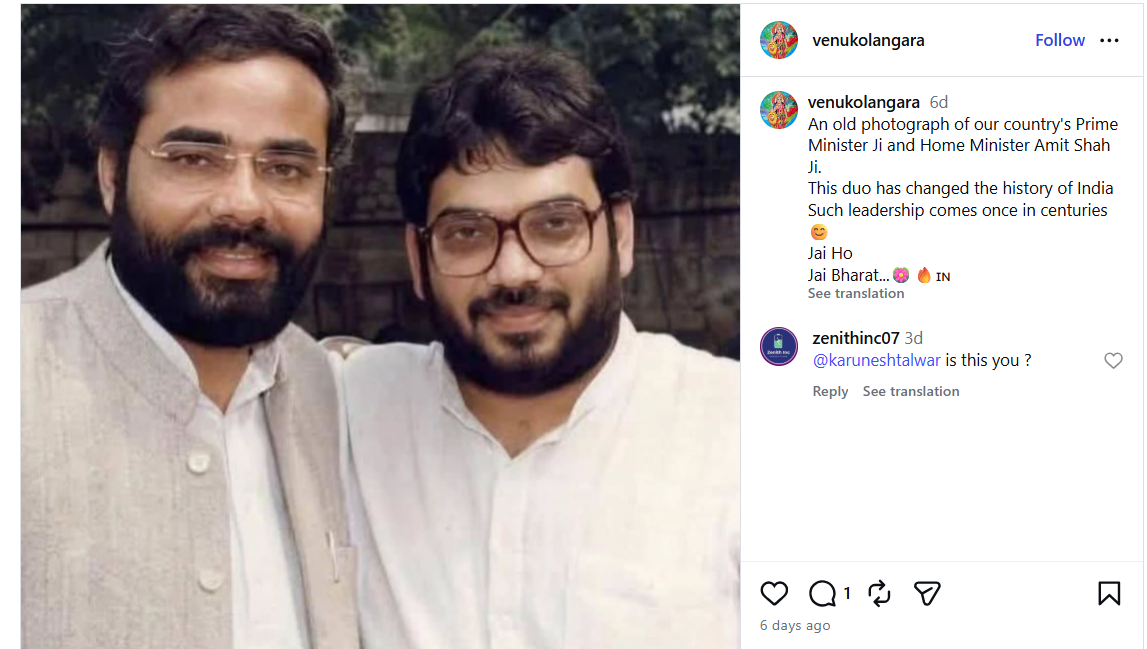
On August 14, 2026, a user shared the viral image on Instagram with the caption: “An old photograph of our country's Prime Minister Ji and Home Minister Amit Shah Ji. This duo has changed the history of India. Such leadership comes once in centuries.”
https://www.instagram.com/p/DcAsngdyjQ0/
Fact Check:
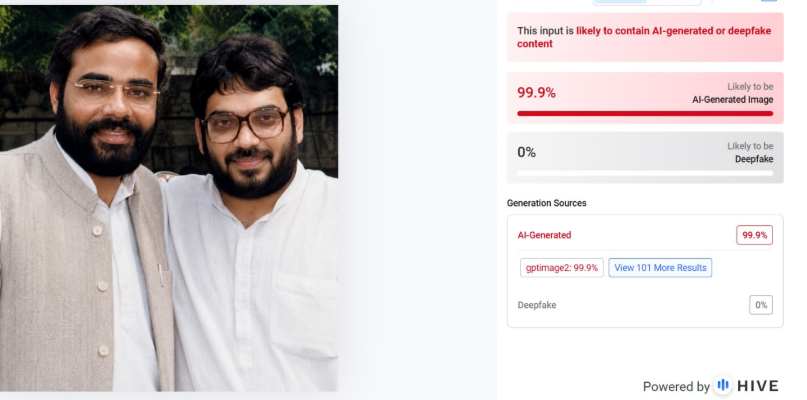
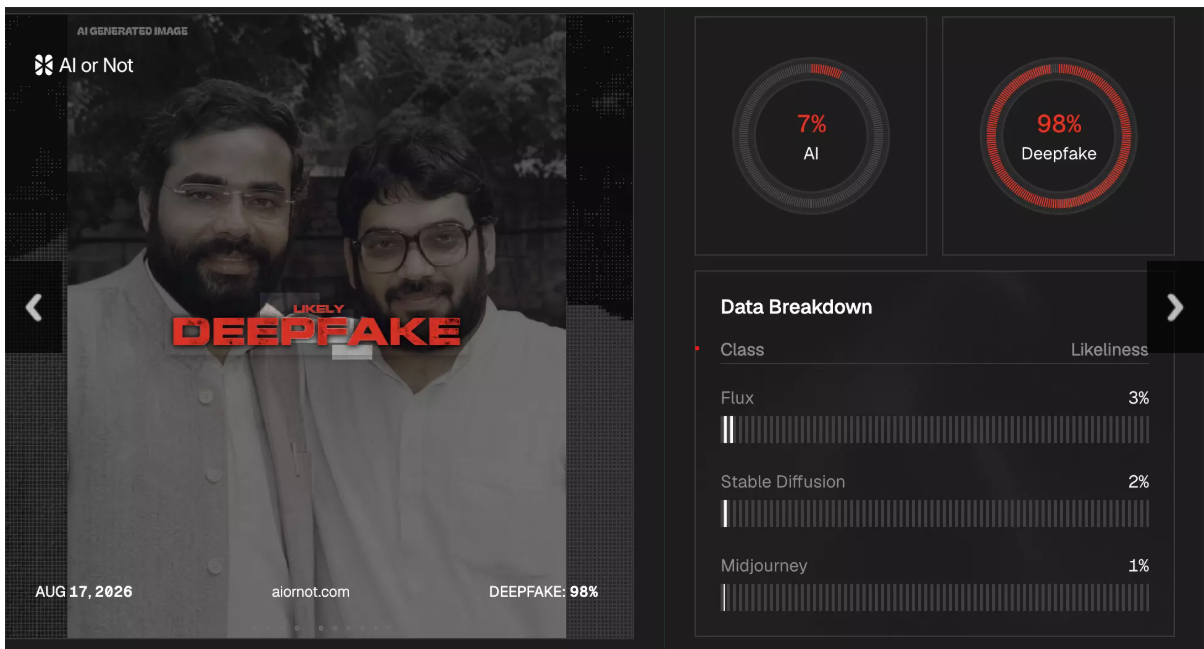
On closely examining the viral image, we noticed several visual inconsistencies that raised suspicion that it may have been AI-generated. We subsequently analysed the image using Hive Moderation, an AI-detection tool. The tool indicated a 99 per cent probability that the image was AI-generated.
As part of the next stage of our research, we analysed the viral image using another AI-detection tool, AI or Not. The tool's results indicated a 98 per cent probability that the image was AI-generated.
Conclusion:
The viral image being circulated as a decades-old photograph of Prime Minister Narendra Modi and Union Home Minister Amit Shah is fake. Our research found that the image was generated using AI and is being falsely presented as a genuine old photograph.

Introduction
The scam involving "drugs in parcels' has resurfaced again with a new face. Cybercriminals impersonating and acting as FedEx, Police and various other authorities and in actuality, they are the perpetrators or bad actors behind the renewed "drugs in parcel" scam, which entails pressuring victims into sending money and divulging private information in order to escape fictitious legal repercussions.
Modus operandi
The modus operandi followed in this scam usually begins with a hacker calling someone on their cell phone posing as FedEx. They say that they are the recipients of a package under their name that includes illegal goods like jewellery, narcotics, or other items. The victim would feel afraid and apprehensive by now. Then there will be a video call with someone else who is posing as a police officer. The victim will be asked to keep the matter confidential while it is being investigated by this "fake officer."
After the call, they would get falsified paperwork from the CBI and RBI stating that an arrest warrant had been issued. Once the victim has fallen entirely under their sway, they would claim that the victim's Aadhaar has been used to carry out the unlawful conduct. They then request that the victim submit their bank account information and Aadhaar data for investigation. Subsequently, the hackers request that the victim transfer funds to a bank account for RBI validation. The victims thus submit money to the hackers believing it to be true for clearing their name.
Recent incidence:
In the most recent instance of a "drug-in-parcel" scam, an IT expert in Pune was defrauded of Rs 27.9 lakh by internet con artists acting as members of the Mumbai police's Cyber Crime Cell. The victim filed the First Information Report (FIR) in this matter at the police station. The victim stated that on November 11, 2023, the complainant received a call from a fraudster posing as a Mumbai police Cyber Crime Cell officer. The scammer falsely claimed to have discovered illegal narcotics in a package addressed to the complainant sent from Mumbai to Taiwan, along with an expired passport and an SBI card. To avoid arrest in a fabricated drug case, the fraudster coerced the complainant into providing bank account information under the guise of "verification." The victim, fearing legal consequences, transferred Rs 27,98,776 in ten online transactions to two separate bank accounts as instructed. Upon realizing the deception, the complainant reported the incident to the police, leading to an investigation.
In another such incident, the victim received an online bogus identity card from the scammers who had phoned him on the phone in October 2023. In an attempt to "clear the case" and issue a "no-objection certificate (NOC)," the fraudster persuaded the victim to wire money to a bank account, claiming to have seized narcotics in a shipment shipped from Mumbai to Thailand under his name. Fraudsters threatened to arrest the victim for mailing the narcotics package if money was not provided.
Furthermore, In August 2023, fraudsters acting as police officers and executives of courier companies defrauded a 25-year-old advertising student of Rs 53 lakh. They extorted money from her under the guise of avoiding legal action, which would include arrest, and informed her that narcotics had been discovered in a package she had delivered to Taiwan. According to the police, callers acting as police officers threatened to arrest the girl and forced her to complete up to 34 transactions totalling Rs 53.63 lakh from her and her mother's bank accounts to different bank accounts.
Measures to protect oneself from such scams
Call Verification:
- Be sure to always confirm the legitimacy of unexpected calls, particularly those purporting to be from law enforcement or delivery services. Make use of official contact information obtained from reliable sources to confirm the information presented.
Confidentiality:
- Use caution while disclosing personal information online or over the phone, particularly Aadhaar and bank account information. In general, legitimate authorities don't ask for private information in this way.
Official Documentation:
- Request official documents via the appropriate means. Make sure that any documents—such as arrest warrants or other government documents—are authentic by getting in touch with the relevant authorities.
No Haste in Transactions:
- Proceed with caution when responding hastily to requests for money or quick fixes. Creating a sense of urgency is a common tactic used by scammers to coerce victims into acting quickly.
Knowledge and Awareness:
- Remain up to date on common fraud schemes and frauds. Keep up with the most recent strategies employed by online fraudsters to prevent falling for fresh scam iterations.
Report Suspicious Activity:
- Notify the local police or other appropriate authorities of any suspicious calls or activities. Reports received in a timely manner can help investigations and shield others from falling for the same fraud.
2fA:
- Enable two-factor authentication (2FA) wherever you can to provide online accounts and transactions an additional degree of protection. This may lessen the chance of unwanted access.
Cybersecurity Software:
- To defend against malware, phishing attempts, and other online risks, install and update reputable antivirus and anti-malware software on a regular basis.
Educate Friends and Family:
- Inform friends and family about typical scams and how to avoid falling victim to fraud. A safer online environment can be achieved through increased collective knowledge.
Be skeptical
- Whenever anything looks strange or too good to be true, it most often is. Trust your instincts. Prior to acting, follow your gut and confirm the information.
By taking these precautions and exercising caution, people may lessen their vulnerability to scams and safeguard their money and personal data from online fraudsters.
Conclusion:
Verifying calls, maintaining secrecy, checking official papers, transacting cautiously, and keeping up to date are all examples of protective measures for protecting ourselves from such scams. Using cybersecurity software, turning on two-factor authentication, and reporting suspicious activity are essential in stopping these types of frauds. Raising awareness and working together are essential to making the internet a safer place and resisting the activities of cybercriminals.
References:
- https://indianexpress.com/article/cities/pune/pune-cybercrime-drug-in-parcel-cyber-scam-it-duping-9058298/#:~:text=In%20August%20this%20year%2C%20a,avoiding%20legal%20action%20including%20arrest.
- https://www.the420.in/pune-it-professional-duped-of-rs-27-9-lakh-in-drug-in-parcel-scam/
- https://www.newindianexpress.com/states/tamil-nadu/2023/oct/16/the-return-of-drugs-in-parcel-scam-2624323.html
- https://timesofindia.indiatimes.com/city/hyderabad/2-techies-fall-prey-to-drug-parcel-scam/articleshow/102786234.cms
