
#FactCheck -Viral Video of Electric Car Powered by Generator Is AI-Generated
Executive Summary
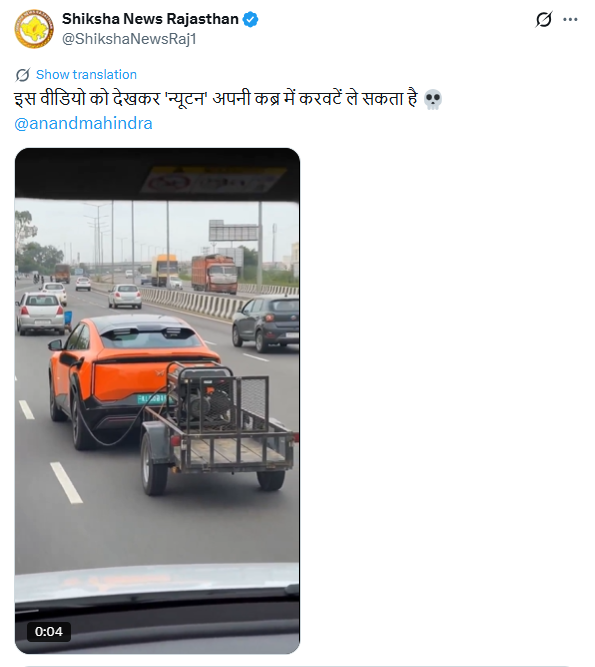
A video circulating on social media shows an electric car allegedly being powered by a portable generator attached to it. The clip is being shared with the claim that the generator is directly running the vehicle, suggesting a groundbreaking or unusual technological feat. However, research conducted by the CyberPeace found the viral claim to be false. Our research revealed that the video is not authentic but AI-generated.
Claim
On February 22, 2026, a user on X (formerly Twitter) shared the viral video with the caption: “After watching this video, Newton might turn in his grave.” The post implied that the video demonstrates a scientific impossibility.
Fact Check:
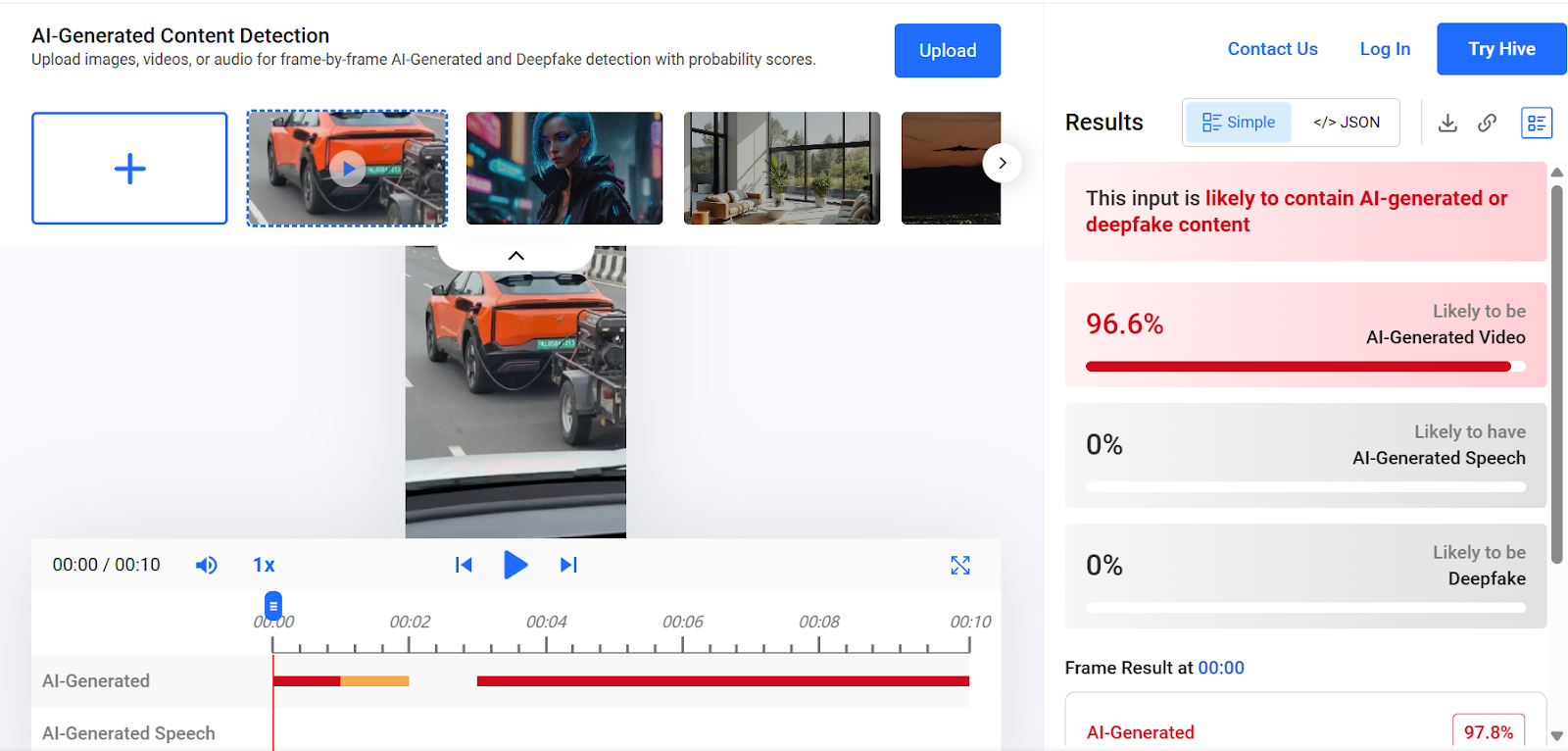
To verify the claim, we conducted a keyword search on Google. However, we found no credible reports from any reputable media organization supporting the assertion made in the viral post. A close examination of the video revealed several visual inconsistencies and unnatural elements, raising suspicion that the footage may have been generated using artificial intelligence. We then analyzed the video using the AI detection tool Hive Moderation. The results indicated a 96 percent probability that the video was AI-generated.
In the next step of our research , we scanned the video using another AI detection platform, WasItAI, which also concluded that the viral video was AI-generated.

Conclusion
Our research confirms that the viral video is not real. It has been artificially created using AI technology and is being circulated with a misleading claim.

Related Blogs

EXECUTIVE SUMMARY:
A viral video is surfacing claiming to capture an aerial view of Mount Kailash that has breathtaking scenery apparently providing a rare real-life shot of Tibet's sacred mountain. Its authenticity was investigated, and authenticity versus digitally manipulative features were analyzed.
CLAIMS:
The viral video claims to reveal the real aerial shot of Mount Kailash, as if exposing us to the natural beauty of such a hallowed mountain. The video was circulated widely in social media, with users crediting it to be the actual footage of Mount Kailash.


FACTS:
The viral video that was circulated through social media was not real footage of Mount Kailash. The reverse image search revealed that it is an AI-generated video created by Sonam and Namgyal, two Tibet based graphic artists on Midjourney. The advanced digital techniques used helped to provide a realistic lifelike scene in the video.
No media or geographical source has reported or published the video as authentic footage of Mount Kailash. Besides, several visual aspects, including lighting and environmental features, indicate that it is computer-generated.
For further verification, we used Hive Moderation, a deep fake detection tool to conclude whether the video is AI-Generated or Real. It was found to be AI generated.

CONCLUSION:
The viral video claiming to show an aerial view of Mount Kailash is an AI-manipulated creation, not authentic footage of the sacred mountain. This incident highlights the growing influence of AI and CGI in creating realistic but misleading content, emphasizing the need for viewers to verify such visuals through trusted sources before sharing.
- Claim: Digitally Morphed Video of Mt. Kailash, Showcasing Stunning White Clouds
- Claimed On: X (Formerly Known As Twitter), Instagram
- Fact Check: AI-Generated (Checked using Hive Moderation).
Introduction
Freedom of speech and expression is fundamental to democracy and is constitutionally entrenched in Article 19(1)(a) of the Indian Constitution. The explosion of online spaces, brought about by the digital age, in the form of social media, blogs, and messaging apps, has reinterpreted how information is authored, disseminated, and consumed. This digital revolution has galvanised individuals to engage further inclusively in public debate, but has also fanatically magnified the risks of misinformation, hate speech, and threats to public order. Against this background, the judiciary is increasingly called upon to determine the limits of free speech, primarily where state regulation seeks to infringe upon constitutional protection.
Constitutional and Statutory Framework related to Freedom of Speech
The judiciary plays an integral role in balancing the fundamental right of freedom of speech with the regulation of online content, especially during the fast-paced evolution of the digital world. In India, with Article 19(1)(a) of the Constitution guaranteeing the freedom of speech, the courts bear the critical responsibility of protecting this liberty while recognising the State's legitimate interests in restricting harmful or unlawful content on a digital scale. This adjudicatory dilemma is even trickier because the said right has been held by the Supreme Court not to be an absolute one and is subject to "reasonable restrictions" as in Article 19(2), which recognises restrictions in the interest of sovereignty, security, public order, decency, and morality. Freedom of speech, being the cornerstone of democracy in India, does have an umbrella of reasonable restrictions under which the state can regulate any form of speech that infringes upon other equally compelling societal interests. However, with the coming of the internet and other digital communication arrangements, there was a need to develop new statutory instruments, i.e., Information Technology Act, 2000 (IT Act) and Rules made thereunder, including Information Technology (Intermediary Guidelines) and Digital Media Ethics Code Rules, 2021. These enactments attempt to regulate digital content, confronting issues such as hate speech, misinformation, and content that threatens public order. The judiciary's mandate is to interpret the enactments within the constitutional precincts, thus ensuring that the arbitrariness of State action is not aggravated or that the regulation is not overbroad. Judicial Landmark Decisions Affirming Balance The judiciary has played a front-ranking role in elaborating a jurisprudence protecting free speech in delineating legitimate regulation thereof. The Supreme Court judgment in Shreya Singhal v. Union of India, 2015, is seminal. Section 66A of the IT Act was struck down as it was vague and overly broad, causing a chilling effect on online speech. The Court has emphasised that any limitation on speech must be precise and fall strictly within the parameters laid down in Article 19(2). While the Court recognises that harmful online content needs to be addressed, the remedy must not encroach upon free political debate, satire, and criticism vital for democracy.
Following this, the Anuradha Bhasin case clarified the convergence of free speech and online access. The court held that the right to free speech had a vital medium in the form of the internet and that it would have to be an inevitable, proportionate shutdown, and transparent for challenge before the judiciary for any shutdown of the internet. This reaffirmed that restrictions on online speech must be rigorously tested.
Subsequent cases involve limitations on the 2021 IT Rules, whereby such government bodies can demand that “fake” or “misleading” material be taken off the internet. Courts move with circumspection, recognising the government's interest in fighting bogus information but remaining vigilant against over-regulation that can be code for pre-emptive censorship and threatening healthy discourses.
The virtual world raises particular and deeper questions: the viral nature of online speech multiplies its impact, distributing both democratic ideas and abusive material instantaneously. The courts recognise this twinning. While pressurising the legislature and executive to formulate clearer, more precise rules, courts simultaneously act as constitutional Guardians, avoiding breaches of the right with executive excess or vague laws. There is a strain between judicial activism, which promotes constitutional rights aggressively, and the fear of judicial paternalism, courts overreaching into policy arenas. But there is a need for vigilance by the judiciary due to the rapidly changing nature of digital technologies and threats to the freedoms of democracy. The judiciary continues to give contours to free speech and online regulation. There are enforcement issues, such as ongoing abuse of struck-down provisions, such as Section 66A, that the court counters with reaffirmation of constitutional directives. The evolving jurisprudence balances on thin stilts, upholding the democratic spirit of India by securing speech on online spaces and sanctioning reasonable, transparent moderation of harmful speech.
Conclusion
The Indian judiciary's leadership in balancing online content regulation with the freedom of speech is central and refined. The courts continually emphasise that speech on the digital medium is highly constitutionally protected and that restrictions must be legally valid, specific, essential, and proportionate. By classical decisions and constant review of new regulating actions, courts safeguard democratic participation in the digital public domain from unmeritorious censorship. Concurrently, the courts recognize the responsibility of the state in regulating digital ills such as mis recipe and hate speech, demanding parameters that uphold constitutional freedoms and the due process. The balancing act of the judiciary continues to be fundamental in defining India's digital democracy so that free speech can thrive even as the state upholds public order and human dignity in the digital communication age.

Executive Summary
A 57-second video featuring India’s Chief of Army Staff Upendra Dwivedi is widely circulating on social media. The clip is being shared with the claim that the Army chief admitted India had “betrayed” Iran by providing the location of an Iranian naval ship to Israel, allegedly leading to its destruction The video is spreading amid heightened tensions in West Asia involving United States, Israel, and Iran. According to posts sharing the claim, the Iranian naval vessel IRIS Dena, which had participated in a naval event in Visakhapatnam and was returning to Iran with around 130 personnel onboard, was torpedoed by a US submarine near the southern coast of Sri Lanka on March 4 while sailing in the Indian Ocean.
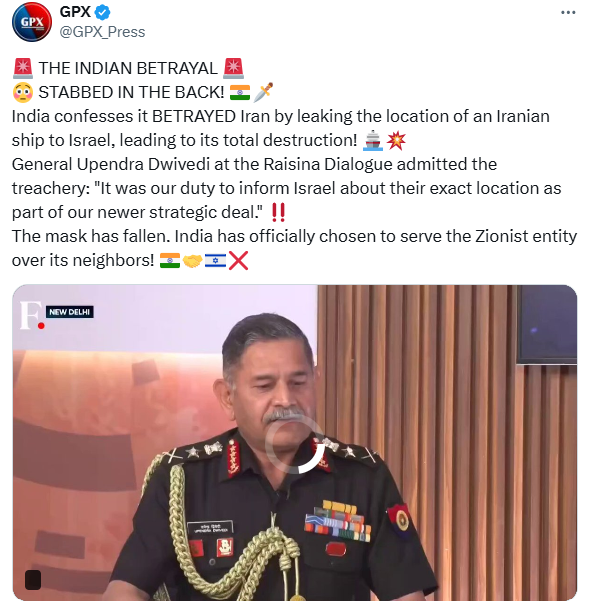
In the viral clip, the speaker—presented as the Indian Army chief—appears to say that India informed Israel about the exact location of the Iranian ship after it left Indian waters, describing Israel as a strategic ally and suggesting that the attack occurred in international waters. The clip also claims that India had no direct involvement in the alleged joint US-Israel torpedo strike.
However, research conducted by the CyberPeace found the claim to be false. Our research shows that the video does not contain a genuine statement from Army Chief Upendra Dwivedi and is in fact a manipulated clip.
Claim
On X (formerly Twitter), a page named GPX (@GPX_Press) shared the video on March 9 with the caption: “India confesses it BETRAYED Iran by leaking the location of an Iranian ship to Israel, leading to its total destruction!”
Fact Check
During the verification process, researchers noticed a ticker in the viral video reading “Raisina Dialogue 2026 × Firstpost.” Using this clue, we conducted a keyword search on YouTube and located a video uploaded by Firstpost on March 7 titled “India’s Army Chief Speaks on Op Sindoor, Pakistan and Future of Warfare | Raisina Dialogue 2026.”
In the 21-minute interview, Army Chief Upendra Dwivedi is seen speaking with strategic affairs expert Harsh V. Pant. According to the video description, the discussion focuses on lessons from Operation Sindoor and the evolving nature of modern warfare.

The viral clip appears to be taken from this interview. However, throughout the conversation, Dwivedi does not mention any conflict involving the United States, Israel, and Iran, nor does he refer to the sinking of an Iranian naval ship in the Indian Ocean. This indicates that the circulating clip has been edited and misrepresented to create a misleading narrative.
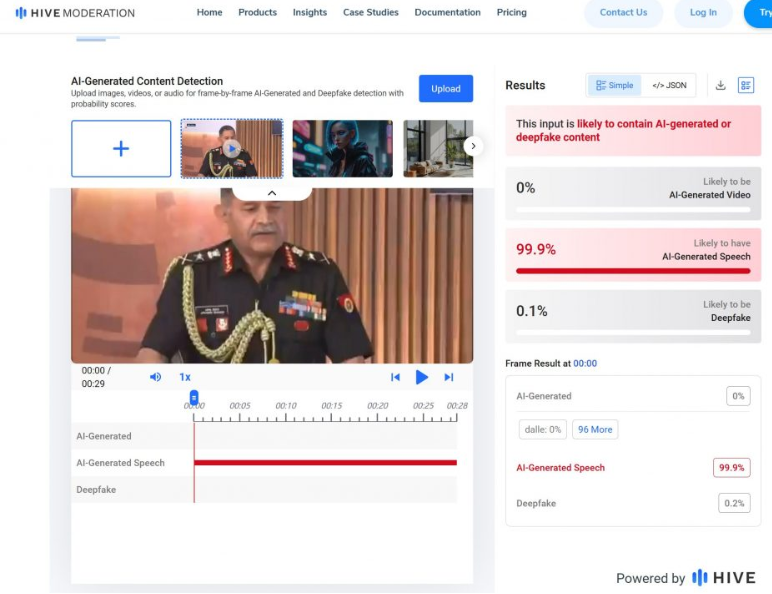
For additional verification, the viral video was analyzed using the AI detection tool Hive Moderation. The results suggested a 99.9% probability that the speech in the clip was generated using AI, indicating manipulation of the original footage.
Conclusion
The research makes it clear that the viral video does not reflect an authentic statement by India’s Army Chief Upendra Dwivedi. The clip has been altered and the audio appears to be AI-generated. In other words, the circulating video is a deepfake being shared with a misleading claim.
