
#FactCheck-Fake X Account Falsely Poses as India’s Ministry of External Affairs
Executive Summary
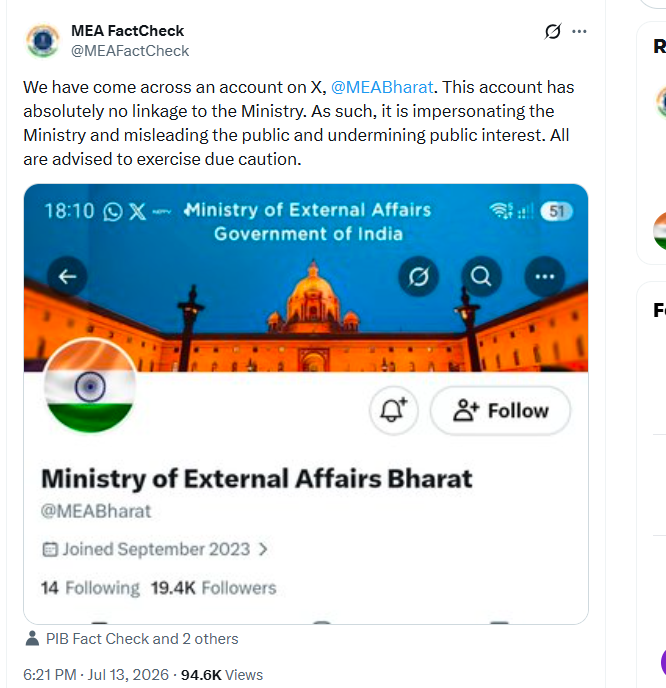
A social media account on X (formerly Twitter) named @MEABharat is being circulated as the official account of India's Ministry of External Affairs (MEA). Many users are sharing posts from the account, believing it to be an authentic government handle and treating the information published there as official communication. CyberPeace Research Wing’s research found the viral claim to be misleading. Our research revealed that @MEABharat is not an official X account of the Ministry of External Affairs. The Ministry has publicly clarified that it has no association with the account and stated that it is impersonating the Ministry, misleading the public, and undermining public interest.
Claim
Social media users are claiming that @MEABharat is the official X account of India's Ministry of External Affairs and that the information posted on the account is officially issued by the Ministry.
https://x.com/MEAFactCheck/status/2076650791453270332

Fact Check
To verify the claim, we conducted a keyword-based search on Google. During the research, we found an official clarification posted by the Ministry of External Affairs' fact-check handle, @MEAFactCheck. In its post, the Ministry clearly stated that the @MEABharat account has no connection whatsoever with the Ministry of External Affairs. It further clarified that the account is impersonating the Ministry, misleading the public, and undermining public interest. The Ministry also advised users to exercise caution and rely only on its verified official social media accounts and website for authentic information.
https://x.com/MEAFactCheck/status/2076650791453270332
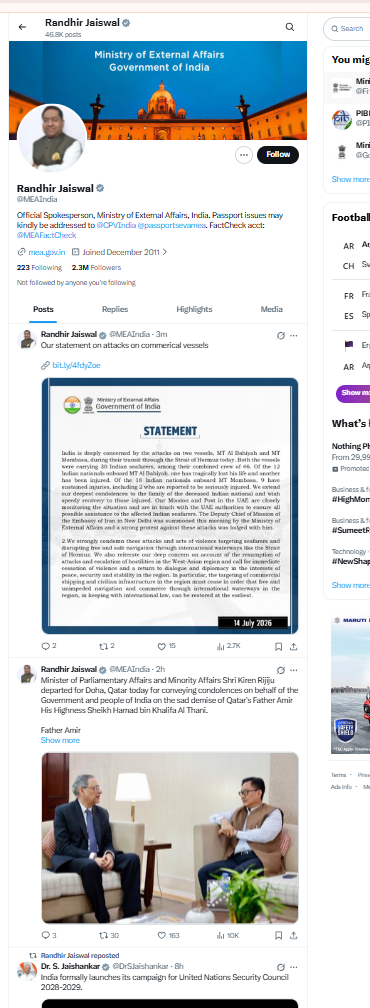
As part of our research, we also examined the Ministry's official X account, @MEAIndia, which carries the verified blue badge. The account regularly publishes official statements, diplomatic updates, press briefings, and other communications related to India's foreign policy. It also serves as the official spokesperson's handle for the Ministry of External Affairs.
https://x.com/MEAIndia
Conclusion
Our research found that @MEABharat is not the official X account of India's Ministry of External Affairs. The Ministry itself has publicly clarified that the account is fake, has no affiliation with the government, and is impersonating the Ministry to mislead the public. Therefore, the claim that @MEABharat is the official MEA handle is misleading. Users should rely only on the Ministry's verified accounts, including @MEAIndia and @MEAFactCheck, for authentic government information.

Related Blogs
.jpeg)
As technological advancements continue to shape the future, the rise of artificial intelligence brings with it significant potential benefits, yet also raises concerns about the spread of misinformation. Recognising the need for accountability on both ends, on 5th May, during the three-day World News Media Congress 2025 in Kraków, Poland the European Broadcasting Union (EBU) and the World Association of News Publishers (WAN-IFRA) have announced to the public the five core principles for their joint initiative called News Integrity in the Age of AI. The initiative is aimed at fostering dialogue and cooperation between media organisations and technology platforms, and the principles announced are to be a code of practice to be followed by all those taking part. With thousands of public and private media outlets around the world joining the effort, the initiative highlights the shared responsibility of AI developers to ensure that AI systems are trustworthy, safe, and supportive of a reliable news ecosystem. It represents a global call to action to uphold the integrity of news in this age of major influx and curb the growing challenge of misinformation.
The five core principles released focus on:
1. Authorisation of content by the originators is a must prior to its usage in Generative AI tools and models
2. High-quality and up-to-date news content must be recognised by third parties that are benefiting from it
3. There must be a focus on accuracy and attribution, making the original sources of news apparent to the public, promoting transparency
4. Harnessing the plural nature of the news perspectives, which will help AI-driven tools perform better and
5. An invitation to tech companies for an open dialogue with news outlets, facilitating conversation to collaborate and develop standards of transparency, accuracy, and safety.
As this initiative provides a unified platform to address and deliberate on issues affecting the integrity of news, there are also some other technical ways in which misinformation in news caused by AI can be curbed:
1. Encourage the usage of Smaller Generative AI Models: The Large Language Models (LLMs) have to be trained on a range of topics. Businesses don’t require such an expanse of information but just a little that is relevant. A narrower context of information to be sourced from allows better content navigation and a reduced chance of mix-up.
2. Fighting AI hallucination: This is a phenomenon that causes generative AI (such as chatbots and computer vision tools) to present nonsensical and inaccurate outputs as the system perceives objects or patterns that are imperceptible or non-existent to human observers. This occurs as a result of the system trying to focus on both language fluency and stitching information from different sources together. In order to deal with this, one can deploy retrieval augmented generation (RAG). This enables connection with external sources of data that include academic journals, a company’s organisational data, among other things, that would help in providing more accurate, domain-specific content.
Conclusion
This global call to action marks an important step toward fostering unified efforts to combat misinformation. The set of principles introduced is designed to be adaptable, providing a flexible framework that can evolve to address emerging challenges (through dialogue and discussion), including issues like copyright infringement. While AI offers powerful tools to support the news industry, it is essential to emphasise that human oversight remains crucial. These technological advancements are meant to enhance and augment the work of journalists, not replace it, ensuring that the core values of journalism, such as accuracy and integrity, are preserved in the age of AI.
References
● https://www.techtarget.com/searchenterpriseai/tip/Generative-AI-ethics-8-biggest-concerns
● https://trilateralresearch.com/responsible-ai/using-responsible-ai-to-combat-misinformation
● https://www.omdena.com/blog/the-ethical-role-of-ai-in-media-combating-misformation
● https://2024.jou.ufl.edu/page/ai-and-misinformation
● https://techxplore.com/news/2025-05-ai-counter-misinformation-fact-based.html
● https://www.advanced-television.com/2025/05/06/media-outlets-call-for-ai-companies-news-integrity-protection/https://www.ibm.com/think/insights/ai-misinformation
.webp)
Introduction
AI-generated fake videos are proliferating on the Internet indeed becoming more common by the day. There is a use of sophisticated AI algorithms that help manipulate or generate multimedia content such as videos, audio, and images. As a result, it has become increasingly difficult to differentiate between genuine, altered, or fake content, and these AI-manipulated videos look realistic. A recent study has shown that 98% of deepfake-generated videos have adult content featuring young girls, women, and children, with India ranking 6th among the nations that suffer from misuse of deepfake technology. This practice has dangerous consequences and could harm an individual's reputation, and criminals could use this technology to create a false narrative about a candidate or a political party during elections.
The working of deepfake videos is based on algorithms that refine the fake content, and the generators are built and trained in such a way as to get the desired output. The process is repeated several times, allowing the generator to improve the content until it seems realistic, making it more flawless. Deepfake videos are created by specific approaches some of them are: -
- Lip syncing: This is the most common technique used in deepfake. Here, the voice recordings of the video, make it appear as to what was originally said by the person appearing in the video.
- Audio deepfake: For Audio-generated deepfake, a generative adversarial network (GAN) is used to colon a person’s voice, based on the vocal patterns and refine it till the desired output is generated.
- Deepfake has become so serious that the technology could be used by bad actors or by cyber-terrorist squads to set their Geo-political agendas. Looking at the present situation in the past few the number of cases has just doubled, targeting children, women and popular faces.
- Greater Risk: in the last few years the cases of deep fake have risen. by the end of the year 2022, the number of cases has risen to 96% against women and children according to a survey.
- Every 60 seconds, a deepfake pornographic video is created, now quicker and more affordable than ever, it takes less than 25 minutes and costs using just one clean face image.
- The connection to deepfakes is that people can become targets of "revenge porn" without the publisher having sexually explicit photographs or films of the victim. They may be made using any number of random pictures or images collected from the internet to obtain the same result. This means that almost everyone who has taken a selfie or shared a photograph of oneself online faces the possibility of a deepfake being constructed in their image.
Deepfake-related security concerns
As deepfakes proliferate, more people are realising that they can be used not only to create non-consensual porn but also as part of disinformation and fake news campaigns with the potential to sway elections and rekindle frozen or low-intensity conflicts.
Deepfakes have three security implications: at the international level, strategic deepfakes have the potential to destroy precarious peace; at the national level, deepfakes may be used to unduly influence elections, and the political process, or discredit opposition, which is a national security concern, and at the personal level, the scope for using Women suffer disproportionately from exposure to sexually explicit content as compared to males, and they are more frequently threatened.
Policy Consideration
Looking at the present situation where the cases of deepfake are on the rise against women and children, the policymakers need to be aware that deepfakes are utilized for a variety of valid objectives, including artistic and satirical works, which policymakers should be aware of. Therefore, simply banning deepfakes is not a way consistent with fundamental liberties. One conceivable legislative option is to require a content warning or disclaimer. Deepfake is an advanced technology and misuse of deepfake technology is a crime.
What are the existing rules to combat deepfakes?
It's worth noting that both the IT Act of 2000 and the IT Rules of 2021 require social media intermediaries to remove deep-fake videos or images as soon as feasible. Failure to follow these guidelines can result in up to three years in jail and a Rs 1 lakh fine. Rule 3(1)(b)(vii) requires social media intermediaries to guarantee that its users do not host content that impersonates another person, and Rule 3(2)(b) requires such content to be withdrawn within 24 hours of receiving a complaint. Furthermore, the government has stipulated that any post must be removed within 36 hours of being published online. Recently government has also issued an advisory to social media intermediaries to identify misinformation and deepfakes.
Conclusion
It is important to foster ethical and responsible consumption of technology. This can only be achieved by creating standards for both the creators and users, educating individuals about content limits, and providing information. Internet-based platforms should also devise techniques to deter the uploading of inappropriate information. We can reduce the negative and misleading impacts of deepfakes by collaborating and ensuring technology can be used in a better manner.
References
- https://timesofindia.indiatimes.com/life-style/parenting/moments/how-social-media-scandals-like-deepfake-impact-minors-and-students-mental-health/articleshow/105168380.cms?from=mdr
- https://www.aa.com.tr/en/science-technology/deepfake-technology-putting-children-at-risk-say-experts/2980880
- https://wiisglobal.org/deepfakes-as-a-security-issue-why-gender-matters/
Executive Summary
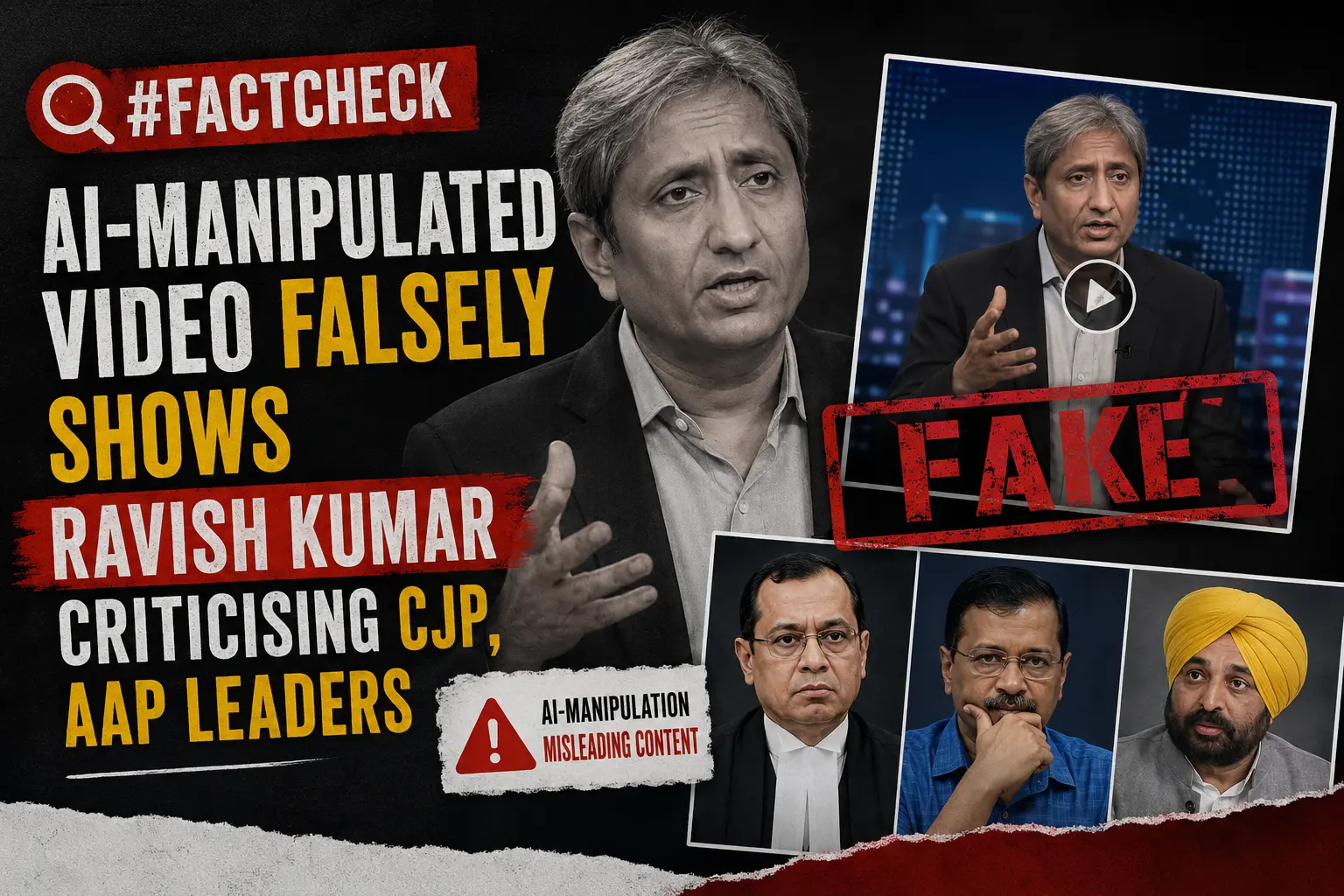
A video of journalist Ravish Kumar is being widely shared on social media. The video is being circulated with the claim that Kumar criticised Abhijeet Deepak, the CJP and Aam Aadmi Party (AAP) leaders over the CJP’s alleged absence from the ongoing student protest in Jharkhand. The CyberPeace Research Wing found the claim to be false. The research established that the original video of Ravish Kumar was digitally manipulated using artificial intelligence (AI), and altered audio was added before it was shared with a misleading claim.
Claim
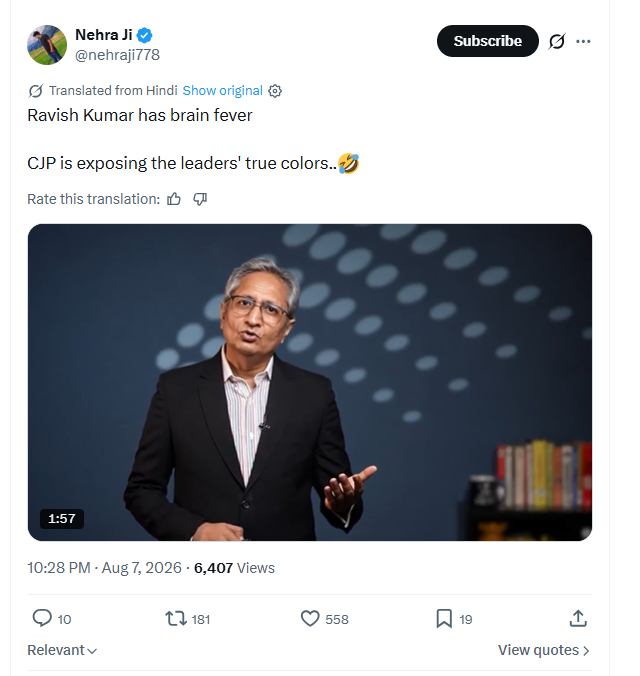
A user on X (formerly Twitter) shared the viral video on August 7, 2026, with the caption: “Ravish Kumar has brain fever. CJP is exposing the leaders’ true colors.”
https://x.com/nehraji778/status/2085772474915164506
Factcheck
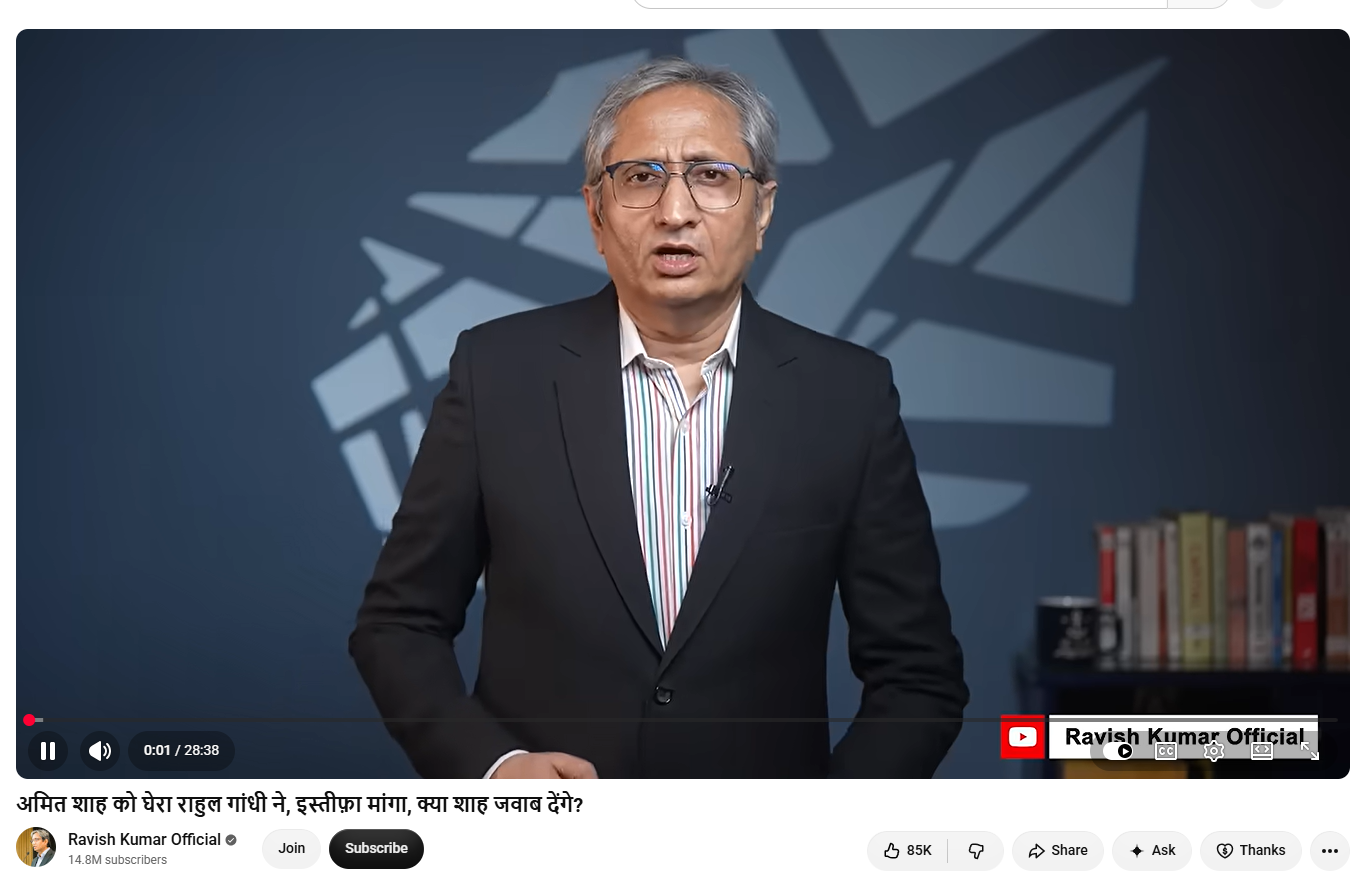
To verify the claim, we extracted several keyframes from the viral video and conducted a reverse image search using Google Lens. During the search, we found a video uploaded on Ravish Kumar’s official YouTube channel on July 29, 2026.
The visuals in the original video match those seen in the viral clip. Ravish Kumar can be seen wearing the same clothes and appearing in almost the same frame as in the viral video.
https://www.youtube.com/watch?v=Rdn_hfyZVRM
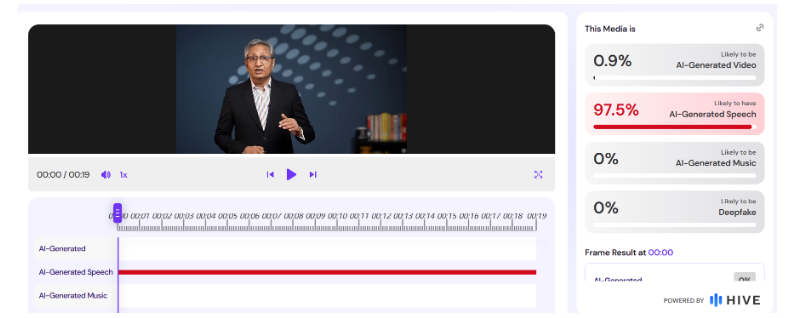
In the next step, we analysed the viral video using Hive Moderation. The tool indicated a 97 per cent probability that the video was AI-generated.
Conclusion
The research found that the viral claim is false. The visuals are taken from a genuine video of Ravish Kumar, but the original footage has been digitally manipulated and altered audio has been added using AI. The modified video is being circulated with a misleading claim that Kumar criticised Abhijeet Deepak, CJP and AAP leaders over the Jharkhand student protest.
