
#FactCheck - AI-Generated Image Falsely Shared as ‘Border 2’ Shooting Photo Goes Viral
Executive Summary
Border 2 is set to hit theatres today, January 23. Meanwhile, a photograph is going viral on social media showing actors Sunny Deol, Suniel Shetty, Akshaye Khanna and Jackie Shroff sitting together and having a meal, while a woman is seen serving food to them. Social media users are sharing this image claiming that it was taken during the shooting of Border 2. It is being alleged that the photograph shows a moment from the film’s set, where the actors were having food during a break in shooting. However, Cyber Peace research has found the viral claim to be false. Our investigation revealed that users are sharing an AI-generated image with a misleading claim.
Claim
On Instagram, a user shared the viral image on January 9, 2026, with the caption: “During the shooting of Border 2.” The link to the post, its archive link and screenshots can be seen below.

Fact Check:
To verify the claim, we first checked Google for the official star cast of the film Border 2. Our search showed that the names of the actors seen in the viral image are not part of the film’s officially announced cast. Next, upon closely examining the image, we noticed that the facial structure and expressions of the actors appeared unnatural and distorted. The facial features did not look realistic, raising suspicion that the image might have been created using Artificial Intelligence (AI). We then scanned the viral image using the AI-generated content detection tool HIVE Moderation. The results indicated that the image is 95 per cent AI-generated.
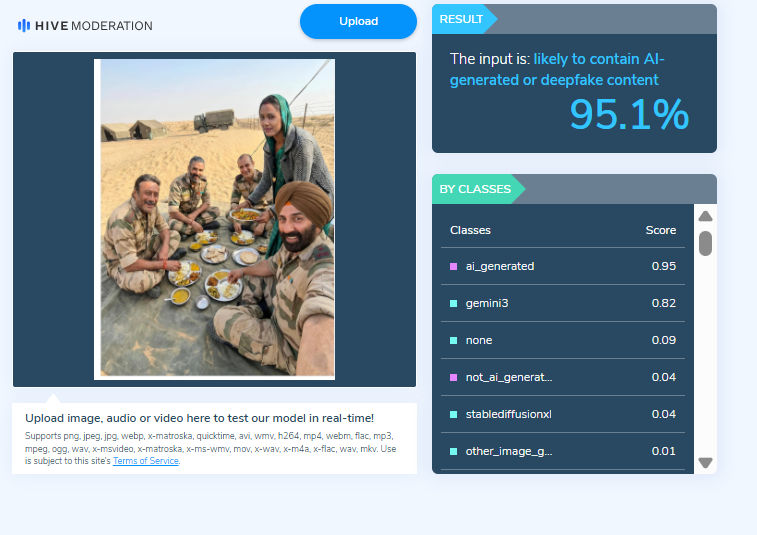
In the final step of our investigation, we analysed the image using another AI-detection tool, Undetectable AI. According to the results, the viral image was confirmed to be AI-generated.
Conclusion:
Our research confirms that social media users are sharing an AI-generated image while falsely claiming that it is from the shooting of Border 2. The viral claim is misleading and false.

Our research revealed that users are sharing an AI-generated image along with misleading claims

Related Blogs

Executive Summary
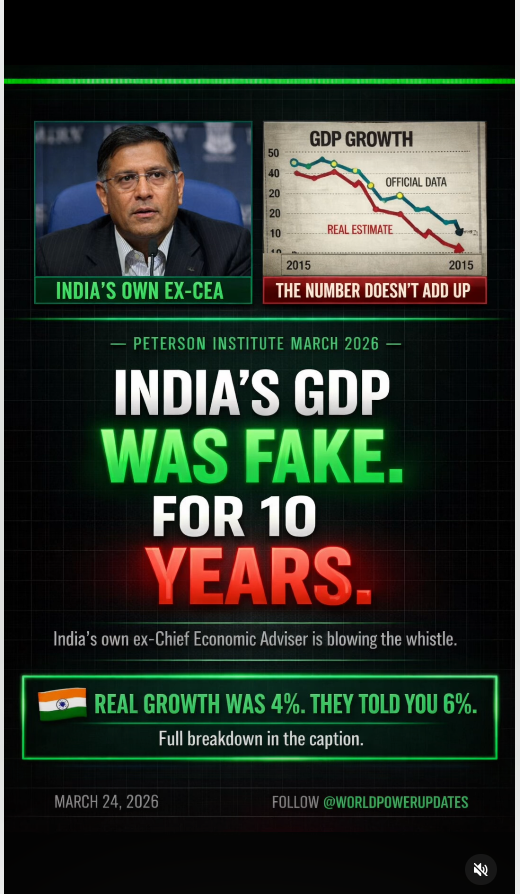
A viral graphic post on social media claims that India’s GDP (Gross Domestic Product) was “fake for 10 years.” The post also states that the real economic growth was around 4%, while official figures reported it at 6%. It further cites a former Chief Economic Adviser (Ex-CEA) and presents the claim as a “revelation.”
Research by CyberPeace Research Wing found this claim to be misleading. No official government document, nor India’s Ministry of Statistics and Programme Implementation (MoSPI), the Reserve Bank of India (RBI), or any recognised international institution has stated that India’s GDP was “fake.”
Claim
On the social media platform Instagram, a user shared a post claiming that the Chief Economic Adviser said India’s GDP (Gross Domestic Product) was “fake for 10 years.” The link to the post and its archive link are given below, along with a screenshot.
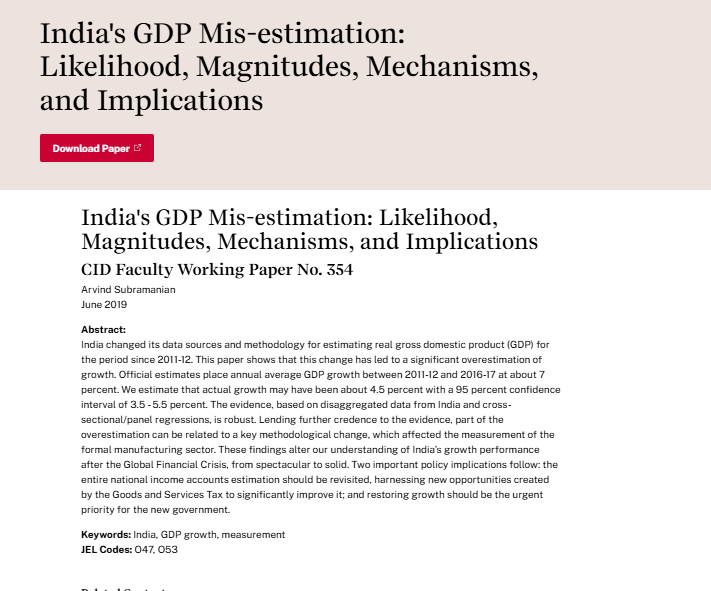
The viral post refers to a 2019 research paper linked to former Chief Economic Adviser (Ex-CEA) Arvind Subramanian. In this study, he raised questions about India’s GDP growth estimation and suggested that during 2011–12 to 2016–17, the actual growth could have been around 4.5%, while the official estimate was close to 7%.
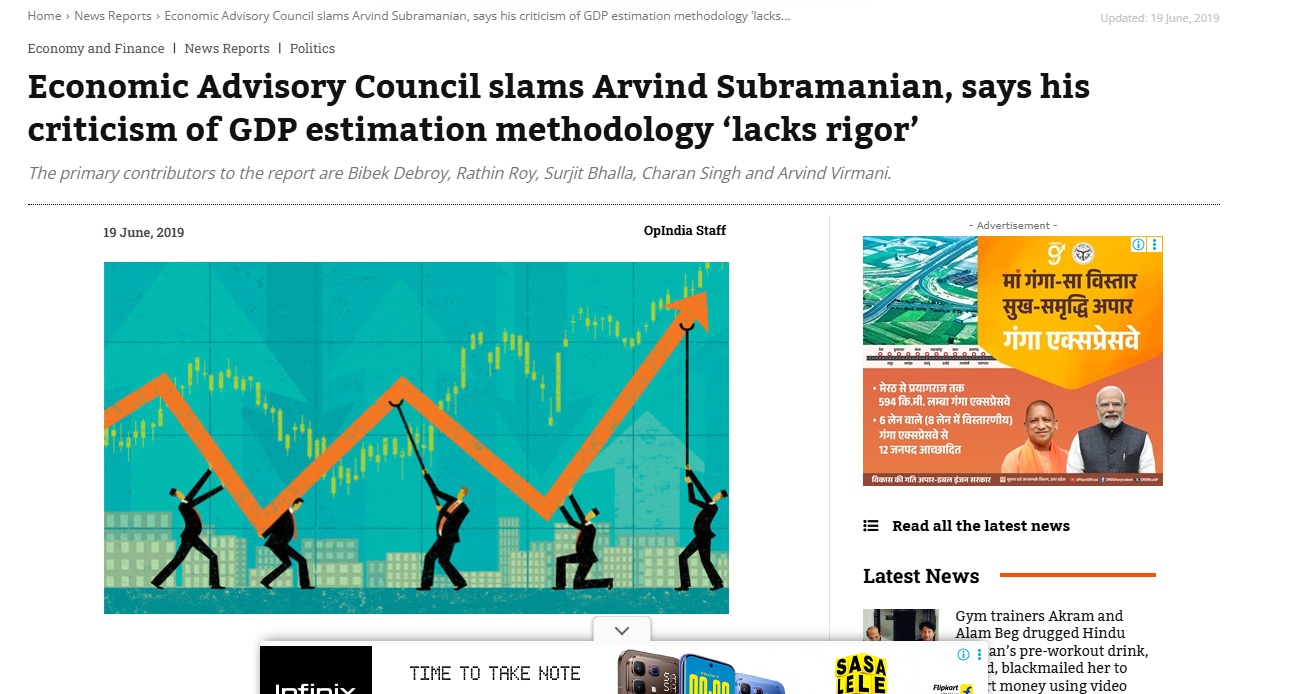
However, the study does not conclude anywhere that India’s GDP was “fake” or entirely incorrect. It only presents an alternative estimation based on different assumptions and methods, which has also been challenged by other economists and government agencies.
- https://www.hks.harvard.edu/centers/cid/publications/faculty-working-papers/india-gdp-overestimate?utm_source
- https://www.hks.harvard.edu/centers/cid/publications/faculty-working-papers/india-gdp-overestimate?utm_source
Conclusion:
The claim circulating on social media is misleading. The former Chief Economic Adviser provided an academic view on GDP estimation, but there is no evidence or official confirmation that India’s GDP was “fake for 10 years.” The data released by the Government of India was not validated by the figures circulated on social media.

Introduction
Cybercrime in India is developing at a rapid rate in terms of depth and volume, with culprits leveraging technology, anonymity, and social engineering to exploit unsuspecting victims. In a high-profile instance of coordinated police action, the Delhi Police Crime Branch recently cracked a large-scale pan-India cybercrime syndicate with its arms stretching across Delhi, Rajasthan, and Uttar Pradesh. The syndicate used to be involved in a range of cybercrimes, from sextortion and online fraud to fake call centres and cloning of bank accounts. With over ₹5 crore of illicit financial transactions revealed, the operation highlights the critical role of proactive cyber policing, data security and public awareness in India's war against digital crime.
A Multi-State Operation: Crime Network across States
On May 24, 2025, on receiving a tip-off, the Delhi Police conducted a specific raid in New Ashok Nagar to catch a suspect consignment said to be used for cybercrime. This resulted in a multi-layered investigation that revealed a large crime syndicate. Police recovered 28 mobile phones, 30 SIM cards, 15 debit cards, 8 cheque books, and two laptops, equipment said to have been used in crimes ranging from sextortion to fake loan scams.
Three of the initial arrests revealed the use of fake kits like pre-activated SIMs and counterfeit documents to create phoney digital identities and bank accounts. They were being used to bypass KYC norms and make untraceable transactions, illustrating how cyber thieves exploit digital identity as well as financial authentication loopholes in the system.
Fake Call Centre Falsely Claiming to be a Lender
Tracing the leads, the investigation then led the police to Mundka, a semi-residential and industrial area in Delhi, where a fake call centre in the name of a loan assistance service was operating. Suspects were allegedly operating the business. With deceptive scripts, their telemarketing staff lured victims with the offer of instant personal loans. When a prospective victim replied favorably and was willing to go further, he was asked to send identification documents and was then forced to pay a "processing fee." Once the payment was made, the accused would cut off contact immediately, leaving the victims shortchanged.
During the raid, seven individuals were apprehended, six of whom were trained tele-callers with a reasonable level of technical skill. In spite of possessing educational certificates and receiving a meagre pay of between ₹8,000 and ₹9,000 a month, these individuals had been enticed into the cybercrime network, demonstrating how educated youth are now more commonly being exploited or recruited by such scam networks in return for quick money.
Uncovering the Sextortion Racket
The most shocking disclosure was that of a sextortion racket being run from New Ashok Nagar, a residential area located in West Delhi, New Delhi. Suspects tricked victims with fraudulent Facebook profiles, contacted them on Messenger, and then changed to WhatsApp video calls. Pornographic videos were played on such calls while the reactions of the victim were secretly recorded. These were later utilised for extortion by threatening to share them with the whole world. The ability of such a group to blackmail and psychologically manipulate the victims indicates the psychological nature of cybercrime and the need for online safety education.
Impact and Significance: A Wake-Up Call for Law Enforcement and Public Awareness
This crackdown is uncovering some ominous trends that reflect the changing face of cybercrime in India. The syndicate's framework highlights the organised and multi-state nature of cybercrime, mostly operating through systemic loopholes. Misuse of social media sites and fintech apps is also rampant, and these are being leveraged for scams, sextortion, and monetary fraud. One of the most concerning trends is young people becoming more engaged in cybercrime, either out of economic necessity or enticed by easy cash. Most of these scams increasingly involve psychological manipulation, particularly in sextortion, where shame and fear are employed as tools. Digital identity fraud has also been facilitated through false documents and lenient Know Your Customer (KYC) checks, with fraudsters being able to evade verification processes.
These observations underscore the necessity of strong reporting channels. There also needs to be an urgent implementation of stringent verification standards in the telecom and banking industries, along with extensive community-level digital literacy initiatives to sensitise citizens to online threats and preventive measures.
CyberPeace Vision: Building a Safe Digital India
India needs a multi-level cyber security approach, comprising people awareness, AI-driven detection systems, and coordination of inter-state policing. Precedence needs to be given to:
- Capacity building of cyber police units.
- Real-time exchange of scam intelligence among law enforcement.
- Schools, colleges, and workplaces should be aware of digital hygiene.
- Rehabilitation of cyber-offenders, especially youth.
- Countering online misinformation and disinformation through fact-checking and public education campaigns
- Ensuring inclusivity in cyber safety policies so vulnerable populations, including rural users, senior citizens, and linguistic minorities, are not left behind
The breakdown of the syndicate is a major victory, but the absence of difficulty with which these networks function highlights the need for cybercrime prevention initiatives, not after the fact.
Conclusion
The Delhi Police bust of a pan-India cybercrime gang is evidence of the increasing reach and audacity of cyber crooks from one corner of India to another. From sextortion and social engineering to financial fraud and identity theft on the web, the bust demonstrates how deep and pervasive cybercrime gangs have become. It is also a reminder that anyone can get entangled and that education, awareness, and early reporting are our best defence. With India's online presence expanding day by day, our collective cyber awareness must keep pace. The fight against cybercrime will not be won only by arrests, but through a national effort to secure our digital spaces.
References
- https://indianexpress.com/article/cities/delhi/delhi-police-cyber-crime-syndicate-10047218/
- https://www.thehindu.com/news/cities/Delhi/delhi-police-bust-pan-india-cybercrime-syndicate/article69652694.ece#:~:text=The%20Delhi%20police%20have%20dismantled,and%20an%20orchestrated%20sextortion%20racket.
- https://cybercrime.gov.in/
- https://www.ncrb.gov.in/
- https://economictimes.indiatimes.com/wealth/save/online-scams-are-on-the-rise-learn-about-the-latest-tricks-fraudsters-are-using-to-identify-frauds-and-protect-yourself/articleshow/114162295.cms?from=mdr

The World Wide Web was created as a portal for communication, to connect people from far away, and while it started with electronic mail, mail moved to instant messaging, which let people have conversations and interact with each other from afar in real-time. But now, the new paradigm is the Internet of Things and how machines can communicate with one another. Now one can use a wearable gadget that can unlock the front door upon arrival at home and can message the air conditioner so that it switches on. This is IoT.
WHAT EXACTLY IS IoT?
The term ‘Internet of Things’ was coined in 1999 by Kevin Ashton, a computer scientist who put Radio Frequency Identification (RFID) chips on products in order to track them in the supply chain, while he worked at Proctor & Gamble (P&G). And after the launch of the iPhone in 2007, there were already more connected devices than people on the planet.
Fast forward to today and we live in a more connected world than ever. So much so that even our handheld devices and household appliances can now connect and communicate through a vast network that has been built so that data can be transferred and received between devices. There are currently more IoT devices than users in the world and according to the WEF’s report on State of the Connected World, by 2025 there will be more than 40 billion such devices that will record data so it can be analyzed.
IoT finds use in many parts of our lives. It has helped businesses streamline their operations, reduce costs, and improve productivity. IoT also helped during the Covid-19 pandemic, with devices that could help with contact tracing and wearables that could be used for health monitoring. All of these devices are able to gather, store and share data so that it can be analyzed. The information is gathered according to rules set by the people who build these systems.
APPLICATION OF IoT
IoT is used by both consumers and the industry.
Some of the widely used examples of CIoT (Consumer IoT) are wearables like health and fitness trackers, smart rings with near-field communication (NFC), and smartwatches. Smartwatches gather a lot of personal data. Smart clothing, with sensors on it, can monitor the wearer’s vital signs. There are even smart jewelry, which can monitor sleeping patterns and also stress levels.
With the advent of virtual and augmented reality, the gaming industry can now make the experience even more immersive and engrossing. Smart glasses and headsets are used, along with armbands fitted with sensors that can detect the movement of arms and replicate the movement in the game.
At home, there are smart TVs, security cameras, smart bulbs, home control devices, and other IoT-enabled ‘smart’ appliances like coffee makers, that can be turned on through an app, or at a particular time in the morning so that it acts as an alarm. There are also voice-command assistants like Alexa and Siri, and these work with software written by manufacturers that can understand simple instructions.
Industrial IoT (IIoT) mainly uses connected machines for the purposes of synchronization, efficiency, and cost-cutting. For example, smart factories gather and analyze data as the work is being done. Sensors are also used in agriculture to check soil moisture levels, and these then automatically run the irrigation system without the need for human intervention.
Statistics
- The IoT device market is poised to reach $1.4 trillion by 2027, according to Fortune Business Insight.
- The number of cellular IoT connections is expected to reach 3.5 billion by 2023. (Forbes)
- The amount of data generated by IoT devices is expected to reach 73.1 ZB (zettabytes) by 2025.
- 94% of retailers agree that the benefits of implementing IoT outweigh the risk.
- 55% of companies believe that 3rd party IoT providers should have to comply with IoT security and privacy regulations.
- 53% of all users acknowledge that wearable devices will be vulnerable to data breaches, viruses,
- Companies could invest up to 15 trillion dollars in IoT by 2025 (Gigabit)
CONCERNS AND SOLUTIONS
- Two of the biggest concerns with IoT devices are the privacy of users and the devices being secure in order to prevent attacks by bad actors. This makes knowledge of how these things work absolutely imperative.
- It is worth noting that these devices all work with a central hub, like a smartphone. This means that it pairs with the smartphone through an app and acts as a gateway, which could compromise the smartphone as well if a hacker were to target that IoT device.
- With technology like smart television sets that have cameras and microphones, the major concern is that hackers could hack and take over the functioning of the television as these are not adequately secured by the manufacturer.
- A hacker could control the camera and cyberstalk the victim, and therefore it is very important to become familiar with the features of a device and ensure that it is well protected from any unauthorized usage. Even simple things, like keeping the camera covered when it is not being used.
- There is also the concern that since IoT devices gather and share data without human intervention, they could be transmitting data that the user does not want to share. This is true of health trackers. Users who wear heart and blood pressure monitors have their data sent to the insurance company, who may then decide to raise the premium on their life insurance based on the data they get.
- IoT devices often keep functioning as normal even if they have been compromised. Most devices do not log an attack or alert the user, and changes like higher power or bandwidth usage go unnoticed after the attack. It is therefore very important to make sure the device is properly protected.
- It is also important to keep the software of the device updated as vulnerabilities are found in the code and fixes are provided by the manufacturer. Some IoT devices, however, lack the capability to be patched and are therefore permanently ‘at risk’.
CONCLUSION
Humanity inhabits this world that is made up of all these nodes that talk to each other and get things done. Users can harmonize their devices so that everything runs like a tandem bike – completely in sync with all other parts. But while we make use of all the benefits, it is also very important that one understands what they are using, how it is functioning, and how one can tackle issues should they come up. This is also important to understand because once people get used to IoT, it will be that much more difficult to give up the comfort and ease that these systems provide, and therefore it would make more sense to be prepared for any eventuality. A lot of times, good and sensible usage alone can keep devices safe and services intact. But users should be aware of any issues because forewarned is forearmed.
