
#FactCheck-AI-Manipulated Video Falsely Claims PM Modi Promised Free Gold for Women
Executive Summary
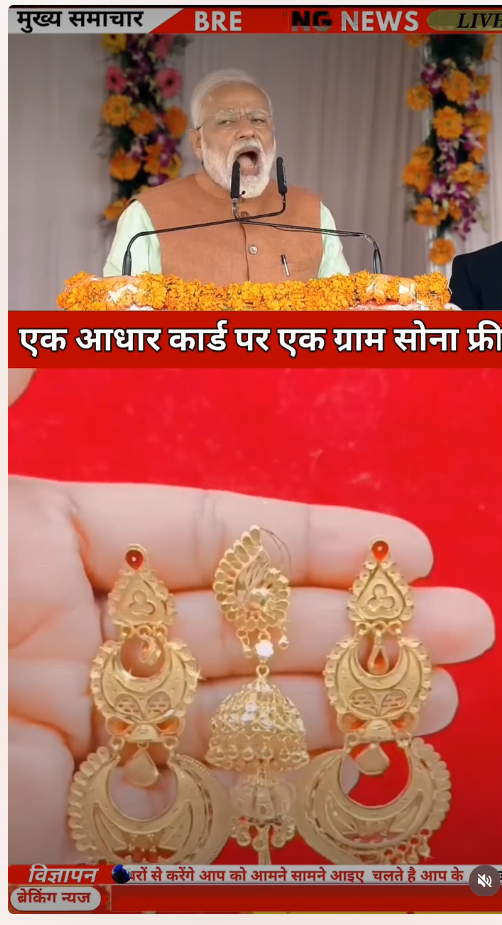
A video of Prime Minister Narendra Modi is being widely shared on social media, in which he appears to say that every woman would receive 1 gram of gold free against one Aadhaar card. The clip is being circulated with misleading claims suggesting a government scheme. Research by CyberPeace Research Wing found that the audio of Prime Minister Modi’s 2019 video was manipulated using AI technology and shared with a misleading claim.
Claim
An Instagram user shared the viral video claiming that PM Modi announced free gold for women.
Fact Check
To verify the claim, we conducted a keyword search on Google but found no credible media reports or official announcements supporting such a scheme. We then extracted keyframes from the viral clip and performed a reverse image search. This led us to the original video uploaded by DD News on February 24, 2019. In the authentic footage, PM Modi was addressing a public rally in Gorakhpur. At no point did he mention distributing gold to women.

Further examination of the viral clip raised suspicions of audio manipulation. We analyzed the speech using AI detection tool Hive Moderation, which indicated a 99% probability that the speech was AI-generated.

Conclusion
Our research found that the viral claim is false. The video uses footage from PM Modi’s 2019 speech, while the original audio appears to have been replaced using AI-generated voice technology to spread a misleading claim about free gold distribution.

Related Blogs

The United Nations in December 2019 passed a resolution that established an open-ended ad hoc committee. This committee was tasked to develop a ‘comprehensive international convention on countering the use of ICTs for criminal purposes’. The UN Convention on Cybercrime is an initiative of the UN member states to foster the principles of international cooperation and establish legal frameworks to provide mechanisms for combating cybercrime. The negotiations for the convention had started in early 2022. It became the first binding international criminal justice treaty to have been negotiated in over 20 years upon its adoption by the UN General Assembly.
This convention addresses the limitations of the Budapest Convention on Cybercrime by encircling a broader range of issues and perspectives from the member states. The UN Convention against Cybercrime will open for signature at a formal ceremony hosted in Hanoi, Viet Nam, in 2025. The convention will finally enter into force 90 days after being ratified by the 40th signatory.
Objectives and Features of the Convention
- The UN Convention against Cybercrime addresses various aspects of cybercrime. These include prevention, investigation, prosecution and international cooperation.
- The convention aims to establish common standards for criminalising cyber offences. These include offences like hacking, identity theft, online fraud, distribution of illegal content, etc. It outlines procedural and technical measures for law enforcement agencies for effective investigation and prosecution while ensuring due process and privacy protection.
- Emphasising the importance of cross-border collaboration among member states, the convention provides mechanisms for mutual legal assistance, extradition and sharing of information and expertise. The convention aims to enhance the capacity of developing countries to combat cybercrime through technical assistance, training, and resources.
- It seeks to balance security measures with the protection of fundamental rights. The convention highlights the importance of safeguarding human rights and privacy in cybercrime investigations and enforcement.
- The Convention emphasises the importance of prevention through awareness campaigns, education, and the promotion of a culture of cybersecurity. It encourages collaborations through public-private partnerships to enhance cybersecurity measures and raise awareness, such as protecting vulnerable groups like children, from cyber threats and exploitation.
Key Provisions of the UN Cybercrime Convention
Some key provisions of the Convention are as follows:
- The convention differentiates cyber-dependent crimes like hacking from cyber-enabled crimes like online fraud. It defines digital evidence and establishes standards for its collection, preservation, and admissibility in legal proceedings.
- It defines offences against confidentiality, integrity, and availability of computer data and includes unauthorised access, interference with data, and system sabotage. Further, content-related offences include provisions against distributing illegal content, such as CSAM and hate speech. It criminalises offences like identity theft, online fraud and intellectual property violations.
- LEAs are provided with tools for electronic surveillance, data interception, and access to stored data, subject to judicial oversight. It outlines the mechanisms for cross-border investigations, extradition, and mutual legal assistance.
- The establishment of a central body to coordinate international efforts, share intelligence, and provide technical assistance includes the involvement of experts from various fields to advise on emerging threats, legal developments, and best practices.
Comparisons with the Budapest Convention
The Budapest Convention was adopted by the Committee of Ministers of the Council of Europe at the 109th Session on 8 November 2001. This Convention was the first international treaty that addressed internet and computer crimes. A comparison between the two Conventions is as follows:
- The global participation in the UNCC is inclusive of all UN member states whereas the latter had primarily European with some non-European signatories.
- The scope of the UNCC is broader and covers a wide range of cyber threats and cybercrimes, whereas the Budapest convention is focused on specific offences like hacking and fraud.
- UNCC strongly focuses on privacy and human rights protections and the Budapest Convention had limited focus on human rights.
- UNCC has extensive provisions for assistance to developing countries and this is in contrast to the Budapest Convention which did not focus much on capacity building.
Future Outlook
The development of the UNCC was a complex process. The diverse views on key issues have been noted and balancing different legal systems, cultural perspectives and policy priorities has been a challenge. The rapid technology evolution that is taking place requires the Convention to be adaptable to effectively address emerging cyber threats. Striking a balance remains a critical concern. The Convention aims to provide a blended approach to tackling cybercrime by addressing the needs of countries, both developed and developing.
Conclusion
The resolution containing the UN Convention against Cybercrime is a step in global cooperation to combat cybercrime. It was adopted without a vote by the 193-member General Assembly and is expected to enter into force 90 days after ratification by the 40th signatory. The negotiations and consultations are finalised for the Convention and it is open for adoption and ratification by member states. It seeks to provide a comprehensive legal framework that addresses the challenges posed by cyber threats while respecting human rights and promoting international collaboration.
References
- https://consultation.dpmc.govt.nz/un-cybercrime-convention/principlesandobjectives/supporting_documents/Background.pdf
- https://news.un.org/en/story/2024/12/1158521
- https://www.interpol.int/en/News-and-Events/News/2024/INTERPOL-welcomes-adoption-of-UN-convention-against-cybercrime#:~:text=The%20UN%20convention%20establishes%20a,and%20grooming%3B%20and%20money%20laundering
- https://www.cnbctv18.com/technology/united-nations-adopts-landmark-global-treaty-to-combat-cybercrime-19529854.htm

Executive Summary:
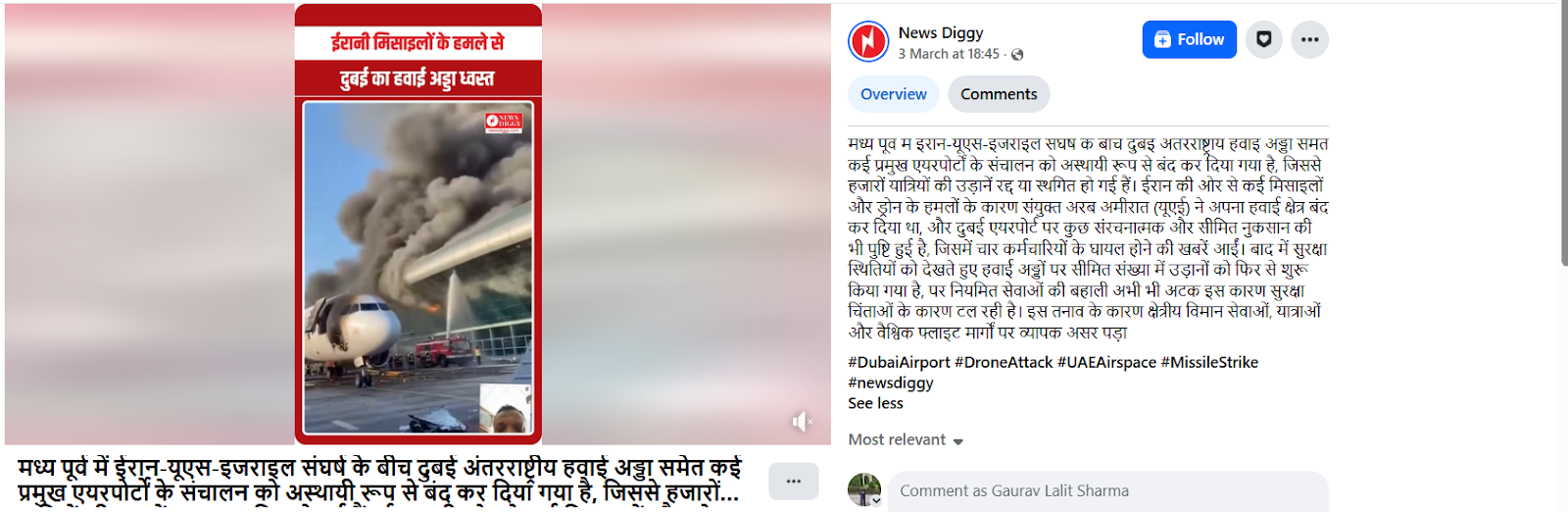
A video is being shared on social media showing an aircraft engulfed in massive flames on an airport runway. The video is being linked to the UAE. It is being claimed that a UAE airport was completely destroyed due to recent drone and missile attacks by Iran. Research by the CyberPeace found the viral claim to be false. Our research revealed that the viral video is not real, but AI-generated.
Claim:
On social media platform Facebook, a user shared the viral video on March 3, 2026, and wrote, “Amid the Iran-US-Israel conflict in the Middle East, operations at several major airports, including Dubai International Airport, have been temporarily suspended, causing thousands of flight cancellations and delays. Due to multiple missile and drone attacks from Iran, the United Arab Emirates (UAE) had shut its airspace, and limited structural damage at Dubai Airport was also confirmed, with reports of four staff members being injured. Later, considering the security situation, a limited number of flights were resumed, but full operations are still delayed due to ongoing safety concerns. This tension has significantly impacted regional aviation, travel, and global flight routes.”
Fact Check:
To verify the viral video, we searched relevant keywords on Google. However, we did not find any credible media report confirming the claim.However, we found a video report on the YouTube channel of CNN-News18 mentioning explosions near Dubai Airport after a suspected Iranian drone strike. But the visuals shown in that report are completely different from the viral video.

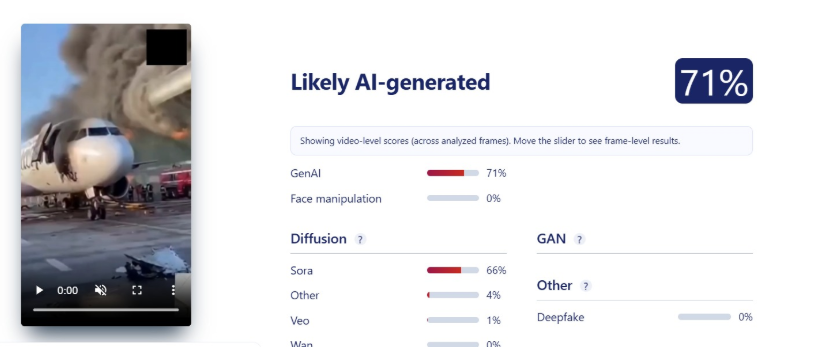
Upon closely examining the viral video, we noticed several inconsistencies, raising suspicion that it might be AI-generated. We then analyzed the video using the AI detection tool Sightengine. The results indicated that the video is 71 percent likely to be AI-generated.
Conclusion:
Our research found that the viral video is not real, but AI-generated.

Introduction
Uttar Pradesh's state government has taken significant step to promote e-sports, organised games played on video or digital formats, under its new sports policy. The plan includes setting up an e-sports centre in the state, providing basic infrastructure to athletes in every district, and including them under various beneficiary schemes. Schools and colleges will also be asked to promote e-sports. The government sees e-sports as a crucial tool for connecting with young people and a significant market for businesses, game developers, and sports organisations. An awareness program will be held at high school and college levels to educate children about the benefits of e-sports. A talent search and skill development model will be created by studying the national and international e-sports ecosystem.
Recognition to E-Sports
The Uttar Pradesh cabinet, chaired by Chief Minister Yogi Adityanath, has approved the New Sports Policy 2023 to promote and foster a sports culture in the state. The policy focuses on various aspects, including physical fitness and training, and supports the development of new institutions and connecting schools, colleges, and private academies with sports. The state government has also incorporated provisions from other states to help athletes chase their goals.
The state's first-ever sports policy, establishing a primary fund of 10 crore for the Uttar Pradesh Sports Development Fund (UPSDF). The policy also inducted e-sports, becoming the first state in India to have e-sports in its official policy. E-sports refers to competitive and organized video game events, and the Centre has officially recognised it.
Key highlights of the Uttar Pradesh Sports Policy 2023
The government's sports department, with the help of the industrial directorate, will plan to promote sports goods manufacturing in the state, with Meerut being one of the main clusters.
The policy also promises to increase the participation of women in sports. Para-athletes will be accommodated in all schemes of the sports department, and special coaches will be appointed for para-sports.
Athletes who have represented the state at national and international levels will be part of the state pension scheme, receiving monthly pensions and preference for university admission and jobs under the sports quota. Cash prizes will be awarded based on international performance and will be increased for those who help these athletes win medals at the top level.
Way forward
The policy promises financial assistance to sports associations and academies, allowing them to expand their infrastructure and training facilities. The state will also establish 14 centres of excellence, each centred around a particular sport, through Public-Private Partnership (PPP) models. The state sports authority will be established, on the lines of the Sports Authority of India (SAI). A State Sports Development Fund will be put in place to provide assistance to weak players, associations, or academies. Five high-performance centres will be built in the state, providing training facilities for high-performance athletes.
The policy also includes provisions for financial assistance to budding athletes, providing health insurance coverage of up to Rs 5 lakh for registered players and funds from the Eklavya Sports Fund for injury treatment. Players will receive training based on their skill power, with three categories: grassroots players, elite-class players, and elite-class players. Other notable aspects of the policy include establishing sports centres in each district, promoting local and indigenous sports, encouraging the sports industry, promoting e-sports, providing better facilities in hostels, forming committees for international players, encouraging schools to start sports nurseries or academies, and forming a committee for the Khelo India University Games which is a largest ever competition held at university level in India.
Conclusion
Uttar Pradesh's New Sports Policy 2023 is a significant step towards sports development, integrating e-sports into its sports promotion strategies. Under Chief Minister Yogi Adityanath, the state government is committed to sports infrastructure development, talent identification, and athlete support systems. The policy emphasises inclusivity, accommodating para-athletes, and providing financial assistance, training, and health insurance coverage for athletes. Initiatives include establishing sports centres, promoting indigenous sports, encouraging private investments, and fostering collaboration between educational institutions and sports academies. The policy also encourages for organising and hosting national and international level e-sports competitions in the state. This forward-looking approach aims to harness the full spectrum of sporting opportunities, empowering citizens and elevating its standing in national and international sporting arenas.
References:
