
#FactCheck -AI-Generated Image Falsely Shared as Iranian Soldiers Standing Near Downed Helicopter
Executive Summary
Amid rising tensions involving Iran, Israel and the United States following reports in early April 2026 that Iran had shot down an American fighter aircraft, a picture is going viral on social media claiming to show Iranian soldiers standing beside the wreckage of a destroyed helicopter while holding the Iranian flag. Research by CyberPeace Research Wing found that the viral claim is false. The image has been created using artificial intelligence and does not depict any real incident. The picture was generated using Google AI tools and is being misleadingly circulated online with different claims.
Claim
A Facebook page named “official salman 09” shared the image on May 1, 2026, along with a lengthy caption describing the scene as a symbol of Iran’s battlefield success. The post portrayed the image as evidence of a helicopter being brought down during ongoing tensions in the Middle East and suggested that the photo reflected strength, morale and victory in war.
- https://www.facebook.com/permalink.phpstory_fbid=pfbid02TAac6JwZha2UU4T8QiCGq4ENmsnNSwvigaz3vKxr9UWLbhghNsnMMpZdQ3dUuQ1rl&id=100092392280139
- https://archive.ph/

Fact Check
To verify the authenticity of the image, we first conducted a reverse image search using Google Lens. The image did not appear in any credible news reports or authentic media coverage. Instead, it was found circulating mainly on social media platforms, raising suspicion about its authenticity. We then analyzed the image using Google’s SynthID detector. The analysis confirmed the presence of a SynthID watermark with a “very high confidence” score, indicating that the image had been generated using Google AI tools. SynthID is Google’s watermarking technology used to identify AI-generated content created through its models.

Further verification using another AI-detection platform, Hive Moderation, also indicated a high probability that the image had been generated using AI. The tool identified Gemini as the likely source and assessed the image as overwhelmingly AI-generated.

Conclusion
Our research confirms that the viral image is AI-generated and unrelated to any real-world event. The picture showing soldiers holding the Iranian flag near helicopter wreckage was created using Google AI tools and is being falsely shared on social media to spread misleading claims.

Related Blogs

A video circulating widely on social media claims to show snowfall near Ambience Mall in Gurugram, Haryana. The clip is being shared alongside assertions that Gurugram witnessed snowfall for the first time in its history amid a severe cold wave in January 2026. However, an research by Cyber Peace Foundation has found the claim to be misleading. Our verification reveals that the viral video is not recent and has been available online since March 2023.
The Claim
On 14 January 2026, a Facebook user shared the video with the caption,“Something truly unbelievable happened today — Gurgaon witnessed snowfall for the first time in its history!”Through this post, the user implied that the visuals showed snowfall near Ambience Mall during the ongoing cold wave.link and screeshot
- https://www.instagram.com/reel/DTfS9X9DyBo/?utm_source=ig_embed&ig_rid=239ddaf7-ec53-4b1d-8f3b-a5e39540b3ee
- https://archive.ph/JVjHf

Fact Check:
To verify the claim, we conducted a detailed search using relevant keywords but found no credible media reports or official statements to support it. Although Gurugram’s temperature dropped to 0.6 degrees Celsius amid an IMD-issued cold wave warning, there is no evidence to suggest that the city experienced snowfall or hail. As of January 16, 2026, weather records and official sources confirm that no such weather event occurred in Gurugram.
A reverse image search of keyframes extracted from the viral clip traced the same footage to a video uploaded on the YouTube channel Crazy Tube on March 21, 2023. This establishes that the video has been in circulation for nearly three years. In the original upload, the person filming clearly mentions that the visuals were recorded near a toll plaza, further indicating that the clip is unrelated to the recent weather conditions in Gurugram. Link and Screen Shot

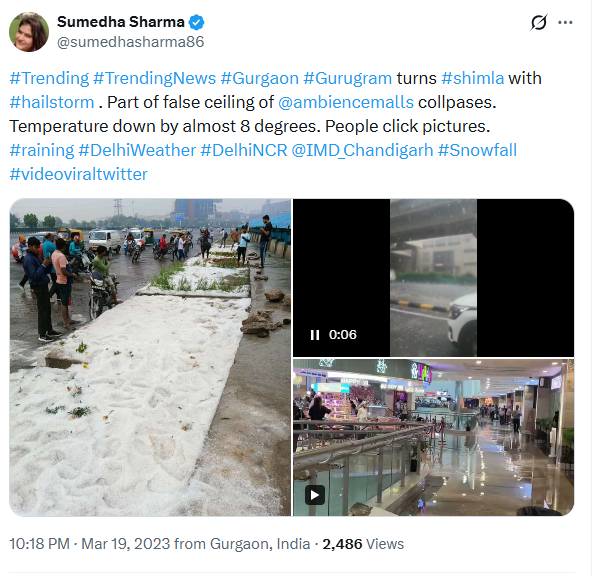
We also came across an X (formerly Twitter) post from March 19, 2023, which featured images similar to those seen in the viral video. The post described the visuals as being from a hailstorm in Gurugram, indicating that the content predates the current weather conditions and is unrelated to the recent cold wave.
Conclusion:
The video is old and predates January 2026, and has been on the internet at least since March 2023. While Gurugram recorded a low of 0.6 degrees Celsius amid an IMD cold wave warning, the city did not experience snowfall or hail as of 16 January 2026. News reports from March 2023 confirm heavy rain and hail in Delhi and adjoining areas, including parts of Gurugram, but there is no evidence of snowfall in January 2026. Hence, the claim made in the post is MISLEADING.

Introduction
Criminal justice in India is majorly governed by three laws which are – Indian Penal Code, Criminal Procedure Code and Indian Evidence Act. The centre, on 11th August 2023’ Friday, proposes a new bill in parliament Friday, which is replacing the country’s major criminal laws, i.e. Indian Penal Code, Criminal Procedure Code and Indian Evidence Act.
The following three bills are being proposed to replace major criminal laws in the country:
- The Bharatiya Nyaya Sanhita Bill, 2023 to replace Indian Penal Code 1860.
- The Bharatiya Nagrik Suraksha Sanhita Bill, 2023, to replace The Code Of Criminal Procedure, 1973.
- The Bharatiya Sakshya Bill, 2023, to replace The Indian Evidence Act 1872.
Cyber law-oriented view of the new shift in criminal lawNotable changes:Bharatiya Nyaya Sanhita Bill, 2023 Indian Penal Code 1860.
Way ahead for digitalisation
The new laws aim to enhance the utilisation of digital services in court systems, it facilitates online registration of FIR, Online filing of the charge sheet, serving summons in electronic mode, trial and proceedings in electronic mode etc. The new bills also allow the virtual appearance of witnesses, accused, experts, and victims in some instances. This shift will lead to the adoption of technology in courts and all courts to be computerised in the upcoming time.
Enhanced recognition of electronic records
With the change in lifestyle in terms of the digital sphere, significance is given to recognising electronic records as equal to paper records.
Conclusion
The criminal laws of the country play a significant role in establishing law & order and providing justice. The criminal laws of India were the old laws existing under British rule. There have been several amendments to criminal laws to deal with the growing crimes and new aspects. However, there was a need for well-established criminal laws which are in accordance with the present era. The step of the legislature by centralising all criminal laws in their new form and introducing three bills is a good approach which will ultimately strengthen the criminal justice system in India, and it will also facilitate the use of technology in the court system.

Introduction
Cyberwarfare has evolved into one of the most decisive instruments of statecraft and conflict. The increasing digitisation of critical infrastructure like power grids, water systems, transportation systems, healthcare networks, and energy sources has made these systems new targets in the war of algorithms. Military logic is evolving to paralyse the nation’s critical infrastructure to keep its resources engaged in repairing them and thereby break the nation’s ability to deter and counter attacks, all without firing a single bullet.
From Ransomware to an Invisible Sabotage: The changing nature of warfare
The operational technology (OT) landscape has become the epicentre of cyber operations, all around the world. Once, which was insulated, related to industrial systems that controlled turbines, pipelines, or dams, they now stand connected to the Internet through supervisory control and data acquisition (SCADA) and the Internet of Things. These connections have also become gateways for attackers, besides enhancing the efficiency of the infrastructural lifelines of the nation.
Groups like Volt Typhoon, Sandworm, Laurionite, and Cyberavengers have transformed the art of digital infiltration into a strategic shift. Volt Typhoon, which is linked to China, has used “living-off-the-land” techniques to exploit the legitimate administrative tools to remain invisible while scanning the critical infrastructures in the US. Sandworm, which is aligned with Russia’s GRU (Glavnoye Razvedyvatelnoye Upravlenie) or Main Intelligence Directorate (in English), has demonstrated the power of cyber sabotage in real time, as its attacks on Ukraine’s power grids in 2015 and 2021 had left millions in darkness, coinciding with kinetic missile strikes. Meanwhile, the Iranian-affiliated Cyberavengers group, which has weaponised the AI-assisted malware, such as IOCONTROL, that are capable of hijacking water and energy control systems. Each of these systems used in these operations reflects a shift from direct espionage activities to a state of strategic paralysis.
In comparison to the traditional cybercrime activities that are aimed at stealing data and extortion of money, these campaigns repeatedly target the physical systems, which consist of the machinery that sustains civilian life and military preparedness.
The Military Logic behind Cyber Targeting: A Web of Vulnerabilities
A critical infrastructure is a complex ecosystem that covers power generation, transportation, communication, and manufacturing are all interconnected, which means a single compromised node can cascade into a national paralysis. For instance, a breach in the systems of the dam can flood an entire city, a grid shutdown can halt water supply to hospitals, and even affect air traffic. The 2015 Black Energy Malware attack in Ukraine has proved this possibility when three utilities were hacked, plunging thousands of homes into darkness. The Iranian hackers once again gained access to the Bowman Avenue Dam of New York and controlled its floodgates, which gave a chilling demonstration of the destructive reality of digital manipulation.
The systems remain vulnerable mainly for 3 reasons such as-
- Legacy Architectures: Many of these industrial systems were designed decades ago with no built-in cybersecurity mechanisms.
- Slow Patching and Segmentation Gaps: All updates and segmentation between IT and TO networks often lag, providing open entry points for attackers.
- Converging with IoT: The integration of smart sensors and cloud-based management tools has expanded the attack surface exponentially.
This interconnected fragility has turned our critical infrastructures into both a weapon and a target or a tool for coercion in modern hybrid warfare. Between 2023 and 2024, over 420 cyberattacks were witnessed in several critical global infrastructures, which averaged to 13 attacks per second, according to a news report. These were not just random acts of digital vandalism; they were deliberate and coordinated operational attempts by state-led actors from China, Russia, and Iran.
Developing a new Resilience as the new tool of Deterrence
Cyber deterrence no longer rests on the fear of retaliation, it relies on the need for resilience. Nations that can absorb attacks, maintain continuity, and recover rapidly would be the true superpowers of this digital age. Segmentation, real-time threat detection, and AI-assisted recovery models are vital pillars of this model of resilience. The logic of modern cyberwarfare is clear, which means that the more a nation digitizes, the more it will need to defend itself.
However, as the line between war and peace blurs, safeguarding critical infrastructure is no longer just an IT priority; rather, it is a national security doctrine. In this silent theatre of cyberwarfare, survival will depend not only on firepower, but on firewalls.
References
- https://rmcglobal.com/critical-infrastructure-under-siege-the-top-ot-threats-of-2025/
- https://ccdcoe.org/uploads/2018/10/Geers2009_The-Cyber-Threat-to-National-Critical-Infrastructures.pdf
- https://www.researchgate.net/publication/335752979_Cybersecurity_of_Critical_Infrastructure
- https://arxiv.org/html/2510.04118v1
- https://www.anapaya.net/blog/top-5-critical-infrastructure-cyberattacks
