#FactCheck: Digitally Manipulated Video of Salman Khan, Rahul Gandhi, and Vijay
Executive Summary
A video is being widely shared on social media, allegedly showing Bollywood superstar Salman Khan alongside Congress leader Rahul Gandhi and Tamil Nadu Chief Minister Vijay, also known simply as Vijay. CyberPeace Research Wing Research Wing researched the viral picture/image and found that it was AI-generated and digitally manipulated. ClaimA user on social media shared a picture featuring Rahul Gandhi, Salman Khan, and CM Vijay together. The link and screenshot of the post are given below:
https://www.facebook.com/reel/2460733931107405
https://archive.is/0ji8e

Factcheck
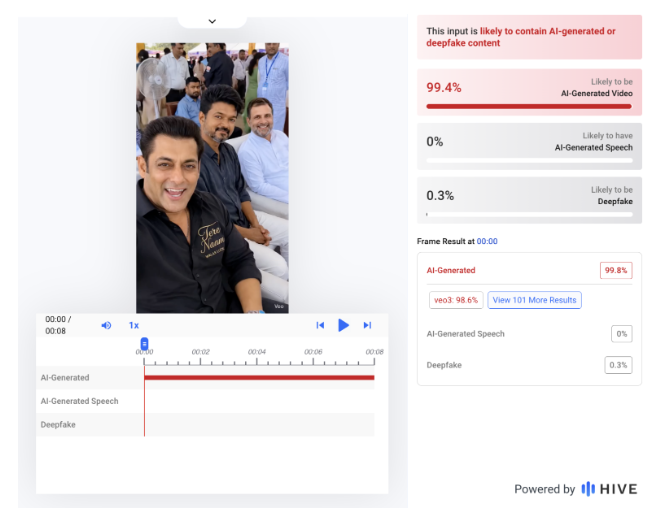
A reverse image search of several key frames of the video, along with searches using relevant keywords, yielded no reliable evidence supporting this claim. We found no verified video, official social media post, or credible media report showing Congress leader Rahul Gandhi, Salman Khan, and Vijay together as depicted in the viral clip. None of the individuals seen in the video have shared this clip on their verified social media accounts. A frame-by-frame analysis also revealed several clear signs of AI manipulation. These include unnatural facial expressions, improper lip-syncing, unnatural body movements, inconsistencies in body proportions, and irregularities in lighting and shadows. The background of the video also appears excessively smooth and lacks realistic depth and texture. To further verify the claim, we analyzed the video using the AI detection tool Hive Moderation. The tool categorized the video as AI-generated with a high probability score, providing additional proof that the viral footage has been digitally created.
Conclusion
We researched the viral picture/image and found that it was AI-generated and digitally manipulated.
Related Blogs

Executive Summary
A video circulating widely on social media purportedly shows Prime Minister Narendra Modi referring to the recently signed defence agreement involving Pakistan, Saudi Arabia and Türkiye during his Independence Day address from the Red Fort.
The clip carries an alleged statement in which Modi is heard saying that he had previously discussed the possibility of Pakistan, Saudi Arabia and Türkiye coming together with Israeli Prime Minister Benjamin Netanyahu. He is further purportedly heard claiming that Netanyahu had said the Gulf countries and Iran would be made to fight each other and eventually eliminated. The voice attributed to Modi allegedly concludes that his assessment had proved correct and that those involved were now looking for a way out of the situation.
An research by the CyberPeace Research Wing’s Research Wing found that the viral clip is misleading. The audio has been digitally altered and superimposed on footage from Modi’s Independence Day address. The alleged remarks do not feature in the Prime Minister’s original speech.
Claim
On August 16, Pakistan-based journalist Fakhar Ur Rehman (@Fakharrehman01) shared the video on X, claiming it showed Modi discussing the defence pact between Pakistan, Saudi Arabia and Türkiye during his Independence Day speech from the Red Fort. The accompanying video purportedly shows Modi saying that he had spoken to Netanyahu about the possibility of the three countries forming an alliance. According to the alleged remarks, Netanyahu had said that the Gulf nations and Iran would be encouraged to fight one another and eventually eliminated.
The speaker, purportedly Modi, is then heard saying that his prediction had turned out to be correct and that the parties involved were now worried about finding a way out of the situation.
https://x.com/Fakharrehman01/status/2088899788788117899?s=20

Fact Check
To verify whether the remarks were actually made by Modi, the Desk first searched Google using a combination of relevant keywords and looked for the complete recording of his Independence Day address. The search led to the official YouTube channel of the Prime Minister’s Office (PMO India), which carries the full recording of Modi’s speech uploaded on August 15, 2026. The Desk reviewed the entire one-hour-and-39-minute video and found no instance in which Modi made the statements heard in the viral clip. The absence of the alleged remarks from the original recording raised concerns that the audio had been added or modified.
https://www.youtube.com/watch?v=aDHjd3GUU7Y

The Desk then cross-checked the Prime Minister’s speech with its official written transcript available on the Press Information Bureau (PIB) website. A review of the transcript found no mention of a proposed or existing alliance involving Pakistan, Saudi Arabia and Türkiye. It also contained no reference to Israeli Prime Minister Benjamin Netanyahu in the context described in the viral video.
https://www.pib.gov.in/PressReleasePage.aspx?PRID=2156749®=48&lang=2

Since the video appeared to contain altered audio, the Desk next separated the soundtrack from the footage for further examination. The extracted audio was analysed using Resemble AI, an AI-based audio detection tool. The tool did not conclusively establish that the recording had been digitally manipulated. However, its assessment indicated that the voice could be an impersonation, adding further doubt to the authenticity of the audio attributed to Modi. The Desk also compared the audio findings with the original speech and its official transcript. Neither source contained the statements being circulated in the viral clip.

Conclusion
The video does not show Prime Minister Narendra Modi making the remarks attributed to him about Pakistan, Saudi Arabia, Türkiye and Israel. The footage is from his Independence Day address, but the audio carrying the alleged comments has been digitally manipulated and superimposed. Analysis by Resemble AI further indicated that the voice may be an impersonation. Therefore, the claim that Modi made the alleged remarks about the Pakistan-Saudi Arabia-Türkiye alliance and Benjamin Netanyahu is false

Introduction
Misinformation is, to its basic meaning, incorrect or misleading information, it may or may not include specific malicious intent and includes inaccurate, incomplete, misleading, or false information and selective or half-truths. The main challenges in dealing with misinformation are defining and distinguishing misinformation from legitimate content. This complexity arises due to the rapid evolution and propagation which information undergoes on the digital platforms. Additionally, balancing the fundamental right of freedom of speech and expression with content regulation by state actors poses a significant challenge. It requires careful consideration to avoid censorship while effectively combating harmful misinformation.
Acknowledging the severe consequences of misinformation and the critical need to combat misinformation, Bharatiya Nyaya Sanhita (BNS), 2023 has implemented key measures to address misinformation in India. These new provisions introduced under the new criminal laws in India penalise the deliberate creation, distribution, or publication of inaccurate information. Previously missing from the IPC, these sections offer an additional legal resource to counter the proliferation of falsehoods, complementing existing laws targeting the same issue.
Section 353 of the BNS on Statements Conducing to Public Mischief criminalises making, publishing, or circulating statements, false information, rumours, or reports, including through electronic means, with the intent or likelihood of causing various harmful outcomes.
This section thus brings misinformation into its ambit, since misinformation has been traditionally used to induce public fear or alarm that may lead to offences against the State or public tranquillity or inciting one class or community to commit offences against another. The section also penalizes the promotion of enmity, hatred, or ill will among different religious, racial, linguistic, or regional groups.
BNS also prescribes punishment of imprisonment for up to three years, a fine, or both for offences under section 353. Interestingly, a longer imprisonment of up to 5 years along with a fine has been prescribed to curb such offences in places of worship or during religious ceremonies. The only exception that may be availed under this section is granted to unsuspecting individuals who, believing the misinformation to be true, spread misinformation without any ill intent. However, this exception may not be as effective in curbing misinformation, since at the outset, the offence is hard to trace and has multiple pockets for individuals to seek protection without any mechanism to verify their intent.
The BNS also aims to regulate misinformation through Section 197(1)(d) on Imputations, assertions prejudicial to national integration. Under this provision, anyone who makes or publishes false or misleading information, whether it is in the form of spoken words, written, by signs, in visible representations, or through electronic communication, therefore, results in jeopardising the sovereignty, unity, integrity, or security of India is liable to face punishment in the form of imprisonment for up to three years, a fine, or both and if it occurs in a place of worship or during religious ceremonies, the quantum of punishment is increased to imprisonment for up to five years and may include a fine. Additionally, Section 212 (a) & (b) provides against furnishing false information. If a person who is legally obligated to provide information to a public servant, knowingly or reasonably believes that the information is false, and still furnishes it, they now face a punishment of six months imprisonment or a fine up to five thousand rupees or both. However, if the false information pertains to the commission or prevention of an offence, or the apprehension of an offender, the punishment increases to imprisonment for up to two years, a fine, or both.
Enforcement Mechanisms: CyberPeace Policy Wing Outlook
To ensure the effective enforcement of these provisions, coordination between the key stakeholders, i.e., the law enforcement agencies, digital platforms, and judicial oversight is essential. Law enforcement agencies must utilize technology such as data analytics and digital forensics for tracking and identifying the origins of false information. This technological capability is crucial for pinpointing the sources and preventing the further spread of misinformation. Simultaneously, digital platforms associated with misinformation content are required to implement robust monitoring and reporting mechanisms to detect and address the generated misleading content proactively. A supporting oversight by judicial bodies plays a critical role in ensuring that enforcement actions are conducted fairly and in line with legal standards. It helps maintain a balance between addressing misinformation and upholding fundamental rights such as freedom of speech. The success of the BNS in addressing these challenges will depend on the effective integration of these mechanisms and ongoing adaptation to the evolving digital landscape.
Resources:
- Bharatiya Nyaya Sanhita, 2023 https://www.mha.gov.in/sites/default/files/250883_english_01042024.pdf
- https://www.foxmandal.in/changes-brought-forth-by-the-bharatiya-nyaya-sanhita-2023/
- https://economictimes.indiatimes.com/news/india/spreading-fake-news-could-land-people-in-jail-for-three-years-under-new-bharatiya-nyaya-sanhita-bill/articleshow/102669105.cms?from=mdr

Introduction
Robotic or Robo dogs are created to resemble dogs in conduct and appearance, usually comprising canine features including barking and wagging tails. Some examples include Rhex (hexapod robot), Littledog and BigDog (created by Boston Dynamics robot). Robodogs, on the whole, can even respond to commands and look at a person with large LED-lit puppy eyes.
A four-legged robotic solution was recently concluded through its foremost successful radiation protection test inside the most extensive experimental area at the European Organization for Nuclear Research known as CERN. Each robot created at CERN is carefully crafted to fulfil exceptional challenges and complement each other. Unlike the previous wheeled, tracked or monorail robots, the robodogs will be capable of penetrating unexplored dimensions of the caverns, expanding the spectrum of surroundings that CERN robots can act as a guide. Also, Incorporating the robodog with the existing monorail robots in the Large Hadron Collider (LHC) tunnel will expand the range of places available for monitoring and supervision, improving the security and efficiency of the operation of CERN. Lenovo too has designed a six-legged robot called the "Daystar Bot GS" to be launched this year, which promises "comprehensive data collection."
Use of Robodogs in diverse domains
Due to the enhancement of Artificial Intelligence (AI), robodogs can be a boon for those with exceptional requirements. The advantage of AI is the dependability of its features, which can be programmed to answer certain commands detailed to the user.
In the context of health and well-being, they can be useful if they are programmed to take care of a person with distinct or special requirements (elderly person or visually impaired person). For this reason, they are considered more advantageous than the real dogs. Recently, New Stanford has designed robodogs that can perform several physical activities, including dancing and may also one day assist in putting pediatric patients in comfort during their hospital stays. Similarly, the robodog, "Pupper", is a revamped version of another robotic dog designed at Stanford called "Doggo", an open-source bot with 3D printed elements that one could create on a fairly small budget. They were also created to interact with humans. Furthermore, Robots as friends are a more comfortable hop for the Japanese. The oldest and most successful social robot in Japan is called "Paro", resembling an ordinary plush toy that can help in treating depression, stress, anxiety and also mood swings in a person. Following 1998, several Paro robots were exported overseas and put into service globally, reducing stress among children in ICUs, treating American veterans suffering from Post Traumatic Stress Disorder (PTSD), and assisting dementia patients.
Post-pandemic, the Japanese experiencing loneliness and isolation have been clinging to social robots for mind healing and comfort. Likewise, at a cafe in Japan, proud owners of the AI-driven robot dog "Aibo" have pawed its course into the minds and hearts of the people. Presently, robots are replacing the conventional class guinea pig or bunny at Moriyama Kindergarten in the central Japanese city of Nagoya. According to the teachers here, the bots apparently reduce stress and teach kids to be more humane.
In the security and defence domain, the unique skills of robodogs allow them to be used in hazardous and challenging circumstances. They can even navigate through rugged topography with reassurance to save stranded individuals from natural catastrophes. They could correspondingly help with search and rescue procedures, surveillance, and other circumstances that could be dangerous for humans. Researchers or experts are still fine-tuning the algorithm to develop them by devising the technology and employing affordable off-shelf robots that are already functional. Robodogs are further used for providing surveillance in hostage crises, defusing bombs, besides killing people to stop them from attacking other individuals. Similarly, a breakthrough in AI is being tested by the Australian military that reportedly allows soldiers to control robodogs solely with their minds. Cities like Florida and St. Petersburg also seem bound to keep police robodogs. The U.S. Department of Homeland Security is further seeking plans to deploy robot dogs at the borderlands. Also, the New York City Police Department (NYPD) intends to once again deploy four-legged 'Robodogs' to deal with high-risk circumstances like hostage negotiations. The NYPD has previously employed alike robodogs for high-octane duties in examining unsafe environments where human officers should not be exposed. The U.S. Marine Corps is additionally experimenting with a new breed of robotic canine that can be helpful in the battleground, enhance the safety and mobility of soldiers, and aid in other tasks. The Unitree Go1 robot dog (Nicknamed GOAT-Grounded Open-Air Transport) by the Marines is a four-legged machine that has a built-in AI system, which can be equipped to carry an infantry anti-armour rocket launcher on its back. The GOAT robot dog is designed to help the Marines move hefty loads, analyse topography, and deliver fire support in distant and dangerous places.
However, on the contrary, robodogs may pose ethical and moral predicaments regarding who is accountable for their actions and how to ensure their adherence to the laws of warfare. This may further increase security and privacy situations on how to safeguard the data of the robotic dogs and contain hacking or sabotage.
Conclusion
Teaching robots to traverse the world conventionally has been an extravagant challenge. Though the world has been seeing an increase in their manufacturing, it is simply a machine and can never replace the feeling of owning a real dog. Designers state that intelligent social robots will never replace humans, though robots provide the assurance of social harmony without social contact. Also, they may not be capable of managing complicated or unforeseen circumstances that need instinct or human decision-making. Nevertheless, owning robodogs in the coming decades is expected to become even more common and cost-effective as they evolve or advance with new algorithms being tested and implemented.
References:
- https://home.cern/news/news/engineering/introducing-cerns-robodog
- https://news.stanford.edu/2023/10/04/ai-approach-yields-athletically-intelligent-robotic-dog/
- https://nypost.com/2023/02/17/combat-ai-robodogs-follow-telepathic-commands-from-soldiers/
- https://www.popsci.com/technology/parkour-algorithm-robodog/
- https://ggba.swiss/en/cern-unveils-its-innovative-robodog-for-radiation-detection/
- https://www.themarshallproject.org/2022/12/10/san-francisco-killer-robots-policing-debate
- https://www.cbsnews.com/news/robo-dogs-therapy-bots-artificial-intelligence/
- https://news.stanford.edu/report/2023/08/01/robo-dogs-unleash-fun-joy-stanford-hospital/
- https://www.pcmag.com/news/lenovo-creates-six-legged-daystar-gs-robot
- https://www.foxnews.com/tech/new-breed-military-ai-robo-dogs-could-marines-secret-weapon
- https://www.wptv.com/news/national/new-york-police-will-use-four-legged-robodogs-again
- https://www.dailystar.co.uk/news/us-news/creepy-robodogs-controlled-soldiers-minds-29638615
- https://www.newarab.com/news/robodogs-part-israels-army-robots-gaza-war
- https://us.aibo.com/