
#FactCheck-Claim of Man Being Burned Alive During Muharram Procession Found False, Deoria Incident Misrepresented
Executive Summary
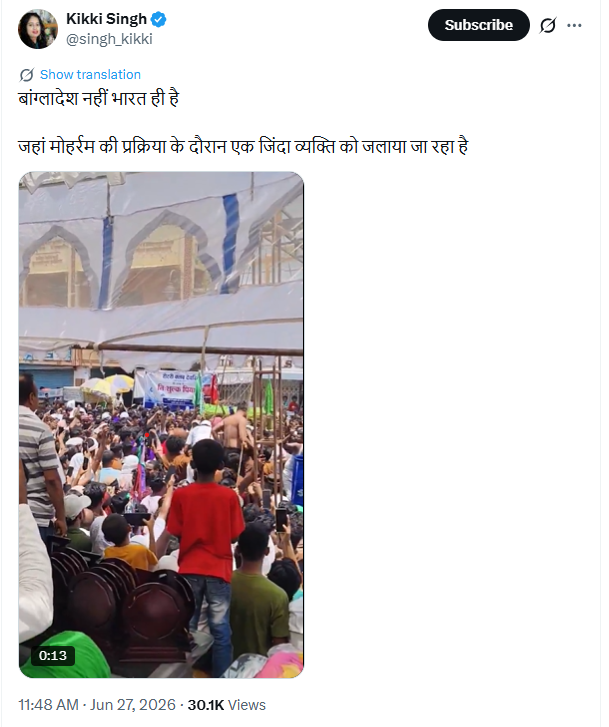
A video is being widely shared on social media linking it to a Muharram procession in India. The video shows a person engulfed in flames, with users claiming that an individual was deliberately set on fire during a Muharram procession in India. Several social media users are circulating the clip with communal claims. CyberPeace Research Wing research found that the viral claim is misleading. The video does not show any incident of a person being deliberately burned during a Muharram procession. In reality, it is from Deoria, Uttar Pradesh, where a performer sustained burn injuries while performing stunts during a Muharram procession.
Claim:
On X (formerly Twitter), a user posted the viral video on 3 June 2026, claiming: “Not Bangladesh, this is India where a person is being burned alive during a Muharram procession.” The post link, archive link, and screenshots are provided below. https://x.com/singh_kikki/status/2070753631167541586 , https://archive.ph/vP3bZ
Fact Check:
For verification, we extracted multiple keyframes from the video and conducted a reverse image search using Google Lens. During the search, we found the same video published on the Public app on 27 June 2026. According to the report, the incident took place on Malviya Road in Deoria city, Uttar Pradesh, during a Muharram procession, where a member of the 5-Star Club akhara, Saddam (24), a resident of Bans Deoria, suffered burn injuries while performing stunts involving fire. The report further stated that members of the akhara immediately rescued him and arranged first aid. Police confirmed that his condition is stable and that the incident was accidental. No other untoward incident was reported, and all Muharram processions were conducted peacefully. A statement by Circle Officer (City), Sanjay Kumar Reddy, was also included in the report. https://public.app/video/sp_zh7dywam0a2pb
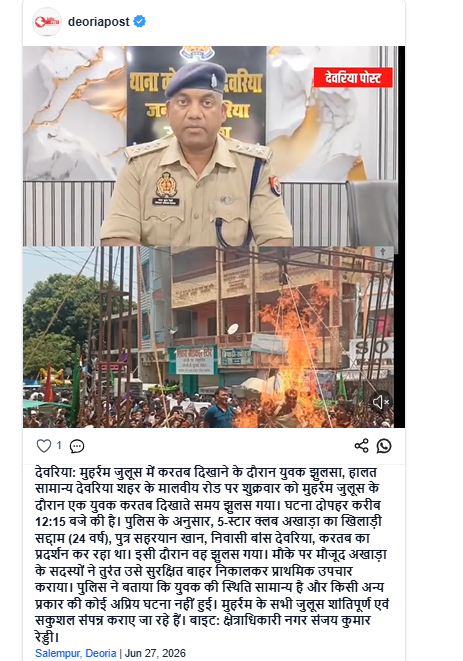
In our subsequent research, we found a report published on Dainik Bhaskar's website with the same claim. A link and screenshot of the post are provided below. https://www.bhaskar.com/amp/local/uttar-pradesh/deoria/news/deoria-youth-burns-muharram-procession-stunt-138296624.html

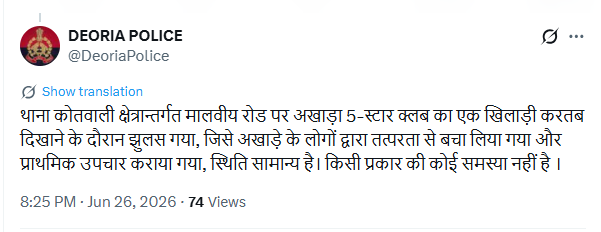
Finally, we also found an official post from the Deoria Police X handle confirming the incident. The police stated that a performer from the 5-Star Club akhara was injured while performing stunts on Malviya Road and was immediately given first aid. His condition is stable, and no other incident occurred. https://x.com/DeoriaPolice/status/2070521290864377982
Conclusion:
The research clearly found that the viral video does not show a person being deliberately burned during a Muharram procession. The footage is from Deoria, Uttar Pradesh, where a performer was accidentally injured during a fire stunt.

Related Blogs

Executive Summary
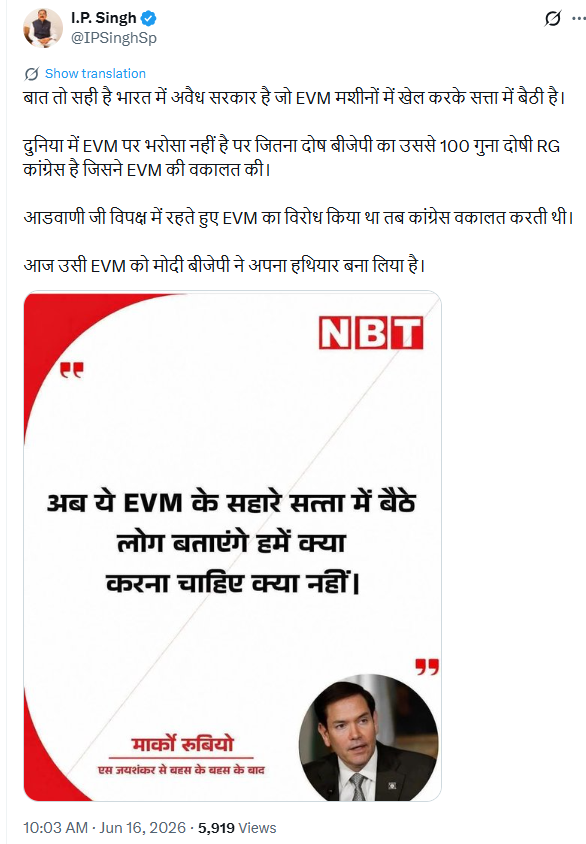
A social media post card featuring a photo of US Secretary of State Marco Rubio, carrying the logo of Navbharat Times, is being widely circulated online. The post claims that Rubio made a remark criticizing the Indian government, allegedly stating that “those in power through EVMs should tell us what to do and what not to do.” CyberPeace Research Wing research found the claim to be false. There is no evidence of Marco Rubio making any such statement, and the viral post card is fabricated.
Claim:
A post shared by SP leader IP Singh alleged that the US Secretary made comments questioning the legitimacy of the Indian government and EVM-based elections, further linking it to broader political criticism of EVMs.
Post link: https://x.com/IPSinghSp/status/2066740933396492706?s=20, https://archive.ph/submit/?url
Fact Check:
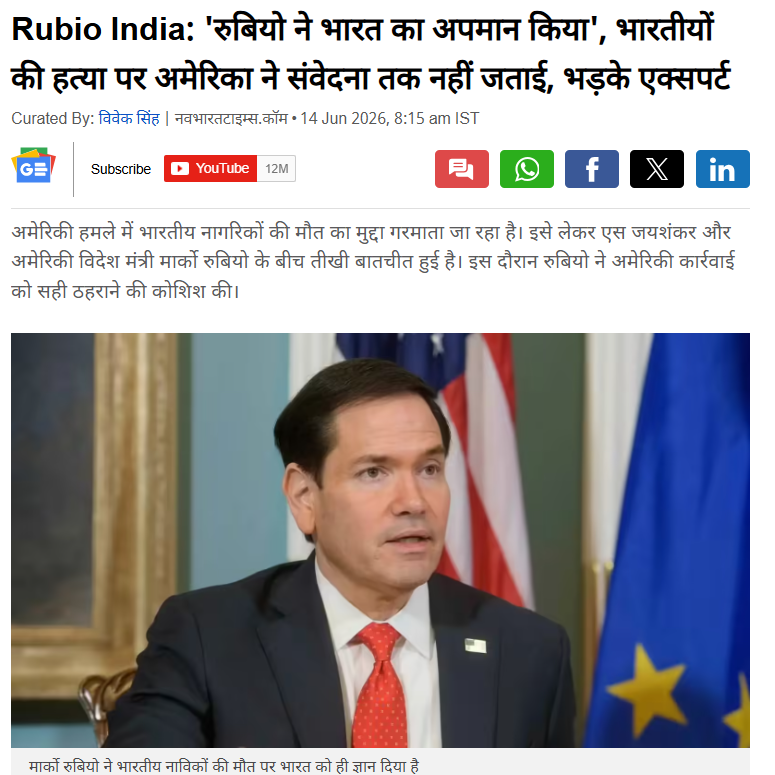
A keyword search of the alleged statement revealed no credible reports or official records of Marco Rubio making any such remark. Additionally, a review of Navbharat Times’ official social media handles did not show any such post card being published, indicating that the viral graphic is not authentic. Further examination of recent statements by Marco Rubio showed no reference to EVMs or the Indian electoral system. Instead, a Navbharat Times report dated June 14 covered a different issue related to tensions in the Hormuz Strait, where Rubio commented on the killing of Indian sailors during a maritime incident and emphasized compliance with US directives for commercial vessels. https://navbharattimes.indiatimes.com/world/america/marco-rubio-remarks-on-killing-of-indian-sailors-in-hormuz-strait-insult-of-india-says
Conclusion:
The research confirms that US Secretary of State Marco Rubio did not make any statement regarding EVMs or the Indian government. The viral post card is fake and misleading.

Executive Summary
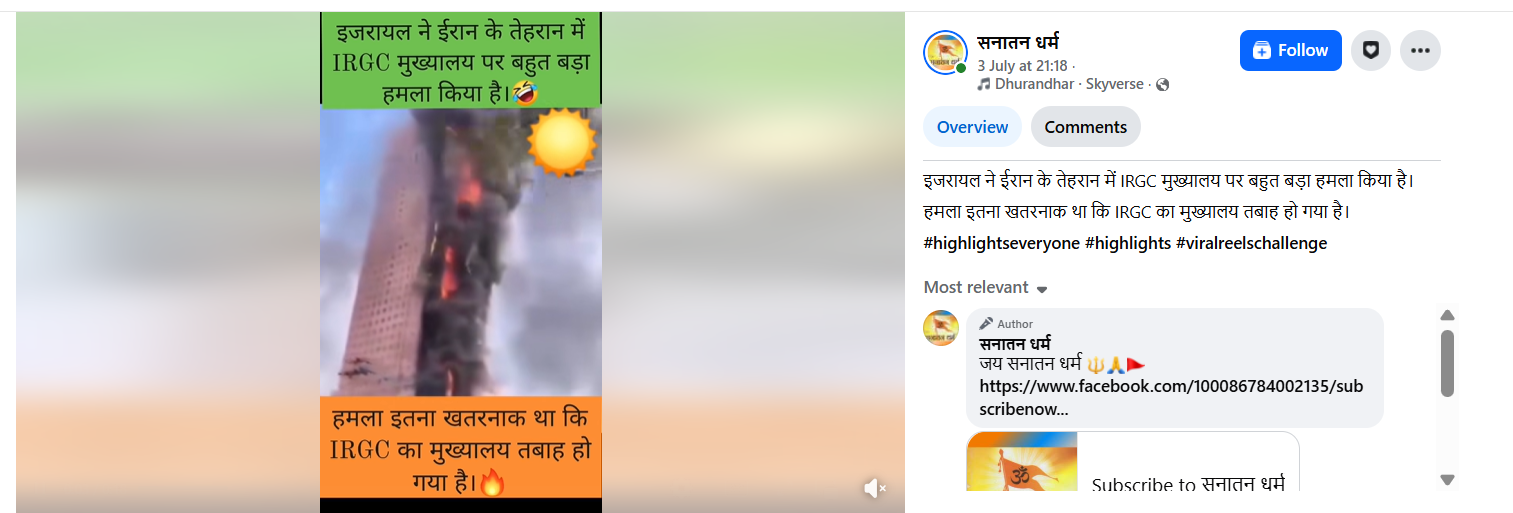
A video showing a massive fire in a high-rise building is being widely shared on social media. The footage shows a tall building engulfed in flames with thick smoke rising from it. Users are circulating the video with multiple claims. Some social media users claim that the video is from Tehran, Iran, where Israel allegedly carried out an attack on the headquarters of the Islamic Revolutionary Guard Corps (IRGC). Others are sharing the same video as an alleged strike by the United States Air Force on the IRGC headquarters. CyberPeace Research Wing’s research found the claim to be misleading. The video is not related to any Israeli or U.S. military strike on Iran’s IRGC. In reality, it shows a massive fire that broke out in a skyscraper in Changsha, China, in 2022.
Claim
On Facebook, a user shared the viral video on 3 July 2026, claiming: “Israel has carried out a massive attack on IRGC headquarters in Tehran, Iran. The headquarters has been destroyed in the strike.” The post link, archive link, and screenshots are provided below.
https://archive.ph/7BknH
https://www.facebook.com/watch/?v=1530020795436530
Fact Check
During verification, we extracted keyframes from the viral video and performed a reverse image search using Google Lens. The research led us to the same footage uploaded on the official YouTube channel of Hindustan Times on 16 September 2022. According to the video description, the incident shows a massive fire at a high-rise building in Changsha, China, not any military strike in Iran.
https://www.youtube.com/watch?v=Cphle9wkjCE

The video description states that the incident took place in a 42-storey building in Changsha, which housed the offices of the state-owned telecommunications company China Telecom. Authorities had initially confirmed that no casualties were reported. Further research led us to a report published on The Guardian website three years ago, which also contained visuals matching the viral footage.
https://www.theguardian.com/world/2022/sep/16/major-fire-breaks-out-at-skyscraper-in-changsha-china
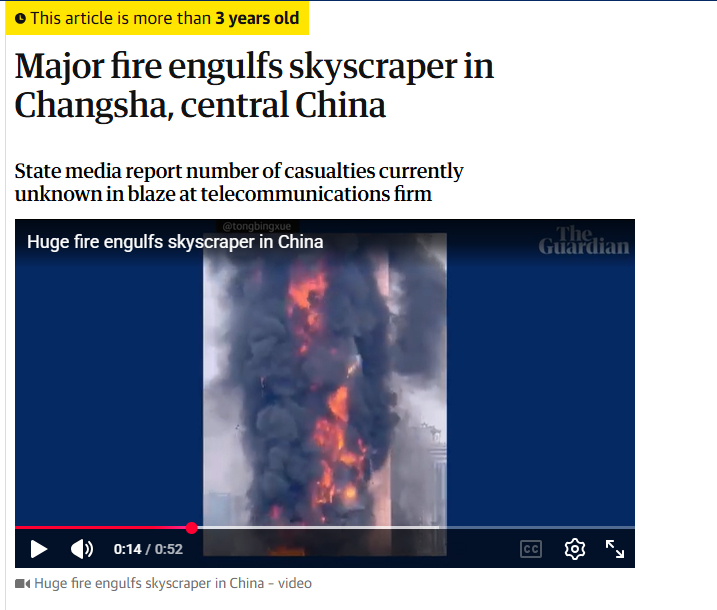
According to The Guardian report, the 42-storey, 218-metre-high building was constructed in 2000 and is located near a major ring road. The report also confirmed that there were no reported fatalities in the incident.
Conclusion
The research clearly found that the viral video does not show an Israeli or U.S. attack on Iran’s IRGC headquarters. The footage is from a massive fire that broke out in a skyscraper in Changsha, China, in 2022. Therefore, the claim being circulated on social media is false and misleading.

Introduction
Digital Arrests are a form of scam that involves the digital restraint of individuals. These restraints can vary from restricting access to the account(s), and digital platforms, to implementing measures to prevent further digital activities or being restrained on video calling or being monitored through video calling. Typically, these scams target vulnerable individuals who are unfamiliar with digital fraud tactics, making them more susceptible to manipulation. These scams often target the victims on allegations of drug trafficking, money laundering, falsified documents, etc. These are serious crimes and these scammers scare the victim into thinking that either their identities were used to commit these crimes or they have committed these crimes. Recently there has been an uptick in the digital fraud scams in India highlighting the growing concerns.
The Legality of Digital Arrests in India
There is no legal provision for law enforcement to conduct ‘arrests’ via video calls or online monitoring. If you receive such calls, it is a clear scam. In fact, recently enacted new criminal laws do not provide for any provision for law enforcement agencies conducting a digital arrest. The law only provides for service of the summons and the proceedings in an electronic mode.
The Bhartiya Nagrik Suraksha Sanhita (BNSS), 2023 provides for the summons to be served electronically under section 63. The section defines the form of summons. It states that every summons served electronically shall be encrypted and bear the image of the seal of the Court or digital signature. Further, according to section 532 of the BNSS, the trial and proceedings may be held in electronic mode, by use of electronic communication or by the use of audio-video electronic means.
Modus Operandi
Under digital arrest scams, the scammer makes a connection via video calls (WhatsApp calls, skype, etc) with the victim over their alleged involvement in crimes (financial, drug trafficking, etc) in bogus charges. The victims are intimidated that the arrest will take place soon and till the time the arresting officers do not reach the victim they are to remain on the call and be under digital surveillance and not contact anyone during the ongoing investigation.
During this period, the scammers start collecting information from the victim to confirm their identity and create an atmosphere in which multiple senior officials are on the victim’s case and they are investigating the case thoroughly. By this time, the victim, scared out of their wits, sits through this arrest and it is then that the scammers posing as law enforcement officials make comments that they can avoid arrest by paying a certain amount of the fines to the accounts that they specify. This monitoring/ surveillance continues till the time the victim makes the transfers to the accounts provided by the scammers. These are the common manipulation tactics used by scammers in digital arrest fraud.
Recent Cyber Arrest Cases
- Recently a 35-year-old NBCC official was duped of Rs 55 lakh in a 'digital arrest' scam. Posing as customs officials, fraudsters claimed her details were linked to intercepted illegal items and a pending arrest. They kept her on video calls, convincing her to transfer Rs 55 lakh to avoid money laundering charges. After the transfer, the scammers vanished. A police investigation traced the funds to a fake company, leading to the arrest of suspects.
- Another recent case involved a neurologist who was duped Rs 2.81 crores in a ‘digital arrest’ scam. Fraudsters claimed her phone number and Aadhaar was linked to accounts transferring funds to an Individual. Under pressure, she was convinced to undergo “verification” and made multiple transactions over two days. The scammers threatened legal consequences for money laundering if she didn’t comply. Now a police investigation is ongoing, and her immense financial loss highlights the severity of this cybercrime.
- One another case took place where the victim was duped of Rs 7.67 crores in a prolonged ‘digital arrest’ scam over three months. Fraudsters posing as TRAI officials claimed complaints against her phone number and threatened to suspend it, alleging illegal use of another number linked to her Aadhaar. Pressured and manipulated through video calls, the victim was coerced into transferring large sums, even taking an Rs 80 lakh loan. The case is under investigation as authorities pursue the cybercriminals behind the massive fraud.
Best Practices
- Do not panic when you get any calls where sudden unexpected news is shared with you. Scammers thrive on the panic that they create.
- Do not share personal details such as Aadhaar number, PAN number etc with unknown or suspect entities. Be cautious of your personal and financial information such as credit card numbers, OTPs, or any other passwords with anyone.
- If individuals contact, claiming to be government officials, always verify their identities by contacting the entity through the proper channels.
- Report and block any fraudulent communications that are received and mark them as Spam. This would further inform other users if they see the caller ID being marked as fraud or spam.
- If you have been defrauded then report about the same to the authorities so that action can be taken and authorities can arrest the fraudsters.
- Do not transfer any money as part of ‘fines’ or ‘dues’ to the accounts that these calls or messages link to.
- In case of any threat, issue or discrepancy, file a complaint at cybercrime.gov.in or helpline number 1930. You can also seek assistance from the CyberPeace helpline at +91 9570000066.
References:
- https://www.cyberpeace.org/resources/blogs/digital-arrest-fraud
- https://www.business-standard.com/india-news/what-is-digital-house-arrest-find-out-how-to-avoid-this-new-scam-124052400799_1.html
- https://www.the420.in/ias-ips-officers-major-generals-doctors-and-professors-fall-victim-to-digital-arrest-losing-crores-stay-alert-read-5-real-cases-inside/
- https://indianexpress.com/article/cities/delhi/senior-nbcc-official-duped-in-case-of-digital-arrest-3-arrested-delhi-police-9588418/#:~:text=Of%20the%20duped%20amount%2C%20Rs,a%20Delhi%20police%20officer%20said (case study 1)
- https://timesofindia.indiatimes.com/city/lucknow/lucknow-sgpgims-professor-duped-of-rs-2-81-crore-in-digital-arrest-scam/articleshow/112521530.cms (case study 2)
- https://timesofindia.indiatimes.com/city/jaipur/bits-prof-duped-of-7-67cr-cops-want-cbi-probe-in-case/articleshow/109514200.cms (case study 3)
