
#FactCheck: AI-manipulated image falsely shows Indian High Commission official at PoK-related protest in UK
Executive Summary:
A photo is being circulated on social media with the claim that it shows Ram Prakash, an official from the Indian High Commission in the United Kingdom (UK), participating in a protest organised over issues related to PoK. CyberPeace Research Wing’s research found the claim associated with the image to be false. The research confirmed that the image was digitally modified using OpenAI’s AI tools.
Claim:
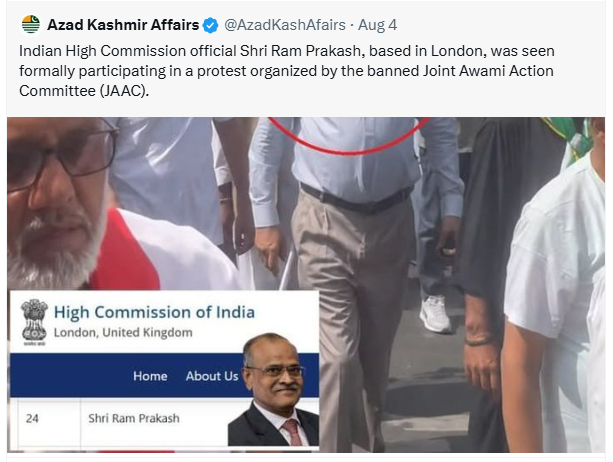
A user on social media platform X (formerly Twitter) shared the viral image on August 4, 2026, claiming that Shri Ram Prakash, an official from the Indian High Commission in London, was seen formally participating in a protest organised by the banned Joint Awami Action Committee (JAAC). The post link, archive link, and screenshot are provided below:
https://x.com/i/birdwatch/t/2084551118189904105?source=6
Fact Check:
During the research, we conducted a Google search using relevant keywords. We traced the original source of the viral visual to a social media post shared by Pakistani media outlet GEO News’ UK Bureau Chief Murtaza Ali Shah on August 2, 2024.
The post featured a video of a protest held in Luton, United Kingdom, where a large number of British Kashmiris were seen marching to express concerns over the situation in Pakistan-occupied Kashmir (PoK). At the time, the Joint Awami Action Committee (JAAC) was leading a prolonged protest in the region.
https://www.facebook.com/reel/1383400640416385

At the 1:23 mark of the video shared by the Pakistani journalist, we found the same scene that appears in the viral image. However, the individual seen in the viral image does not appear in the original footage. Instead, the video shows a different person participating in the protest.

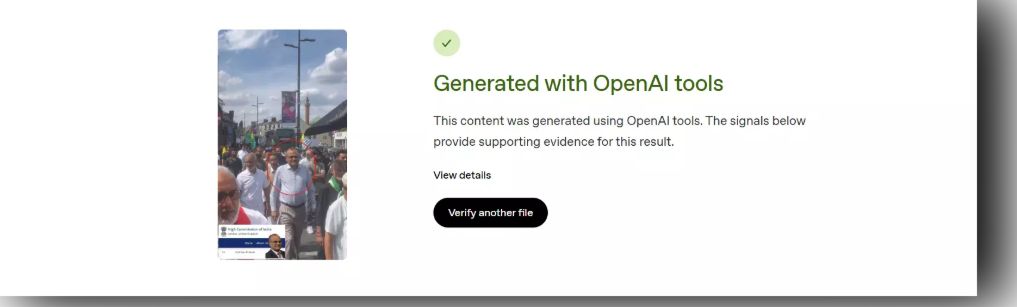
To further verify the authenticity of the image, we analysed it using multiple AI detection tools, including OpenAI’s image detection tool. The analysis detected provenance signals associated with OpenAI tools such as ChatGPT, OpenAI API, or Codex. These signals indicate that the image was created or modified using OpenAI’s AI tools.
Conclusion:
The research established that the viral image has been manipulated to falsely portray Indian High Commission official Ram Prakash as a participant in the protest. The original footage shows a different individual, while AI analysis confirmed that the image was modified using OpenAI tools. Therefore, the claim circulating with the image is misleading.

Related Blogs
.webp)
Introduction
In today’s cybersecurity landscape, ransomware has emerged as one of the most significant and rapidly growing cyber threats. What began as attacks carried out by individual hackers has evolved into a highly organised criminal enterprise, with groups operating through structured business models and global networks. The emergence of The Gentlemen ransomware group reflects this transformation, demonstrating how modern threat actors can quickly expand their operations and target organisations across multiple sectors. Their rise highlights the increasing sophistication of ransomware campaigns and the growing challenges faced by organisations in defending against them. The attribution of the group's administrator to an identified individual in Izhevsk, Russia, provides a valuable lens through which to examine three interconnected developments: the maturation of ransomware-as-a-service (RaaS) business models, the inherent operational security (OPSEC) weaknesses that emerge over the course of cybercriminal careers, and the geopolitical environments that enable such actors to operate with relative impunity. Together, these dynamics illustrate the industrialisation of modern cybercrime.
The Industrialisation of Ransomware-as-a-Service
The remarkable rapid rise of The Gentlemen is impossible without discussing the maturation of ransomware-as-a-service (RaaS). RaaS systems utilize network intrusion experts as affiliates who conduct networks intrusions and secure access in exchange for a cut of the total ransoms paid, while a core group builds and maintains the ransomware framework itself. Although Reveton, one of the earliest Raas providers, can be credited with bringing early iterations of RaaS to fruition in 2012, the potential scale was truly evident in the mid-2020s. By 2025 it was estimated that there were over 100 active ransomware gangs operating; this proliferation is the direct result of the franchise-like system, which has lowered the barriers to entry for cybercrime.
The marketplace surrounding RaaS is intensely competitive, and this is clearly exemplified in the business structure of The Gentlemen: while many of the top ransomware groups provide an 80/20 profit share (with the majority of the profit going to the affiliates), The Gentlemen has an exceptionally profitable 90/10 split (affiliates keep 90% of the profit share) for affiliates, likely to draw experienced operators away from their rivals given recent decreases in victim willingness to pay and corresponding increases in the incentives RaaS platforms are required to offer.
The operational efficiency of the group is representative of a successful enterprise. They attack vulnerable internet-facing VPNs and firewalls and generally complete the network encryption within a matter of hours, leaving defenders with very little time to respond, as confirmed by Check Point Software, a renowned cybersecurity vendor.
Additionally, PRODAFT reports that the administrator of The Gentlemen, known by the alias Zeta88 (previously known as Hastalamuerte), directly provides affiliates with SSL VPN credentials, often obtained through brutal force attacks or their own private leaked databases, indicating an unusually high level of vertical integration for RaaS groups.
AI as a Force Multiplier in Ransomware Development
A particularly significant aspect of the Hastalamuerte case is PRODAFT's finding that the administrator employs artificial intelligence to develop and maintain ransomware, support associated tooling, and assist post-exploitation operations. This reflects a broader trend observed across the 2025–2026 threat landscape, where AI has increasingly lowered the capability threshold for participation in organised cybercrime. Researchers have documented its role in automating stages of intrusion, accelerating malware development cycles, and simplifying the maintenance of malicious infrastructure. These capabilities have been leveraged by both nation-state actors and criminal enterprises.
The trajectory of Hastalamuerte is especially illustrative. Cybersecurity Forum posts during 2019-2020 depict a hacker who is fairly novice at fundamental penetration testing procedures. A subsequent emergence as the operator of a top-tier ransomware-as-a-service operation indicates that AI-assisted development may be responsible for dramatically reducing the skill level and time necessary to create a successful criminal enterprise in cyberspace. The evolution of these tools should make the route from novice forum user to accomplished ransomware operator more attainable for a wider array of perpetrators in the future.
The OPSEC Paradox: How Cybercriminals Leave a Trail
The attribution of Hastalamuerte's identity by researchers from Intel 471, Flashpoint, and Constella Intelligence demonstrates the effectiveness of modern open-source and commercial intelligence methodologies. A forum registration traceable to an IP address from Izhevsk, Russia linked a Protonmail address, which linked to an Apple account, a GitHub profile, a Telegram handle, a Russian phone number, and finally to a 36 year old marketing professional named Alexander Andreevich Yapaev who was also living in Izhevsk. Investigators did not use an advanced capability in their attribution, but rather a simple OPSEC mistake of consistently reusing credentials. Every username and email address and every phone number creates a linkage between disparate data points, eventually building into a real-world persona.
It has also come out in the forum discussion that while training for a penetration testing course in 2020, Hastalamuerte displayed the kind of inexperience that a novice would display in traceable, recorded fashion to intelligence databases. It's an example of a broader rule about attribution; attacker mistakes provide the most value. With Russians the lack of apparent consequences may contribute to a lack of need to maintain tight OPSEC from the start.
The Russian Safe Haven: Conditional Impunity and Its Limits
Yapaev's base in Izhevsk is emblematic of the geostrategic situation that has allowed Russian cybercriminality to prosper. Security researchers routinely label Russia's policy as one of "controlled impunity," where the cybercriminality directed at foreign entities is ignored or implicitly condoned, while that directed at Russian interests will prompt a law enforcement response. This constitutes what has been called a "managed market" rather than an "unconditional sanctuary," where many of the named defendants could and likely will continue their illegal enterprise with little fear of reprisal, provided that they do not threaten the interests of the Russian state and do not attempt to move their operations outside of Russian control.
Yet this protection is neither absolute nor permanent. In May 2024, the transnational Operation Endgame campaign highlighted the growing global appetite for damaging the cybercrime ecosystem rooted in Russia. Russian authorities did indeed pursue and seize some assets and operators, but arrests seem largely confined to the lower-rung facilitators of these attacks (hosting providers and payment services), and it seems higher-end ransomware operators continue to evade scrutiny. Selective enforcement thus further bolsters the perception that protection is accorded according to strategic value, not legal standards. For operators such as Hastalamuerte, who possess no publicly documented intelligence connections, growing attribution capabilities, and sustained international pressure may gradually erode the security traditionally associated with operating from within Russia.
Attribution as a Deterrence Instrument
The public identification of Alexander Andreevich Yapaev as Hastalamuerte/Zeta88 shows the continued struggle with the utility of attribution in situations where immediate prosecution is not feasible. Its utility is far more extensive than simply an ability to make an arrest. Functionally, public naming forces a perpetrator into an open evidentiary space and can lead to alterations in their operational habits and effectiveness. Strategically, attribution provides future leverage for sanctions, indictments, financial restrictions, or extradition if the target can leave their safe haven country. The logic behind US rewards programs (paying up to $10 million for the capture and conviction of ransomware operators) relies on this principle. The analytical insight provided by the case cannot be understated either. Hastalamuerte's trajectory from a relative amateur forum participant on Nulled and Raidforums in 2019 to leading a significant ransomware operation by 2026 offers an invaluable look into the career progression of a cyber criminal. It confirms one of the lessons learned through deterrence and attribution: pseudonymity is not everlasting, and many years of OPSEC failures can be pieced together to establish a real-world identity.
Conclusion
The Gentlemen incident is emblematic of the three broad themes that currently characterise cyber warfare: ransomware-as-a-service through innovative competition, common OPSEC failures that enable attribution, and a new, conditional regime of protection for Russian cybercriminals. The obvious defense lesson: increasing attack surfaces require stronger identity, behavioural monitoring, and intelligence capacities. The policy lesson: effective attribution is still an essential tool for comprehension, deterrence, and disruption in an increasingly industrialised environment of criminals supporting each other's operations in ransomware-as-a-service.
References
- https://krebsonsecurity.com/2026/06/who-runs-the-ransomware-group-the-gentlemen/
- https://www.recordedfuture.com/
- https://www.vectra.ai/topics/ransomware-as-a-service
- https://www.trmlabs.com/es/resources/blog/new-disruption-opportunities-in-the-evolving-ransomware-ecosystem

Introduction
In recent years, the city of Hyderabad/Cyberabad has emerged as a technology hub, a place with the strong presence of multi corporations, Startups, and research institutions, Hyderabad has become a hub of innovations and technological advancement. However, this growing land of cyber opportunities has also become a hub for cybercriminals as well. In this blog post, we shall explore the reasons why professionals are being targeted and the effects of cyber fraud on techies. Through this investigation, we hope to raise awareness about the seriousness of the problem as well as give vital insights and techniques for Cyberabad’s computer workers to defend themselves against cyber theft. We can work together to make Cyberabad’s technology ecosystem safer and more secure.
Defining Cyber Fraud
In today’s age, where everything has an interconnected digital world, cyber fraud cases are increasing daily. Cyber fraud encompasses a wide range of threats and techniques employed by bad actors, such as Phishing, Ransomware, identity theft, online scams, data breaches, and fake websites designed for users. The sophistication of cyber fraud techniques is constantly evolving, making it challenging for individuals and organisations to stay ahead. Cybercriminals use software vulnerabilities, social engineering tactics, and flaws in cybersecurity defences to carry out their harmful operations. Individuals and organisations must grasp these dangers and tactics to protect themselves against cyber fraud.
Impact of Cyber Frauds
The consequences of Falling victim to cyber fraud can be devastating, both personally and professionally. The emotional and financial toll on individuals may be a challenge. Identity theft may lead to damaged credit scores, fraudulent transactions, and years of recovery work to rehabilitate one’s image. Financial fraud can result in depleted bank accounts, unauthorised charges, and substantial monetary losses. Furthermore, being tricked and violated in the digital environment can generate anxiety, tension, and a lack of confidence.
The impact of cyber fraud goes beyond immediate financial losses and can have long-term consequences for individuals’ and organisations’ entire well-being and stability. As the threat environment evolves, it is critical for people and organisations to recognise the gravity of these repercussions and take proactive actions to protect themselves against cyber theft.

Why are Cyberabad Tech Professionals Targeted?
Tech professionals in Cyberabad are particularly vulnerable to cyber due to various factors. Firstly, their expertise and knowledge in technology make them attractive targets for cybercrooks. These professionals possess valuable coding, Software, and administration skills, making them attractive to cybercriminals.
Secondly, the nature of work often involves enormous use of technology, including regular internet contacts, email exchanges, and access to private information. This expanded digital presence exposes them to possible cyber dangers and makes them more vulnerable to fraudsters’ social engineering efforts. Furthermore, the fast-moving nature of the tech industry, with many deadlines and work pressure to deliver, can create a distraction. This can let them click on some malicious links or share sensitive information unknowingly all these factors let the cyber criminals exploit vulnerabilities.
Unveiling the Statistics
According to various reports, 80% of cyber fraud victims in Hyderabad are techies; the rest are the public targeted by cyber crooks. This surprising number emphasises the critical need to address the vulnerabilities and threats this specific segment within the IT community faces.
Going further into the data, we can acquire insights into the many forms of cyber fraud targeting tech workers, the strategies used by cybercriminals, and the impact these occurrences have on individuals and organisations. Examining precise features and patterns within data might give important information for developing successful preventative and protection methods.
Factors Contributing
Several reasons contribute to the elevated risk of cyber fraud among ICT professionals in Cyberabad. Understanding these aspects helps explain why this group is specifically targeted and may be more vulnerable to such assaults.
Technical Expertise: Tech workers frequently have specialised technical knowledge, but this knowledge may only sometimes extend to cybersecurity. Their primary concentration is writing software, designing systems, or implementing technologies, which may result in missing possible vulnerabilities or a lack of overall cybersecurity understanding.
Confidence in Technology: IT workers have a higher level of confidence in technology because of their knowledge and dependence on technology. This trust can sometimes make individuals more vulnerable to sophisticated frauds or social engineering approaches that prey on their faith in the services they utilise.
Time Constraints and Pressure: Tech workers frequently operate under tight deadlines and tremendous pressure to reach project milestones. This may result in hurried decision-making or disregarding possible warning signals of cyber fraud, rendering them more exposed to assaults that prey on time-sensitive circumstances.
Cybercriminals know that technology workers have valuable knowledge, trade secrets, and intellectual property that may be economically profitable. As a result, they are attractive targets for attacks aiming at stealing sensitive data or gaining unauthorised access to critical systems.
The best practices that cyber techies can apply to safeguard their personal and professional data by following these simple tips:
Strong Passwords: create a strong password, using passwords for all your online accounts and changing them regularly. Remember to use unique combinations!
MFA (Multi-Factor Authentication): Enable MFA wherever possible. This provides an extra degree of protection by requiring a second form of verification, such as a code texted to your mobile device and your password.
Use Secured WiFi: Use secure and encrypted Wi-Fi networks, especially while viewing sensitive information. Avoid connecting to public or unprotected networks, as they can be readily exploited. Recognising Red Flags and Staying Ahead
Social Engineering: Be sceptical of unwanted solicitations or offers, both online and offline. Cybercriminals may try to persuade or fool you using social engineering tactics. Before revealing any personal or private information, think critically and confirm the veracity of the request.
Secure Web Browsing: Only browse trustworthy websites with valid SSL certificates (look for “https://” in the URL). Avoid clicking on strange links or downloading files from unknown sources since they may contain malware or ransomware.
Report Suspicious actions: If you encounter any suspicious or fraudulent actions, report them to the relevant authorities, such as the Cyber Crime Police or your organisation’s IT department. Reporting events can assist in avoiding additional harm and aid in identifying and apprehending hackers.
Stay Current on Security Practises: Stay up to speed on the newest cybersecurity risks and best practices. Follow credible sources, participate in cybersecurity forums or seminars, and remain current on new threats and preventative measures.

Conclusion
The rise in cybercrimes and fraud cases among tech experts in Cyberabad is a disturbing trend that requires prompt intervention. We can establish a safer tech cluster that lives on creativity, trust, and resilience by adopting proactive actions, raising awareness, and encouraging cooperation. Let us work together to prevent cybercrime and ensure the future of Cyberabad’s IT ecosystem.

Executive Summary:
A video is being widely circulated on social media in connection with the relief and rescue operations following the devastating floods in Nepal. The video shows security personnel rescuing a girl trapped under debris and later giving her soup. The video is being shared with the claim that security personnel rescued a girl who had been buried under mud three days after the disaster in Timure village of Nepal’s Rasuwa district. A research by CyberPeace Research Wing found the viral claim to be false. Our research revealed that the viral video does not depict a real incident but is AI-generated.
Claim:
A user on social media platform X (formerly Twitter) shared the viral video with the caption: “Nepal: It was nothing short of a miracle to witness this. After three days, death had to retreat and life emerged victorious. A six-year-old girl, who had been buried under the disaster debris for three days, was rescued by Nepal’s security forces. The incident took place in Timure village of Nepal’s Rasuwa district. Six-year-old Manisha was pulled out alive after being buried under debris caused by floods and landslides.”
https://x.com/AjitSinghRathi/status/2094306889001742826?s=20

Fact Check:
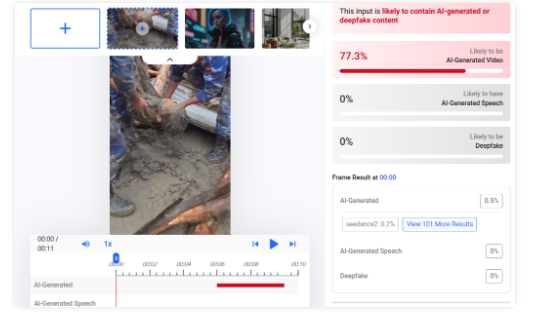
A close examination of the viral video revealed several inconsistencies, raising suspicions that the video was AI-generated. We then scanned the viral video using the AI detection tool Hive Moderation. According to the results, there is a 77 per cent likelihood that the viral video is AI-generated.
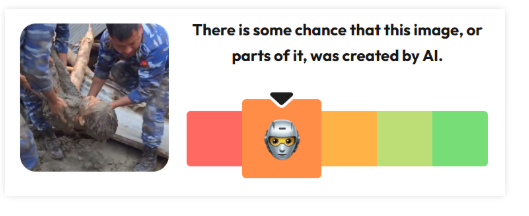
As part of our research, we scanned the video using the AI detection tool Wasitai. According to the results, the viral video is AI-generated.
Conclusion:
Our research found the viral claim to be false. Our findings revealed that the viral video does not depict a real incident but is AI-generated.
