
#FactCheck - Viral Video Falsely Claims RSS Chief Mohan Bhagwat Called for ‘Saffronisation’ of Indian Army
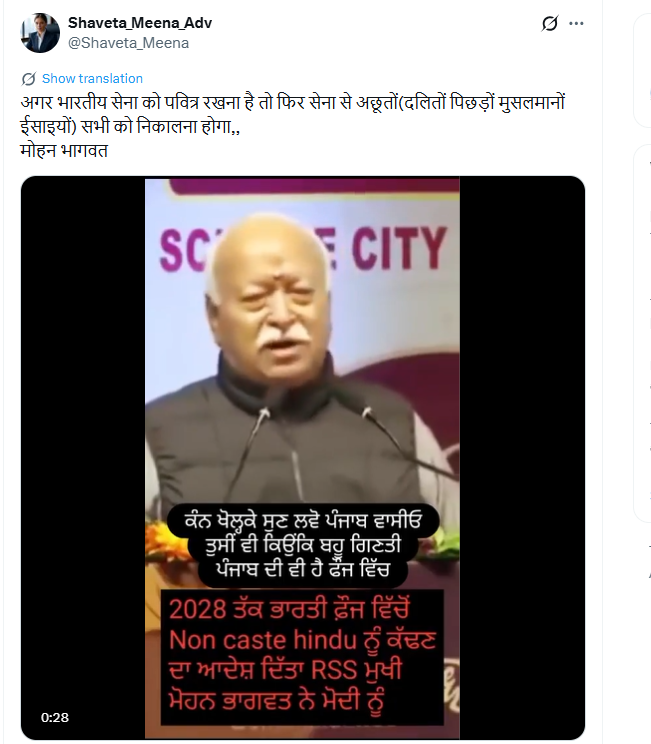
A video purportedly showing Rashtriya Swayamsevak Sangh (RSS) chief Mohan Bhagwat making remarks about the “saffronisation” of the Indian Army has been widely circulated on social media. The clip claims that Bhagwat called for the removal of non-Hindus from the armed forces and linked the issue to future political leadership changes in the country.
Claim
However, a verification by the Cyber Peace Foundation has established that the video is misleading and has been digitally manipulated.
In the video, Bhagwat is allegedly heard saying that unless more than 50 percent of non-Hindus are removed from the Indian Army by 2028, Prime Minister Narendra Modi would be replaced by Uttar Pradesh Chief Minister Yogi Adityanath. The clip further attributes another statement to him, suggesting that he would resign if the Prime Minister were to demand Nitish Kumar’s resignation.
By the time of publication, the video had been viewed over 7,000 times.( lINK, ARCHIVE Link, Screenshot
Fact Check:
The reverse image search also directed the Desk to a video uploaded on CNN-News18’s official YouTube channel on December 21, 2025. The footage was found to be a longer version of the viral clip and was recorded at the RSS centenary event held in Kolkata on the same date. A comparison of both videos confirmed that the background visuals, stage setup and camera angles were identical.
However, a careful review of the original CNN-News18 video revealed that Mohan Bhagwat did not make any of the statements attributed to him in the viral clip.
In his original address, Bhagwat spoke about unity and referred to concerns over increasing atrocities against Hindus in Bangladesh. He made no reference to the Indian Army, nor did he comment on its composition or alleged saffronisation. Here is the link to the original video, along with a screenshot: https://www.youtube.com/watch?v=KnsAUGfBQBk&t=1s

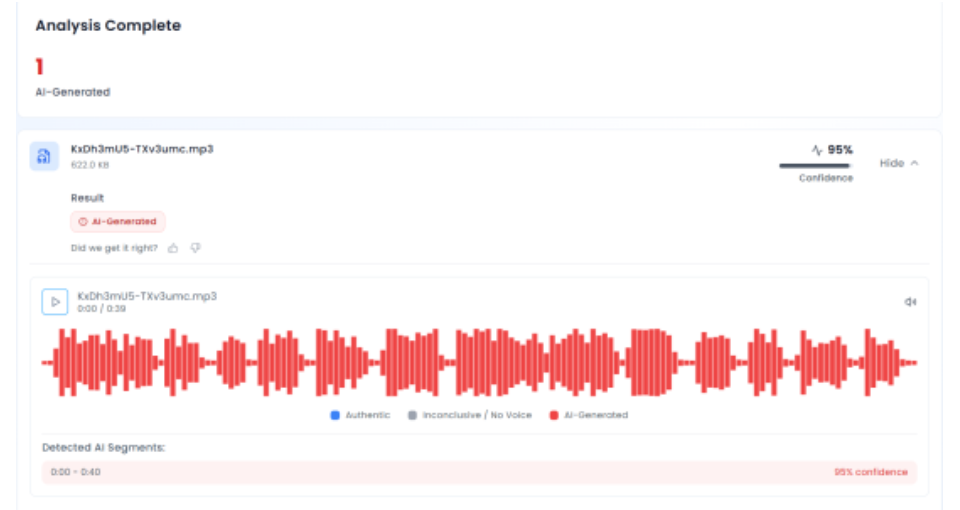
In the next phase of the investigation, the audio track from the viral video was extracted and analysed using the AI audio detection tool Aurigin. The tool’s assessment indicated that the voice heard in the clip was artificially generated, confirming that the audio did not originate from the original speech.
Conclusion
The claim that RSS chief Mohan Bhagwat called for the saffronisation of the Indian Army is false. PTI Fact Check found that the viral video was digitally manipulated, using genuine footage from an RSS centenary event but pairing it with an AI-generated audio track. The altered video was shared online to mislead viewers by falsely attributing statements Bhagwat never made.

Related Blogs

Introduction
The Indian government has developed the National Cybersecurity Reference Framework (NCRF) to provide an implementable measure for cybersecurity, based on existing legislations, policies, and guidelines. The National Critical Information Infrastructure Protection Centre is responsible for the framework. The government is expected to recommend enterprises, particularly those in critical sectors like banking, telecom, and energy, to use only security products and services developed in India. The NCRF aims to ensure that cybersecurity is protected and that the use of made-in-India products is encouraged to safeguard cyber infrastructure. The Centre is expected to emphasise the significant progress in developing indigenous cybersecurity products and solutions.
National Cybersecurity Reference Framework (NCRF)
The Indian government has developed the National Cybersecurity Reference Framework (NCRF), a guideline that sets the standard for cybersecurity in India. The framework focuses on critical sectors and provides guidelines to help organisations develop strong cybersecurity systems. It can serve as a template for critical sector entities to develop their own governance and management systems. The government has identified telecom, power, transportation, finance, strategic entities, government entities, and health as critical sectors.
The NCRF is non-binding in nature, meaning its recommendations will not be binding. It recommends enterprises allocate at least 10% of their total IT budget towards cybersecurity, with monitoring by top-level management or the board of directors. The framework may suggest that national nodal agencies evolve platforms and processes for machine-processing data from different sources to ensure proper audits and rate auditors based on performance.
Regulators overseeing critical sectors may have greater powers to set rules for information security and define information security requirements to ensure proper audits. They also need an effective Information Security Management System (ISMS) instance to access sensitive data and deficiencies related to operations in the critical sector. The policy is based on a Common but Differentiated Responsibility (CBDR) approach, recognising that different organisations have varying levels of cybersecurity needs and responsibilities.
India faces a barrage of cybersecurity-related incidents, such as the high-profile attack on AIIMS Delhi in 2022. Many ministries feel hamstrung by the lack of an overarching framework on cybersecurity when formulating sector-specific legislation. In recent years, threat actors backed by nation-states and organised cyber-criminal groups have attempted to target the critical information infrastructure (CII) of the government and enterprises. The current guiding framework on cybersecurity for critical infrastructure in India comes from the National Cybersecurity Policy of 2013. From 2013 to 2023, the world has evolved significantly due to the emergence of new threats necessitating the development of new strategies.
Significance in the realm of Critical Infrastructure
India faces numerous cybersecurity incidents due to a lack of a comprehensive framework. Critical Information Infrastructure like banking, energy, healthcare, telecommunications, transportation, strategic enterprises, and government enterprises are most targeted by threat actors, including nation-states and cybercriminals. These critical information sectors especially by their vary nature as they hold sensitive data make them prime targets for cyber threats and attacks. Cyber-attacks can compromise patient privacy, disrupt services, compromise control systems, pose safety risks, and disrupt critical services. Hence it is of paramount importance to come up with NCRF which can potentially address the emerging issues by providing sector-specific guidelines.
The Indian government is considering promoting the use of made-in-India products to enhance Cyber Infrastructure
India is preparing to recommend the use of domestically developed cybersecurity products and services, particularly for critical sectors like banking, telecom, and energy, to enhance national security in the face of escalating cybersecurity threats. The initiative aims to enhance national security in response to increasing cybersecurity threats.
Conclusion
Promoting locally made cybersecurity products and services in important industries shows India's commitment to strengthening national security. A step of coming up with the National Cybersecurity Reference Framework (NCRF) which outlines duties, responsibilities, and recommendations for organisations and regulators shows the critical step towards a comprehensive cybersecurity policy framework which is a need of the hour. The government underscoring made-in-India solutions and allocating cybersecurity resources underlines its determination to protect the country's cyber infrastructure in light of increasing cyber threats & attacks. The NCRF is expected to help draft sector-specific guidelines on cyber security.
References
- https://indianexpress.com/article/business/market/overhaul-of-cybersecurity-framework-to-safeguard-cyber-infra-govt-may-push-use-of-made-in-india-products-9133687/
- https://vajiramandravi.com/upsc-daily-current-affairs/mains-articles/national-cybersecurity-reference-framework-ncrf/
- https://m.toppersnotes.com/current-affairs/blog/to-push-cyber-infra-govt-may-push-use-of-made-in-india-products-DxQP
- https://appkida.in/overhaul-of-cybersecurity-framework-in-2024/
Introduction
Company law solved a version of this problem more than a century ago, and artificial intelligence regulation is now quietly borrowing the solution. When something goes wrong inside a company, the law generally cannot reach past the corporate entity to punish the people who ran it, because the company is treated as a legal person entirely separate from its shareholders and directors. Courts developed an exception for exactly the cases where that separation becomes a shield for wrongdoing, and lawyers now call it lifting, or piercing, the corporate veil. A growing body of legal scholarship argues that AI systems present a strikingly similar problem, and needs a strikingly similar fix. That emerging idea has come to be called lifting the AI veil.
Where the original doctrine comes from
The doctrine of lifting the corporate veil traces directly to the House of Lords decision in Salomon v. Salomon & Co. Ltd. in 1897. Aron Salomon, a leather and boot manufacturer, incorporated his existing business, sold it to the new company, and structured share ownership so that he and his family held nearly all the shares. When the company later failed, creditors argued Salomon should be held personally liable, since the company was effectively just him operating under a different name. The House of Lords disagreed, holding decisively that once validly incorporated, a company is a person in law entirely distinct from its subscribers, with its own rights and liabilities. That ruling established what remains company law's foundational principle: separate legal personality.
Separate personality is not, however, unconditional. Courts across common law jurisdictions, including India, carved out an exception for cases where the corporate form is used as a facade for fraud, to evade a statutory obligation, or to circumvent a legal duty that would otherwise apply to the individuals behind it. In such cases, a court will "lift the veil," looking past the company's separate legal identity to attribute liability directly to the directors or shareholders actually in control. India's Supreme Court, in Life Insurance Corporation of India v. Escorts Ltd., reaffirmed that this remains an exception applied only in narrow, exceptional circumstances, generally where a statute contemplates it, or fraud or improper conduct needs to be prevented. The doctrine has since found application well beyond fraud alone, including in tax matters, as seen in cases like State of U.P. v. Renusagar Power Co., where courts treated closely related corporate entities as one for the purpose of a specific statutory benefit.
Why AI creates the same structural problem
Scholarship examining AI liability has increasingly pointed to a near identical structural gap. As AI systems take on functions once reserved for human decision makers, board level analytics, automated lending decisions, algorithmic hiring, even proposed "robo-director" advisory roles, a familiar question resurfaces: who answers for the outcome when the AI system, rather than a named individual, produced the decision. A 2025 academic paper titled Lifting the AI Veil in Company Law argues explicitly that AI liability should be approached through an extension of existing doctrines, including directors' duty of care and precisely the piercing of the veil doctrine traditionally reserved for shareholders, rather than inventing an entirely new liability regime from scratch.
The concern driving this argument is not abstract. Commentary in outlets like MIT Technology Review has warned that granting AI systems anything resembling legal personhood risks handing companies a genuinely dangerous new shield, allowing a company to argue that a harmful outcome was the AI's autonomous decision, disconnected from any human actor's intent or negligence, much as a company might once have argued a harmful outcome was simply "the company's" doing and not any individual's. Critics of AI personhood proposals, writing in journals examining AI as legal persons, make the parallel explicit: while corporate veil piercing exists precisely to stop the corporate form being misused as a liability shield, the justification for extending similar legal personhood to AI is considerably weaker, since corporate personhood serves a clear economic purpose, enabling investment and risk pooling, that AI personhood does not obviously replicate.
How regulators have actually responded
The European Union's experience is instructive precisely because it shows the doctrine's underlying logic being adopted through legislation rather than judicial precedent. The European Commission originally proposed a dedicated AI Liability Directive in September 2022, intended to ease the burden of proof on claimants harmed by AI systems, including a rebuttable presumption of causality where a claimant could show an AI system breached EU AI Act obligations. That proposal was formally withdrawn in 2025, with the withdrawal notice published in the Official Journal on 6 October 2025, after member states failed to reach agreement. In its place, the revised EU Product Liability Directive now does much of the same underlying work through a different legal mechanism, explicitly treating AI software as a "product" for the purposes of manufacturer liability, meaning AI providers face strict liability for defective AI products without claimants needing to prove fault, applicable to AI products placed on the EU market from 9 December 2026 onward. Functionally, this achieves something close to piercing the AI veil by statute: instead of allowing a company to attribute harm to an autonomous algorithmic process and stop the inquiry there, liability is anchored back to the entity that built, trained, or deployed the system.
The Indian angle, and why it matters here
India has no AI specific liability statute at present, and no reported judicial decision has yet applied the corporate veil piercing doctrine by analogy to an AI system. But the underlying legal architecture is already familiar territory for Indian courts. India's jurisprudence on lifting the corporate veil, built through Escorts, Renusagar, and subsequent cases, already establishes the judicial comfort with looking past a formal legal structure to find the real, controlling actor when justice demands it. Indian courts have been consistently clear that this remains an exceptional remedy rather than a routine one, generally invoked where a statute contemplates it, where fraud or improper conduct needs to be prevented, or where a taxing or beneficial statute would otherwise be defeated by rigid adherence to corporate form. That same cautious, fact specific posture is likely to shape how any future Indian AI liability doctrine develops, applied sparingly rather than as a blanket rule.
As AI systems increasingly mediate lending decisions, insurance claims processing, and algorithmic hiring in Indian companies, the same reasoning that let Indian courts see through a corporate facade could plausibly extend to seeing through an "AI made the decision" defence, attributing responsibility to whichever human actor, developer, deployer, or governing board, exercised actual control over how that system was built and used. Given how central technology sector employment and AI deployment already are to India's economy, the absence of a clear domestic answer to this question is unlikely to remain untested for long.
The larger point
The doctrine of lifting the AI veil is less a wholly new legal invention and more a recognition that AI systems and corporations create the same essential problem: a formally separate entity that can, if left unchecked, absorb blame that properly belongs to the humans directing it. Company law solved this by refusing to let the corporate form become an alibi. AI law, whether through judicial doctrine, statute, or a hybrid of both as the EU's experience suggests, will likely need to reach the same conclusion, because the alternative is allowing genuine harm to disappear into a system nobody can be made to answer for.
References
- Bird & Bird, "Proposed EU AI liability rules withdrawn." https://www.twobirds.com/en/insights/2025/proposed-eu-ai-liability-rules-withdrawn
- LegalClarity, "AI Liability Directive: What It Was and Why It Was Withdrawn." https://legalclarity.org/ai-liability-directive-what-it-was-and-why-it-was-withdrawn/
- WCR Legal, "EU AI Liability Directive: Withdrawn, What Now Applies?" https://wcr.legal/eu-ai-liability-directive-withdrawn-pld/
- Verfassungsblog, "Anatomy of a Fall: On the Anticipated Withdrawal of the AI Liability Directive Proposal." https://verfassungsblog.de/anatomy-of-a-fall-aiact-aild-pld/
- MIT Technology Review, "Debates over AI consciousness are a trap." https://www.technologyreview.com/2026/08/20/1142571/ai-consciousness-debate-trap/
- ResearchGate, "Lifting the AI Veil in Company Law." https://www.researchgate.net/publication/393305638_Lifting_the_AI_veil_in_company_law
- Review of Law and Regulation, "Lifting the AI Veil in Company Law." https://rlr.iup.rs/wp-content/uploads/2025/07/04.pdf
- Bhatt & Joshi Associates, "Decoding the Jurisprudence on Lifting the Corporate Veil in Indian Court. https://bhattandjoshiassociates.com/decoding-the-jurisprudence-on-lifting-the-corporate-veil-in-indian-court/
- Mondaq, "Analysis Of Standard Of Proof For Lifting Of The Corporate Veil In Cases Of Fraud." https://www.mondaq.com/india/corporate-and-company-law/1259382/analysis-of-standard-of-proof-for-lifting-of-the-corporate-veil-in-cases-of-fraud
- Record Of Law, "Analysis of the theory of corporate veil lifting." https://recordoflaw.in/analysis-of-the-theory-of-corporate-veil-lifting/
- Suren Uppal Offices, "Lifting of Corporate Veil: Navigating Judicial Precedents." https://www.suolaw.com/lifting-of-corporate-veil-navigating-judicial-precedents/
Introduction
Meta smart glasses are now banned from courts across England and Wales. His Majesty's Courts and Tribunals Service (HMCTS), the body responsible for criminal, civil, and family courts throughout the jurisdiction, has confirmed that anyone entering a court building wearing the devices will have them confiscated at the door and returned only when they leave. The decision follows a comparable restriction introduced by New York's court system weeks earlier, and it lands at a moment when Meta's artificial intelligence (AI) powered eyewear, now sold in more than seven million pairs worldwide, has already been turned away from a wide range of British venues, from pubs and restaurants to theatres and members' clubs, over the same underlying worry: that a camera built into an ordinary looking pair of glasses can record people who have no way of knowing it is happening. Courts occupy a category of their own in this debate. Photography and recording inside a courtroom have been prohibited for the better part of a century, precisely because the integrity of witness testimony, jury deliberation, and the dignity of the proceedings depend on people being able to speak and be observed only by those the law intends. Smart glasses do not just test that rule. They expose a gap in how it was ever meant to be enforced.
What actually changed, and why smartphones were never the real problem
Unauthorised filming inside a courtroom can be prosecuted as contempt of court. Smartphones, despite carrying multiple cameras, have always been let through security on a kind of implicit social contract: everyone understands that the device could record, everyone understands that using it to do so is a punishable offence, and the visible act of holding a phone up to film someone is itself a signal that can be seen and stopped. As per reports citing an HMCTS spokesperson, "There are clear restrictions on taking images or videos within courts and tribunals which is why the use of Meta glasses is prohibited."
Smart glasses dissolve that social contract. A person wearing them looks, to everyone around them, exactly like a person not recording anything at all.
The wider pattern this fits into
England and Wales did not act in isolation. New York's court system introduced a comparable restriction weeks earlier, following an incident during a trial in which a presiding judge warned Meta's own legal team, present in court wearing the company's glasses, that recording proceedings would be treated as contempt. Reports note that the same device has already been shut out of a striking range of everyday venues across Britain, including a major pub chain, high end restaurants, private members' clubs, theatres, music venues, and comic book conventions, with critics giving the product the unflattering nickname "pervert glasses" well before any court got involved.
That pattern matters analytically because it shows this is not really a story about courts distrusting one particular gadget. It is a story about physical spaces everywhere recalibrating what "no recording" can plausibly mean once recording no longer requires a visible object pointed at someone. Meta, for its part, has said the glasses carry a pulsing light-emitting diode (LED) indicator that activates during recording and tamper detection technology intended to stop wearers covering the light, and the company has shipped more than seven million pairs, commanding, according to reports, more than 80 percent of the global AI eyewear market. None of that changes how the device is experienced by the person being recorded, who typically has no reliable way of noticing a small light on the side of someone's face across a room.
There is a genuine innovation story sitting underneath this controversy, and it deserves to be told honestly rather than dismissed. Wearable AI devices that layer translation, navigation, accessibility support, and hands free computing onto ordinary looking eyewear represent one of the more interesting consumer hardware categories to emerge in years, and the underlying engineering, fitting a camera, microphones, speakers, and AI processing into frames that look like Ray-Bans, is a legitimate technical achievement. The court ban is not a verdict on that achievement. It is a verdict on a specific gap between what the hardware makes physically possible and what existing social and legal norms were designed to detect and police. Those are two different conversations, and collapsing them into one tends to produce worse policy on both sides.
Reading the legal architecture underneath the ban
What HMCTS has effectively done is draw a bright line around function rather than form. Smartphones stay in because the courts are relying on deterrence, the near certainty of visible detection and prosecution if someone is caught filming, to manage the risk they pose. Smart glasses are excluded because that deterrence model breaks down when the recording apparatus is invisible by design. Clara Westbrook, a privacy law partner quoted in coverage of the decision, framed the underlying issue as a gap between the technology and the rules meant to govern it, rather than a simple case of institutional overreaction. That framing holds up under scrutiny. Courtroom rules were written for an era in which recording devices announced themselves. Smart glasses were engineered, whatever the stated intent, to do the opposite.
The view from India
Photography and videography are already prohibited inside Indian court premises as a general rule. Filming inside courtrooms has long been treated as a threat to witness candour, judicial dignity, and the orderly conduct of proceedings, and the principle has been reinforced recently. The Supreme Court, in a circular issued in September 2025, imposed a strict ban on photography, videography, and the creation of social media content within its High Security Zone, prohibiting mobile phones, cameras, tripods, and similar equipment except for official use. More recently, in an interim order passed in 2026, the Court went further, restricting the extraction, editing, and re-dissemination of audio-video recordings of judicial proceedings on social media or digital platforms without prior written permission from the Registrar General of the concerned High Court or the Secretary General of the Supreme Court.
Read together, these rules already prohibit the underlying act that smart glasses would enable inside a courtroom, unauthorized capture and circulation of what happens during a hearing. In that sense, Meta glasses are indirectly covered the moment someone wears a pair inside an Indian court, since using them to record would fall squarely within conduct the existing circulars already forbid. What has not happened, and this distinction matters, is any explicit order naming smart glasses as a class of device to be confiscated or barred at entry, the way HMCTS has now done in England and Wales. Indian courts have regulated the act of recording. They have not yet regulated the device that makes covert recording structurally easier to commit without detection.
It remains to be seen whether Indian courts will explicitly name and ban Meta glasses, rather than relying on existing photography rules to cover them indirectly. If that happens, the reasoning will be drawn on constitutional privacy jurisprudence or courtroom security concerns already in play.
Conclusion
What courts owe the people who appear before them is not hostility toward innovation, but a firm defence of the trust a courtroom is built on, that witnesses can speak freely, that proceedings remain what they are meant to be, and that privacy inside those walls is not negotiable. The question worth asking is not what smart glasses can see, but what courts must protect. Innovation earns its place by respecting the spaces it enters, not by outrunning their rules.
References
- The Guardian, "Meta glasses banned from courts in England and Wales," 11 August 2026 https://www.theguardian.com/technology/2026/aug/11/meta-glasses-banned-from-courts-in-england-and-wales
- Engadget, "England and Wales ban Meta Glasses from courtrooms.” https://www.engadget.com/2234606/england-and-wales-ban-meta-glasses-from-courtrooms/
- TechRepublic, "England and Wales Courts Ban Meta Smart Glasses Over Recording Risks." https://www.techrepublic.com/article/news-meta-smart-glasses-ban-england-wales-courts/
- BM Magazine, "Meta glasses banned from courts across England and Wales." https://bmmagazine.co.uk/legal/meta-glasses-banned-courts-england-wales/
- IBTimes UK" UK Court Service Bans Meta Smart Glasses After Restaurants, Theatres and Pubs Lead 'Spyware' Privacy Push." https://www.ibtimes.co.uk/uk-courts-ban-meta-smart-glasses-privacy-concerns-18141
- 97 Boing Boing, "English courts ban Meta glasses and other spyware." https://boingboing.net/2026/08/11/english-courts-ban-meta-glasses-and-other-spywear.html
- MediaPost, "Meta Smart Glasses Banned In England, Wales Courtrooms." https://www.mediapost.com/publications/article/417180/meta-smart-glasses-banned-in-england-wales-courtr.html
- LiveLaw, "When Seeing Becomes Recording: Invisible Bystander And Limits Of Indian Privacy Law." https://www.livelaw.in/lawschool/articles/invisible-bystander-limits-indian-privacy-law-545517
- PCQuest "B by Lenskart AI Glasses: India's Privacy Laws May Not Be Ready." https://www.pcquest.com/tech-trends/b-by-lenskart-ai-smart-glasses-india-privacy-dpdp-act-12141827
- MediaNama, "Meta tightens AI glasses security as questions over bystander privacy persist." https://www.medianama.com/2026/07/223-meta-tightens-ai-glasses-security-questions-bystander-privacy-persist/
- India Legal, "The State Of Surveillance." https://indialegallive.com/cover-story-articles/il-feature-news/surveillance-jantar-mantar-protests-delhi-police-wearable-recording-devices/
- Feminism In India, "AI Glasses: Is India Ready To Handle The Privacy Implications?" https://feminisminindia.com/2026/07/29/is-india-ready-to-handle-ai-glasses-social-ethical-and-regulatory-governance/
- LiveLaw, "Supreme Court Bans Photography, Videography In Court's High Security Zone." https://www.livelaw.in/top-stories/supreme-court-bans-photography-videography-in-courts-high-security-zone-after-bars-concerns-over-reels-selfies-in-court-premises-303682
- LiveLaw, "Supreme Court Bans Uploading and Sharing Of Audio-Video Recordings Of Court Hearings Without Prior Permission." https://www.livelaw.in/amp/top-stories/breaking-supreme-court-bans-uploading-sharing-of-audio-video-recordings-of-court-hearings-without-prior-permission-542719
- Deccan Herald, "SC bans clicking photos, making reels in its high security zone." https://www.deccanherald.com/amp/story/india%2Fdelhi%2Fsc-bans-clicking-photos-making-reels-in-its-high-security-zone-3724668
