
#FactCheck: AI-Generated Video Falsely Shows Tiger Approaching Neem Karoli Baba
Executive Summary
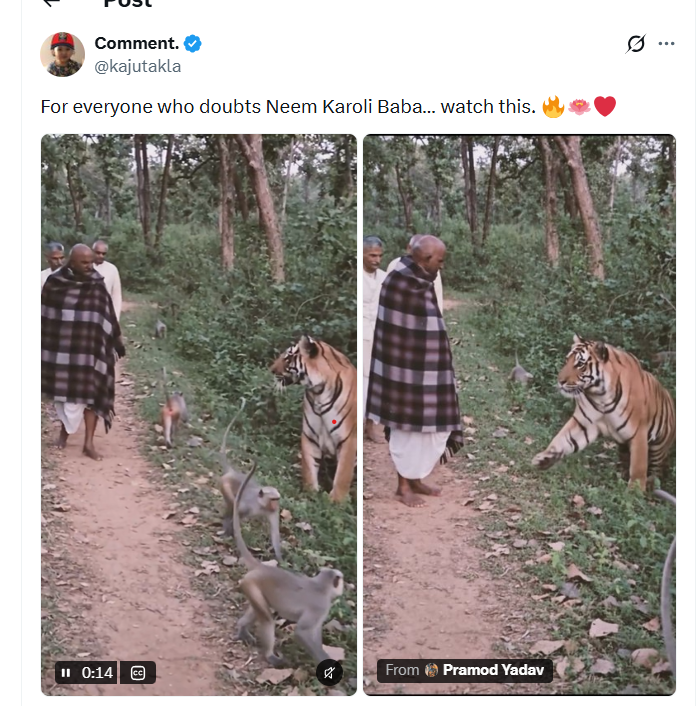
A video is being shared on social media, purportedly showing a tiger approaching Neem Karoli Baba. In the video, Baba appears to place his hand on the tiger before walking away. Users are sharing the video on social media, believing it to depict a real incident. However, CyberPeace Research found the viral claim to be false. Our research found that the viral video is not authentic but AI-generated.
Claim:
A user on the social media platform X (formerly Twitter) shared the viral video on October 5, purportedly showing a tiger approaching Neem Karoli Baba. In the video, Baba appears to place his hand on the tiger before walking away. The post link, archive link, and screenshot are provided below.
https://x.com/kajutakla/status/2106961156674031795?s=20
Fact Check
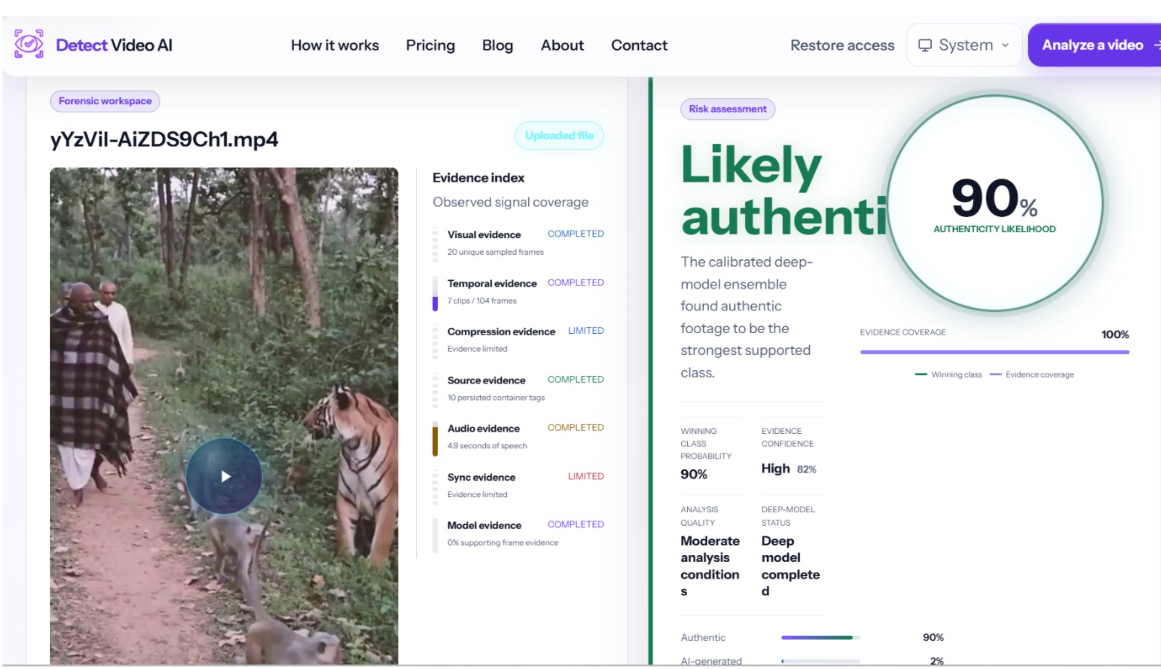
To verify the authenticity of the viral claim, we conducted a Google search using relevant keywords. During the search, we did not find any credible media reports confirming the claim. We then analysed the video using the AI detection tool DetectVideo AI. According to the tool’s results, the video has a 90 per cent probability of being AI-generated.
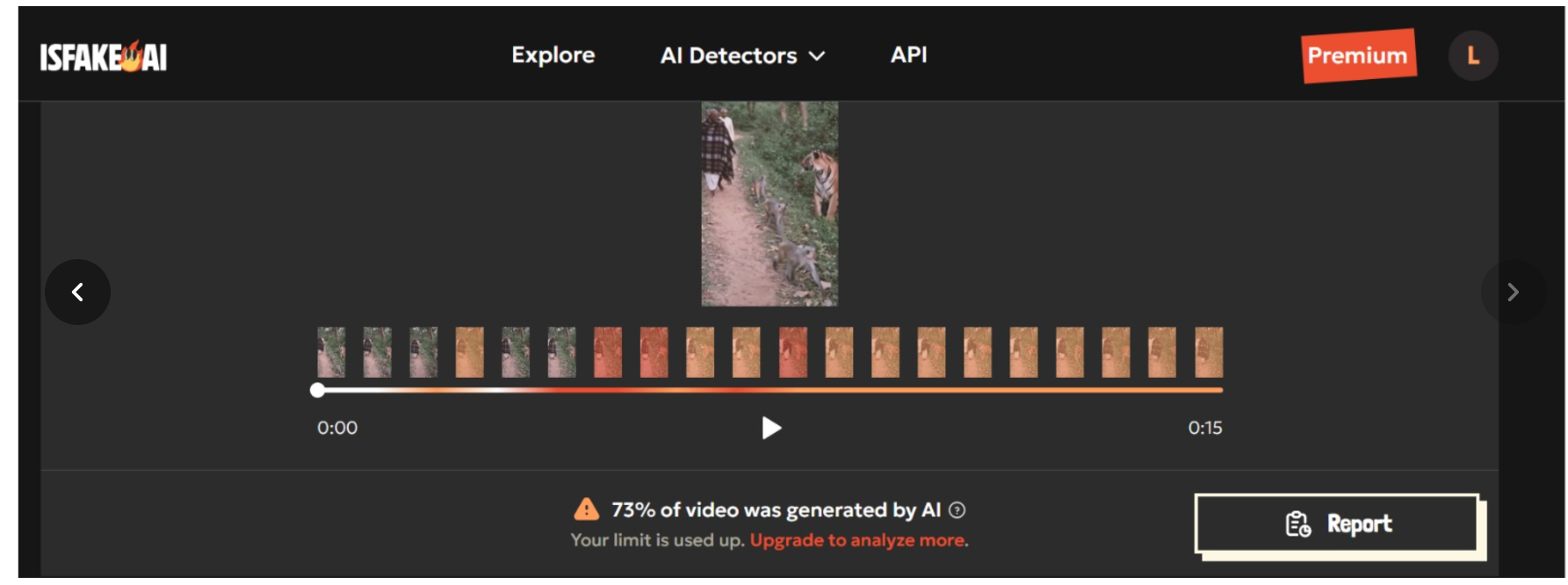
To further verify the authenticity of the viral video, we scanned it using another AI detection tool, ISFAKE AI. According to the results, the viral video is AI-generated.
Conclusion
Our research found that the viral video is not authentic but AI-generated. We did not find any credible media reports or other reliable sources confirming that the video shows a real incident involving Neem Karoli Baba and a tiger. The findings of AI detection tools further indicate that the visuals have been artificially generated. Therefore, the viral video is being circulated on social media with a misleading claim, presenting AI-generated visuals as a real incident.

Related Blogs

Introduction
According to a shocking report, there are multiple scam loan apps on the App Store in India that charge excessive interest rates and force users to pay by blackmailing and harassing them. Apple has prohibited and removed these apps from the App Store, but they may still be installed on your iPhone and running. You must delete any of these apps if you have downloaded them. Learn the names of these apps and how they operated the fraud.
Why Apple banned these apps?
- Apple has taken action to remove certain apps from the Indian App Store. These apps were engaging in unethical behaviour, such as impersonating financial institutions, demanding high fees, and threatening borrowers. Here are the titles of these apps, as well as what Apple has said about their suspension.
- Following user concerns, Apple removed six loan apps from the Indian App Store. Loan apps include White Kash, Pocket Kash, Golden Kash, Ok Rupee, and others.
- According to multiple user reviews, certain apps seek unjustified access to users’ contact lists and media. These apps also charge exorbitant fees that are not necessitated. Furthermore, companies have been found to engage in unethical tactics such as charging high-interest rates and “processing fees” equal to half the loan amount.
- Some lending app users have reported being harassed and threatened for failing to return their loans on time. In some circumstances, the apps threatened the user’s contacts if payment was not completed by the deadline. According to one user, the app company threatened to produce and send false photographs of her to her contacts.
- These loan apps were removed from the App Store, according to Apple, because they broke the norms and standards of the Apple Developer Program License Agreement. These apps were discovered to be falsely claiming financial institution connections.
Issue of Fake loan apps on the App Store
- The App Store and our App Review Guidelines are designed to ensure we provide our users with the safest experience possible,” Apple explained. “We do not tolerate fraudulent activity on the App Store and have strict rules against apps and developers who attempt to game the system.
- In 2022, Apple blocked nearly $2 billion in fraudulent App Store sales. Furthermore, it rejected nearly 1.7 million software submissions that did not match Apple’s quality and safety criteria and cancelled 428,000 developer accounts due to suspected fraudulent activities.
- The scammers also used heinous tactics to force the loanees to pay. According to reports, the scammers behind the apps gained access to the user’s contact list as well as their images. They would morph the images and then scare the individual by sharing their fake nude photos with their whole contact list.
Dangerous financial fraud apps have surfaced on the App Store
- TechCrunch acquired a user review from one of these apps. “I borrowed an amount in a helpless situation, and a day before the repayment due date, I got some messages with my picture and my contacts in my phone saying that repay your loan or they will inform our contacts that you are not paying the loan,” it said.
- Sandhya Ramesh, a journalist from The Print, recently tweeted a screenshot of a direct message she got. A victim’s friend told a similar story in the message.
- TechCrunch contacted Apple, who confirmed that the apps had been removed from the App Store for breaking the Apple Developer Program License Agreement and guidelines.
Conclusion
Recently, some users have claimed that some quick-loan applications, such as White Kash, Pocket Kash, and Golden Kash, have appeared on the Top Finance applications chart in recent days. These apps necessitate unauthorised and intrusive access to users’ contact lists and media. According to hundreds of user evaluations, these apps charged exorbitantly high and useless fees. They used unscrupulous techniques such as demanding “processing fees” equal to half the loan amount and charging high-interest rates. Users were also harassed and threatened with restitution. If payments were not made by the due date, the lending applications threatened to notify users’ contacts. According to one user, the app provider even threatened to generate phoney nude images of her and send them to her contacts.

Introduction
Devices and interconnectivity are the pipelines which drive the data into cyberspace, and in turn, the users consume this data to perform different tasks in the digital age. The security of devices and networks is essential as they are the first defenders of cyberspace. Bad actors often target systems and networks with malware and ransomware, these attacks are differently motivated, but all wreak havoc upon the system and can impact individuals and organisations alike. Mobile users worldwide prefer iOS or Android, but both operating systems are vulnerable to cyberattacks these days. Some of these attacks go undetected for a long time.
Op Triangulation
As reported by Kaspersky, While monitoring the network traffic of their own corporate Wi-Fi network dedicated to mobile devices using the Kaspersky Unified Monitoring and Analysis Platform (KUMA), Kaspersky noticed suspicious activity that originated from several iOS-based phones. Since it is impossible to inspect modern iOS devices from the inside, they created offline backups of the devices in question, inspected them using the Mobile Verification Toolkit’s mvt-ios and discovered traces of compromise. This is known as Operation Triangulation and has been in action since 2019 and got detected in 2023.
The Malware
A portion of the filesystem, including some of the user data and service databases, is included in mobile device backups. The files, directories, and database entries’ timestamps make it possible to reconstruct the events that happened to the device roughly. The “timeline.csv” file created by the mvt-ios software contains a sorted timeline of events that is comparable to the super-timeline utilised by traditional digital forensic tools. Pinpointing particular artefacts that show the compromise using this timeframe. This made it possible to advance the research and reassemble the broad infection sequence:
Through the iMessage service, a message with an attachment containing an exploit is delivered to the target iOS device.
The message initiates a vulnerability that results in code execution without any user input.
The exploit’s code downloads multiple additional stages, including additional exploits for privilege escalation, from the C&C server.
After successful exploitation, a fully functional APT platform is downloaded as the final payload from the C&C server.
The first message and the attachment’s exploit are removed

The lack of persistence support in the harmful toolset is most likely a result of OS restrictions. Multiple devices’ timeframes suggest that after rebooting, they might get infected again. The earliest signs of infection that we found date to 2019. The most recent version of the devices that have been successfully attacked as of the time of writing in June 2023 is iOS 15.7.
The final payload analysis is still ongoing. The programme executes with root rights, implements a set of commands for gathering user and system data, and can run any code downloaded as plugin modules from the C&C server.
Malicious Domains
Using the forensic artefacts, it was possible to identify the domain name set used by the exploits and further malicious stages. They can be used to check the DNS logs for historical information and to identify the devices currently running the malware:
addatamarket[.]net
backuprabbit[.]com
businessvideonews[.]com
cloudsponcer[.]com
datamarketplace[.]net
mobilegamerstats[.]com
snoweeanalytics[.]com
tagclick-cdn[.]com
topographyupdates[.]com
unlimitedteacup[.]com
virtuallaughing[.]com
web-trackers[.]com
growthtransport[.]com
anstv[.]netAns7tv[.]net
Safeguards for iOS users
Despite its world-class safety and privacy architecture, iOS is vulnerable to a few attacks; the following steps can be undertaken to safeguard iOS users –
Keeping Device updated
Security patches
Disabling iMessage would prevent Zero clicks exploits or the Triangulation attacks
Paying zero attention to unwanted, unsolicited messages
The user should make sure that any application they are downloading or installing; it should be from a trusted source ( This Zero click attack does not occur by any other means, It exploits / it targets software vulnerabilities in operating systems networks and applications)
Being cautious with the messaging app and emails
Implement device restrictions (management features like parental control and restrictions over using necessary applications)

Conclusion
Operation Triangulation is one of the recent operations combating cyber attacks, but such operations are launched nearly daily. This is also due to a rapid rise in internet and technology penetration across the world. Cyberattacks have taken a new face as they have evolved with the new and emerging technology. The influence of the Darknet has allowed many hackers to remain on the black hat side due to easy accessibility to illegal tools and material over the dark net, which facilitates such crimes.

Introduction
As e-sports flourish in India, mobile gaming platforms and apps have contributed massively to this boom. The wave of online mobile gaming has led to a new recognition of esports. As we see the Sports Ministry being very proactive for e-sports and e-athletes, it is pertinent to ensure that we do not compromise our cyber security for the sake of these games. When we talk about online mobile gaming, the most common names that come to our minds are PUBG and BGMI. As news for all Indian gamers, BGMI is set to be relaunched in India after approval from the Ministry of Electronics and Information Technology.
Why was BGMI banned?
The Govt banned Battle Ground Mobile India on the pretext of being a Chinese application and the fact that all the data was hosted in China itself. This caused a cascade of compliance and user safety issues as the Data was stored outside India. Since 2020 The Indian Govt has been proactive in banning Chinese applications, which might have an adverse effect on national security and Indian citizens. Nearly 200 plus applications have been banned by the Govt, and most of them were banned due to their data hubs being in China. The issue of cross-border data flow has been a key issue in Geo-Politics, and whoever hosts the data virtually owns it as well and under the potential threat of this fact, all apps hosting their data in China were banned.
Why is BGMI coming back?
BGMI was banned for not hosting data in India, and since the ban, the Krafton Inc.-owned game has been engaging in Idnai to set up data banks and servers to have a separate gaming server for Indian players. These moves will lead to a safe gaming ecosystem and result in better adherence to the laws and policies of the land. The developers have not declared a relaunch date yet, but the game is expected to be available for download for iOS and Android users in the coming few days. The game will be back on app stores as a letter from the Ministry of Electronics and Information Technology has been issued stating that the games be allowed and made available for download on the respective app stores.
Grounds for BGMI
BGMI has to ensure that they comply with all the laws, policies and guidelines in India and have to show the same to the Ministry to get an extension on approval. The game has been permitted for only 90 days (3 Months). Hon’ble MoS Meity Rajeev Chandrashekhar stated in a tweet “This is a 3-month trial approval of #BGMI after it has complied with issues of server locations and data security etc. We will keep a close watch on other issues of User harm, Addiction etc., in the next 3 months before a final decision is taken”. This clearly shows the magnitude of the bans on Chinese apps. The ministry and the Govt will not play the soft game now, it’s all about compliance and safeguarding the user’s data.
Way Forward
This move will play a significant role in the future, not only for gaming companies but also for other online industries, to ensure compliance. This move will act as a precedent for the issue of cross-border data flow and the advantages of data localisation. It will go a long way in advocacy for the betterment of the Indian cyber ecosystem. Meity alone cannot safeguard the space completely, it is a shared responsibility of the Govt, industry and netizens.
Conclusion
The advent of online mobile gaming has taken the nation by storm, and thus, being safe and secure in this ecosystem is paramount. The provisional permission form BGMI shows the stance of the Govt and how it is following the no-tolerance policy for noncompliance with laws. The latest policies and bills, like the Digital India Act, Digital Personal Data Protection Act, etc., will go a long way in securing the interests and rights of the Indian netizen and will create a blanket of safety and prevention of issues and threats in the future.
