
#FactCheck -Analysis Reveals AI-Generated Anomalies in Viral ‘Russia Snow Jump’ Video”
Executive Summary
A dramatic video showing several people jumping from the upper floors of a building into what appears to be thick snow has been circulating on social media, with users claiming that it captures a real incident in Russia during heavy snowfall. In the footage, individuals can be seen leaping one after another from a multi-storey structure onto a snow-covered surface below, eliciting reactions ranging from amusement to concern. The claim accompanying the video suggests that it depicts a reckless real-life episode in a snow-hit region of Russia.
A thorough analysis by CyberPeace confirmed that the video is not a real-world recording but an AI-generated creation. The footage exhibits multiple signs of synthetic media, including unnatural human movements, inconsistent physics, blurred or distorted edges, and a glossy, computer-rendered appearance. In some frames, a partial watermark from an AI video generation tool is visible. Further verification using the Hive Moderation AI-detection platform indicated that 98.7% of the video is AI-generated, confirming that the clip is entirely digitally created and does not depict any actual incident in Russia.
Claim:
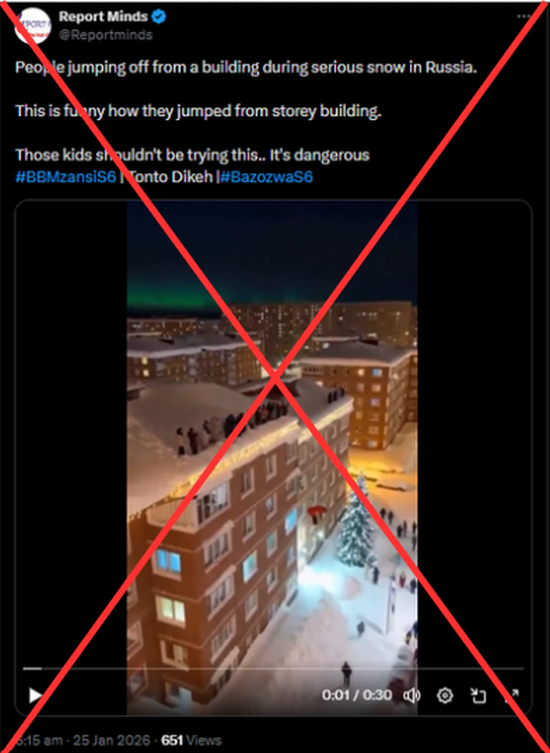
The video was shared on social media by an X (formerly Twitter) user ‘Report Minds’ on January 25, claiming it showed a real-life event in Russia. The post caption read: "People jumping off from a building during serious snow in Russia. This is funny, how they jumped from a storey building. Those kids shouldn't be trying this. It's dangerous." Here is the link to the post, and below is a screenshot.
Fact Check:
The Desk used the InVid tool to extract keyframes from the viral video and conducted a reverse image search, which revealed multiple instances of the same video shared by other users with similar claims. Upon close visual examination, several anomalies were observed, including unnatural human movements, blurred and distorted sections, a glossy, digitally-rendered appearance, and a partially concealed logo of the AI video generation tool ‘Sora AI’ visible in certain frames. Screenshots highlighting these inconsistencies were captured during the research .
- https://x.com/DailyLoud/status/2015107152772297086?s=20
- https://x.com/75secondes/status/2015134928745164848?s=20
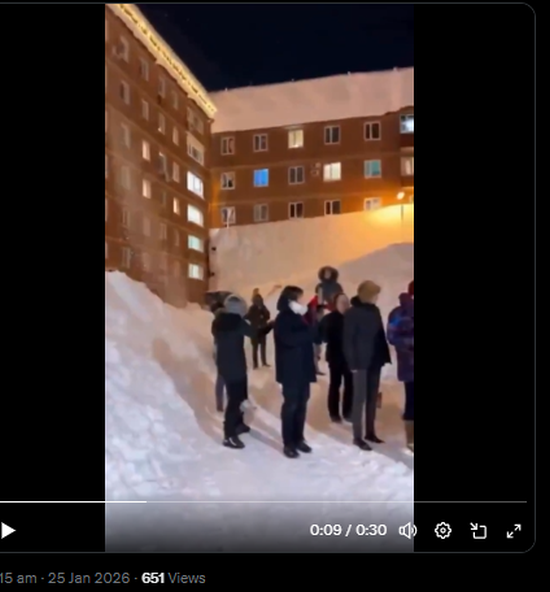

The video was analyzed on Hive Moderation, an AI-detection platform, which confirmed that 98.7% of the content is AI-generated.

The viral video showing people jumping off a building into snow, claimed to depict a real incident in Russia, is entirely AI-generated. Social media users who shared it presented the digitally created footage as if it were real, making the claim false and misleading.

Related Blogs

Executive Summary:
This report deals with a recent cyberthreat that took the form of a fake message carrying a title of India Post which is one of the country’s top postal services. The scam alerts recipients to the failure of a delivery due to incomplete address information and requests that they click on a link (http://iydc[.]in/u/5c0c5939f) to confirm their address. Privacy of the victims is compromised as they are led through a deceitful process, thereby putting their data at risk and compromising their security. It is highly recommended that users exercise caution and should not click on suspicious hyperlinks or messages.
False Claim:
The fraudsters send an SMS stating the status of delivery of an India Mail package which could not be delivered due to incomplete address information. They provide a deadline of 12 hours for recipients to confirm their address by clicking on the given link (http://iydc[.]in/u/5c0c5939f). This misleading message seeks to fool people into disclosing personal information or compromising the security of their device.

The Deceptive Journey:
- First Contact: The SMS is sent and is claimed to be from India Post, informs users that due to incomplete address information the package could not be delivered.
- Recipients are then expected to take action by clicking on the given link (http://iydc[.]in/u/5c0c5939f) to update the address. The message creates a panic within the recipient as they have only 12 hours to confirm their address on the suspicious link.
- Click the Link: Inquiring or worried recipients click on the link.
- User Data: When the link is clicked, it is suspected to launch possible remote scripts in the background and collect personal information from users.
- Device Compromise: Occasionally, the website might also try to infect the device with malware or take advantage of security flaws.
The Analysis:
- Phishing Technique: The scam allures its victims with a phishing technique and poses itself as the India Post Team, telling the recipients to click on a suspicious link to confirm the address as the delivery package can’t be delivered due to incomplete address.
- Fake Website Creation: Victims are redirected to a fraudulent website when they click on the link (http://iydc[.]in/u/5c0c5939f) to update their address.
- Background Scripts: Scripts performing malicious operations such as stealing the visitor information, distributing viruses are suspected to be running in the background. This script can make use of any vulnerability in the device/browser of the user to extract more info or harm the system security.
- Risk of Data Theft: This type of fraud has the potential to steal the data involved because it lures the victims into giving their personal details by creating fake urgency. The threat actors can use it for various illegal purposes such as financial fraud, identity theft and other criminal purposes in future.
- Domain Analysis: The iydc.in domain was registered on the 5th of April, 2024, just a short time ago. Most of the fraud domains that are put up quickly and utilized in criminal activities are usually registered in a short time.
- Registrar: GoDaddy.com, LLC, a reputable registrar, through which the domain is registered.
- DNS: Chase.ns.cloudflare.com and delilah.ns.cloudflare.com are the name servers used by Cloudflare to manage domain name resolution.
- Registrant: Apart from the fact that it is in Thailand, not much is known about the registrant probably because of using the privacy reduction plugins.

- Domain Name: iydc.in
- Registry Domain ID: DB3669B210FB24236BF5CF33E4FEA57E9-IN
- Registrar URL: www.godaddy.com
- Registrar: GoDaddy.com, LLC
- Registrar IANA ID: 146
- Updated Date: 2024-04-10T02:37:06Z
- Creation Date: 2024-04-05T02:37:05Z (Registered in very recent time)
- Registry Expiry Date: 2025-04-05T02:37:05Z
- Registrant State/Province: errww
- Registrant Country: TH (Thailand)
- Name Server: delilah.ns.cloudflare.com
- Name Server: chase.ns.cloudflare.com
Note: Cybercriminals used Cloudflare technology to mask the actual IP address of the fraudulent website.
CyberPeace Advisory:
- Do not open the messages received from social platforms in which you think that such messages are suspicious or unsolicited. In the beginning, your own discretion can become your best weapon.
- Falling prey to such scams could compromise your entire system, potentially granting unauthorized access to your microphone, camera, text messages, contacts, pictures, videos, banking applications, and more. Keep your cyber world safe against any attacks.
- Never reveal sensitive data such as your login credentials and banking details to entities where you haven't validated as reliable ones.
- Before sharing any content or clicking on links within messages, always verify the legitimacy of the source. Protect not only yourself but also those in your digital circle.
- Verify the authenticity of alluring offers before taking any action.
Conclusion:
The India Post delivery scam is an example of fraudulent activity that uses the name of trusted postal services to trick people. The campaign is initiated by using deceptive texts and fake websites that will trick the recipients into giving out their personal information which can later be used for identity theft, financial losses or device security compromise. Technical analysis shows the sophisticated tactics used by fraudsters through various techniques such as phishing, data harvesting scripts and the creation of fraudulent domains with less registration history etc. While encountering such messages, it's important to verify their authenticity from official sources and take proactive measures to protect both your personal information and devices from cyber threats. People can reduce the risk of falling for online scams by staying informed and following cybersecurity best practices.

Executive Summary
A viral video allegedly featuring cricketer Virat Kohli endorsing a betting app named ‘Aviator’ is being shared widely across the social platform. CyberPeace Research Team’s Investigations revealed that the same has been made using the deepfake technology. In the viral video, we found some potential anomalies that can be said to have been created using Synthetic Media, also no genuine celebrity endorsements for the app exist, we have also previously debunked such Deep Fake videos of cricketer Virat Kohli regarding the misuse of deep fake technology. The spread of such content underscores the need for social media platforms to implement robust measures to combat online scams and misinformation.

Claims:
The claim made is that a video circulating on social media depicts Indian cricketer Virat Kohli endorsing a betting app called "Aviator." The video features an Indian News channel named India TV, where the journalist reportedly endorses the betting app followed by Virat Kohli's experience with the betting app.
Fact Check:
Upon receiving the news, we thoroughly watched the video and found some featured anomalies that are usually found in regular deep fake videos such as the lip sync of the journalist is not proper, and if we see it carefully the lips do not match with the audio that we can hear in the Video. It’s the same case when Virat Kohli Speaks in the video.

We then divided the video into keyframes and reverse searched one of the frames from the Kohli’s part, we found a video similar to the one spread, where we could see Virat Kohli wearing the same brown jacket in that video, uploaded on his verified Instagram handle which is an ad promotion in collaboration with American Tourister.

After going through the entire video, it is evident that Virat Kohli is not endorsing any betting app, rather he is talking about an ad promotion collaborating with American Tourister.
We then did some keyword searches to see if India TV had published any news as claimed in the Viral Video, but we didn’t find any credible source.
Therefore, upon noticing the major anomalies in the video and doing further analysis found that the video was created using Synthetic Media, it's a fake and misleading one.
Conclusion:
The video of Virat Kohli promoting a betting app is fake and does not actually feature the celebrity endorsing the app. This brings up many concerns regarding how Artificial Intelligence is being used for fraudulent activities. Social media platforms need to take action against the spread of fake videos like these.
Claim: Video surfacing on social media shows Indian cricket star Virat Kohli promoting a betting application known as "Aviator."
Claimed on: Facebook
Fact Check: Fake & Misleading

Executive Summary
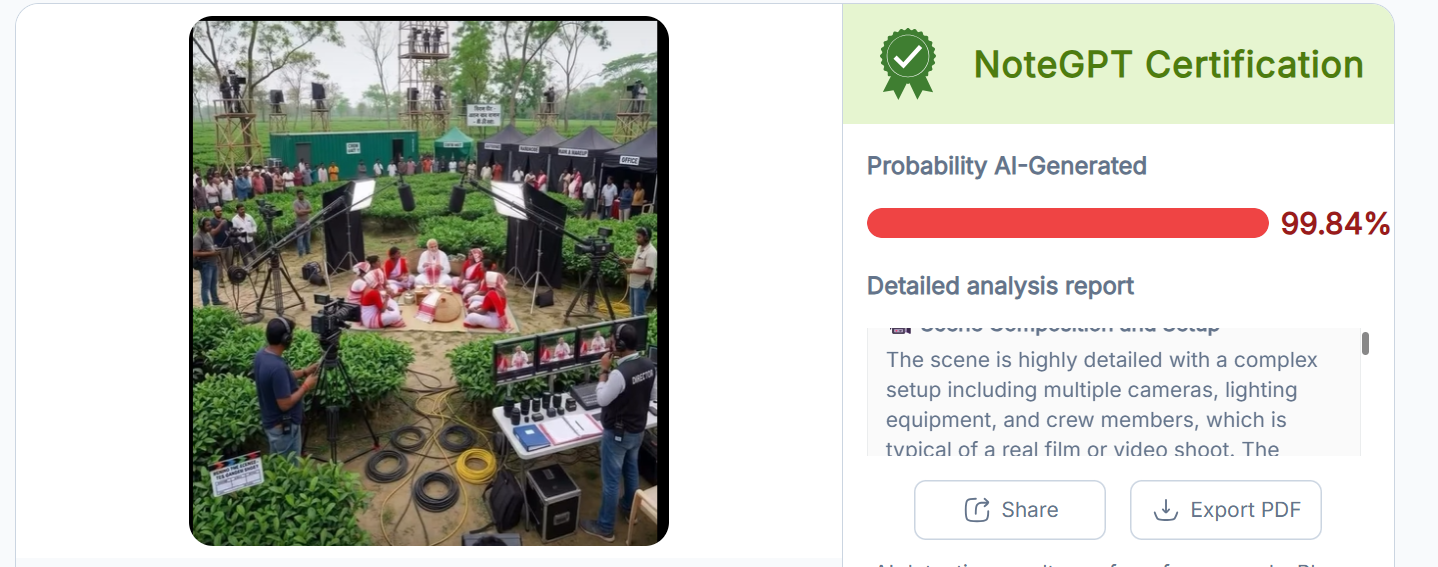
An image of Prime Minister Narendra Modi is being widely circulated on social media. The picture is being shared with the claim that during an election campaign in Assam, a full-fledged shooting set was arranged in a tea garden where Modi interacted with women workers, complete with cameras, microphones, lights, and a director-led production team. However, research by the CyberPeace has found the claim to be false. Our research reveals that the viral image is AI-generated and is being shared with a misleading narrative.
Claim
An Instagram user shared the viral image with the caption suggesting that such a large-scale “shoot” setup had been arranged and questioned the cost involved.
Post link:
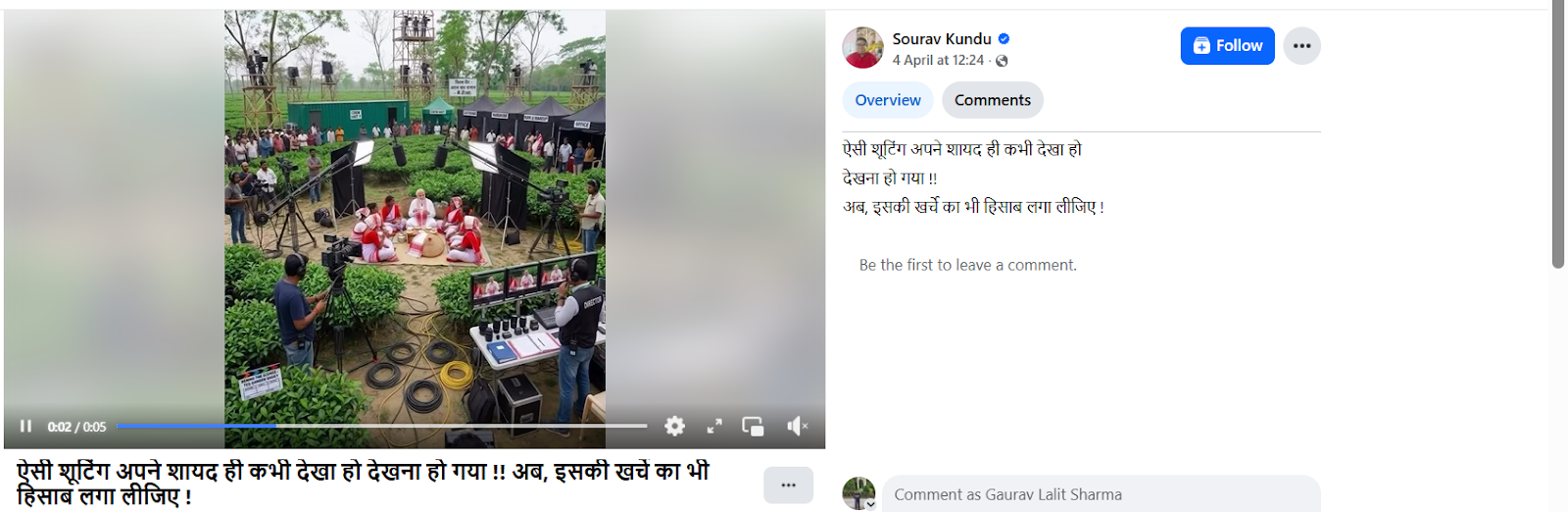
Fact Check
To verify the claim, we conducted a keyword-based search on Google. However, we did not find any credible media reports supporting the claim that such a shooting setup was arranged during Prime Minister Modi’s visit to Assam. Upon closely examining the viral image, we noticed several visual inconsistencies that raised suspicion about it being artificially generated. To confirm this, we analyzed the image using the AI detection tool Hive Moderation, which indicated that the image is approximately 99% AI-generated.
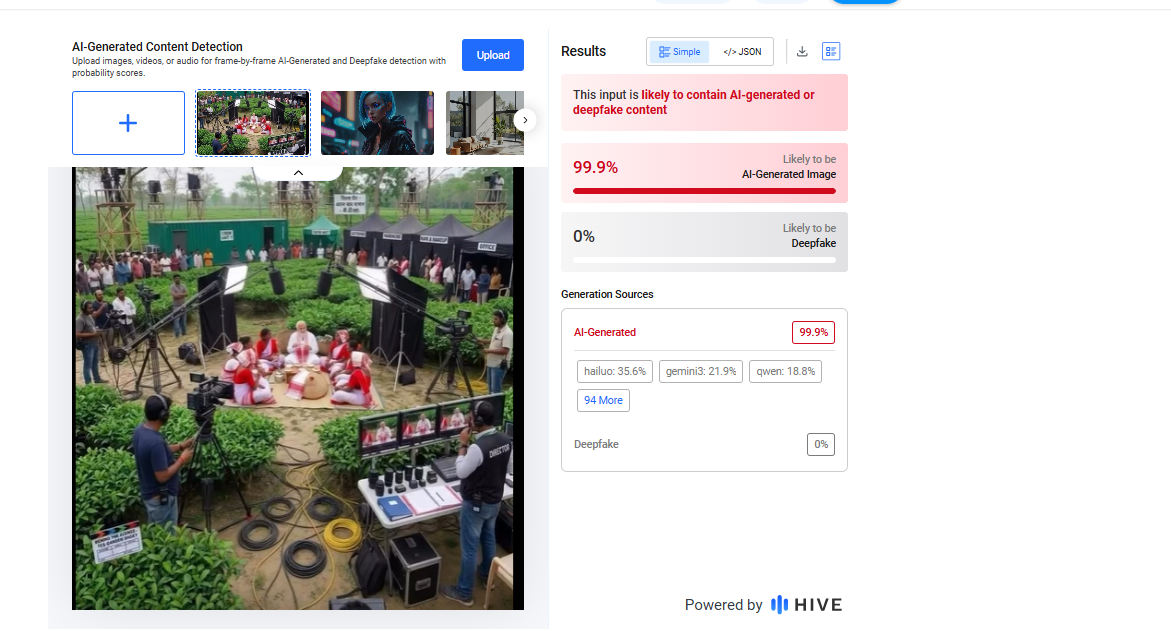
To further validate the findings, we also tested the image using another AI detection tool, NoteGPT, which similarly classified the image as 99% AI-generated.
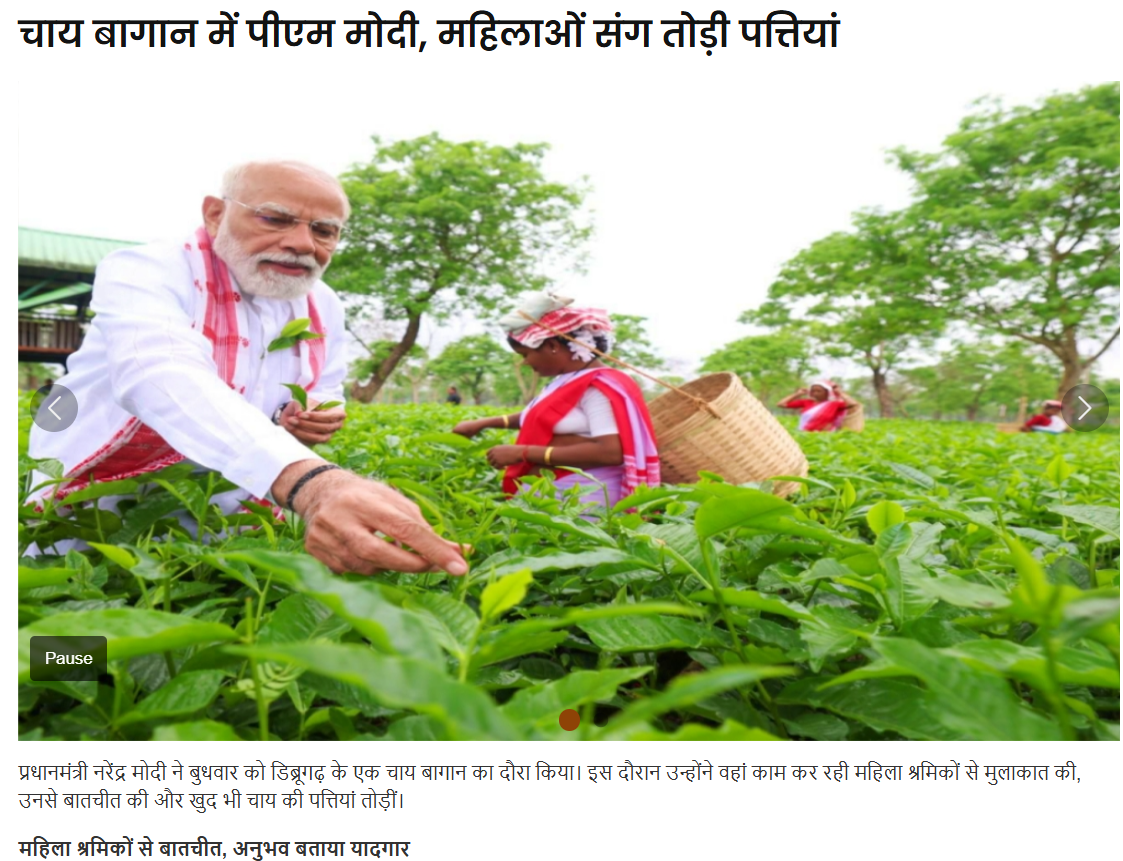
For context, ahead of the 2026 Assam Assembly elections, Prime Minister Narendra Modi has been on a campaign visit to the state. According to a report by DD News, he visited a tea garden in Dibrugarh, where he interacted with women workers and even plucked tea leaves himself.
Conclusion
Our research clearly establishes that the viral image of Prime Minister Narendra Modi is not authentic and has been digitally created using AI tools. There is no evidence to support the claim that a staged shooting setup involving cameras, lights, and a production crew was arranged during his visit. The image is being circulated with a misleading narrative to create a false impression. This case highlights how AI-generated visuals can be used to distort real events and spread misinformation.
