
#FactCheck: Video of Khadija Belghoum and Billy Rahman Falsely Linked to Bangladeshi Nationals Executed in Saudi Arabia
Executive Summary
A video is being shared on social media with the claim that it shows a Bangladeshi couple sentenced to death in Saudi Arabia. In the video, a woman is seen telling her husband that she is pregnant. The claim states that the woman's only “crime” was that she was about to become a mother, and that Saudi Arabia sentenced not two, but three people to death. CyberPeace Research found that the couple shown in the video are husband and wife and have no connection to the Bangladeshi nationals sentenced to death in Saudi Arabia.
Claim
An X user shared the viral video with the following caption: “This is the Bangladeshi couple. Her only crime was that she was about to become a mother. She told her husband, ‘You are going to be a father.’ Hearing this, tears welled up in his eyes, and he kissed his wife's forehead out of joy. Saudi Arabia has sentenced not two, but three people to death.”
View the archived post here. Similar posts can be found here and here.
https://x.com/imarpit96/status/2113128510848172287

Fact Check
To verify the viral video being shared as showing a Bangladeshi couple sentenced to death in Saudi Arabia, we conducted a reverse image search of its keyframes. During the search, we found the same video uploaded on August 7, 2026, on the Instagram account of Khadija Belghoum (@khadijabelgoum).
Text overlaid on the video reads, “I told my husband that I am pregnant.” In the caption, the woman also wrote that she gave her husband the most precious gift at the holiest place during the most difficult time. The post also tags her husband, Billy Rahman, on Instagram. Additionally, the hashtag Mecca was included in the post.
https://www.instagram.com/p/DbtdSc

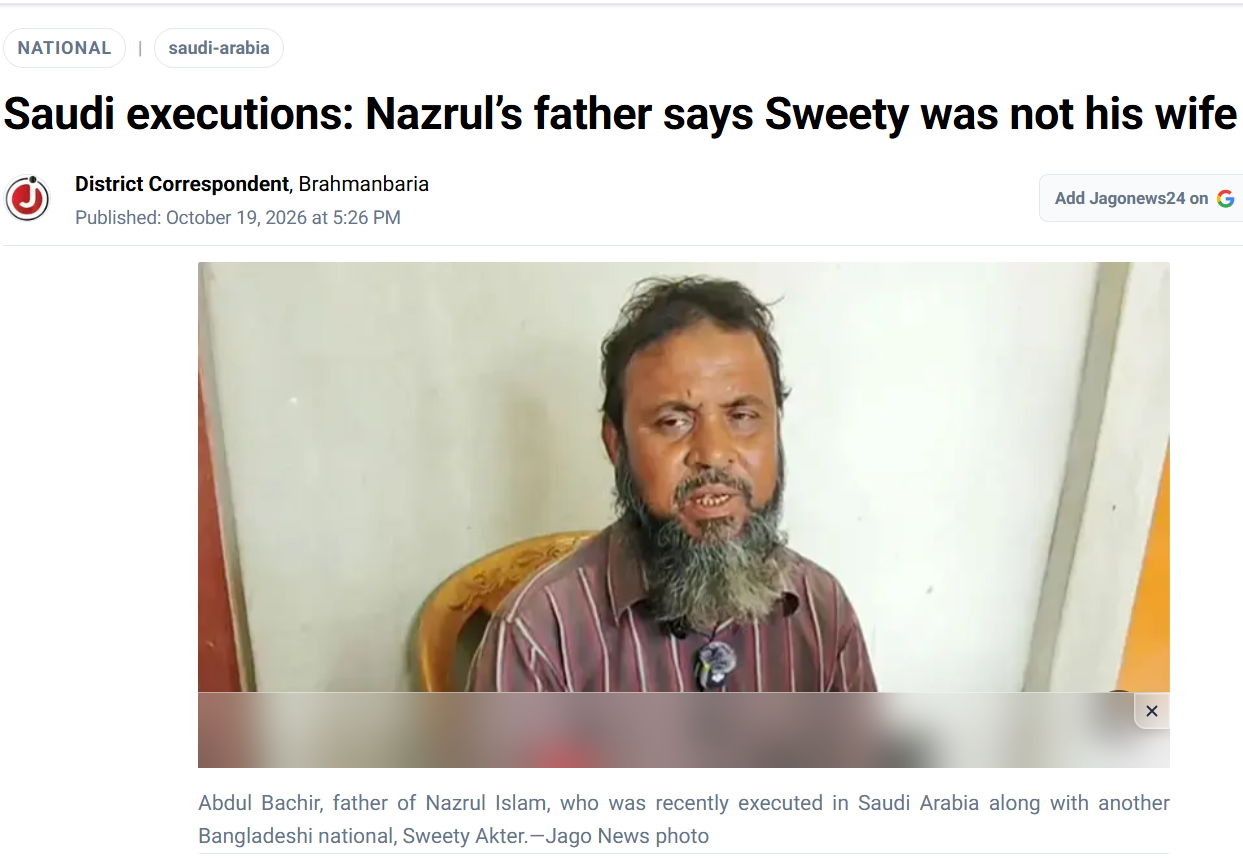
During our research into the claim, we found a report published on October 19, 2026, by Bangladeshi news website Jago News. According to the report, Nazrul Islam and Sweety Akhtar, who were sentenced to death in Saudi Arabia, were being described as husband and wife in social media posts. However, Nazrul's father, Abdul Bashir, refuted this claim. Speaking to Jago News, he said that Sweety was not Nazrul's wife and that his family did not even know her. According to the report, he also said that Nazrul had worked for only six months after arriving in Saudi Arabia, following which he spent three years and three months in prison. The family was still unaware of the reason for his arrest.
https://www.jagonews24.com/en/national/news/97248
Conclusion
The evidence gathered during our research clearly establishes that the claim accompanying the viral video is false. The couple shown in the video are Khadija Belghoum and Billy Rahman, who are husband and wife. They have no connection to the Bangladeshi nationals who were executed in Saudi Arabia.

Related Blogs
Introduction
Parliament is about to begin its Monsoon Session from July 20, 2026 to August 13, 2026, and the mood in Delhi already feels charged. Ahead of the opening bell, the government has flagged five new bills for introduction, alongside a couple of pending pieces of legislation it may take up for passage. Predictably, the political oxygen in the run-up has gone almost entirely to what isn't on that list — reports this week noted the conspicuous absence of the long-anticipated Delimitation Bill and a Constitutional amendment for women's reservation in the Lok Sabha, a gap that has already drawn sharp reactions from Congress leaders. What is on the list has generated its own share of noise: a Foreign Contribution (Regulation) Amendment Bill that NGOs are watching warily, a Prevention of Insults to National Honour (Amendment) Bill tied to safeguards for the National Flag and Anthem, and a Supreme Court (Number of Judges) Amendment Bill proposing to raise the Court's sanctioned strength from 33 to 37. Every one of these will command its share of prime-time debate. But tucked quietly among the five is a bill that, headline for headline, may end up mattering more to the everyday Indian economy than all the others combined: the Micro, Small and Medium Enterprises Development (Amendment) Bill, 2026.
MSMEs play a foundational role in India’s economic engine, powering employment, entrepreneurship and growth across the country. That makes this Bill one worth watching closely, because even seemingly technical changes to the MSME framework could have very real consequences for millions of businesses and the people whose livelihoods depend on them.
What the Bill Actually Does
The MSME sector hasn't seen a structural legal update since the original MSMED Act of 2006 nearly two decades in an economy that looks nothing like it did back then. The new amendment is designed to close that gap. According to the government's own description of the bill, it aims to align the 2006 law with the sector's changed realities, improve ease of doing business, and shift toward what officials are calling "trust-based" regulation rather than a purely compliance-driven approach.
Three provisions stand out.
- First, it strengthens the mechanism for resolving delayed payments to micro and small enterprises, arguably the single biggest complaint MSME owners have voiced for years.
- Second, it creates a pathway to enforce arbitral awards specifically for micro and small units, giving smaller suppliers real teeth when a dispute is decided in their favor.
- Third, it gives states more flexibility in deciding the composition of Micro and Small Enterprises Facilitation Councils (MSEFCs) , the bodies that adjudicate payment disputes which should allow more councils to be formed and cut down on case backlogs.
The Delayed Payment Crisis, in Numbers
To understand why this matters, look at the scale of the problem the bill is trying to fix. The MSME Ministry's Samadhaan portal, which lets small enterprises file delayed-payment complaints online, had received close to 2.57 lakh applications as of June 2026, involving claimed dues of roughly ₹55,244 crore. Of these, only about 58,000 cases had actually been resolved by facilitation councils. That's a resolution rate that leaves the vast majority of small businesses waiting often for money already owed to them for goods or services delivered.
The government did tighten the screws somewhat in 2024 through Section 43B(h) of the Income Tax Act, which denies large buyers a tax deduction if they don't pay MSME suppliers within the 15-to-45-day window mandated by law. Enforcement, however, has remained patchy, and industry bodies like Assocham have continued to flag delayed payments including from PSUs and government departments as a core source of financial stress for small firms, with high interest charges on overdue statutory dues compounding the problem.
Why This Is Bigger Than One Bill
A regulation targeting the payments practices of India's micro, small, and medium-sized enterprises is more than just paperwork and procedural wrangling; the stakes for the Indian economy and society are enormous. According to the 2025-26 Economic Survey, MSMEs now contribute about 31.1% of India’s GDP, 35.4% of its manufacturing output, and 48.58% of its exports, while employing 33 to 39 crore people and providing India’s second largest source of employment after agriculture. The official Udyam database of MSMEs crossed the 8.7 crore mark by June 2026, underscoring a clear trend towards the sector’s formalisation in the last few years. Access to finance is the second pillar of MSME empowerment. The Credit Guarantee Fund Trust for Micro and Small Enterprises has authorised several lakh crores in guarantees, and most recently, the government increased its loan guarantee cover ceiling from Rs 5 crore to Rs 10 crore to facilitate more collateral-free loans to businesses. However, the actual credit gap remains estimated in the tens of lakh crores, with the biggest gaps faced by women-led and medium enterprises. While the MSME Bill doesn’t directly address access to finance, improved and quicker payment settlement mechanisms are expected to relieve some working-capital stress and dissuade small firms from falling into expensive informal credit markets. The MSME Bill also adds to a wave of recent measures to de-regulate smaller enterprises, such as the Jan Vishwas (Amendment of Provisions) Bill that was passed earlier in 2026. That Bill modified or deleted criminal offences with a more lenient civil equivalent across numerous central acts, a change industry lobby FISME called a significant move towards ease of doing business.
The Data Protection Clock Is Already Ticking - The Gap Payment Reform Won't Close
It's also worth noting that India's Digital Personal Data Protection (DPDP) Act, 2023 is now in force, with rules notified in November 2025 and full compliance — including breach notification, security safeguards. With nearly half of Indian small businesses already reporting cyber incidents each year, MSMEs have a narrowing runway to build the security practices this regime will expect of them. Given that scale of exposure, there's a real case for the MSME Amendment Bill, or a companion policy, to go further — mandating baseline cyber-hygiene standards for Udyam-registered firms or tying credit-guarantee schemes to demonstrated security practices. Payment reform alone protects an MSME's right to be paid; it does little to protect what happens to that money, or that data, once it arrives.Payment reform alone protects an MSME's right to be paid; it does little to protect what happens to that money, or that data, once it arrives. CyberPeace calls on relevant agencies to issue clearer advisories and introduce additional, cost-friendly cybersecurity safeguards tailored to MSMEs' limited budgets and IT capacity.
What to Watch For
Whether the MSME Bill gets the attention it deserves during this session is an open question. With the Opposition expected to spend political capital on delimitation, the Vande Mataram bill, unemployment, inflation, and the NEET paper-leak controversy, a technical amendment to an enterprise development law is unlikely to dominate floor debate even though it may end up affecting more households than any single headline bill this session.
Conclusion
For India's roughly 7-8 crore MSMEs, most of them family-run and thinly capitalised, the details that get finalised in the coming weeks how MSEFCs are reconstituted, how arbitral awards get enforced, how "trust-based" regulation is actually defined will matter far more than who wins the argument over delimitation. It's worth watching this one closely, even if the cameras are pointed elsewhere.
Sources
- https://www.business-standard.com/india-news/vande-mataram-bill-among-five-new-legislations-listed-for-monsoon-session-126071601319_1.html
- https://www.prokerala.com/news/articles/a1780267.html

Executive Summary:
Recently PAN-OS software of Palo Alto Networks was discovered with the critical vulnerability CVE-2024-3400. It is the software used to power all their networks in the next generation firewalls. This vulnerability is a common injection vulnerability which provides access to unauthenticated attackers to execute random code having root privileges on the attacked system. This has been exploited actively by threat actors, leaving many organizations at risk for severe cyberattacks. This report helps to understand the exploitation, detection, mitigations and recommendations for this vulnerability.

Understanding The CVE-2024-3400 Vulnerability:
CVE-2024-3400 impacts the particular version of PAN-OS and a certain configuration susceptible to this kind of a security issue. It is a command injection, which exists in the GlobalProtect module of the PAN-OS software. The vulnerability can be exploited by an unauthorized user to run any code on the firewall having root privileges. This targets Active Directory database (ntds.dit), important data (DPAPI), and Windows event logs (Microsoft-Windows-TerminalServices-LocalSessionManager%4Operational.evtx) and also login data, cookies, and local state data for Chrome and Microsoft Edge from specific targets leading attackers to capture the browser master key and steal sensitive information of the organization.
The CVE-2024-3400 has been provided with a critical severity rating of 10.0. The following two weaknesses make this CVE highly severe:
- CWE-77: Improper Neutralization of Special Elements used in a Command ('Command Injection')
- CWE-20: Improper Input Validation.
Impacted Products:
The affected version of PAN-OS by CVE-2024-3400 are-

Only the versions 10.2, 11.0, and 11.1, setup with GlobalProtect Gateway or GlobalProtect Portal are exploited by this vulnerability. Whereas the Cloud NGFW, Panorama appliances and Prisma Access are not affected.
Detecting Potential Exploitation:
Palo Alto Networks has confirmed that they are aware of the exploitation of this particular vulnerability by threat actors. In a recent publication they have given acknowledgement to Volexity for identifying the vulnerability. There is an increasing number of organizations that face severe and immediate risk by this exploitation. Third parties also have released the proof of concept for the vulnerability.
The suggestions were provided by Palo Alto Networks to detect this critical vulnerability. To detect this vulnerability, the following command shall be run on the command-line interface of PAN-OS device:
grep pattern "failed to unmarshal session(.\+.\/" mp-log gpsvc.log*
This command looks through device logs for specific entries related to vulnerability.
These log entries should contain a long, random-looking code called a GUID (Globally Unique Identifier) between the words "session(" and ")". If an attacker has tried to exploit the vulnerability, this section might contain a file path or malicious code instead of a GUID.
Presence of such entries in your logs, could be a sign of a potential attack to hack your device which may look like:
- failed to unmarshal session(../../some/path)
A normal, harmless log entry would look like this:
- failed to unmarshal session(01234567-89ab-cdef-1234-567890abcdef)
Further investigations and actions shall be needed to secure the system in case the GUID entries were not found and suspicious.
Mitigation and Recommendations:
Mitigation of the risks posed by the critical CVE-2024-3400 vulnerability, can be accomplished by the following recommended steps:
- Immediately update Software: This vulnerability is fixed in software releases namely PAN-OS 10.2.9-h1, PAN-OS 11.0.4-h1, PAN-OS 11.1.2-h3, and all higher versions. Updating software to these versions will protect your systems fully against potential exploitation.
- Leverage Hotfixes: Palo Alto Networks has released hotfixes for commonly deployed maintenance releases of PAN-OS 10.2, 11.0, and 11.1 for the users who cannot upgrade to the latest versions immediately. These hotfixes do provide a temporary solution while you prepare for the full upgrade.
- Enable Threat Prevention: Incase of available Threat Prevention subscription, enable Threat IDs 95187, 95189, and 95191 to block attacks targeting the CVE-2024-3400 vulnerability. These Threat IDs are available in Applications and Threats content version 8836-8695 and later.
- Apply Vulnerability Protection: Ensure that vulnerability protection has been applied in the GlobalProtect interface to prevent the exploitation on the device. It can be implemented using these instructions.
- Monitor Advisory Updates: Regularly checking for the updates to the official advisory of Palo Alto Networks. This helps to stay up to date of the new releases of the guidance and threat prevention IDs of CVE-2024-3400.
- Disable Device Telemetry – Optional: It is suggested to disable the device telemetry as an additional precautionary measure.
- Remediation: If there is an active exploitation observed, follow the steps mentioned in this Knowledge Base article by Palo Alto Networks.
Implementation of the above mitigation measures and recommendations would be in a position to greatly reduce the risk of exploitation you might face from a cyber attack targeting the CVE-2024-3400 vulnerability in Palo Alto Networks' PAN-OS software.
Conclusion:
The immediate response should be taken against the offensive use of the critical CVE-2024-3400 vulnerability found in the PAN-OS platform of Palo Alto Networks. Organizations should actively respond by implementing the suggested mitigation measures such as upgrading to the patched versions, enabling threat prevention and applying vulnerability protection to immediately protect from this vulnerability. Regular monitoring, implementing security defense mechanisms and security audits are the necessary measures that help to combat emerging threats and save critical resources.
Executive Summary
A video is going viral on social media in which Defence Minister Rajnath Singh is seen allegedly saying, “During Operation Sindoor, we initially hid the losses of jets and soldiers so that Pakistan could not use them for propaganda. Later, a documentary was made to reveal the truth.” Research by the CyberPeace Research Wing found that the video is completely fake and was created using artificial intelligence (AI). Defence Minister Rajnath Singh never made any such statement. The video has primarily been circulated by Pakistani accounts.
Claim:
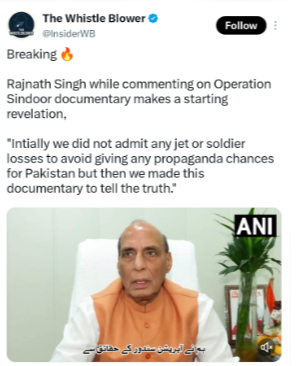
A video of Rajnath Singh has been shared by a Pakistani user on the social media platform X, with the caption: “Rajnath Singh while commenting on Operation Sindoor documentary makes a starting revelation, Initially we did not admit any jet or soldier losses to avoid giving any propaganda chances for Pakistan but then we made this documentary to tell the truth.” The post link and screenshot are provided below.
https://x.com/i/status/2091095915021193252
Fact Check:
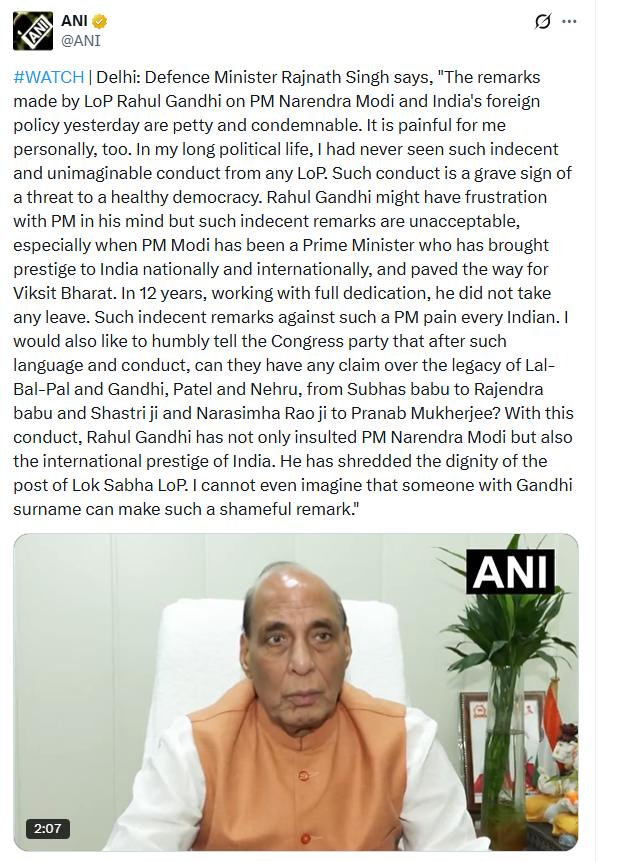
To investigate the viral claim, we first extracted keyframes from the video and conducted a reverse image search using Google Lens. During this process, we found the original video on ANI’s X account, in which Defense Minister Rajnath Singh can be seen saying: Defense Minister Rajnath Singh said, “The remarks made yesterday in the Lok Sabha by Leader of Opposition Rahul Gandhi regarding Prime Minister Narendra Modi and India’s foreign policy are extremely cheap and condemnable. Personally, this is painful for me as well. In my long political life, I have never seen such unbecoming and unthinkable behavior from any Leader of Opposition. Such conduct poses a serious threat to a healthy democracy. Rahul Gandhi may feel disappointment toward the Prime Minister, but such improper remarks are unacceptable—especially when PM Modi has elevated India’s national and international prestige and paved the way for a ‘Viksit Bharat’.
Working with complete dedication for 12 years, he has not taken a single day off. Such unbecoming remarks against such a Prime Minister pain every Indian I would also humbly like to ask the Congress Party: after such language and conduct, can it still claim the legacy of great stalwarts ranging from Lal-Bal-Pal and Gandhi, Patel, Nehru to Subhas Babu, Rajendra Babu, Shastri Ji, Narasimha Rao Ji, and Pranab Mukherjee? Through this behavior, Rahul Gandhi has not only insulted Prime Minister Narendra Modi but also damaged India’s international reputation. He has tarnished the dignity of the post of Leader of Opposition in the Lok Sabha. I cannot even imagine that anyone carrying the surname 'Gandhi' could make such a shameful remark.” Throughout the entire video, he never made the statement attributed to him in the viral claim. The post link and screenshot are provided below.
https://x.com/ANI/status/2088230045102002466
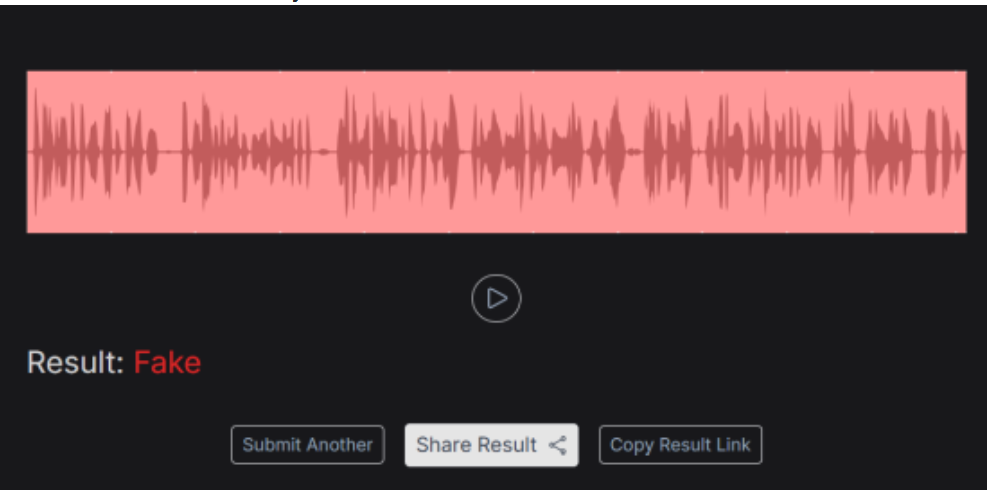
We scanned the audio on the AI detection tool Resemble AI, where the results confirmed that the voice is AI-generated.
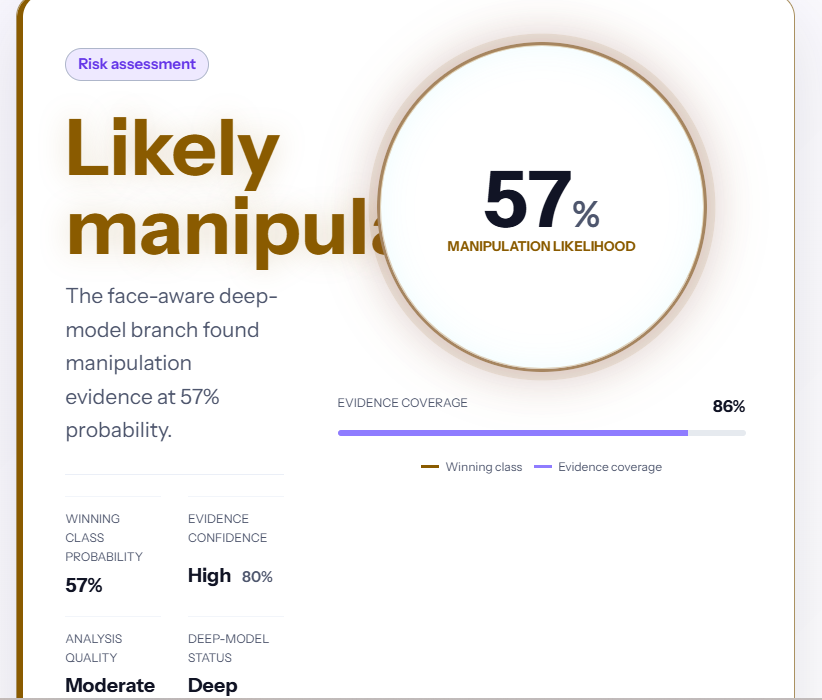
We also scanned the clip on another AI detection tool, Detect Video AI, where the results indicated that the viral video is 57 percent AI-generated.
Conclusion:
Our research revealed that the viral video is completely fake and was created using Artificial Intelligence (AI). The research confirmed that Defense Minister Rajnath Singh made no such statement. It was also revealed during the fact-check that this fake video is being primarily circulated on social media through Pakistani accounts.
