
#FactCheck-AI-Generated Video Falsely Shows Mishandling of Baggage at Indian Airport
Executive Summary
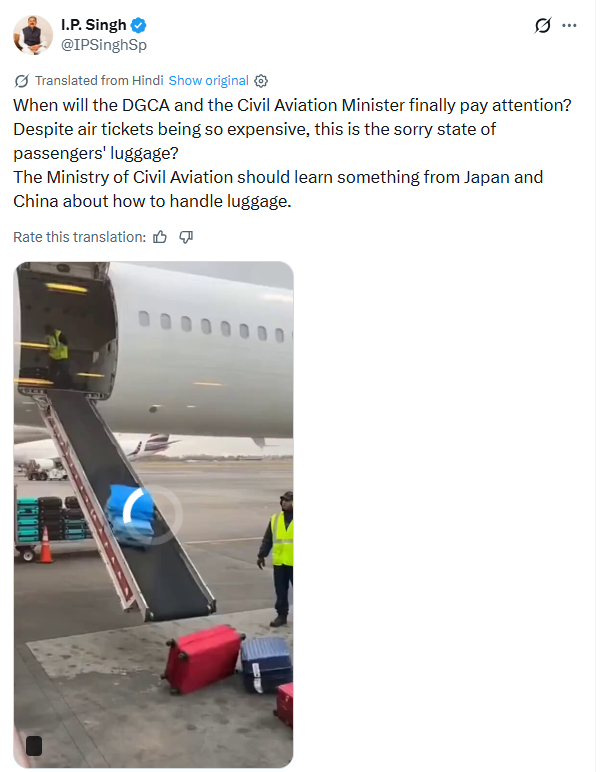
A video is being widely shared on social media claiming to show baggage handlers in India carelessly unloading passenger luggage from an aircraft cargo hold. The clip allegedly shows a handler ignoring standard procedures and throwing bags directly onto the tarmac instead of placing them on a motorized conveyor belt. CyberPeace Research Wing research found the video to be entirely fake. The clip has been generated using artificial intelligence (AI) and is being falsely shared as a real incident from India.
Claim
An X user, I.P. Singh (@IPSinghSp), shared the video on June 25, claiming it shows baggage handlers unloading luggage from an aircraft in India. The post criticized the alleged mishandling of passenger baggage and questioned aviation authorities over poor service standards.
The accompanying post read:
“When will the DGCA and the Civil Aviation Minister finally pay attention? Despite high airfares, this is the state of passengers’ luggage. The Ministry of Civil Aviation should learn from Japan and China how luggage should be handled.” https://x.com/IPSinghSp/status/2070164107551273109?s=20 , https://archive.ph/heiHA
Fact Check
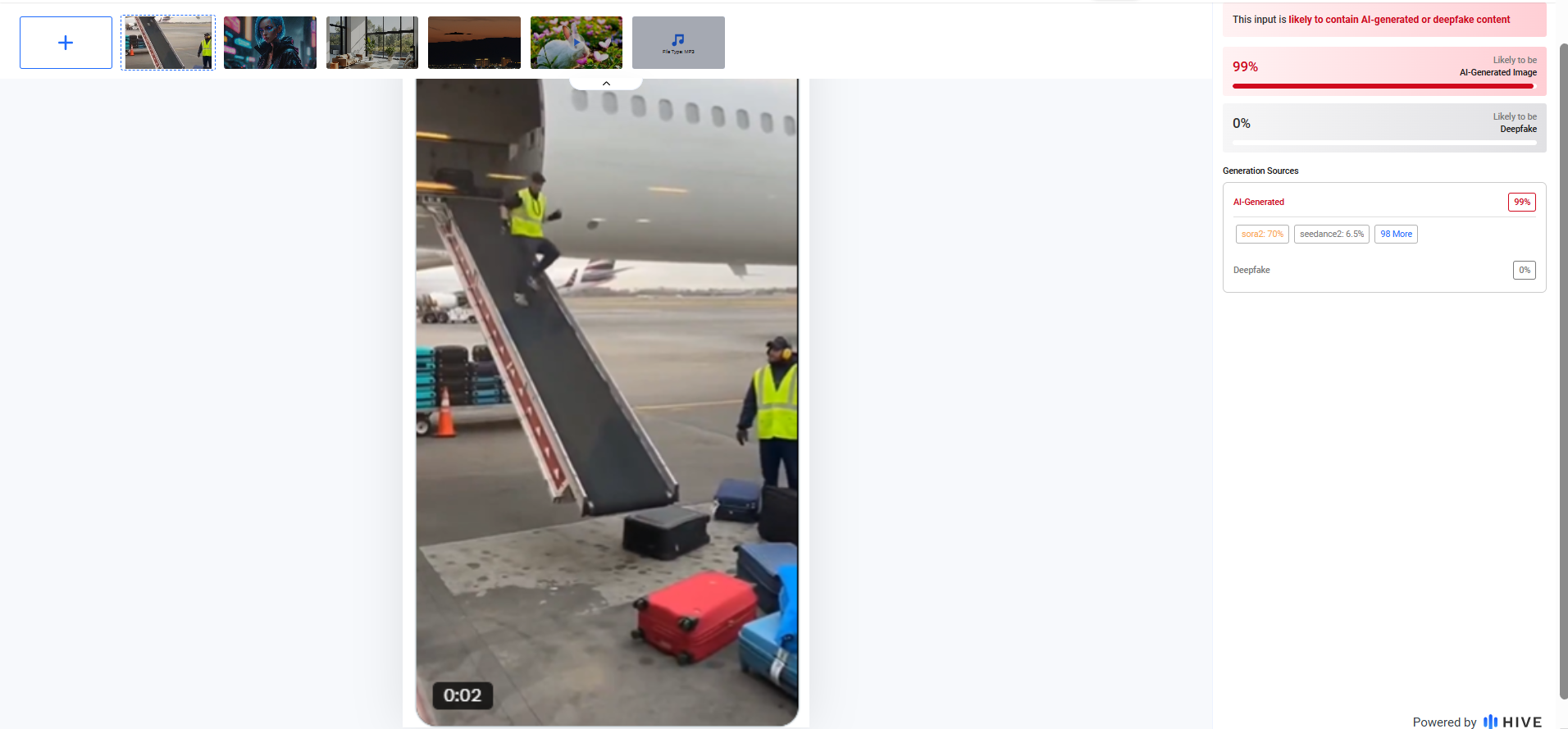
A detailed analysis of the footage revealed multiple visual inconsistencies suggesting AI generation. Notably, even after the baggage handler seen initially tossing the luggage exits via the conveyor belt, bags continue to emerge from the cargo hold and fall onto the tarmac on their own. This physically impossible sequence strongly indicates digital manipulation. To verify these findings, the video was analyzed using the AI detection tool Hive Moderation. The results indicated that a significant portion of the footage was generated using artificial intelligence.
Conclusion
Our research confirms that the viral video is entirely fake. It has been generated using AI and is being misrepresented as a real incident from India involving baggage handling at an airport.

Related Blogs
Introduction
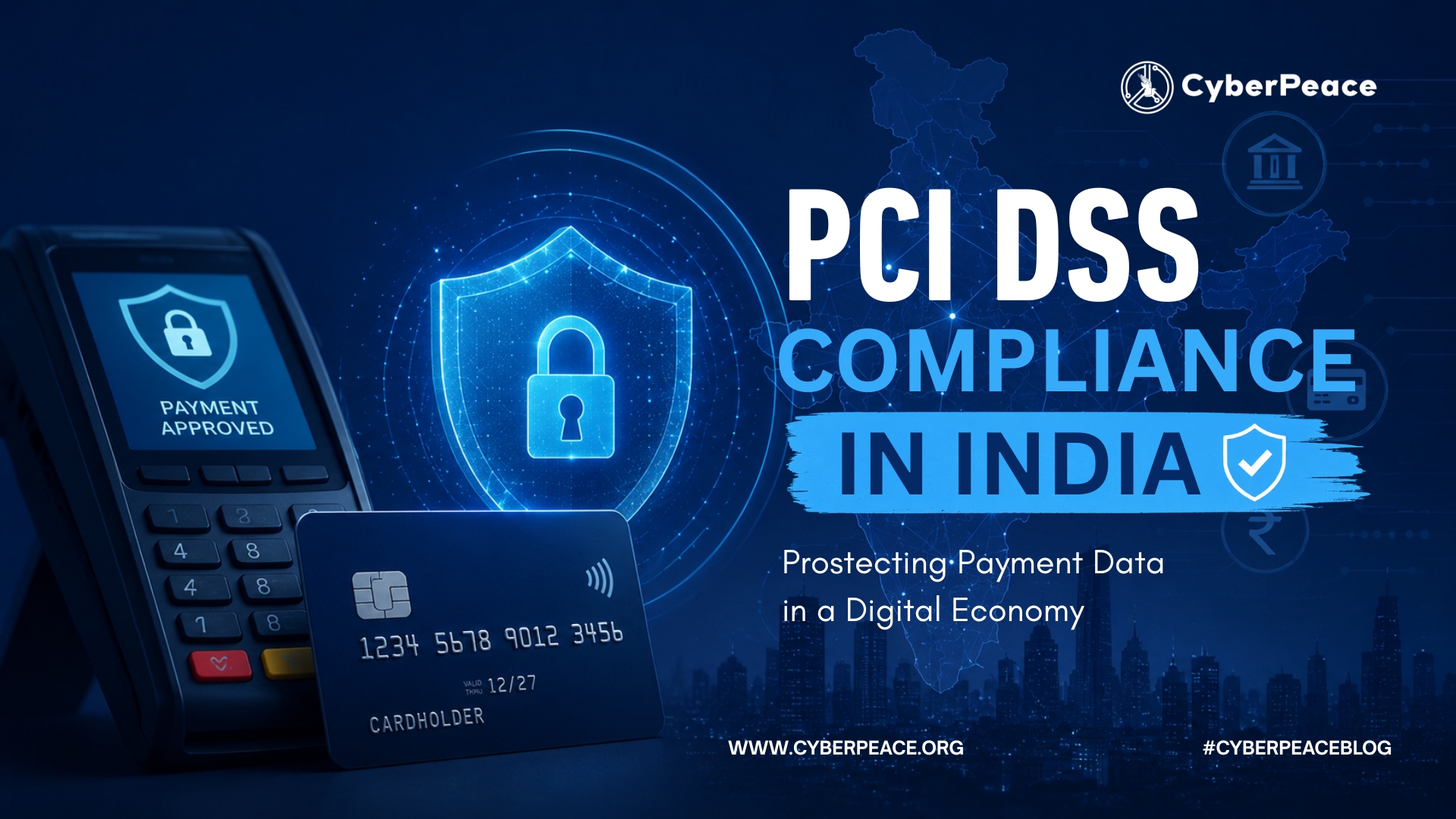
India is becoming more digital. People are using cards and phones to pay for things. This means there is a risk of people stealing card information and committing fraud. The Payment Card Industry Data Security Standard or PCI DSS is a set of rules that helps companies keep card information safe. It was created by the PCI Security Standards Council, which was started by Visa, Mastercard, American Express, Discover and JCB. The goal of PCI DSS is to reduce the risk of data breaches and card fraud by making sure companies have security controls in place. For India, where digital payments are becoming more popular, PCI DSS is becoming a thing to do.
Applicability in India
PCI DSS applies to all companies in India that store, process or transmit card information. This includes banks, payment companies like Razorpay, PayU and CCAvenue and online sellers. Even companies that use a hosted payment page are responsible for following the rules. Companies that have their payment forms and handle card information have to follow more rules.
Why PCI DSS Matters
Payment security is very important for customers to trust a company. If a company has a security breach it can expose a lot of card information. Damage the company's reputation. In India, where cybercrime's a big problem, PCI DSS helps companies keep card information safe. It has rules for firewalls, encryption, access controls and regular testing to prevent fraud.
Regulatory Landscape: The RBIs Role
PCI DSS is not a law in India. The Reserve Bank of India or RBI has made it a requirement. The RBI has rules that require companies to follow PCI DSS and have security audits. Non-bank companies have to get permission from the RBI and follow rules to store payment information in India. This makes PCI DSS a standard for keeping card information safe in India.
Key Requirements and the Compliance Process
The current version of PCI DSS has twelve requirements that companies have to follow. These requirements include building a network protecting card information and regular testing. Companies have to start by identifying what parts of their system handle card information. Then do a gap analysis to see what they need to do to comply. Smaller companies can usually do this in a week but bigger companies may take several months.
Common Challenges and Practical Solutions
Some problems companies face when trying to comply with PCI DSS include old computer systems that cannot handle modern encryption and unclear rules that make it hard to know what to do. Some solutions include separating the card information system from the rest of the network using tokens and encryption to keep card information safe and regularly checking for vulnerabilities.
Business and Regulatory Benefits
Following PCI DSS rules can help companies avoid penalties and have security breaches. It can also make it easier for companies to work with banks and card networks and build trust with customers. Regulators also look favorably on companies that follow the rules.
Recent Developments and Trends
The RBI has been making rules and requiring companies to follow PCI DSS more closely. As digital payments become more popular it is likely that the RBI will keep making rules to keep card information safe.
As India's digital economy grows, keeping payment information safe is becoming more important. PCI DSS is a set of rules that helps companies keep card information safe. The RBI has made it a requirement for companies to follow these rules. Companies that follow the rules can build trust with customers. Avoid security breaches.
Conclusion
As India's digital economy deepens, protecting payment data is no longer optional; it is the price of participating in the card ecosystem. PCI DSS gives banks, fintechs, gateways and merchants a common, internationally recognised language for security, while RBI's guidelines add local regulatory teeth. Organisations that treat compliance as a continuous discipline, rather than a once-a-year audit exercise, will find it easier to earn customer trust, avoid costly breaches, and scale with confidence. For every business touching cardholder data in India, the message is clear: PCI DSS compliance is now foundational to running a secure, trustworthy digital payments operation.
References
- https://www.pcisecuritystandards.org/document_library/
- https://www.rbi.org.in/Scripts/BS_ViewMasDirections.aspx
- https://www.rbi.org.in/Scripts/NotificationUser.aspx
- https://www.rbi.org.in/Scripts/NotificationUser.aspx?Id=11822
- https://www.incorpx.io/blog/pci-dss-compliance-ecommerce-fintech-india
- https://cyraacs.com/pci-dss-compliance-checklist
- https://www.skydo.com/blog/pci-dss-compliance-guide
- https://www.cybercrime.gov.in/

Executive Summary:
A dramatic image circulating online, showing a Boeing 787 of Air India engulfed in flames after crashing into a building in Ahmedabad, is not a genuine photograph from the incident. Our research has confirmed it was created using artificial intelligence.

Claim:
Social media posts and forwarded messages allege that the image shows the actual crash of Air India Flight AI‑171 near Ahmedabad airport on June 12, 2025.

Fact Check:
In our research to validate the authenticity of the viral image, we conducted a reverse image search and analyzed it using AI-detection tools like Hive Moderation. The image showed clear signs of manipulation, distorted details, and inconsistent lighting. Hive Moderation flagged it as “Likely AI-generated”, confirming it was synthetically created and not a real photograph.

In contrast, verified visuals and information about the Air India Flight AI-171 crash have been published by credible news agencies like The Indian Express and Hindustan Times, confirmed by the aviation authorities. Authentic reports include on-ground video footage and official statements, none of which feature the viral image. This confirms that the circulating photo is unrelated to the actual incident.

Conclusion:
The viral photograph is a fabrication, created by AI, not a real depiction of the Ahmedabad crash. It does not represent factual visuals from the tragedy. It’s essential to rely on verified images from credible news agencies and official investigation reports when discussing such sensitive events.
- Claim: An Air India Boeing aircraft crashed into a building near Ahmedabad airport
- Claimed On: Social Media
- Fact Check: False and Misleading

Executive Summary:
A picture about the April 8 solar eclipse, which was authored by AI and was not a real picture of the astronomical event, has been spreading on social media. Despite all the claims of the authenticity of the image, the CyberPeace’s analysis showed that the image was made using Artificial Intelligence image-creation algorithms. The total solar eclipse on April 8 was observable only in those places on the North American continent that were located in the path of totality, whereas a partial visibility in other places was possible. NASA made the eclipse live broadcast for people who were out of the totality path. The spread of false information about rare celestial occurrences, among others, necessitates relying on trustworthy sources like NASA for correct information.
Claims:
An image making the rounds through social networks, looks like the eclipse of the sun of the 8th of April, which makes it look like a real photograph.


Fact Check:
After receiving the news, the first thing we did was to try with Keyword Search to find if NASA had posted any lookalike image related to the viral photo or any celestial events that might have caused this photo to be taken, on their official social media accounts or website. The total eclipse on April 8 was experienced by certain parts of North America that were located in the eclipse pathway. A part of the sky above Mazatlan, Mexico, was the first to witness it. Partial eclipse was also visible for those who were not in the path of totality.
Next, we ran the image through the AI Image detection tool by Hive moderation, which found it to be 99.2% AI-generated.

Following that, we applied another AI Image detection tool called Isitai, and it found the image to be 96.16% AI-generated.

With the help of AI detection tools, we came to the conclusion that the claims made by different social media users are fake and misleading. The viral image is AI-generated and not a real photograph.
Conclusion:
Hence, it is a generated image by AI that has been circulated on the internet as a real eclipse photo on April 8. In spite of some debatable claims to the contrary, the study showed that the photo was created using an artificial intelligence algorithm. The total eclipse was not visible everywhere in North America, but rather only in a certain part along the eclipse path, with partial visibility elsewhere. Through AI detection tools, we were able to establish a definite fact that the image is fake. It is very important, when you are talking about rare celestial phenomena, to use the information that is provided by the trusted sources like NASA for the accurate reason.
- Claim: A viral image of a solar eclipse claiming to be a real photograph of the celestial event on April 08
- Claimed on: X, Facebook, Instagram, website
- Fact Check: Fake & Misleading
