
#FactCheck-AI-Generated Video Falsely Shared as Venezuela Earthquake Footage
Executive Summary
Two powerful earthquakes measuring 7.2 and 7.5 in magnitude struck Venezuela on June 24, 2026, within a span of one minute, causing widespread destruction. Hundreds of buildings were reportedly reduced to rubble. Against this backdrop, a video is being widely shared on social media showing two high-rise buildings colliding with each other before collapsing. Several users have claimed that the footage shows the aftermath of the recent earthquake in Venezuela. CyberPeace Research Wing team conducted a detailed research and found that the viral video is not authentic. The footage was generated using artificial intelligence and is being falsely shared as real visuals from the Venezuela earthquake.
Claim
A Facebook user, “Rana Yashwant,” shared the video on June 26, 2026, with the caption: "Venezuela: The high-rise buildings fell as if they were fast-moving train coaches. How long could they withstand such a powerful earthquake? Both collapsed face-first. What happened to the people? Who knows." https://www.facebook.com/reel/1036186612182534 ,https://perma.cc/98PE-DFKB

Fact Check
We first extracted several keyframes from the viral video and conducted reverse image searches using Google Lens. However, we found no credible news reports or evidence linking the footage to the recent earthquakes in Venezuela. A closer examination of the video revealed several anomalies. Despite the intense shaking and collision of the buildings, the windows and structural features remained unchanged throughout the footage. No visible deformation or damage appeared in the buildings before they collapsed, which is highly unrealistic and raised suspicions that the video had been generated using AI. To verify this, we analyzed the video using the AI detection tool detectvideo.ai. The results indicated a 73 percent probability that the footage was AI-generated.

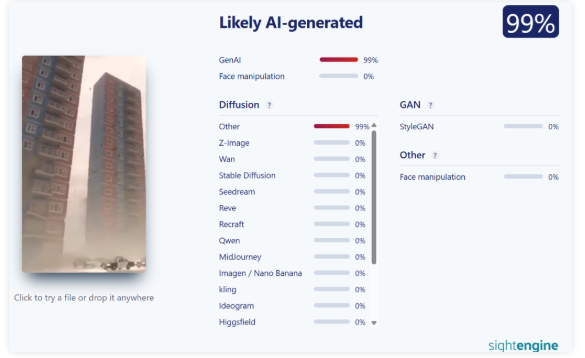
Similarly, analysis conducted using Sightengine found a 99 percent probability that the video had been created using artificial intelligence.
Conclusion
Our research found the viral claim to be false. The video showing two buildings colliding and collapsing is not related to the recent earthquakes in Venezuela. The footage was generated using artificial intelligence and is being misleadingly shared as real disaster footage.

Related Blogs

Introduction
For two decades, cybercrime enforcement was built around a simple assumption: criminals hide behind screens, but they still operate mostly within reachable borders. That assumption has collapsed. Today's fraud economy runs through industrial-scale scam compounds in Myanmar and Cambodia, laundering networks spanning a dozen jurisdictions, and trafficked labour forced to defraud victims thousands of miles away. INTERPOL's own trend reporting has tracked victims from more than 60 countries pulled into scam operations that now stretch well beyond Southeast Asia into Africa, the Gulf, and Latin America. Global losses from this activity are estimated in the hundreds of billions of dollars annually, and the networks rebuild faster than any single government can dismantle them.
A Threat That Outran the Old Playbook
The mismatch is the real story behind a wave of policy moves in 2025 and 2026. The August 12, 2026 U.S. National Security Presidential Memorandum authorising vetted private companies to conduct government-supervised offensive cyber operations against transnational criminal organisations is one data point in that wave, not the whole story. Washington's move sits alongside a broader, still-unfinished experiment: can the international system build cooperative machinery fast enough to match a threat that treats borders as an inconvenience rather than a barrier?
Three Tracks of International Response
Three distinct but overlapping tracks have emerged.
The treaty: The most consequential recent development is the UN Convention against Cybercrime, adopted by the General Assembly in December 2024 and opened for signature in Hanoi in October 2025, where 71 states and the EU signed on. It is the first comprehensive global treaty addressing cybercrime and cross-border evidence sharing, building on the older Budapest Convention framework that has anchored cooperation since 2004. The Hanoi Convention needs 40 ratifications to enter into force; as of mid-2026, only three states (Qatar, Azerbaijan, and Vietnam) had ratified it, and human rights groups continue to warn that its broad scope could be used by authoritarian governments to justify surveillance and cross-border data requests dressed up as cybercrime cooperation. The treaty's fate will hinge on a Conference of States Parties process now being negotiated, where democracies are pushing for genuine multi-stakeholder oversight rather than a rubber stamp.
The operational track: While treaty diplomacy moves slowly, police-to-police cooperation has scaled up dramatically. INTERPOL's Operation First Light, now an annual standing initiative, illustrates the trajectory: its 2026 iteration spanned January to April, generated over 5,800 arrests and roughly $293 million in intercepted funds, and made heavy use of the Global Rapid Intervention of Payments mechanism to freeze illicit transfers before they disappeared into crypto wallets. A parallel operation led by Dubai Police with the FBI and Chinese authorities dismantled nine pig-butchering compounds across Myanmar, Indonesia, Cambodia, and Thailand, seizing more than $701 million. In Europe, Europol's EMPACT framework has entered a new 2026–2029 cycle, deepening ties with Frontex, Eurojust, and regional partners like Ameripol and the EL PACTTO programme in Latin America, effectively building a lattice of standing coordination bodies rather than one-off task forces. These operations demonstrate real capacity, but they also expose the "whack-a-mole" problem: raided compounds in Myanmar's Myawaddy region simply relocated, reconnected via satellite internet, and resumed operations within weeks, according to regional reporting.
The public-private track: This is where the U.S. memorandum fits into a genuinely global pattern rather than standing alone. The United Kingdom's 2026–2029 Fraud Strategy centres on a £31 million Online Crime Centre, opening in 2026, that fuses data from the National Crime Agency, the intelligence community, and private partners across banking, telecoms, and technology into a single coordination hub building on existing arrangements like Stop Scams UK, where telecom operators and banks already share suspicious SIM and account data in near real time. In the U.S., a June 2026 joint action involving the Justice Department, Meta, Microsoft, Google, Apple, and Coinbase froze $3.8 billion in cryptocurrency and disrupted 1.4 million fraud-linked accounts, showing that platform cooperation can move faster than formal treaty processes. Singapore has positioned itself as a hub for this model too, anchoring the Global Anti-Scam Alliance, which now includes ASEAN's own foundation as a member, bringing governments, banks, and tech platforms into shared intelligence loops. What distinguishes the U.S. memorandum is that it goes a step further than data-sharing: it authorises companies to take disruptive technical action, not just contribute intelligence, under a legal theory that folds them into the government's own authority under the Computer Fraud and Abuse Act's law-enforcement exception.
Where the System Still Breaks Down
Despite this activity, structural gaps, like jurisdiction, are the deepest ones. Scam compounds deliberately locate in special economic zones and border regions precisely because territorial control there is contested or weak, leaving no single government with clean authority to act. ASEAN's own policy work acknowledges that nearly every stage of the regional scam value chain crosses at least one border, which is why the bloc has shifted toward standing coordination bodies like its Working Group on Anti-Online Scams rather than relying on bilateral requests.
Attribution and accountability lag behind operational tempo. Financial intelligence and blockchain analytics have improved enforcement precision, but identifying the human traffickers and financiers sitting above front-line scam operators remains slow, uneven, and dependent on political will in host countries.
Governance of the newer public-private authorities is also unsettled. Human rights advocates flag that expanding both the Hanoi Convention's surveillance-adjacent powers and unilateral hack-back authorities like the U.S. memorandum could, without careful oversight, blur the line between fighting organised fraud and enabling broader digital overreach. The U.S. memorandum's own guardrails, which are a ban on operations causing serious injury or rising to a use of force, mandatory federal sign-off, and a $1 million forfeitable bond, reflect an awareness of that risk, but its implementing procedures remain classified, and comparable transparency gaps exist in several other national programs.
The Emerging Consensus
What's notable is not any single instrument but the convergence: nearly every serious national or regional response now combines the same three ingredients deeper platform and financial-sector data sharing, standing multilateral operational coordination, and a cautious expansion of what non-state actors are permitted to do. The countries and blocs making the fastest progress, from the UK's Online Crime Centre to INTERPOL's payment-interdiction tools to ASEAN's regional information-sharing arrangement, are the ones treating cyber-enabled transnational crime as a persistent infrastructure problem rather than a series of discrete crimes to be prosecuted after the fact. Whether that convergence produces durable results or simply better-coordinated whack-a-mole will depend on the unglamorous work still ahead: ratifying treaties, writing classified rulebooks, and building the cross-border trust that lets financial and technical data move as fast as the criminals do.
Conclusion
Transnational cybercrime has outgrown fragmented national enforcement. The emerging combination of international treaties, operational cooperation, and public-private partnerships offers a stronger response, but serious gaps in jurisdiction, accountability, and oversight remain. Ultimately, success will depend on whether states can build cooperation and safeguards capable of matching criminals’ speed, adaptability, and global reach.
Sources
- Presidential Memorandum: Expanding Capabilities to Combat Transnational Cyber-Enabled Crime — The White House
- United Nations Convention against Cybercrime — UNODC
- The Promise and Peril of the U.N. Convention Against Cybercrime — Just Security
- Moving Forward with the United Nations Convention against Cybercrime — ICCLR
- Growing threat of transnational scam centres highlighted at INTERPOL General Assembly
- Over 5,800 arrests, USD 293 million intercepted in global fraud bust — INTERPOL
- Operation First Light 2026: 276 Arrested, $701M Seized — Breached.Company
Executive Summary:
A purported media release allegedly issued in the name of the International Cricket Council (ICC) is being widely circulated on social media. The release claims that the ICC has decided to impose a one-year ban on Pakistan cricket. CyberPeace’s research found this claim to be false.The research revealed that the media release circulating on social media is fake, and no such letter or official statement has been issued by the ICC.
Claim:
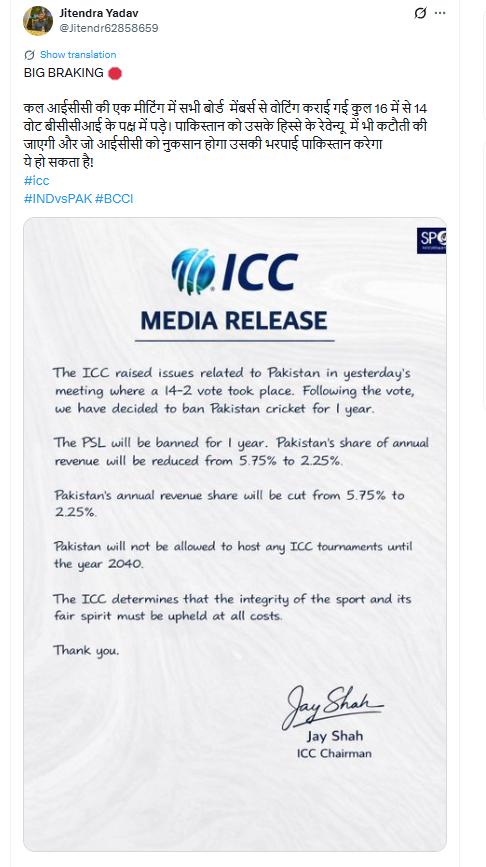
On social media platform X (formerly Twitter), a user shared the viral letter on February 3, 2026, claiming that an ICC meeting was held in which board members voted on issues related to Pakistan. The post alleged that 14 out of 16 votes were cast in favour of the BCCI. The user further claimed that Pakistan’s share of ICC revenue would be reduced and that Pakistan might be asked to compensate for losses incurred by the ICC.
The viral letter, written in English, stated that matters related to Pakistan were discussed in an ICC meeting and that a 14–2 majority vote led to the decision to impose a one-year ban on Pakistan cricket. It further claimed that the Pakistan Super League (PSL) would be suspended for one year, Pakistan’s annual revenue share would be reduced from 5.75 percent to 2.25 percent, and Pakistan would not be allowed to host any ICC tournaments until 2040. The letter also claimed that these decisions were taken to safeguard the integrity and spirit of the game. Links to the viral post, archive link, and screenshots can be seen below.
Fact Check:
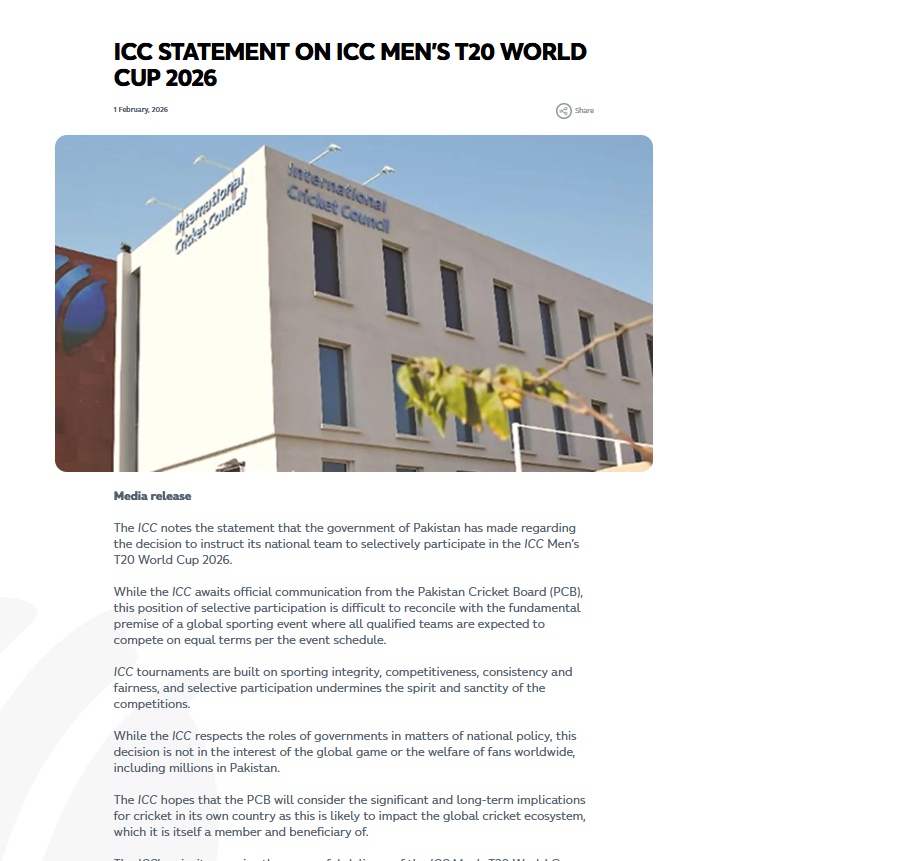
To verify the viral claim, CyberPeace conducted a Google search using relevant keywords. However, no credible or reliable media reports supporting the claim were found. In the next step of the research , an official press release uploaded on DD Sports’ Facebook page on February 2, 2026, was found. The press release responded to Pakistan’s decision not to play against India in a Group A match. The DD Sports statement said that the Pakistan Cricket Board should consider the long-term and serious implications of such a decision, as it could impact the global cricket ecosystem—of which Pakistan is itself a member and beneficiary.
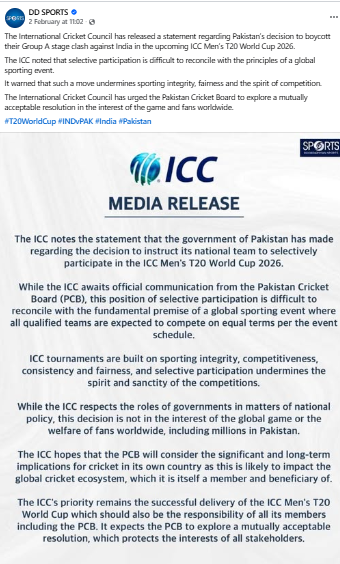
Notably, the official press release made no mention of any ban on Pakistan cricket, reduction in revenue share, suspension of the PSL, or restrictions on hosting ICC tournaments, contrary to the claims made in the viral letter. Further, the same official statement was found published on the ICC’s website on February 1, 2026. This release also did not mention any decision related to banning Pakistan cricket or barring the country from hosting ICC tournaments for the next 40 years.
Conclusion
CyberPeace concludes that the media release circulating on social media is fake. The ICC has not issued any official letter or statement announcing a one-year ban on Pakistan cricket, revenue cuts, or restrictions on hosting ICC tournaments.

Executive Summary:
A video circulating online claims to show a man being assaulted by BSF personnel in India for selling Bangladesh flags at a football stadium. The footage has stirred strong reactions and cross border concerns. However, our research confirms that the video is neither recent nor related to the incident that occurred in India. The content has been wrongly framed and shared with misleading claims, misrepresenting the actual incident.
Claim:
It is being claimed through a viral post on social media that a Border Security Force (BSF) soldier physically attacked a man in India for allegedly selling the national flag of Bangladesh in West Bengal. The viral video further implies that the incident reflects political hostility towards Bangladesh within Indian territory.

Fact Check:
After conducting thorough research, including visual verification, reverse image searching, and confirming elements in the video background, we determined that the video was filmed outside of Bangabandhu National Stadium in Dhaka, Bangladesh, during the crowd buildup prior to the AFC Asian Cup. A match featuring Bangladesh against Singapore.

Second layer research confirmed that the man seen being assaulted is a local flag-seller named Hannan. There are eyewitness accounts and local news sources indicating that Bangladeshi Army officials were present to manage the crowd on the day under review. During the crowd control effort a soldier assaulted the vendor with excessive force. The incident created outrage to which the Army responded by identifying the officer responsible and taking disciplinary measures. The victim was reported to have been offered reparations for the misconduct.

Conclusion:
Our research confirms that the viral video does not depict any incident in India. The claim that a BSF officer assaulted a man for selling Bangladesh flags is completely false and misleading. The real incident occurred in Bangladesh, and involved a local army official during a football event crowd-control situation. This case highlights the importance of verifying viral content before sharing, as misinformation can lead to unnecessary panic, tension, and international misunderstanding.
- Claim: Viral video claims BSF personnel thrashing a person selling Bangladesh National Flag in West Bengal
- Claimed On: Social Media
- Fact Check: False and Misleading
