
#FactCheck - AI-Generated Video Falsely Shared as ‘Multi-Hooded Snake’ Sighting in Vrindavan
A video is being widely shared on social media showing devotees seated in a boat appearing stunned as a massive, multi-hooded snake—resembling the mythical Sheshnag—suddenly emerges from the middle of a water body.
The video captures visible panic and astonishment among the devotees. Social media users are sharing the clip claiming that it is from Vrindavan, with some portraying the sight as a divine or supernatural event. However, research conducted by the Cyber Peace Foundation found the viral claim to be false. Our research revealed that the video is not authentic and has been generated using artificial intelligence (AI).
Claim
On January 17, 2026, a user shared the viral video on Instagram with the caption suggesting that God had appeared again in the age of Kalyug. The post claims that a terrifying video from Vrindavan has surfaced in which devotees sitting in a boat were shocked to see a massive multi-hooded snake emerge from the water. The caption further states that devotees are hailing the creature as an incarnation of Sheshnag or Vasuki Nag, raising religious slogans and questioning whether the sight represents a divine sign. (The link to the post, its archive link, and screenshots are available.)
- https://www.instagram.com/reel/DTngN9FkoX0/?igsh=MTZvdTN1enI2NnFydA%3D%3D
- https://archive.ph/UuAqB
Fact Check:
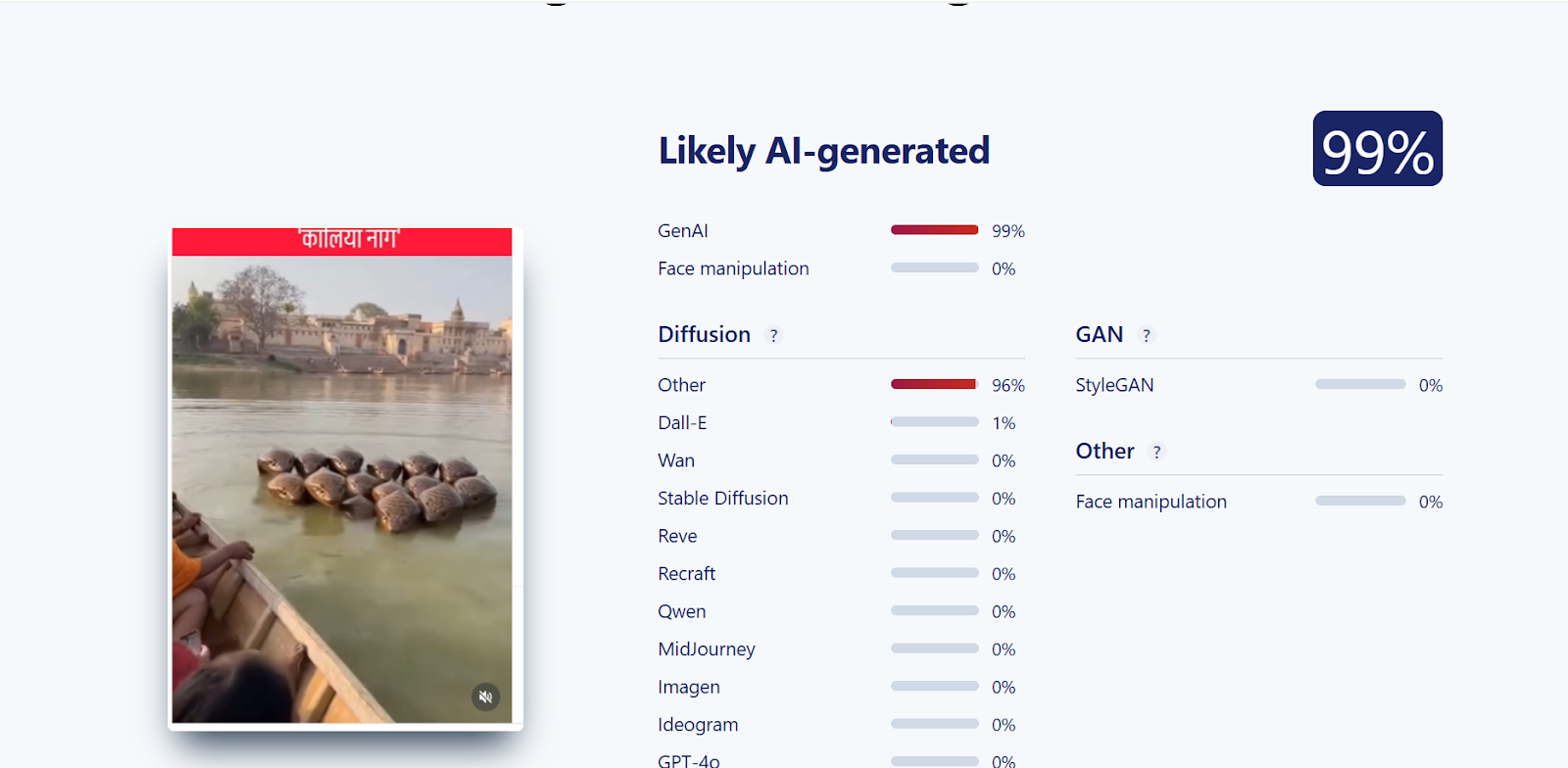
Upon closely examining the viral video, we suspected that it might be AI-generated. To verify this, the video was scanned using the AI detection tool SIGHTENGINE, which indicated that the visual is 99 per cent AI-generated.
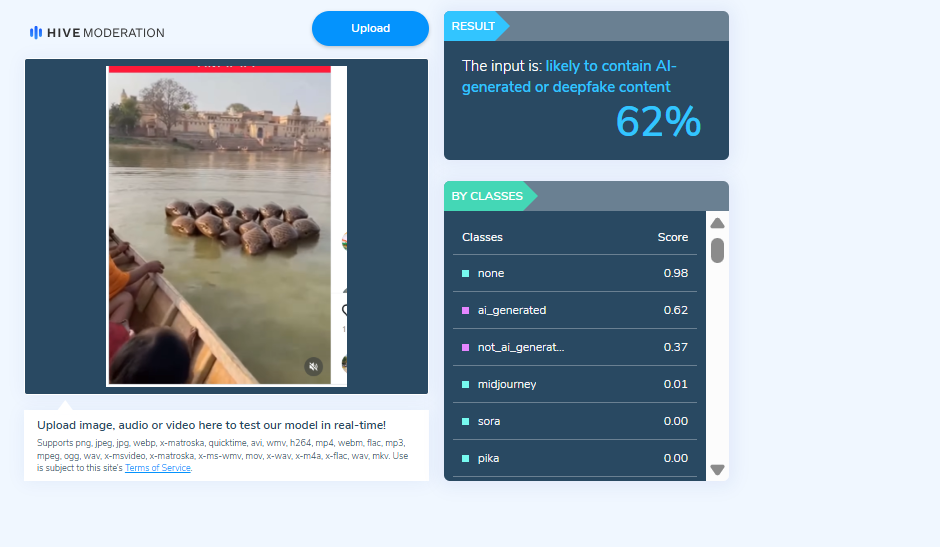
In the next step of the research , the video was analysed using another AI detection tool, HIVE Moderation. According to the results obtained, the video was found to be 62 per cent AI-generated.
Conclusion
Our research clearly establishes that the viral video claiming to show a multi-hooded snake in Vrindavan is not real. The clip has been created using artificial intelligence and is being falsely shared on social media with religious and sensational claims.

Related Blogs

Introduction
With the ever-growing technology where cyber-crimes are increasing, a new cyber-attack is on the rise, but it’s not in your inbox or your computer- it's targeting your phone, especially your smartphone. Cybercriminals are expanding their reach in India, with a new text-messaging fraud targeting individuals. The Indian Computer Emergency Response Team (CERT-In) has warned against "smishing," or SMS phishing.
Understanding Smishing
Smishing is a combination of the terms "SMS" and "phishing." It entails sending false text messages that appear to be from reputable sources such as banks, government organizations, or well-known companies. These communications frequently generate a feeling of urgency in their readers, prompting them to click on harmful links, expose personal information, or conduct financial transactions.
When hackers "phish," they send out phony emails in the hopes of tricking the receiver into clicking on a dangerous link. Smishing is just the use of text messaging rather than email. In essence, these hackers are out to steal your personal information to commit fraud or other cybercrimes. This generally entails stealing money – usually your own, but occasionally also the money of your firm.
The cybercriminals typically use these tactics to lure victims and steal the information.
Malware- The cyber crooks send the smishing URL link that might tick you into downloading malicious software on your phone itself. This SMS malware may appear as legitimate software, deceiving you into putting in sensitive information and transmitting it to crooks.
Malicious website- The URL in the smishing message may direct you to a bogus website that seeks sensitive personal information. Cybercriminals employ custom-made rogue sites meant to seem like legitimate ones, making it simpler to steal your information.
Smishing text messages often appear to be from your bank, asking you to share personal sensitive information, ATM numbers, or account details. Mobile device cybercrime is increasing, as is mobile device usage. Aside from the fact that texting is the most prevalent usage of cell phones, a few additional aspects make this an especially pernicious security issue. Let's go over how smishing attacks operate.
Modus Operandi
The cyber crooks commit the fraud via SMS. As attackers assume an identity that might be of someone trusted, Smishing attackers can use social engineering techniques to sway a victim's decision-making. Three things are causing this deception:
- Trust- Cyber crooks target individuals, by posing to someone from a legitimate individual and organization, this naturally lowers a person’s defense against threats.
- Context- Using a circumstance that might be relevant to targets helps an attacker to create an effective disguise. The message feels personalized, which helps it overcome any assumption that it is spam.
- Emotion- The nature of the SMS is critical; it makes the victim think that is urgent and requires rapid action. Using these tactics, attackers craft communications that compel the receiver to act.
- Typically, attackers want the victim to click on a URL link within the text message, which takes them to a phishing tool that asks them for sensitive information. This phishing tool is frequently in the form of a website or app that also assumes a phony identity.
How does Smishing Spread?
As we have revealed earlier smishing attacks are delivered through both traditional texts. However, SMS phishing attacks primarily appear to be from known sources People are less careful while they are on their phones. Many people believe that their cell phones are more secure than their desktops. However, smartphone security has limits and cannot always guard against smishing directly.
Considering the fact phones are the target While Android smartphones dominate the market and are a perfect target for malware text messages, iOS devices are as vulnerable. Although Apple's iOS mobile technology has a high reputation for security, no mobile operating system can protect you from phishing-style assaults on its own. A false feeling of security, regardless of platform, might leave users especially exposed.
Kinds of smishing attacks
Some common types of smishing attacks that occurred are;
- COVID-19 Smishing: The Better Business Bureau observed an increase in reports of US government impersonators sending text messages requesting consumers to take an obligatory COVID-19 test via a connected website in April 2020. The concept of these smishing assaults may readily develop, as feeding on pandemic concerns is a successful technique of victimizing the public.
- Gift Smishing: Give away, shopping rewards, or any number of other free offers, this kind of smishing includes free services or products, from a reputable or other company. attackers plan in such a way that the offer is for a limited time or is an exclusive offer and the offers are so lucrative that one gets excited and falls into the trap.
CERT Guidelines
CERT-In shared some steps to avoid falling victim to smishing.
- Never click on any suspicious link in SMS/social media charts or posts.
- Use online resources to validate shortened URLs.
- Always check the link before clicking.
- Use updated antivirus and antimalware tools.
- If you receive any suspicious message pretending to be from a bank or institution, immediately contact the bank or institution.
- Use a separate email account for personal online transactions.
- Enforce multi-factor authentication (MFA) for emails and bank accounts.
- Keep your operating system and software updated with the latest patches.
Conclusion
Smishing uses fraudulent mobile text messages to trick people into downloading malware, sharing sensitive data, or paying cybercriminals money. With the latest technological developments, it has become really important to stay vigilant in the digital era not only protecting your computers but safeguarding the devices that fit in the palm of your hand, CERT warning plays a vital role in this. Awareness and best practices play a pivotal role in safeguarding yourself from evolving threats.
Reference
- https://www.ndtv.com/india-news/government-warns-of-smishing-attacks-heres-how-to-stay-safe-4709458
- https://zeenews.india.com/technology/govt-warns-citizens-about-smishing-scam-how-to-protect-against-this-online-threat-2654285.html
- https://www.the420.in/protect-against-smishing-scams-cert-in-advice-online-safety/

Executive Summary:
A video gone viral on Facebook claims Union Finance Minister Nirmala Sitharaman endorsed the government’s new investment project. The video has been widely shared. However, our research indicates that the video has been AI altered and is being used to spread misinformation.

Claim:
The claim in this video suggests that Finance Minister Nirmala Sitharaman is endorsing an automotive system that promises daily earnings of ₹15,00,000 with an initial investment of ₹21,000.
Fact Check:
To check the genuineness of the claim, we used the keyword search for “Nirmala Sitharaman investment program” but we haven’t found any investment related scheme. We observed that the lip movements appeared unnatural and did not align perfectly with the speech, leading us to suspect that the video may have been AI-manipulated.
When we reverse searched the video which led us to this DD News live-stream of Sitharaman’s press conference after presenting the Union Budget on February 1, 2025. Sitharaman never mentioned any investment or trading platform during the press conference, showing that the viral video was digitally altered. Technical analysis using Hive moderator further found that the viral clip is Manipulated by voice cloning.

Conclusion:
The viral video on social media shows Union Finance Minister Nirmala Sitharaman endorsing the government’s new investment project as completely voice cloned, manipulated and false. This highlights the risk of online manipulation, making it crucial to verify news with credible sources before sharing it. With the growing risk of AI-generated misinformation, promoting media literacy is essential in the fight against false information.
- Claim: Fake video falsely claims FM Nirmala Sitharaman endorsed an investment scheme.
- Claimed On: Social Media
- Fact Check: False and Misleading

Introduction
The European Union has fined the meta $ 1.3 billion for infringing the EU privacy laws by transferring the personal data of Facebook users to the United States. The EU fined Meta’s business in Ireland. As per the European Union, transferring Personal data to the US is a breach of the General data protection Regulation or European Union law on data protection and privacy.
GDPR Compliance
The terms of GDPR promise to gather users’ personal information legally and under strict conditions. And those who collect and manage personal data must protect users’ personal data from exploitation. The GDPR restricts an organisation’s capacity to transfer personal data outside the EU if the transfer is solely based on that body’s evaluation of the sufficiency of the personal data’s protection. Transfers should only be made where European authorities have determined that a third country, a territory within that third country, or an international organisation provides acceptable protection for data protection.
Violation by Meta
The punishment, announced by Ireland’s Data Protection Commission, might be one of the most significant in the five years since the European Union passed the landmark General Data Protection Regulation. According to regulators, Facebook failed to comply with a 2020 judgment by the European Union’s top court that Facebook data transferred over the Atlantic was not sufficiently safeguarded from American espionage agencies. However, whether Meta will ever need to encrypt Facebook users’ data in Europe is still being determined. Meta announced it would appeal the ruling, launching a potentially legal procedure.
Simultaneously, European Union and American officials are negotiating a new data-sharing pact that would provide legal protections for Meta and scores of other companies to continue moving information between the US and Europe. This pact could overturn much of the European Union’s Monday ruling.
Article 46(1) GDPR Has been violated by the meta, And as per the Irish privacy.
What is required by the GDPR before transferring personal information across national boundaries?

Personal data transfers to countries outside the European Economic Area are generally permitted if these nations are regarded to provide a sufficient degree of data protection. According to Article 45 of the GDPR, the European Commission evaluates the degree of personal data protection in third countries.
The European Union judgment demonstrates how government rules are upending the borderless way data has traditionally migrated. Companies are increasingly being pressed to store data within the country where it is acquired rather than allowing it to transfer freely to data centres around the world as a result of data-protection requirements, national security laws, and other regulations.
The US internet giant had previously warned that if forced to stop using SCCs (standard contractual clauses) without a proper alternative data transfer agreement in place, it would be compelled to shut down services such as Facebook and Instagram in Europe.
What will happen next for Facebook in Europe?
The ruling includes a six-month transition period before it must halt data flows, meaning the service will continue to operate in the meantime. (More specifically, Meta has been given a five-month transition period to freeze any future transfer of personal data to the United States and a six-month deadline to terminate the unlawful processing and/or storage of European user data it has previously transferred without a legitimate legal basis. Meta has also stated that it will appeal and appears to seek a stay of execution while it pursues its legal arguments in court.
Conclusion
The GDPR places restrictions on transferring personal data outside the European Union to third-party nations or international bodies to ensure that the GDPR’s level of protection for individuals is not jeopardised. But the meta violated the European Union’s privacy laws by the user’s personal information to the US. Under the compliance of GDPR, transferring and sending personal information to users intentionally is an offence. and presently, the personal data of Facebook users has been breached by the Meta, as they shared the information with the US.
