
#FactCheck - Viral Clip Claiming PM Modi Pushed BJP President Nitin Nabin Is Misleading
Executive Summary:
A video clip featuring Prime Minister Narendra Modi and the newly elected Bharatiya Janata Party (BJP) national president, Nitin Nabin, is going viral on social media. In the clip, PM Modi is seen apparently pushing Nitin Nabin, prompting claims that Nabin had accidentally stepped between the Prime Minister and the camera, after which Modi allegedly pushed him out of the frame. CyberPeace’s research found that the viral clip is misleading and cropped. The original, unedited video shows Prime Minister Modi gesturing for Nitin Nabin to move ahead and offer floral tributes to the statues of Bharatiya Jana Sangh founder Syama Prasad Mukherjee and Pandit Deendayal Upadhyaya at the BJP headquarters in Delhi. It is pertinent to note that on 20 January 2026, BJP leader Nitin Nabin was elected as the party’s national president. Several senior BJP leaders, including Prime Minister Narendra Modi, were present at the event. During his address, PM Modi remarked, “Nitin Nabin ji is my boss, and I am a party worker.” The statement received widespread attention, following which multiple videos linking to the remark began circulating on social media. A Facebook user shared the viral clip with a Hindi caption alleging that despite calling himself a “party worker,” PM Modi pushed his “boss” out of the camera frame. The post further mocked the position of BJP president, claiming it to be merely ceremonial. (Archived link)
To verify the claim, we conducted a reverse image and video search, which led us to a longer version of the video uploaded on news agency INS’s official X handle on 20 January 2026. The caption stated that PM Modi, BJP president Nitin Nabin, Defence Minister Rajnath Singh, Home Minister Amit Shah, Union Minister Nitin Gadkari and senior leader J.P. Nadda paid tributes to Syama Prasad Mukherjee and Pandit Deendayal Upadhyaya at the BJP headquarters.
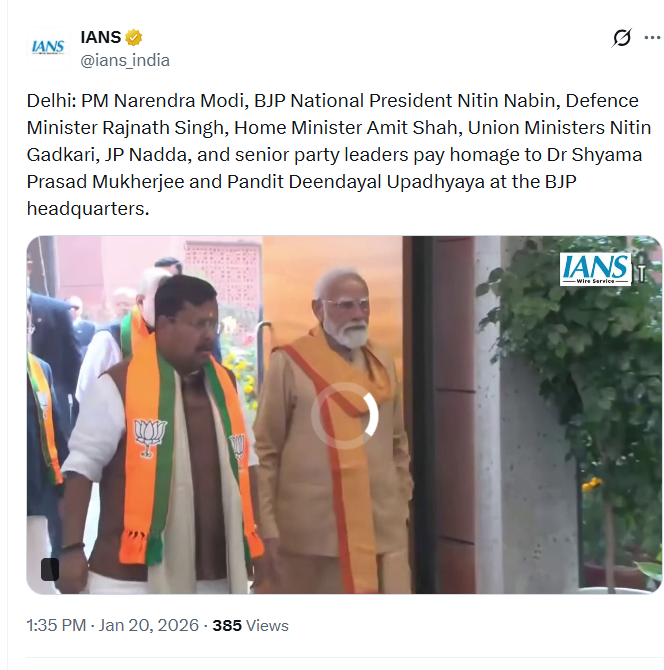
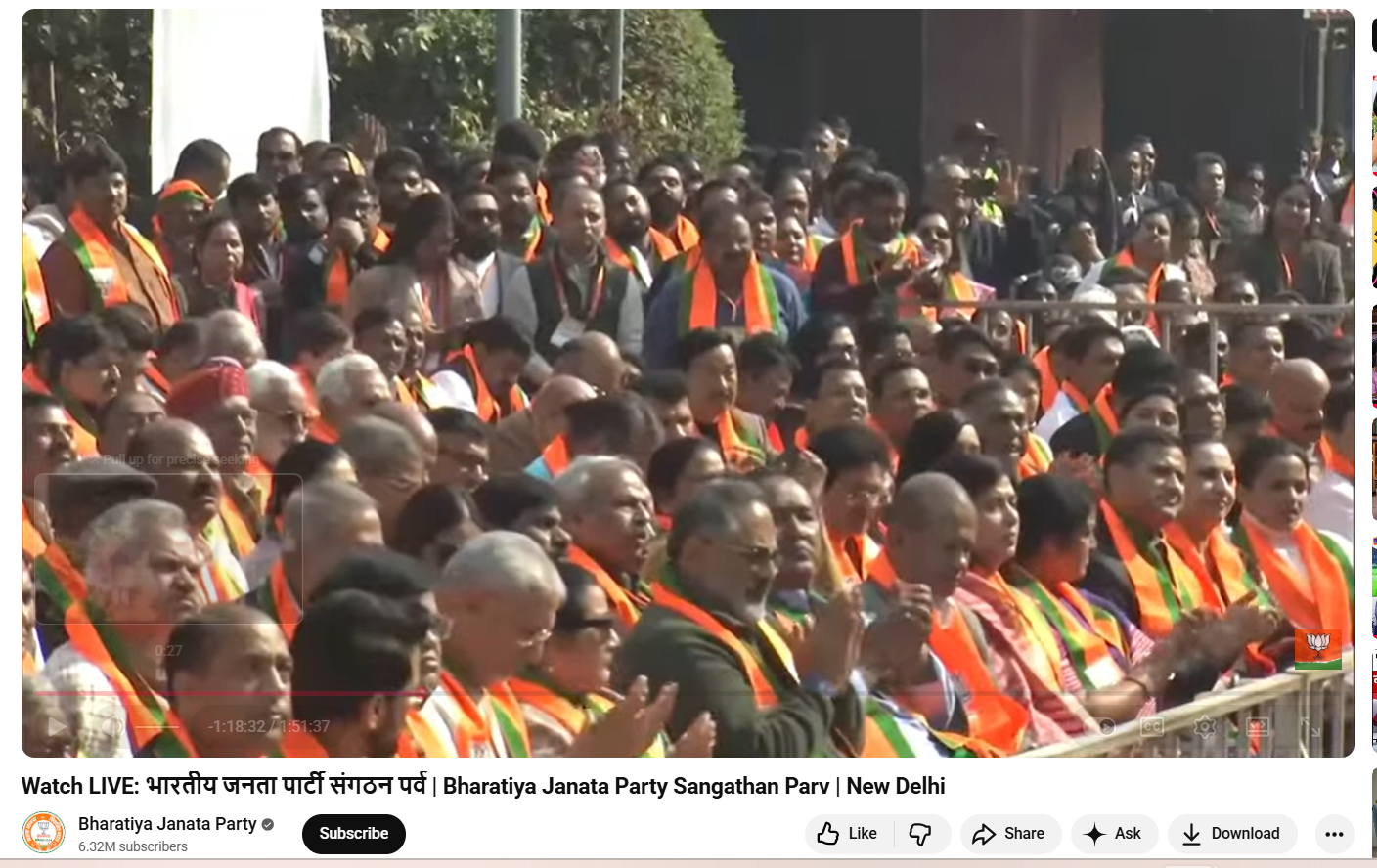
In the full video, PM Modi and Nitin Nabin are seen walking together. PM Modi then requests Nitin Nabin to proceed first for the floral tribute, placing his hand on Nabin’s back as a gesture to move forward. The viral clip selectively cuts this moment out of context and loops it to create a misleading impression. The complete footage clearly shows that PM Modi asked Nitin Nabin to offer tributes first, after which other leaders followed. There is no indication whatsoever that Nitin Nabin was pushed out of the camera frame, as claimed in the viral posts. We also found the live broadcast of the ‘Bharatiya Janata Party Sangathan Parv’ on BJP’s official YouTube channel. The same visuals appear at the end of the live stream, further confirming that PM Modi was merely gesturing for Nitin Nabin to proceed first.
Additionally, photographs available on Nitin Nabin’s official X handle show him offering floral tributes ahead of PM Modi, who is seen standing behind and waiting.
Conclusion:
CyberPeace research confirms that the viral clip has been cropped and shared with a false narrative. In the original context, Prime Minister Narendra Modi was respectfully inviting BJP national president Nitin Nabin to move ahead and pay tributes, not pushing him out of the camera frame.

Related Blogs

Executive Summary:
A viral video circulating on social media platforms, claimed to show the final moments of an Air India flight carrying passengers inside the cabin just before it crashed near Ahmedabad on June 12, 2025, is false. However, upon further research, the footage was found to originate from the Yeti Airlines Flight 691 crash that occurred in Pokhara, Nepal, on January 15, 2023. For all details, please follow the report.

Claim:
Viral videos circulating on social media claiming to show the final moments inside Air India flight AI‑171 before it crashed near Ahmedabad on June 12, 2025. The footage appears to have been recorded by a passenger during the flight and is being shared as real-time visuals from the recent tragedy. Many users have believed the clip to be genuine and linked it directly to the Air India incident.


Fact Check:
To confirm the validity of the video going viral depicting the alleged final moments of Air India's AI-171 that crashed near Ahmedabad on 12 June 2025, we engaged in a comprehensive reverse image search and keyframe analysis then we got to know that the footage occurs back in January 2023, namely Yeti Airlines Flight 691 that crashed in Pokhara, Nepal. The visuals shared in the viral video match up, including cabin and passenger details, identically to the original livestream made by a passenger aboard the Nepal flight, confirming that the video is being reused out of context.

Moreover, well-respected and reliable news organisations, including New York Post and NDTV, have shared reports confirming that the video originated from the 2023 Nepal plane crash and has no relation to the recent Air India incident. The Press Information Bureau (PIB) also released a clarification dismissing the video as disinformation. Reliable reports from the past, visual evidence, and reverse search verification all provide complete agreement in that the viral video is falsely attributed to the AI-171 tragedy.


Conclusion:
The viral footage does not show the AI-171 crash near Ahmedabad on 12 June 2025. It is an irrelevant, previously recorded livestream from the January 2023 Yeti Airlines crash in Pokhara, Nepal, falsely repurposed as breaking news. It’s essential to rely on verified and credible news agencies. Please refer to official investigation reports when discussing such sensitive events.
- Claim: A dramatic clip of passengers inside a crashing plane is being falsely linked to the recent Air India tragedy in Ahmedabad.
- Claimed On: Social Media
- Fact Check: False and Misleading
.webp)
Executive Summary:
Our Team recently came across a post on X (formerly twitter) where a photo widely shared with misleading captions was used about a Hindu Priest performing a vedic prayer at Washington after recent elections. After investigating, we found that it shows a ritual performed by a Hindu priest at a private event in White House to bring an end to the Covid-19 Pandemic. Always verify claims before sharing.

Claim:
An image circulating after Donald Trump’s win in the US election shows Pujari Harish Brahmbhatt at the White House recently.
Fact Check:
The analysis was carried out and found that the video is from an old post that was uploaded in May 2020. By doing a Reverse Image Search we were able to trace the sacred Vedic Shanti Path or peace prayer was recited by a Hindu priest in the Rose Garden of the White House on the occasion of National Day of Prayer Service with other religious leaders to pray for the health, safety and well-being of everyone affected by the coronavirus pandemic during those difficult days, and to bring an end to Covid-19 Pandemic.

Conclusion:
The viral claim mentioning that a Hindu priest performed a Vedic prayer at the White House during Donald Trump’s presidency isn’t true. The photo is actually from a private event in 2020 and provides misleading information.
Before sharing viral posts, take a brief moment to verify the facts. Misinformation spreads quickly and it’s far better to rely on trusted fact-checking sources.
- Claim: Hindu priest held a Vedic prayer at the White House under Trump
- Claimed On:Instagram and X (Formerly Known As Twitter)
- Fact Check: False and Misleading
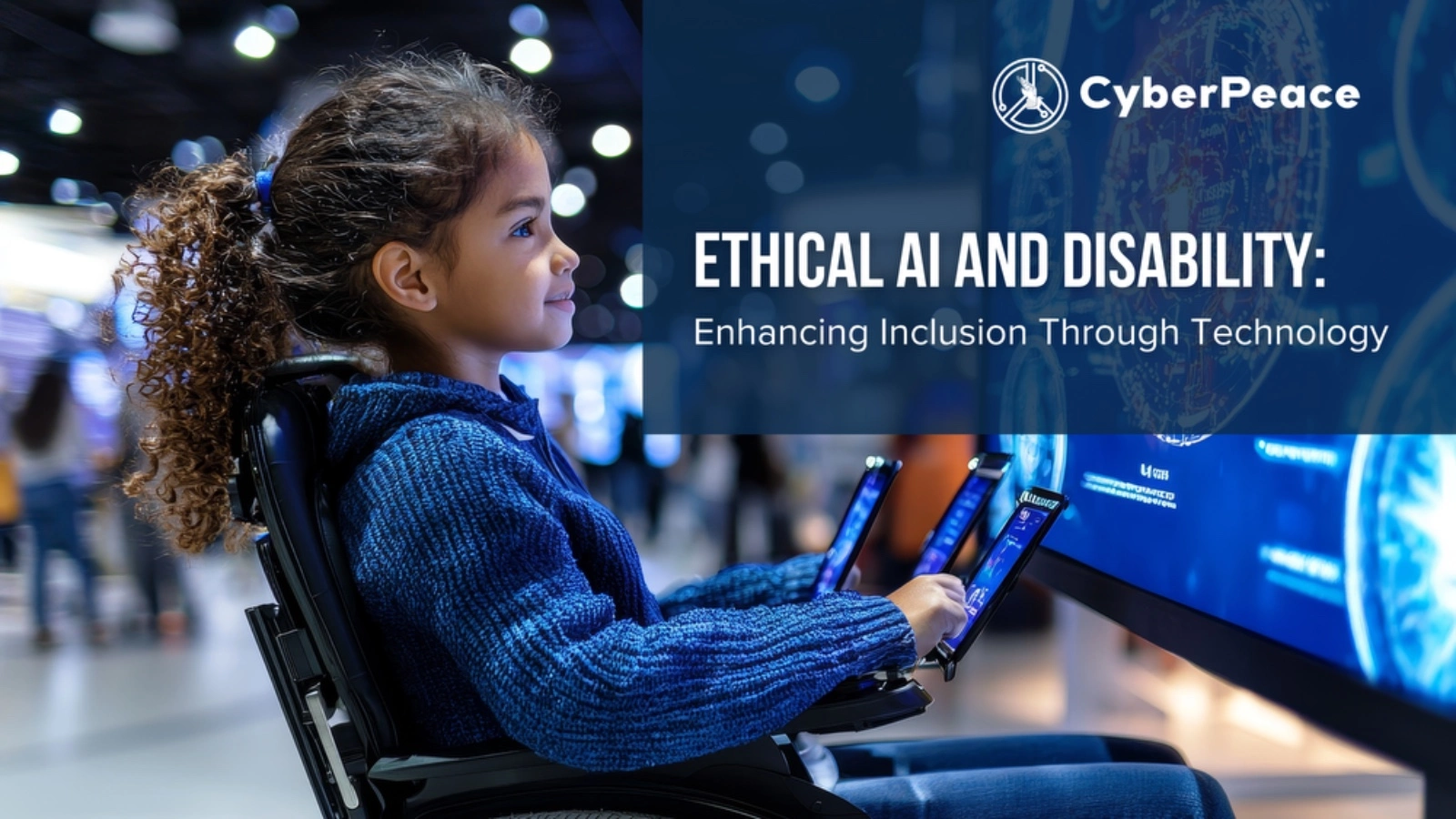
AI systems have grown in both popularity and complexity on which they operate. They are enhancing accessibility for all, including people with disabilities, by revolutionising sectors including healthcare, education, and public services. We are at the stage where AI-powered solutions that can help people with mental, physical, visual or hearing impairments perform everyday and complex tasks are being created.
Generative AI is now being used to amplify human capability. The development of tools for speech-to-text and image recognition is helping in facilitating communication and interaction for visually or hearing-impaired individuals, and smart prosthetics are providing tailored support. Unfortunately, even with these developments, PWDs have continued to face challenges. Therefore, it is important to balance innovation with ethical considerations aand ensuring that these technologies are designed with qualities like privacy, equity, and inclusivity in mind.
Access to Tech: the Barriers Faced by PWDs
PWDs face several barriers while accessing technology. Identifying these challenges is important as they lack computer accessibility, in the use of hardware and software, which has become a norm in life nowadays. Website functions that only work when users click with a mouse, self-service kiosks without accessibility features, touch screens without screen reader software or tactile keyboards, and out-of-order equipment, such as lifts, captioning mirrors and description headsets, are just some difficulties that they face in their day-to-day life.
While they are helpful, much of the current technology doesn’t fully address all disabilities. For example, many assistive devices focus on visual or mobility impairments, but they fall short of addressing cognitive or sensory conditions. In addition to this, these solutions often lack personalisation, making them less effective for individuals with diverse needs. AI has significant potential to bridge this gap. With adaptive systems like voice assistants, real-time translation, and personalised features, AI can create more inclusive solutions, improving access to both digital and physical spaces for everyone.
The Importance of Inclusive AI Design
Creating an Inclusive AI design is important. It ensures that PWDs are not excluded from technological advancements because of the impairments that they are suffering from. The concept of an ‘inclusive or universal’ design promotes creating products and services that are usable for the widest possible range of people. Tech Developers have an ethical responsibility to create advancements in AI that serve everyone. Accessibility features should be built into the core design. They should be treated as a practice rather than an afterthought. However, bias in AI development often stems from data of a non-representative nature, or assumptions can lead to systems that overlook or poorly serve PWDs. If AI algorithms are trained on limited or biased data, they risk excluding marginalised groups, making ethical, inclusive design a necessity for equity and accessibility.
Regulatory Efforts to Ensure Accessible AI
In India, the Rights of Persons with Disabilities Act of 2016 impresses upon the need to provide PWDs with equal accessibility to technology. Subsequently, the DPDP Act of 2023 highlights data privacy concerns for the disabled under section 9 to process their data.
On the international level, the newly incorporated EU’s AI Act mandates measures for transparent, safe, and fair access to AI systems along with including measures that are related to accessibility.
In the US, the Americans with Disabilities Act of 1990 and Section 508 of the 1998 amendment to the Rehabilitation Act of 1973 are the primary legislations that work on promoting digital accessibility in public services.
Challenges in implementing Regulations for AI Accessibility for PWDs
Defining the term ‘inclusive AI’ is a challenge. When working on implementing regulations and compliance for the accessibility of AI, if the primary work is left undefined, it makes the task of creating tools to address the issue an issue. The rapid pace of tech and AI development has more often outpaced legal frameworks in development. This leads to the creation of enforcement gaps. Countries like Canada and tech industry giants like Microsoft and Google are leading forces behind creating accessible AI innovations. Their regulatory frameworks focus on developing AI ethics with inclusivity and collaboration with disability rights groups.
India’s efforts in creating an inclusive AI include the redesign of the Sugamya Bharat app. The app had been created to assist PWDs and the elderly. It will now be incorporating AI features specifically to assist the intended users.
Though AI development has opportunities for inclusivity, unregulated development can be risky. Regulation plays a critical role in ensuring that AI-driven solutions prioritise inclusivity, fairness, and accessibility, harnessing AI’s potential to empower PWDs and contribute to a more inclusive society.
Conclusion
AI development can offer PWDs unprecedented independence and accessibility in leading their lives. The development of AI while keeping inclusivity and fairness in mind is needed to be prioritised. AI that is free from bias, combined with robust regulatory frameworks, together are essential in ensuring that AI serves equitably. Collaborations between tech developers, policymakers, and disability advocates need to be supported and promoted to build AI systems. This will in turn work towards bridging the accessibility gaps for PWDs. As AI continues to evolve, maintaining a steadfast commitment to inclusivity will be crucial in preventing marginalisation and advancing true technological progress for all.
References
- https://www.business-standard.com/india-news/over-1-4k-accessibility-related-complaints-filed-on-govt-app-75-solved-124090800118_1.html
- https://www.forbes.com/councils/forbesbusinesscouncil/2023/06/16/empowering-individuals-with-disabilities-through-ai-technology/ .
- https://hbr.org/2023/08/designing-generative-ai-to-work-for-people-with-disabilities
- Thehttps://blogs.microsoft.com/on-the-issues/2018/05/07/using-ai-to-empower-people-with-disabilities/andensur,personalization
