
#FactCheck: No, PM Modi Did Not Appear in Royal Attire,Image Is AI-Generated
A photograph showing Prime Minister Narendra Modi holding a trident and dressed in royal attire is being widely shared on social media. Users circulating the image are claiming that it shows PM Modi in a regal outfit.
However, a verification by the Cyber Peace Foundation’s Research Desk has found that the claim is false. The investigation established that the viral image is not authentic and has been generated using Artificial Intelligence (AI).
Claim:
On January 11, 2026, several Instagram users shared the image with captions describing it as a photograph of Prime Minister Modi in royal attire.
Links and archived versions of the posts, along with screenshots, are provided below.

Fact Check:
To verify the claim, relevant keywords such as “PM Modi holding trishul” were searched on Google. This led to a report published by Navbharat Times on January 10, 2025. The report features photographs of Prime Minister Modi holding a trident during his visit to the Somnath Temple. However, in the original images, he is seen wearing normal attire, not royal clothing as shown in the viral image. Link and screenshot

In the next step of the investigation, the original photograph was traced to the official Instagram account of BJP Gujarat, where it was posted on January 11, 2026. The post clearly identifies the image as being from Somnath Temple. Link and screenshot: https://www.instagram.com/p/DTVlb-9Da1V

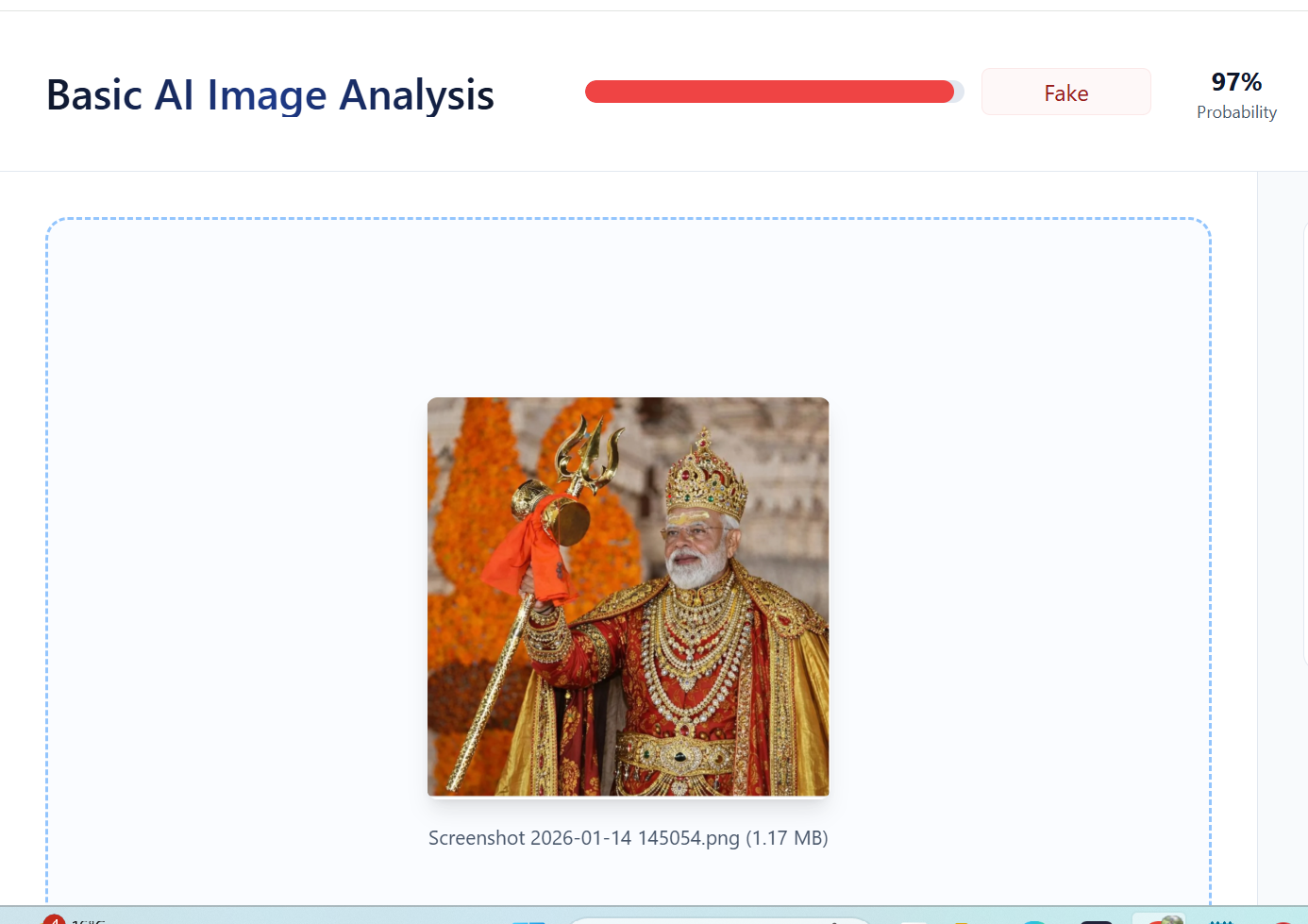
A close examination of the viral image raised suspicion about digital manipulation. The image was then analysed using the AI detection tool TruthScan. The tool’s assessment indicated a 97 percent likelihood that the image was AI-generated.
Further comparison between the viral image and the original photograph revealed that all visual elements match except the clothing, confirming that the attire was digitally altered using AI tools.
Conclusion
The claim that Prime Minister Narendra Modi appeared in royal attire is false. The Cyber Peace Foundation’s research confirms that the viral image was created using AI by altering the clothing in an original photograph taken during PM Modi’s visit to Somnath Temple. The manipulated image was shared online to mislead users.

Related Blogs

Introduction:
This report examines ongoing phishing scams targeting "State Bank of India (SBI)" customers, India's biggest public bank using fake SelfKYC APKs to trick people. The image plays a part in a phishing plan to get users to download bogus APK files by claiming they need to update or confirm their "Know Your Customer (KYC)" info.
Fake Claim:
A picture making the rounds on social media comes with an APK file. It shows a phishing message that says the user's SBI YONO account will stop working because of their "Old PAN card." It then tells the user to install the "WBI APK" APK (Android Application Package) to check documents and keep their account open. This message is fake and aims to get people to download a harmful app.
Key Characteristics of the Scam:
- The messages "URGENTLY REQUIRED" and "Your account will be blocked today" show how scammers try to scare people into acting fast without thinking.
- PAN Card Reference: Crooks often use PAN card verification and KYC updates as a trick because these are normal for Indian bank customers.
- Risky APK Downloads: The message pushes people to get APK files, which can be dangerous. APKs from places other than the Google Play Store often have harmful software.
- Copying the Brand: The message looks a lot like SBI's real words and logos to seem legit.
- Shady Source: You can't find the APK they mention on Google Play or SBI's website, which means you should ignore the app right away.
Modus Operandi:
- Delivery Mechanism: Typically, users of messaging services like "WhatsApp," "SMS," or "email" receive identical messages with an APK link, which is how the scam is distributed.
- APK Installation: The phony APK frequently asks for a lot of rights once it is installed, including access to "SMS," "contacts," "calls," and "banking apps."
- Data Theft: Once installed, the program may have the ability to steal card numbers, personal information, OTPs, and banking credentials.
- Remote Access: These APKs may occasionally allow cybercriminals to remotely take control of the victim's device in order to carry out fraudulent financial activities.
While the user installs the application on their device the following interface opens:


It asks the user to allow the following:
- SMS is used to send and receive info from the bank.
- User details such as Username, Password, Mobile Number, and Captcha.
Technical Findings of the Application:
Static Analysis:
- File Name: SBI SELF KYC_015850.apk
- Package Name: com.mark.dot.comsbione.krishn
- Scan Date: Sept. 25, 2024, 6:45 a.m.
- App Security Score: 52/100 (MEDIUM RISK)
- Grade: B
File Information:
- File Name: SBI SELF KYC_015850.apk
- Size: 2.88MB
- MD5: 55fdb5ff999656ddbfa0284d0707d9ef
- SHA1: 8821ee6475576beb86d271bc15882247f1e83630
- SHA256: 54bab6a7a0b111763c726e161aa8a6eb43d10b76bb1c19728ace50e5afa40448
App Information:
- App Name: SBl Bank
- Package Name:: com.mark.dot.comsbione.krishn
- Main Activity: com.mark.dot.comsbione.krishn.MainActivity
- Target SDK: 34
- Min SDK: 24
- Max SDK:
- Android Version Name:: 1.0
- Android Version Code:: 1
App Components:
- Activities: 8
- Services: 2
- Receivers: 2
- Providers: 1
- Exported Activities: 0
- Exported Services: 1
- Exported Receivers: 2
- Exported Providers:: 0
Certificate Information:
- Binary is signed
- v1 signature: False
- v2 signature: True
- v3 signature: False
- v4 signature: False
- X.509 Subject: CN=PANDEY, OU=PANDEY, O=PANDEY, L=NK, ST=NK, C=91
- Signature Algorithm: rsassa_pkcs1v15
- Valid From: 20240904 07:38:35+00:00
- Valid To: 20490829 07:38:35+00:00
- Issuer: CN=PANDEY, OU=PANDEY, O=PANDEY, L=NK, ST=NK, C=91
- Serial Number: 0x1
- Hash Algorithm: sha256
- md5: 4536ca31b69fb68a34c6440072fca8b5
- sha1: 6f8825341186f39cfb864ba0044c034efb7cb8f4
- sha256: 6bc865a3f1371978e512fa4545850826bc29fa1d79cdedf69723b1e44bf3e23f
- sha512:05254668e1c12a2455c3224ef49a585b599d00796fab91b6f94d0b85ab48ae4b14868dabf16aa609c3b6a4b7ac14c7c8f753111b4291c4f3efa49f4edf41123d
- PublicKey Algorithm: RSA
- Bit Size: 2048
- Fingerprint: a84f890d7dfbf1514fc69313bf99aa8a826bade3927236f447af63fbb18a8ea6
- Found 1 unique certificate
App Permission

1. Normal Permissions
- Access_network_state: Allows the App to View the Network Status of All Networks.
- Foreground_service: Enables Regular Apps to Use Foreground Services.
- Foreground_service_data_sync: Allows Data Synchronization With Foreground Services.
- Internet: Grants Full Internet Access.
2. Signature Permission:
- Broadcast_sms: Sends Sms Received Broadcasts. It Can Be Abused by Malicious Apps to Forge Incoming Sms Messages.
3. Dangerous Permissions:
- Read_phone_numbers: Grants Access to the Device’s Phone Number(S).
- Read_phone_state: Reads the Phone’s State and Identity, Including Phone Features and Data.
- Read_sms: Allows the App to Read Sms or Mms Messages Stored on the Device or Sim Card. Malicious Apps Could Use This to Read Confidential Messages.
- Receive_sms: Enables the App to Receive and Process Sms Messages. Malicious Apps Could Monitor or Delete Messages Without Showing Them to the User.
- Send_sms: Allows the App to Send Sms Messages. Malicious Apps Could Send Messages Without the User’s Confirmation, Potentially Leading to Financial Costs.
On further analysis on virustotal platform using md5 hash file, the following results were retrieved where there are 24 security vendors out of 68, marked this apk file as malicious and the graph represents the distribution of malicious file in the environment.


Key Takeaways:
- Normal Permissions: Generally Safe for Accessing Basic Functionalities (Network State, Internet).
- Signature Permissions: May Pose Risks When Misused, Especially Related to Sms Broadcasts.
- Dangerous Permissions: Provide Sensitive Data Access, Such as Phone Numbers and Device Identity, Which Can Be Exploited by Malicious Apps.
- The Dangerous Permissions Pose Risks Regarding the Reading, Receiving, and Sending of Sms, Which Can Lead to Privacy Breaches or Financial Consequences.
How to Identify the Scam:
- Official Statement: SBI never asks clients to download unauthorized APKs for upgrades related to KYC or other services. All formal correspondence takes place via the SBI YONO app, which may be found in reputable app shops.
- No Immediate Threats: Bank correspondence never employs menacing language or issues harsh deadlines, such as "your account will be blocked today."
- Email Domain and SMS Number: Verified email addresses or phone numbers are used for official SBI correspondence. Generic, unauthorized numbers or addresses are frequently used in scams.
- Links and APK Files: Steer clear of downloading APK files from unreliable sources at all times. For app downloads, visit the Apple App Store or Google Play Store instead.
CyberPeace Advisory:
- The Research team recommends that people should avoid opening such messages sent via social platforms. One must always think before clicking on such links, or downloading any attachments from unauthorised sources.
- Downloading any application from any third party sources instead of the official app store should be avoided. This will greatly reduce the risk of downloading a malicious app, as official app stores have strict guidelines for app developers and review each app before it gets published on the store.
- Even if you download the application from an authorised source, check the app's permissions before you install it. Some malicious apps may request access to sensitive information or resources on your device. If an app is asking for too many permissions, it's best to avoid it.
- Keep your device and the app-store app up to date. This will ensure that you have the latest security updates and bug fixes.
- Falling into such a trap could result in a complete compromise of the system, including access to sensitive information such as microphone recordings, camera footage, text messages, contacts, pictures, videos, and even banking applications and could lead users to financial loss.
- Do not share confidential details like credentials, banking information with such types of Phishing scams.
- Never share or forward fake messages containing links on any social platform without proper verification.
Conclusion:
Fake APK phishing scams target financial institutions more often. This report outlines safety steps for SBI customers and ways to spot and steer clear of these cons. Keep in mind that legitimate banks never ask you to get an APK from shady websites or threaten to close your account right away. To stay safe, use SBI's official YONO app on both systems and get apps from trusted places like Google Play or the Apple App Store. Check if the info is true before you do anything turn on 2FA for all your bank and money accounts, and tell SBI or your local cyber police about any scams you see.
.webp)
Introduction
The spread of misinformation online has become a significant concern, with far-reaching social, political, economic and personal implications. The degree of vulnerability to misinformation differs from person to person, dependent on psychological elements such as personality traits, familial background and digital literacy combined with contextual factors like information source, repetition, emotional content and topic. How to reduce misinformation susceptibility in real-world environments where misinformation is regularly consumed on social media remains an open question. Inoculation theory has been proposed as a way to reduce susceptibility to misinformation by informing people about how they might be misinformed. Psychological inoculation campaigns on social media are effective at improving misinformation resilience at scale.
Prebunking has gained prominence as a means to preemptively build resilience against anticipated exposure to misinformation. This approach, grounded in Inoculation Theory, allows people to analyse and avoid manipulation without prior knowledge of specific misleading content by helping them build generalised resilience. We may draw a parallel here with broad spectrum antibiotics that can be used to fight infections and protect the body against symptoms before one is able to identify the particular pathogen at play.
Inoculation Theory and Prebunking
Inoculation theory is a promising approach to combat misinformation in the digital age. It involves exposing individuals to weakened forms of misinformation before encountering the actual false information. This helps develop resistance and critical thinking skills to identify and counter deceptive content.
Inoculation theory has been established as a robust framework for countering unwanted persuasion and can be applied within the modern context of online misinformation:
- Preemptive Inoculation: Preemptive inoculation entails exposing people to weaker kinds of misinformation before they encounter genuine erroneous information. Individuals can build resistance and critical thinking abilities by being exposed to typical misinformation methods and strategies.
- Technique/logic based Inoculation: Individuals can educate themselves about typical manipulative strategies used in online misinformation, which could be emotionally manipulative language, conspiratorial reasoning, trolling and logical fallacies. Learning to recognise these tactics as indicators of misinformation is an important first step to being able to recognise and reject the same. Through logical reasoning, individuals can recognize such tactics for what they are: attempts to distort the facts or spread misleading information. Individuals who are equipped with the capacity to discern weak arguments and misleading methods may properly evaluate the reliability and validity of information they encounter on the Internet.
- Educational Campaigns: Educational initiatives that increase awareness about misinformation, its consequences, and the tactics used to manipulate information can be useful inoculation tools. These programmes equip individuals with the knowledge and resources they need to distinguish between reputable and fraudulent sources, allowing them to navigate the online information landscape more successfully.
- Interactive Games and Simulations: Online games and simulations, such as ‘Bad News,’ have been created as interactive aids to protect people from misinformation methods. These games immerse users in a virtual world where they may learn about the creation and spread of misinformation, increasing their awareness and critical thinking abilities.
- Joint Efforts: Combining inoculation tactics with other anti-misinformation initiatives, such as accuracy primes, building resilience on social media platforms, and media literacy programmes, can improve the overall efficacy of our attempts to combat misinformation. Expert organisations and people can build a stronger defence against the spread of misleading information by using many actions at the same time.
CyberPeace Policy Recommendations for Tech/Social Media Platforms
Implementation of the Inoculation Theory on social media platforms can be seen as an effective strategy point for building resilience among users and combating misinformation. Tech/social media platforms can develop interactive and engaging content in the form of educational prebunking videos, short animations, infographics, tip sheets, and misinformation simulations. These techniques can be deployed through online games, collaborations with influencers and trusted sources that help design and deploy targeted campaigns whilst also educating netizens about the usefulness of Inoculation Theory so that they can practice critical thinking.
The approach will inspire self-monitoring amongst netizens so that people consume information mindfully. It is a powerful tool in the battle against misinformation because it not only seeks to prevent harm before it occurs, but also actively empowers the target audience. In other words, Inoculation Theory helps build people up, and takes them on a journey of transformation from ‘potential victim’ to ‘warrior’ in the battle against misinformation. Through awareness-building, this approach makes people more aware of their own vulnerabilities and attempts to exploit them so that they can be on the lookout while they read, watch, share and believe the content they receive online.
Widespread adoption of Inoculation Theory may well inspire systemic and technological change that goes beyond individual empowerment: these interventions on social media platforms can be utilized to advance digital tools and algorithms so that such interventions and their impact are amplified. Additionally, social media platforms can explore personalized inoculation strategies, and customized inoculation approaches for different audiences so as to be able to better serve more people. One such elegant solution for social media platforms can be to develop a dedicated prebunking strategy that identifies and targets specific themes and topics that could be potential vectors for misinformation and disinformation. This will come in handy, especially during sensitive and special times such as the ongoing elections where tools and strategies for ‘Election Prebunks’ could be transformational.
Conclusion
Applying Inoculation Theory in the modern context of misinformation can be an effective method of establishing resilience against misinformation, help in developing critical thinking and empower individuals to discern fact from fiction in the digital information landscape. The need of the hour is to prioritize extensive awareness campaigns that encourage critical thinking, educate people about manipulation tactics, and pre-emptively counter false narratives associated with information. Inoculation strategies can help people to build mental amour or mental defenses against malicious content and malintent that they may encounter in the future by learning about it in advance. As they say, forewarned is forearmed.
References
- https://www.science.org/doi/10.1126/sciadv.abo6254
- https://stratcomcoe.org/publications/download/Inoculation-theory-and-Misinformation-FINAL-digital-ISBN-ebbe8.pdf

Introduction
The rapid advancement of artificial intelligence (AI) technology has sparked intense debates and concerns about its potential impact on humanity. Sam Altman, CEO of AI research laboratory OpenAI, and Altman, known as the father of ChatGPT, an AI chatbot, hold a complex position, recognising both the existential risks AI poses and its potential benefits. In a world tour to raise awareness about AI risks, Altman advocates for global cooperation to establish responsible guidelines for AI development. Artificial intelligence has become a topic of increasing interest and concern as technology advances. Developing sophisticated AI systems raises many ethical questions, including whether they will ultimately save or destroy humanity.
Addressing Concerns
Altman engages with various stakeholders, including protesters who voice concerns about the race toward artificial general intelligence (AGI). Critics argue that focusing on safety rather than pushing AGI development would be a more responsible approach. Altman acknowledges the importance of safety progress but believes capability progress is necessary to ensure safety. He advocates for a global regulatory framework similar to the International Atomic Energy Agency, which would coordinate research efforts, establish safety standards, monitor computing power dedicated to AI training, and possibly restrict specific approaches.
Risks of AI Systems
While AI holds tremendous promise, it also presents risks that must be carefully considered. One of the major concerns is the development of artificial general intelligence (AGI) without sufficient safety precautions. AGI systems with unchecked capabilities could potentially pose existential risks to humanity if they surpass human intelligence and become difficult to control. These risks include the concentration of power, misuse of technology, and potential for unintended consequences.
There are also fears surrounding AI systems’ impact on employment. As machines become more intelligent and capable of performing complex tasks, there is a risk that many jobs will become obsolete. This could lead to widespread unemployment and economic instability if steps are not taken to prepare for this shift in the labour market.
While these risks are certainly caused for concern, it is important to remember that AI systems also have tremendous potential to do good in the world. By carefully designing these technologies with ethics and human values in mind, we can mitigate many of the risks while still reaping the benefits of this exciting new frontier in technology.

Open AI Systems and Chatbots
Open AI systems like ChatGPT and chatbots have gained popularity due to their ability to engage in natural language conversations. However, they also come with risks. The reliance on large-scale training data can lead to biases, misinformation, and unethical use of AI. Ensuring open AI systems’ safety and responsible development mitigates potential harm and maintains public trust.
The Need for Global Cooperation
Sam Altman and other tech leaders emphasise the need for global cooperation to address the risks associated with AI development. They advocate for establishing a global regulatory framework for superintelligence. Superintelligence refers to AGI operating at an exceptionally advanced level, capable of solving complex problems that have eluded human comprehension. Such a framework would coordinate research efforts, enforce safety standards, monitor computing power, and potentially restrict specific approaches. International collaboration is essential to ensure responsible and beneficial AI development while minimising the risks of misuse or unintended consequences.
Can AI Systems Make the World a Better Place: Benefits of AI Systems
AI systems hold many benefits that can greatly improve human life. One of the most significant advantages of AI is its ability to process large amounts of data at a rapid pace. In industries such as healthcare, this has allowed for faster diagnoses and more effective treatments. Another benefit of AI systems is their capacity to learn and adapt over time. This allows for more personalised experiences in areas such as customer service, where AI-powered chatbots can provide tailored solutions based on an individual’s needs. Additionally, AI can potentially increase efficiency in various industries, from manufacturing to transportation. By automating repetitive tasks, human workers can focus on higher-level tasks that require creativity and problem-solving skills. Overall, the benefits of AI systems are numerous and promising for improving human life in various ways.
We must remember the impact of AI on education. It has already started to show its potential by providing personalised learning experiences for students at all levels. With the help of AI-driven systems like intelligent tutoring systems (ITS), adaptive learning technologies (ALT), and educational chatbots, students can learn at their own pace without feeling overwhelmed or left behind.
While there are certain risks associated with the development of AI systems, there are also numerous opportunities for them to make our world a better place. By harnessing the power of these technologies for good, we can create a brighter future for ourselves and generations to come.

Conclusion
The AI revolution presents both extraordinary opportunities and significant challenges for humanity. The benefits of AI, when developed responsibly, have the potential to uplift societies, improve quality of life, and address long-standing global issues. However, the risks associated with AGI demand careful attention and international cooperation. Governments, researchers, and industry leaders must work together to establish guidelines, safety measures, and ethical standards to navigate the path toward AI systems that serve humanity’s best interests and safeguard against potential risks. By taking a balanced approach, we can strive for a future where AI systems save humanity rather than destroy it.
