
#FactCheck-AI-Generated Video Falsely Shared as Thermal Footage of Hundreds of Crocodiles in the Amazon River
Executive Summary
A video is being widely shared on social media claiming to show a helicopter's thermal camera capturing hundreds of crocodiles hidden along the Amazon River at night. The footage appears to show a thermal imaging view of a river and its banks, where hundreds of crocodiles can allegedly be seen. Users claim the video was recorded using night-vision/thermal imaging technology over the Amazon River. CyberPeace Research Wing’s research found the claim to be false. The research revealed that the viral video is not authentic but has been generated using artificial intelligence (AI) and is being circulated with a fabricated claim.
Claim
Social media users are sharing the video claiming that it shows a thermal camera recording of hundreds of crocodiles in and around the Amazon River at night. The post link and screenshot are provided below.
https://www.instagram.com/reel/DalJ41bIezV/?utm_source=ig_web_button_share_sheet
https://www.instagram.com/reel/DalJ41bIezV/?utm_source=ig_web_button_share_sheet

Fact Check
To verify the claim, we extracted several keyframes from the viral video and conducted a reverse image search using Google Lens. However, we found no credible news reports, authentic videos, or reliable sources confirming that the footage was recorded over the Amazon River.
We then conducted a detailed visual analysis of the video. The footage exclusively shows crocodile-like figures spread across the river and its banks, while no other aquatic animals or natural environmental activity—normally expected in a river ecosystem of that scale—are visible. These inconsistencies raised further doubts about the video's authenticity.
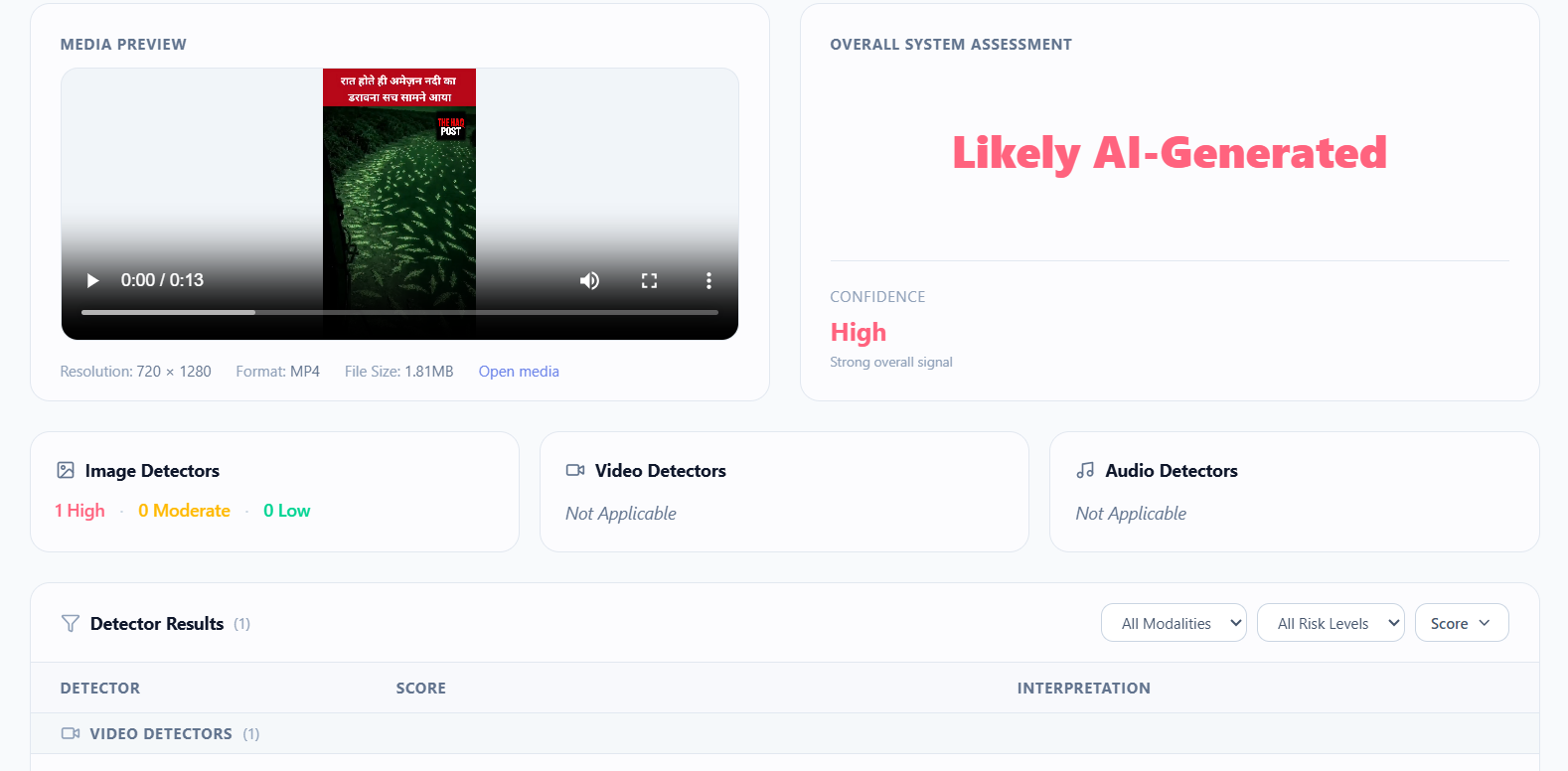
As part of our verification, we analysed the video using the AI detection tool Hive Moderation. The analysis indicated a 95.7% probability that the video was AI-generated.
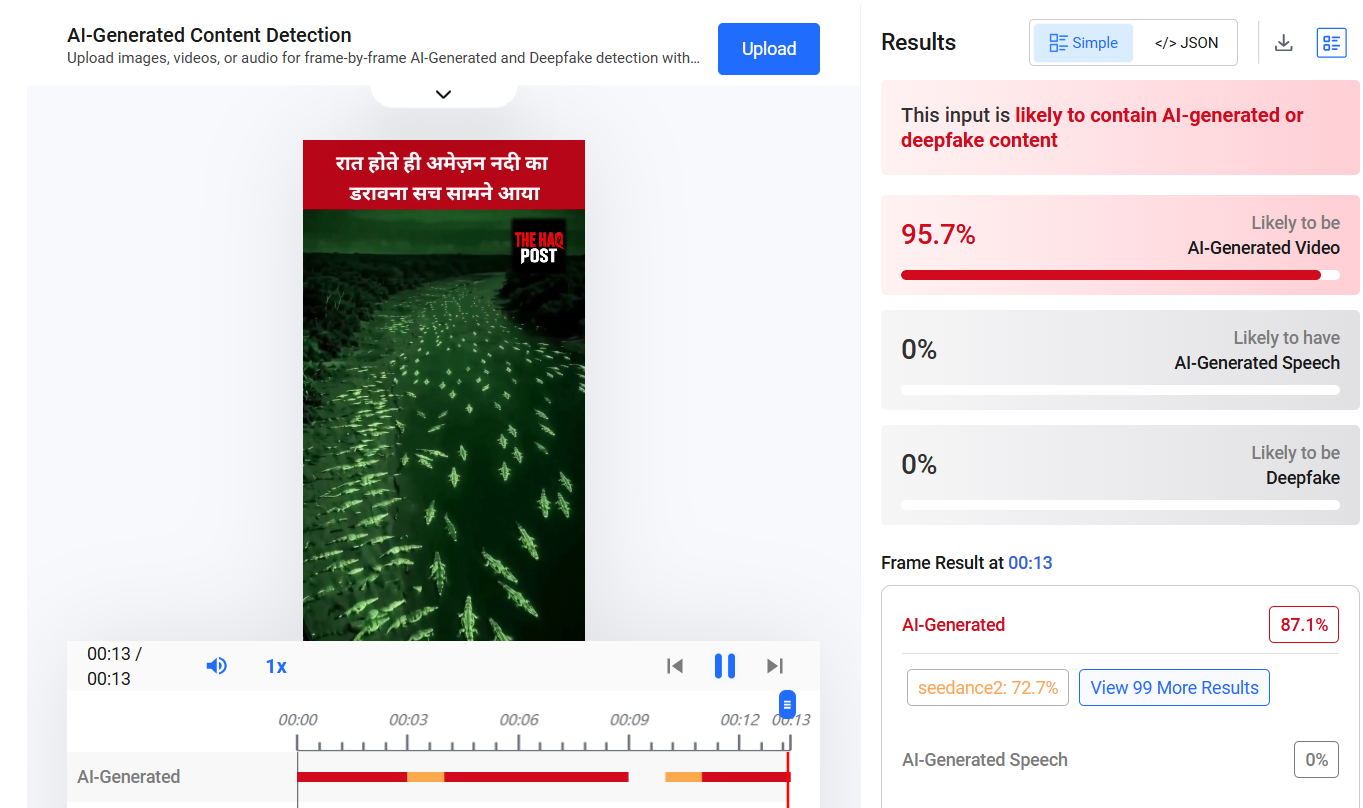
As part of our verification, we analysed the video using the AI detection tool Hive Moderation. The analysis indicated a 95.7% probability that the video was AI-generated.
Conclusion
Our research found that the viral video does not show a genuine thermal-camera recording of the Amazon River. The footage was created using artificial intelligence and is being circulated online with a false and misleading claim.

Related Blogs
.webp)
Data has become a critical asset for the advancement of a nation’s economic, social, and technological development. India’s emergence as a global digital economy hub makes it necessary to create a robust framework that addresses the challenges and opportunities of digital transformation. The Indian government introduced the Draft National Data Governance Framework Policy in 2022, aiming to create a comprehensive data handling and governance framework. This policy draft addresses key challenges in data management, privacy, and digital economy growth. As per the recent media reports, the Draft National Data Governance Policy so prepared is under the finalisation stage, the government specified in its implementation document for the Budget 2023-24 announcement. The policy also aims to address the country's AI adoption and the issue of lack of datasets by providing widespread access to anonymized data.
Background and Need for the Policy
India has a robust digital economy with its adoption of the Digital India Initiative, Aadhaar digital identification, UPI for seamless payments and many more. In India, 751.5 million people connect to the internet, and is home to 462.0 million social media users in January 2024, equivalent to 32.2% of its total population (Data Reportal 2024). This has brought challenges including data privacy concerns, cybersecurity threats, digital exclusion, and a need for better regulation frameworks. To overcome them, the Draft National Data Governance Policy has been designed to provide institutional frameworks for data rules, standards, guidelines, and protocols for the sharing of non-personal data sets in a manner that ensures privacy, security, and trust so that they remain secure, transparent, and accountable.
Objectives omphasizesf the Framework
The objective of the Framework Policy is to accelerate Digital Governance in India. The framework will standardize data management and security standards across the Government. It will promote transparency, accountability, and ownership in Non-Personal data and dataset access and build a platform to receive and process data requests. It will also set quality standards and promote the expansion of the datasets program and overall non-personal ecosystem. Further, it aims to build India’s digital government goals and capacity, knowledge, and competency in Government departments and entities. All this would be done while ensuring greater citizen awareness, participation, and engagement.
Key Provisions of the Draft Policy
The Draft Framework Policy aims to establish a cohesive digital governance ecosystem in India that balances the need for data utilization with protecting citizens' privacy rights. It sets up an institutional framework of the "India Data Management Office (IDMO) set up under the Digital India Corporation (DIC) which will be responsible for developing rules, standards, and guidelines under this Policy.
The key provisions of the framework policy include:
- Promoting interoperability among government digital platforms, ensuring data privacy through data anonymization and security, and enhancing citizen access to government services through digital means.
- The policy e the creation of unified digital IDs, a standardisation in digital processes, and data-sharing guidelines across ministries to improve efficiency.
- It also focuses on building digital infrastructure, such as cloud services and data centres in order to support e-governance initiatives.
- Furthermore, it encourages public-private partnerships and sets guidelines for accountability and transparency in digital governance.
Implications and Concerns of the Framework
- The policy potentially impacts data sharing in India as it mentions data anonymization. The scale of data that would need to be anonymised in India is at a very large scale and it could become a potential challenge to engage in.
- Data localization and cross-border transfers have raised concerns among global tech companies and trade partners. They argue that such requirements could increase operational costs and hinder cross-border data flows. Striking a balance between protecting national interests and facilitating business operations remains a critical challenge.
- Another challenge associated with the policy is over-data centralization under the IDMO and the potential risks of government overreach in data access.
Key Takeaways and Recommendations
The GDPR in the European Union and the Digital Personal Data Protection Act passed in 2023 in India and many others are the data privacy laws in force in different countries. The policy needs to be aligned with the DPDP Act, 2023 and be updated as per the recent developments. It further needs to maintain transparency over the sharing of data and a user’s control. The policy needs engagement with industry experts, privacy advocates, and civil society to ensure a balance of innovation with privacy and security.
Conclusion
The Draft National Data Governance Framework Policy of 2022 represents a significant stage in shaping India's digital future. It ensures the evolution of data governance evolves alongside technological advancements. The framework policy seeks to foster a robust digital ecosystem that benefits citizens, businesses, and the government alike by focusing on the essentials of data privacy, transparency, and security. However, achieving this vision requires addressing concerns like data centralisation, cross-border data flows, and maintaining alignment with global privacy standards. Continued engagement with stakeholders and necessary updates to the draft policy will be crucial to its success in balancing innovation with user rights and data integrity. The final version of the policy is expected to be released soon.
References
- https://meity.gov.in/writereaddata/files/National-Data-Governance-Framework-Policy.pdf
- https://datareportal.com/?utm_source=DataReportal&utm_medium=Country_Article_Hyperlink&utm_campaign=Digital_2024&utm_term=India&utm_content=Home_Page_Link
- https://www.imf.org/en/Publications/fandd/issues/2023/03/data-by-people-for-people-tiwari-packer-matthan
- https://inc42.com/buzz/draft-national-data-governance-policy-under-finalisation-centre/
- https://legal.economictimes.indiatimes.com/news/industry/government-unveiled-national-data-governance-policy-in-budget-2023/97680515
Introduction
In April 2026, Anthropic revealed Claude Mythos, an artificial intelligence application capable of finding security flaws in computer networks more effectively than human beings. The corporation claimed to have found hundreds of thousands of substantially serious vulnerabilities in established desktop operating systems and web-based browsers that have not been used for at least 20 years. This news has greatly alarmed those responsible for leading financial organisations, banks, and governments throughout the world. Nevertheless, this news demonstrates a much larger problem: we do not have enough cybersecurity professionals trained to do this kind of work. At the current estimate, there are 4.8 million cyber security professionals short of what is needed globally. There is a need to develop different kinds of workforce training programs to help prepare these professionals as we continue to see the emergence of new AI technologies.
What Is Claude Mythos ?
Anthropic created Claude Mythos as part of its Claude AI system, competing against ChatGPT and Google Gemini. In April 2026, expert testing revealed Mythos excelled at identifying problems in legacy code and suggested exploitation methods. It found a vulnerability that had existed for 27 years. Because of these advanced capabilities, Anthropic restricted access through “Project Glasswing,” giving it only to 12 major tech companies and 40 organizations managing critical software. Canadian Finance Minister François-Philippe Champagne called it an “unknown unknown.” Andrew Bailey of the Bank of England said regulators needed to examine what Mythos could mean for financial attacks. The European Union raised concerns. India’s Finance Minister Nirmala Sitharaman warned at SEBI’s Foundation Day on April 25, 2026, that cybersecurity is the single most pressing challenge facing markets today. She stated a single successful cyberattack on a major exchange or large broker could disrupt markets nationally and shake public confidence for years. Sitharaman emphasized that AI tools make attacks faster, more adaptive, and autonomous, capable of discovering system vulnerabilities and manipulating code.
The Real Problem: Discovery Versus Fixing
Mythos highlights a fundamental mismatch in cybersecurity. Finding a vulnerability does not guarantee it will be fixed. Organizations face challenges patching systems. Many use obsolete technology, and updates can break dependent components. Organizations in developing nations often lack financial resources for repairs or downtime. Critical systems like hospitals, banks, and power grids cannot go offline. Before Mythos, human hackers found vulnerabilities slowly. Now AI tools find weaknesses faster than they can be fixed, creating a dangerous gap. Ciaran Martin, former head of the UK’s National Cyber Security Centre, explained that Mythos is “a really good hacker” against unprotected systems. Organizations following basic security practices—regular updates, strong passwords, network protection, trained staff can likely defend against it. The UK AI Safety Institute concluded Mythos poses the biggest threat to poorly defended systems, noting: “We cannot say for sure whether Mythos Preview would be able to attack well-defended systems.”
The Workforce Challenge
The Mythos announcement exposes the real problem: we lack enough trained cybersecurity workers. There is a global shortage of 4.8 million workers against a current workforce of 5.5 million. In AI security specifically, 34 percent of needed skills are missing. But the harder problem is that AI is changing needed skills. Entry-level jobs monitoring security alerts are being automated. These were traditional career starting points. Young people learned basic skills and moved to advanced roles. Now these positions disappear while new AI security jobs emerge for which nobody has training. Organizations cannot hire fast enough for new AI roles because few people have these skills. This leads to a vicious cycle. With fewer entry-level positions available, there will be fewer young adults entering the job market which results in even fewer workers with this skill set; thus, the shortage of qualified applicants increases; this thereby increases organizations’ vulnerability. Without action taken immediately, this issue will continue to worsen
Way Forward
- Clarify What Skills We Need
Governments and industry must work together to define what cybersecurity workers need in an AI world. Currently, aspiring professionals study networking, software, and vulnerability finding, but AI security training barely exists. Governments should work with universities and companies to clarify needed skills: understanding what AI tools can and cannot do in security, finding and fixing AI system problems.
- Support Workers Who Lose Jobs To Automation
Workers who find themselves losing their jobs due to automation will require government support. All too often without an alternative, these skilled and trained workers will leave their profession forever. The government will need to provide funding for training of displaced employees, support for those changing careers to become cyber security professionals.
- Create Clear Rules For AI Security Tools
When companies create powerful security tools, governments must understand their capabilities and risks. Companies should be required to thoroughly test tools before release, clearly explain what tools can do and their limitations, and explain safety and misuse prevention plans. Governments should monitor actual tool usage, not simply trust voluntary compliance.
- Focus On Basic Security First
Most attacks do not need advanced AI tools. They succeed because organizations have not implemented basic security. Some never update software, train employees, use strong passwords, protect data properly, or test defenses. Governments should require organizations, especially those managing critical systems, to implement these basics.
Conclusion
Claude Mythos matters not because it is a weapon of destruction, but because it forces hard questions: Do we have enough skilled workers? Are our systems well-protected? The answer is no. We face a shortage of 4.8 million cybersecurity workers and lack AI security training. Yet this is also an opportunity. Governments can invest in training, strengthen defenses, and create clear rules for AI security tools. Governments, organizations and educational institutions must collaborate to create viable Cybersecurity career pathways. We can act through either creating panic or creating a trained and prepared workforce to meet today’s challenges. The time is now.
References
- https://www.bbc.com/news/articles/crk1py1jgzko
- https://red.anthropic.com/2026/mythos-preview/
- https://www.anthropic.com/project/glasswing
- https://www.aisi.gov.uk/blog/our-evaluation-of-claude-mythos-previews-cyber-capabilities
- https://www.bsg.ox.ac.uk/people/ciaran-martin
- https://www.isc2.org/Insights/2024/10/Cybersecurity-Workforce-INSIGHTS-October-2024
- https://decrypt.co/364141/anthropic-claude-mythos-serious-threat-overhyped-ai-security-institute
- https://www.businesstoday.in/latest/economy/story/fm-nirmala-sitharaman-wants-sebi-regulated-entities-to-remain-exceptionally-vigilant-heres-why-527437-2026-04-25
- https://www.theweek.in/news/biz-tech/2026/04/25/sebi-38th-anniversary-cybersecurity-concerns.html

Executive Summary
A video is being widely shared on social media linking it to the ongoing tensions between Israel and Iran. The clip shows multiple fighter jets flying across the sky, while massive flames appear to be rising from tall buildings below. The visuals are dramatic and alarming, creating the impression of a large-scale military strike. Users sharing the video claim that after Israel carried out an attack, Iran launched a retaliatory strike on Israel, and that the viral footage captures the aftermath of this counterattack. However, research conducted by the CyberPeace found the claim to be misleading. Our research revealed that the viral video is not authentic but AI-generated.
Claim
On the social media platform Facebook, a user shared the viral video with the caption: “Iran has also carried out a retaliatory attack on Israel.”
(Post link and archive link provided above.)

Factcheck
Upon closely examining the video, we noticed several irregularities in the visuals and motion patterns, which raised suspicion that the footage may have been generated using artificial intelligence. To verify this, we analyzed the video using the AI detection tool developed by Hive Moderation. According to the analysis report, there is a 62 percent likelihood that the viral video is AI-generated.
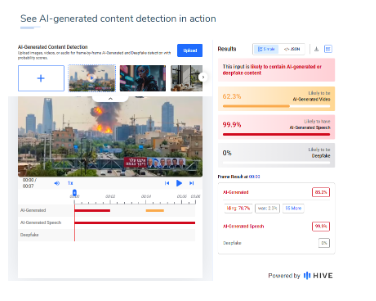
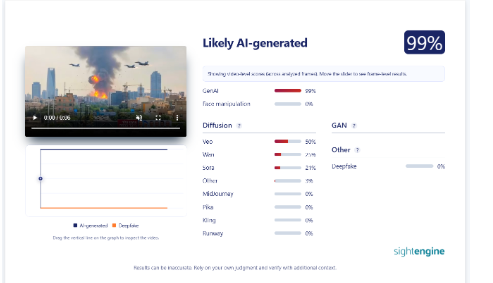
As part of further verification, we also scanned the video using Sightengine. The results indicated an even stronger probability, suggesting that the video is 99 percent AI-generated.
Conclusion
Our research confirms that the viral video does not depict a real military attack. It is AI-generated content being falsely shared in the context of Israel-Iran tensions.
