
#FactCheck - Digitally Altered Image Falsely Shows World Bank President Ajay Banga Holding Khalistani Flag
Executive Summary
A digitally manipulated image of World Bank President Ajay Banga has been circulating on social media, falsely portraying him as holding a Khalistani flag. The image was shared by a Pakistan-based X (formerly Twitter) user, who also incorrectly identified Banga as the President of the International Monetary Fund (IMF), thereby fuelling misleading speculation that he supports the Khalistani movement against India.
The Claim
On February 5, an X user with the handle @syedAnas0101010 posted an image allegedly showing Ajay Banga holding a Khalistani flag. The user misidentified him as the IMF President and captioned the post, “IMF president sending signals to INDIA.” The post quickly gained traction, amplifying false narratives and political speculation. Here is the link and archive link to the post, along with a screenshot:
Fact Check:
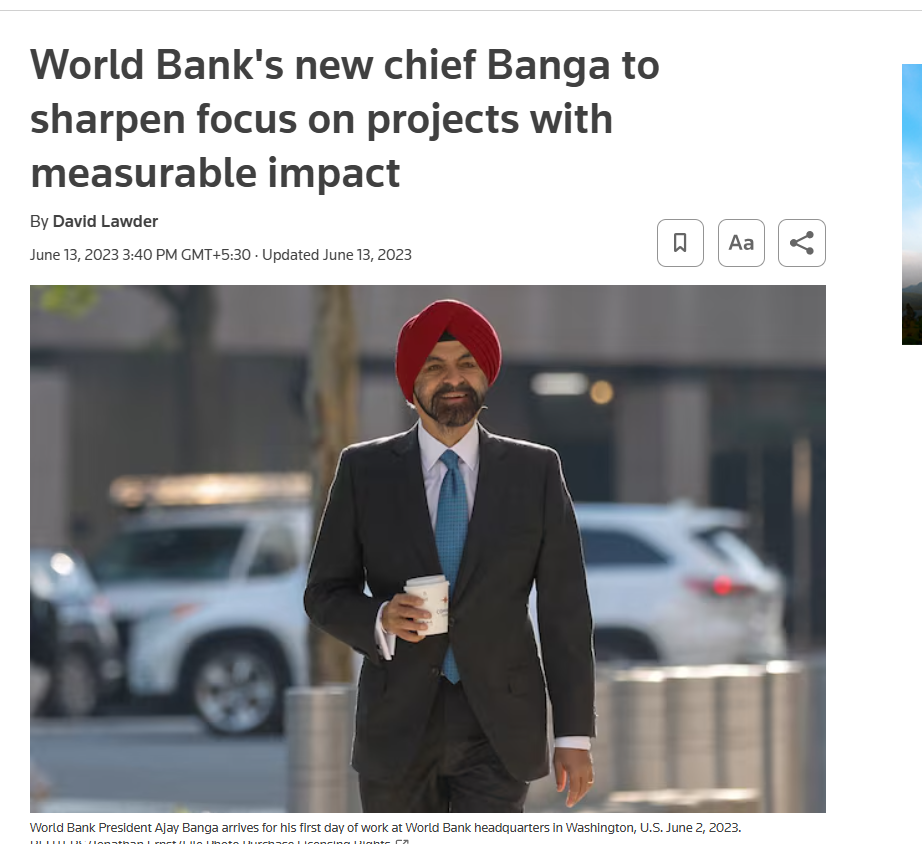
To verify the authenticity of the image, the CyberPeace Fact Check Desk conducted a detailed research . The image was first subjected to a reverse image search using Google Lens, which led to a Reuters news report published on June 13, 2023. The original photograph, captured by Reuters photojournalist Jonathan Ernst, showed Ajay Banga arriving at the World Bank headquarters in Washington, D.C., on June 2, 2023, marking his first day in office. In the authentic image, Banga is seen holding a coffee cup, not a flag.
Further analysis confirmed that the viral image had been digitally altered to replace the coffee cup with a Khalistani flag, thereby misrepresenting the context and intent of the original photograph. Here is the link to the report, along with a screenshot.
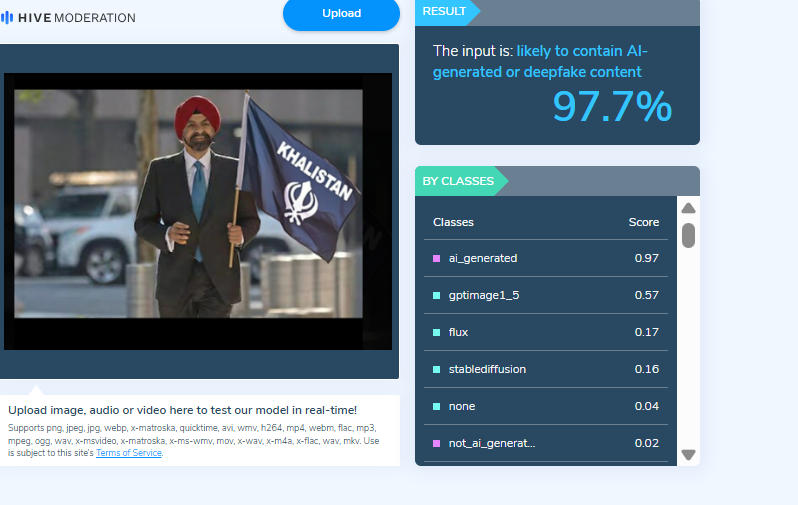
To strengthen the findings, the altered image was also analysed using the Hive Moderation AI detection tool. The tool’s assessment indicated a high likelihood that the image contained AI-generated or manipulated elements, reinforcing the conclusion that the image was not genuine. Below is a screenshot of the result.
Conclusion
The viral image claiming to show World Bank President Ajay Banga holding a Khalistani flag is fake. The photograph was digitally manipulated to spread misinformation and provoke political speculation. In reality, the original Reuters image from June 2023 shows Banga holding a coffee cup during his arrival at the World Bank headquarters. The claim that he supports the Khalistani movement is false and misleading.

Related Blogs
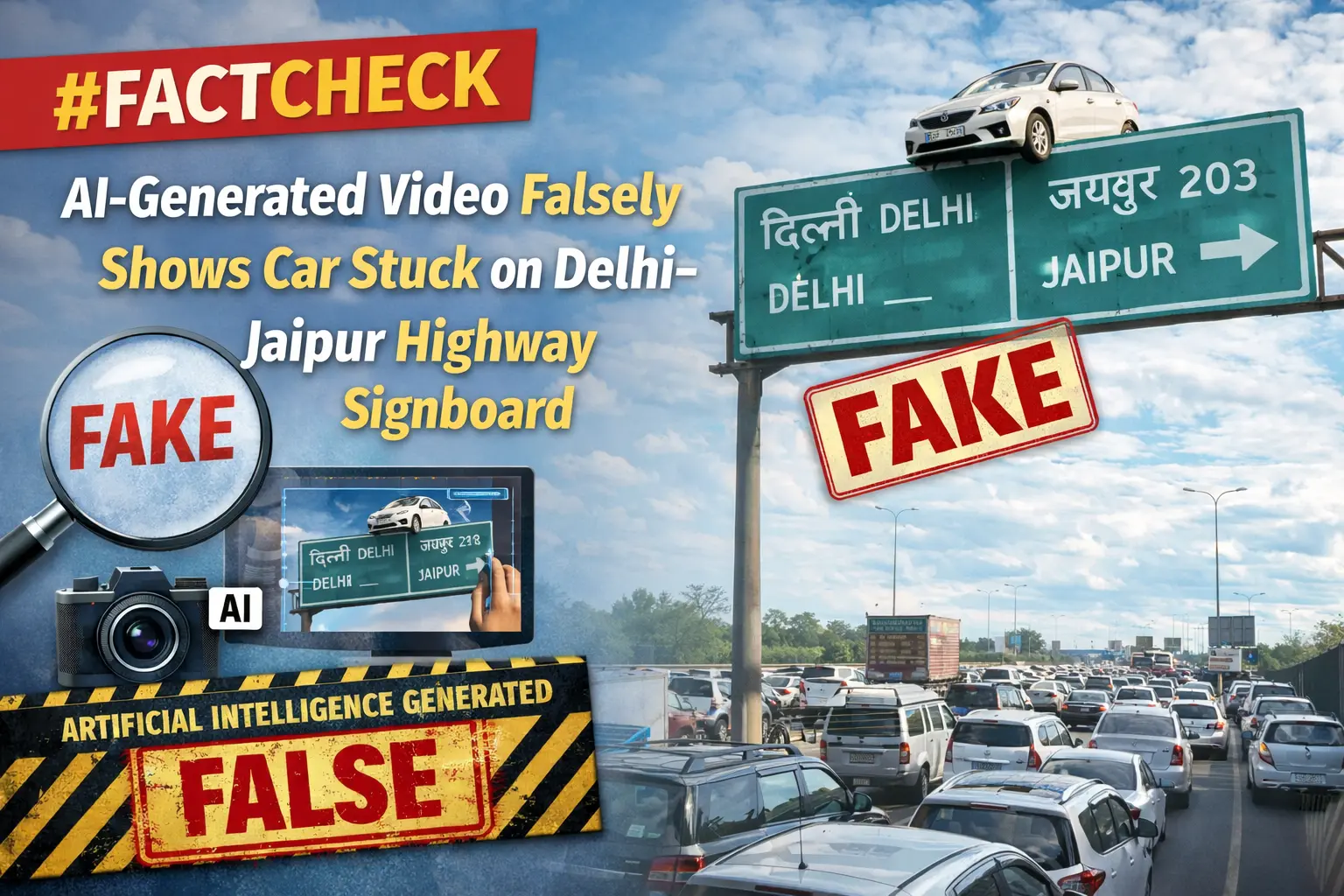
Executive Summary
A shocking video showing a car hanging from a highway signboard is going viral on social media. The clip allegedly shows a black Mahindra Thar stuck on an overhead direction signboard on the Delhi–Jaipur Highway (NH-48). Social media users are widely sharing the video, claiming it shows a real road accident. However, a research by CyberPeace found the viral claim to be false. Our findings reveal that the circulating video is not real but AI-generated.
Claim
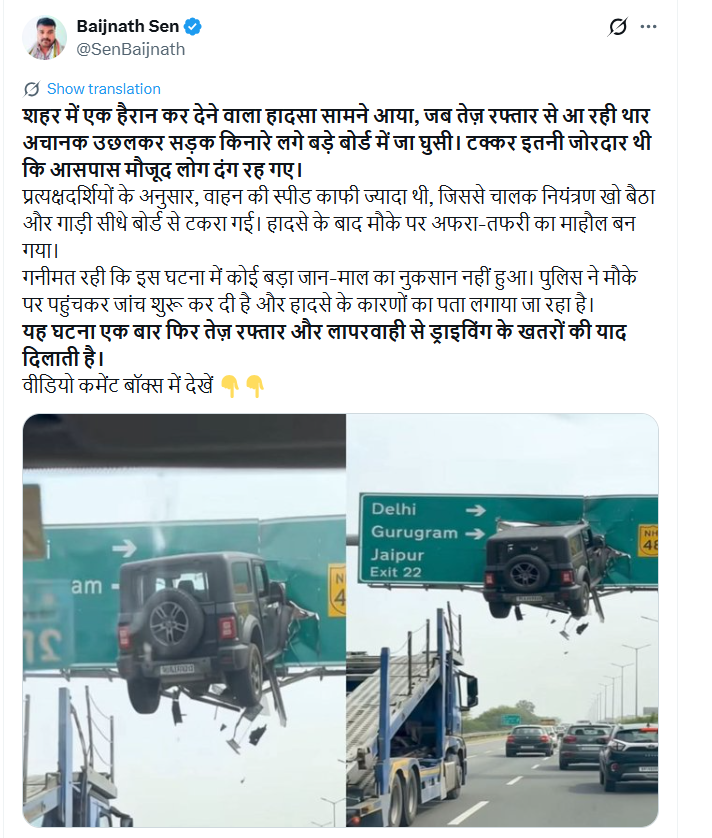
Social media users are sharing the clip as footage of an actual road accident. A viral post on X (formerly Twitter) claims that the incident took place on the Delhi–Jaipur Highway, showing a black Mahindra & Mahindra Thar lodged in a highway signboard.
- https://x.com/SenBaijnath/status/2024098520006029504
- https://archive.ph/cmr5e
Fact Check
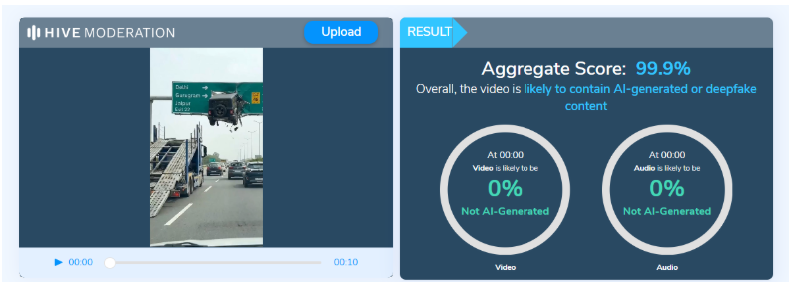
On closely examining the viral video, several inconsistencies were observed that are commonly associated with AI-generated content. For instance, it appears highly improbable for a heavy vehicle to get stuck precisely at the center of a signboard at such a height. Despite the scale of the alleged incident, traffic on the highway below continues moving normally without any disruption. Additionally, the text visible on the right side of the signboard appears distorted and unusually written. To further verify the authenticity of the video, we analysed it using the AI detection tool Hive Moderation, which indicated a 99.9% probability that the video was AI-generated.
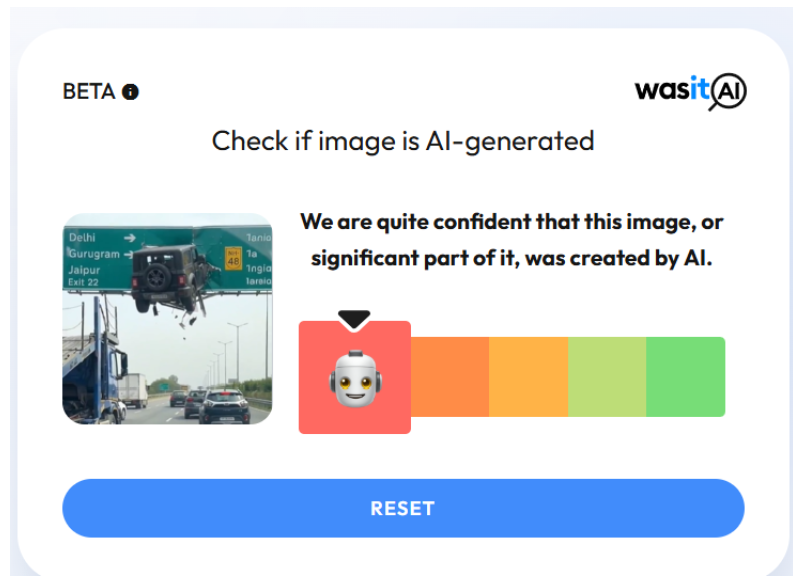
Another AI image detection tool, WasitAI, also found that the visuals in the viral clip were largely AI-generated.
Conclusion
Based on our research and available evidence, it is clear that the viral video showing a Mahindra Thar hanging from a highway signboard is not real but AI-generated.
Social media has become far more than a tool of communication, engagement and entertainment. It shapes politics, community identity, and even shapes agendas. When misused, the consequences can be grave: communal disharmony, riots, false rumours, harassment or worse. Emphasising the need for digital Atmanirbhar, Prime Minister Narendra Modi recently urged India’s youth to develop the country’s own social media platforms, like Facebook, Instagram and X, to ensure that the nation’s technological ecosystems remain secure and independent, reinforcing digital autonomy. This growing influence of platforms has sharpened the tussle between government regulation, the independence of social media companies, and the protection of freedom of expression in most countries.
Why Government Regulation Is Especially Needed
While self-regulation has its advantages, ‘real-world harms’ show why state oversight cannot be optional:
- Incitement to violence and communal unrest: Misinformation and hate speech can inflame tensions. In Manipur (May 2023), false posts, including unverified sexual-violence claims, spread online, worsening clashes. Authorities shut down mobile internet on 3 May 2023 to curb “disinformation and false rumours,” showing how quickly harmful content can escalate and why enforceable moderation rules matter.
- Fake news and misinformation: False content about health, elections or individuals spreads far faster than corrections. During COVID-19, an “infodemic” of fake cures, conspiracy theories and religious discrimination went viral on WhatsApp and Facebook, starting with false claims that the virus came from eating bats. The WHO warned of serious knock-on effects, and a Reuters Institute study found that although such claims by public figures were fewer, they gained the highest engagement, showing why self-regulation alone often fails to stop it.
Nepal’s Example:
Nepal provides a clear example of the tension between government regulation and the self-regulation tussle of social media. In 2023, the government issued rules requiring all social media platforms, whether local or foreign, to register with the Ministry of Communication and Information Technology, appoint a local contact person, and comply with Nepali law. By 2025, major platforms such as Facebook, Instagram, and YouTube had not met the registration deadline. In response, the Nepal Telecommunications Authority began blocking unregistered platforms until they complied. While journalists, civil-rights groups and Gen Z criticised the move as potentially limiting free speech and exposing corruption against the government. The government argued it was necessary to stop harmful content and misinformation. The case shows that without enforceable obligations, self-regulation can leave platforms unaccountable, but it must also balance with protecting free speech.
Self-Regulation: Strengths and Challenges
Most social-media companies prefer to self-regulate. They write community rules, trust & safety guidelines, and give users ways to flag harmful posts, and lean on a mix of staff, outside boards and AI filters to handle content that crosses the line. The big advantage here is speed: when something dangerous appears, a platform can react within minutes, far quicker than a court or lawmaker. Because they know their systems inside out, from user habits to algorithmic quirks, they can adapt fast.
But there’s a downside. These platforms thrive on engagement, hence sensational or hateful posts often keep people scrolling longer. That means the very content that makes money can also be the content that most needs moderating , a built-in conflict of interest.
Government Regulation: Strengths and Risks
Public rules make platforms answerable. Laws can require illegal content to be removed, force transparency and protect user rights. They can also stop serious harms such as fake news that might spark violence, and they often feel more legitimate when made through open, democratic processes.
Yet regulation can lag behind technology. Vague or heavy-handed rules may be misused to silence critics or curb free speech. Global enforcement is messy, and compliance can be costly for smaller firms.
Practical Implications & Hybrid Governance
For users, regulation brings clearer rights and safer spaces, but it must be carefully drafted to protect legitimate speech. For platforms, self-regulation gives flexibility but less certainty; government rules provide a level playing field but add compliance costs. For governments, regulation helps protect public safety, reduce communal disharmony, and fight misinformation, but it requires transparency and safeguards to avoid misuse.
Hybrid Approach
A combined model of self-regulation plus government regulation is likely to be most effective. Laws should establish baseline obligations: registration, local grievance officers, timely removal of illegal content, and transparency reporting. Platforms should retain flexibility in how they implement these obligations and innovate with tools for user safety. Independent audits, civil society oversight, and simple user appeals can help keep both governments and platforms accountable.
Conclusion
Social media has great power. It can bring people together, but it can also spread false stories, deepen divides and even stir violence. Acting on their own, platforms can move fast and try new ideas, but that alone rarely stops harmful content. Good government rules can fill the gap by holding companies to account and protecting people’s rights.
The best way forward is to mix both approaches, clear laws, outside checks, open reporting, easy complaint systems and support for local platforms, so the digital space stays safer and more trustworthy.
References
- https://timesofindia.indiatimes.com/india/need-desi-social-media-platforms-to-secure-digital-sovereignty-pm/articleshow/123327780.cms#
- https://www.bbc.com/news/world-asia-india-66255989
- https://nepallawsunshine.com/social-media-registration-in-nepal/ https://www.newsonair.gov.in/nepal-bans-26-unregistered-social-media-sites-including-facebook-whatsapp-instagram/
- https://hbr.org/2021/01/social-media-companies-should-self-regulate-now
- https://www.drishtiias.com/daily-updates/daily-news-analysis/social-media-regulation-in-india

Introduction
The 2023-24 annual report of the Union Home Ministry states that WhatsApp is among the primary platforms being targeted for cyber fraud in India, followed by Telegram and Instagram. Cybercriminals have been conducting frauds like lending and investment scams, digital arrests, romance scams, job scams, online phishing etc., through these platforms, creating trauma for victims and overburdening law enforcement, which is not always the best equipped to recover their money. WhatsApp’s scale, end-to-end encryption, and ease of mass messaging make it both a powerful medium of communication and a vulnerable target for bad actors. It has over 500 million users in India, which makes it a primary subject for scammers running illegal lending apps, phishing schemes, and identity fraud.
Action Taken by Whatsapp
As a response to this worrying trend and in keeping with Rule 4(1)(d) of the Information Technology (Intermediary Guidelines and Digital Media Ethics Code) Rules, 2021, [updated as of 6.4.2023], WhatsApp has been banning millions of Indian accounts through automated tools, AI-based detection systems, and behaviour analysis, which can detect suspicious activity and misuse. In July 2021, it banned over 2 million accounts. By February 2025, this number had shot up to over 9.7 million, with 1.4 million accounts removed proactively, that is, before any user reported them. While this may mean that the number of attacks has increased, or WhatsApp’s detection systems have improved, or both, what it surely signals is the acknowledgement of a deeper, systemic challenge to India’s digital ecosystem and the growing scale and sophistication of cyber fraud, especially on encrypted platforms.
CyberPeace Insights
- Under Rule 4(1)(d) of the IT Rules, 2021, significant social media intermediaries (SSMIs) are required to implement automated tools to detect harmful content. But enforcement has been uneven. WhatsApp’s enforcement action demonstrates what effective compliance with proactive moderation can look like because of the scale and transparency of its actions.
- Platforms must treat fraud not just as a content violation but as a systemic abuse of the platform’s infrastructure.
- India is not alone in facing this challenge. The EU’s Digital Services Act (DSA), for instance, mandates large platforms to conduct regular risk assessments, maintain algorithmic transparency, and allow independent audits of their safety mechanisms. These steps go beyond just removing bad content by addressing the design of the platform itself. India can draw from this by codifying a baseline standard for fraud detection, requiring platforms to publish detailed transparency reports, and clarifying the legal expectations around proactive monitoring. Importantly, regulators must ensure this is done without compromising encryption or user privacy.
- WhatsApp’s efforts are part of a broader, emerging ecosystem of threat detection. The Indian Cyber Crime Coordination Centre (I4C) is now sharing threat intelligence with platforms like Google and Meta to help take down scam domains, malicious apps, and sponsored Facebook ads promoting illegal digital lending. This model of public-private intelligence collaboration should be institutionalized and scaled across sectors.
Conclusion: Turning Enforcement into Policy
WhatsApp’s mass account ban is not just about enforcement but an example of how platforms must evolve. As India becomes increasingly digital, it needs a forward-looking policy framework that supports proactive monitoring, ethical AI use, cross-platform coordination, and user safety. The digital safety of users in India and those around the world must be built into the architecture of the internet.
References
- https://scontent.xx.fbcdn.net/v/t39.8562-6/486805827_1197340372070566_282096906288453586_n.pdf?_nc_cat=104&ccb=1-7&_nc_sid=b8d81d&_nc_ohc=BRGwyxF87MgQ7kNvwHyyW8u&_nc_oc=AdnNG2wXIN5F-Pefw_FTt2T4K6POllUyKpO7nxwzCWxNgQEkVLllHmh81AHT2742dH8&_nc_zt=14&_nc_ht=scontent.xx&_nc_gid=iaQzNQ8nBZzxuIS4rXLOkQ&oh=00_AfEnbac47YDXvymJ5vTVB-gXteibjpbTjY5uhP_sMN9ouw&oe=67F95BF0
- https://scontent.xx.fbcdn.net/v/t39.8562-6/217535270_342765227288666_5007519467044742276_n.pdf?_nc_cat=110&ccb=1-7&_nc_sid=b8d81d&_nc_ohc=aj6og9xy5WQQ7kNvwG9Vzkd&_nc_oc=AdnDtVbrQuo4lm3isKg5O4cw5PHkp1MoMGATVpuAdOUUz-xyJQgWztGV1PBovGACQ9c&_nc_zt=14&_nc_ht=scontent.xx&_nc_gid=gabMfhEICh_gJFiN7vwzcA&oh=00_AfE7lXd9JJlEZCpD4pxW4OOc03BYcp1e3KqHKN9-kaPGMQ&oe=67FD6FD3
- https://www.hindustantimes.com/india-news/whatsapp-is-most-used-platform-for-cyber-crimes-home-ministry-report-101735719475701.html
- https://www.indiatoday.in/technology/news/story/whatsapp-bans-over-97-lakhs-indian-accounts-to-protect-users-from-scam-2702781-2025-04-02
