
#FactCheck - Viral Video Claiming to Show Kashmir Avalanche Is AI-Generated
Executive Summary
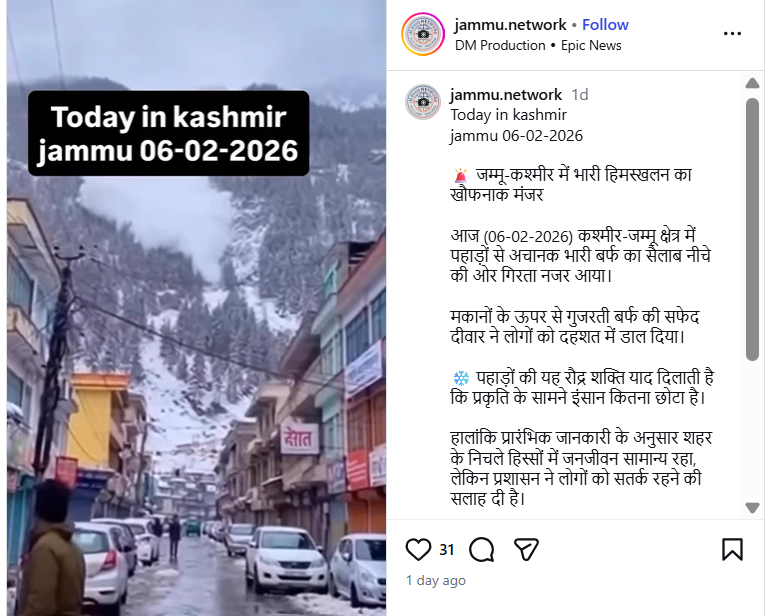
A video is being shared on social media claiming to show an avalanche in Kashmir. The caption of the post alleges that the incident occurred on February 6. Several users sharing the video are also urging people to avoid unnecessary travel to hilly regions. CyberPeace’s research found that the video being shared as footage of a Kashmir avalanche is not real. The research revealed that the viral video is AI-generated.
Claim
The video is circulating widely on social media platforms, particularly Instagram, with users claiming it shows an avalanche in Kashmir on February 6. The archived version of the post can be accessed here. Similar posts were also found online. (Links and archived links provided)
Fact Check:
To verify the claim, we searched relevant keywords on Google. During this process, we found a video posted on the official Instagram account of the BBC. The BBC post reported that an avalanche occurred near a resort in Sonamarg, Kashmir, on January 27. However, the BBC post does not contain the viral video that is being shared on social media, indicating that the circulating clip is unrelated to the real incident.

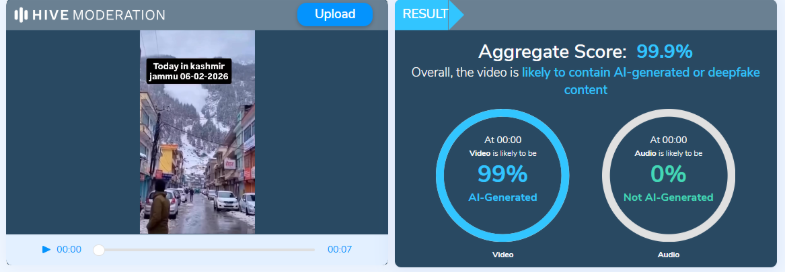
A close examination of the viral video revealed several inconsistencies. For instance, during the alleged avalanche, people present at the site are not seen panicking, running for cover, or moving toward safer locations. Additionally, the movement and flow of the falling snow appear unnatural. Such visual anomalies are commonly observed in videos generated using artificial intelligence. As part of the research , the video was analyzed using the AI detection tool Hive Moderation. The tool indicated a 99.9% probability that the video was AI-generated.
Conclusion
Based on the evidence gathered during our research , it is clear that the video being shared as footage of a Kashmir avalanche is not genuine. The clip is AI-generated and misleading. The viral claim is therefore false.

Related Blogs

Introduction
Whatsapp is one of the leading OTT messaging platforms, which has been owned by the tech giant Meta since 2013. WhatsApp enjoys a user base of nearly 2.24 billion people globally, with almost 487 million users in India. Since the advent of Whatsapp, it has been the most commonly used messaging app, and it has made an impact to such an extent that it is used for professional as well as personal purposes. Meta powers the platform and follows similar guidelines and policies as its parent company.
The New Feature
Users of WhatsApp on the web and desktop can now access one account from various devices. One WhatsApp account may now be used on up to four handsets thanks to a new update from Meta. Be aware that the multi-device capability has been planned for some time and is finally being made available to stable WhatsApp users. Each linked device (up to four devices can be linked) will function independently, and the independent devices will continue to receive messages even if the central device’s network connection is lost. Remember that WhatsApp will automatically log out of all the companion devices if the primary smartphone is dormant for an extended period. Four more gadgets may be a mix of four PCs and smartphones or four smartphones. This feature is now available for updates and downloads on Android as well as iOS platforms.
Potential issues
As we go deeper into the digital age, it is the responsibility of the tech giants to pilot innovation with features of security by design. Thus such new features should be accompanied by coherent safety and security policies or advisories to ensure the users understand the implications of the new features. Convenience over conditions is an essential part of cyberspace. It points to the civic duty of netizens to go through the conditions of any app rather than only focus on the convenience it creates. The following potential issues may arise from the new features on Whatsapp –
- Increased cybercrime- The bad actors now do not need to access SIM cards to commit frauds over the platforms as now on a single number 4 devices can be used hence the cybercriminal activity can increase over the platform. It is also pertinent for the platform to create SoPs for fake accounts which use multiple devices, as they pose a direct threat to the users and their interests.
- Difficulty in identifying and tracing- The LEAs will face a significant issue in identifying the bad actors and tracing them as the individual’s involvement through a linked device needs to be given legal validity and scope for investigation. This may also cause issues in evidence handling and analysis.
- Surge in Misinformation and Disinformation- With access to multiple devices, the screen time of an individual is also bound to increase. This leads to more time spent online, thus causing a rise in instances of misinformation and disinformation by bad actors. Thus the aspect of fack checking is of prime importance.
- Potential Oversharing of Personal Data- With the increased accessibility on different devices, it is very easy for the app to seek data from all devices on which the app is running, thus leading to a bigger reservoir of personal data for the platforms and data fiduciaries.
- Higher risk of Phishing, Ransomware and Malware Attacks- As the devices under the same login credentials and mobile number will increase, the message can be viewed on all the devices, thus increasing the risk of widespread embedded ransomware and malware in multiple devices is and ever-present threat.
- One number, more criminals- This feature will allow cybercriminals to operate using one device only, earlier they used to forge Adhaar cards to get new sims, but this feature will enable the bad actors to commit crimes and attacks from one single SIM using 4 different devices.
- Rise in Digital Footprint- As the number of devices increases, the users will generate more digital footprints. As a tech giant, Meta will have access to a bigger database, which increases the risk of data breaches by third-party actors.
Conclusion
In the fast-paced digital world, it is important to remain updated about new software, technologies and policies for our applications or forms of tech. This was a long-awaited feature from WhatsApp, and its value of it doesn’t lie in technological advancement only but also in the formulation of policies to govern this technology towards the trust and safety aspect of users. The platforms, in synergy with the policy makers, need to create a robust framework to accommodate the new features and add-ons on apps vehicle, staying in compliance with the laws of the land. Awareness about new features and vulnerabilities is a must for all netizens, and it is a shared responsibility for all netizens to spread the word about safety and security mechanisms.

Introduction
Who would have predicted that the crime of slavery would haunt our lives through the digital world? In a recent unfolding of events, the cyber wing of Maharashtra has saved 60 Indian nationals from a cyber slavery racket run by armed rebel groups operating in Myanmar and arrested five suspects who acted as recruiting agents, including a foreign national. As per the reports, the racketeers made contact with various individuals, enticing them with offers of high-paying jobs in East Asian countries. The operation unfolds a carefully designed crime network that operates through bordering states, Myanmar, Thailand, and Malaysia, targeting vulnerable individuals through deceptive means and forcing them to commit cyber fraud and financial crimes, operating as an authentic industrial setup. The disturbing set of events makes up only one of many such cyber-slavery incidents that are uncovered and various other rackets that operate in the shadows of cyberspace. Another similar event was reported in March 2025, where the disturbing ordeal of a 52-year-old father from Bihar’s Gopalganj, whose son was lured into working in a scam call centre under the pretence of a data entry job in Thailand.
Counting the Unseen: The Dark Metrics of Cyber Slavery
As per the United Nations report from October 2024, a large number of young individuals are enslaved, acting under the impression they will be employed in high-paying jobs, often on social media platforms, and what follows is an intricate web of cybercriminals operating from illegal scam compounds. According to the UN Office on Drugs and Crime (UNODC), financial losses from scams in Southeast Asia reached between $18 billion (Rs 1.6 lakh crore) and $37 billion (Rs 3.2 lakh crore) in 2023, much of it linked to organised crime in these three countries. Also, acting on a similar premise, the Indian Cyber Crime Coordination Centre (I4C), a division under the Ministry of Home Affairs (MHA), organised an inter-ministerial committee to address a significant rise in cybercrime in Southeast Asian countries, which includes Cambodia, Myanmar, and Laos.
The data from the Bureau of Immigration in the Union Ministry of Home Affairs, which included around 29,466 Indians who travelled on visitor visas to Thailand, Vietnam, Myanmar, and Cambodia between January 2022 and May 2024, has gone missing.
From Rescue to Reform: How India is Tackling Cyber Slavery
The recent events that unfolded have agitated the government to undertake vigilant rescue operations for the missing individuals who became victims of this modern-day trafficking and coordinate with foreign ministries in Myanmar, Thailand and Cambodia for extradition and repatriation. It is notable that in the year 2015, India along with seven other countries in South Asia, including Afghanistan, Bangladesh, Bhutan, Maldives, Nepal, Pakistan and Sri Lanka, came together to address transnational threats that transcend geographical and cultural borders in cooperation with the United Nations Office on Drugs and Crimes (UNODC). The collaboration brought together a Compendium of Bilateral and Regional Instruments for South Asia providing for International Cooperation in Criminal Matters. Further, in January 2025, UNODC and the European Union launched a €9 million regional project titled "Preventing and Addressing Trafficking in Human Beings and the Smuggling of Migrants in South Asia." The Government of India, through its various agencies, also lays down various guidelines and advisories on the National Cyber Crime Reporting Portal. Additionally, law enforcement agencies are actively involved, and cybersecurity NGOs are proactively spreading awareness about identifying red flags associated with threats such as cyber slavery.
Recommendations: A Call to Action
- The various advisories released by the Gov. of India emphasise the need for Indian nationals to verify the credentials of the employer through the Indian Embassy located in that country.
- The authorities and various agencies also stress the need for individuals to refrain from sharing personal information such as location details, contact information or any information pertaining to personal relationships that can be exploited by such criminals.
- The fundamental manner of tackling the crime of cyber slavery is to ensure digital literacy and increase awareness through public campaigns and educational programmes
- The need of the hour is international cooperation and collaboration to undertake a concerted effort to bring back the victims and penalise all those who facilitate such criminal activities.
References
- https://www.thehindu.com/news/national/more-than-60-indians-forced-into-cyber-slavery-rescued-from-myanmar-5-arrested/article69438991.ece
- https://www.indiatoday.in/india-today-insight/story/cyber-slavery-the-new-job-con-trapping-indian-youth-abroad-2637157-2024-11-21
- https://indianexpress.com/article/india/mha-high-powered-committee-cybercrimes-from-se-asia-9345843/
- https://www.unodc.org/documents/terrorism/Publications/SAARC%20compendium/SA_Compendium_Volume-2.pdf

Executive Summary
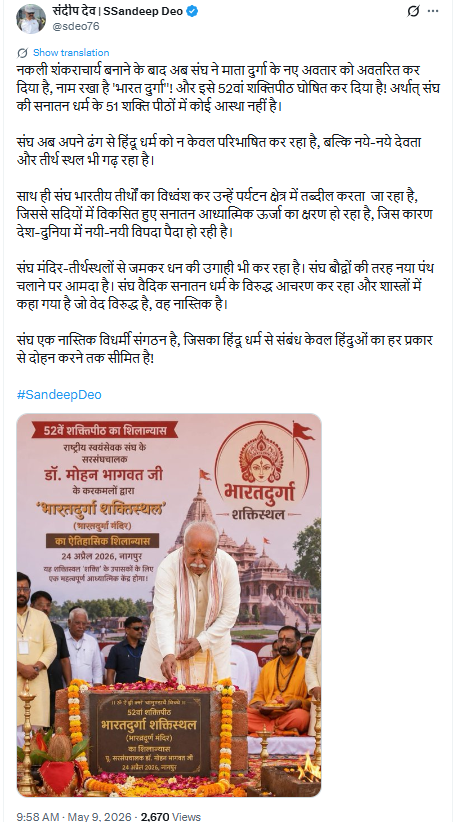
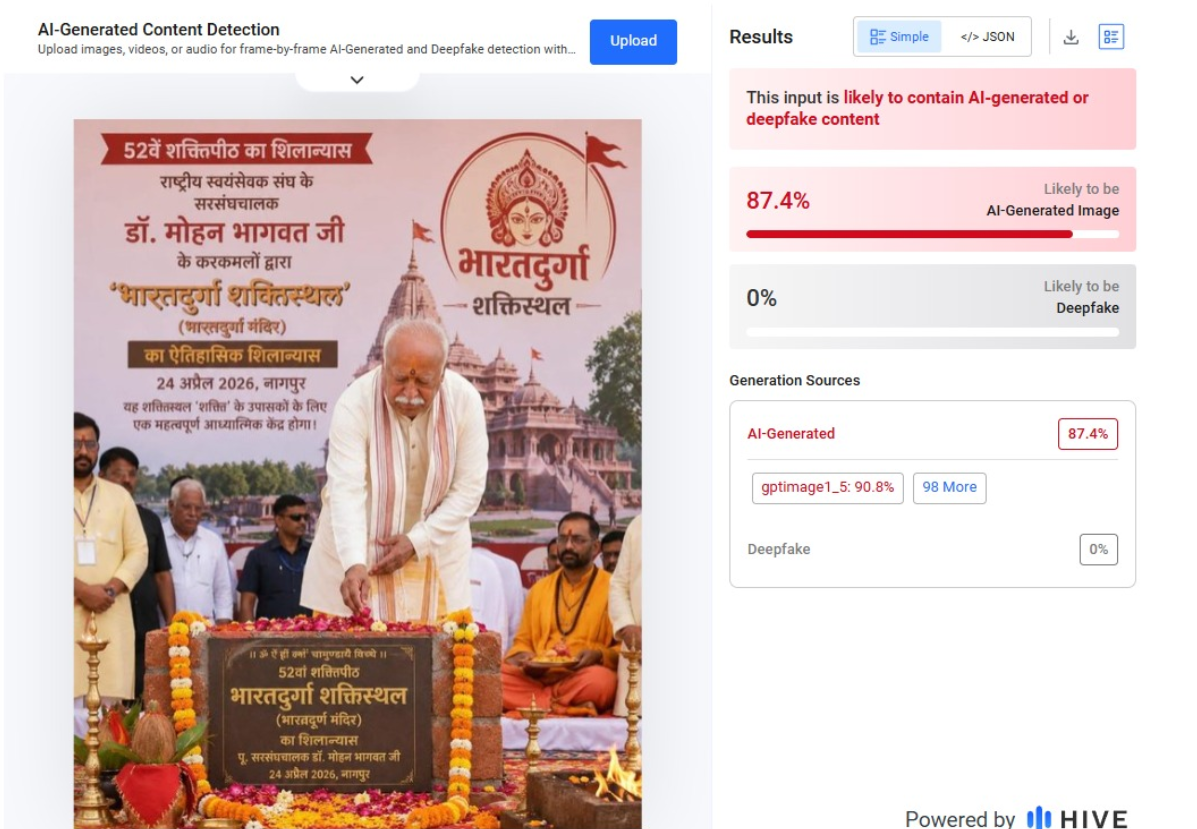
A picture of Mohan Bhagwat is going viral on social media, showing him allegedly laying the foundation stone of a so-called “52nd Shakti Peeth” named Bharatdurga. Users are claiming that the RSS chief insulted Sanatan Dharma by creating a new Shakti Peeth in Nagpur. Research by CyberPeace Research Wing found that the claim is false. The viral image is AI-generated, and Mohan Bhagwat did not inaugurate any “52nd Shakti Peeth.” In reality, he laid the foundation stone of the Bharatdurga Temple.
Claim
An X user named Sandeep Dev shared the viral image and alleged that after creating “fake Shankaracharyas,” the RSS had now introduced a new form of Goddess Durga called “Bharat Durga” and declared it the 52nd Shakti Peeth. The post further claimed that the RSS was redefining Hinduism and creating new religious sites.
Fact Check
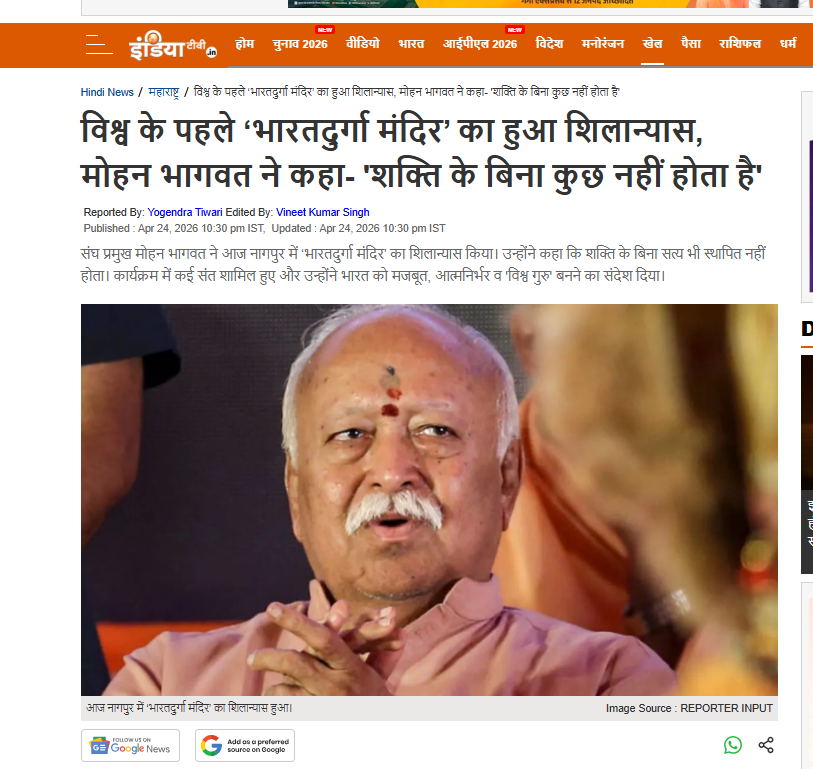
To verify the claim, we searched relevant keywords and found reports published on April 24, 2026, by India TV and Navbharat Times. According to these reports, Mohan Bhagwat laid the foundation stone of the world’s first Bharatdurga Temple in Nagpur during a ceremony organized at the Jamtha campus of Dr. Abaji Thatte Seva and Research Institute. Several prominent saints and religious leaders attended the event. Importantly, none of the reports described the temple as the “52nd Shakti Peeth.”
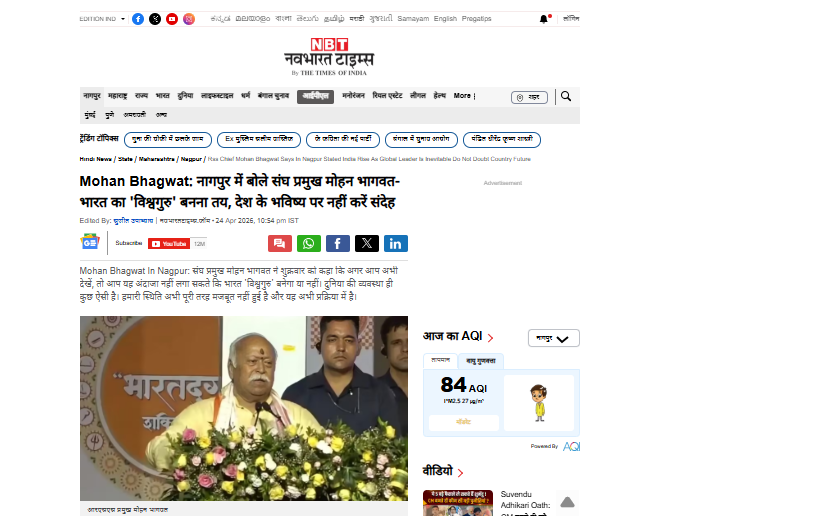
Further research led us to the full video of the foundation ceremony uploaded on the YouTube channel of Devendra Fadnavis. The stage backdrop and video thumbnail clearly mention “Bharatdurga Temple Foundation Ceremony.” However, the viral image frame was not visible anywhere in the authentic footage.

We also analyzed the viral image using AI detection tools, which indicated that the image was AI-generated.
Conclusion
Our research confirms that the claim about Mohan Bhagwat laying the foundation of a “52nd Shakti Peeth” is false. The viral image is AI-generated. In reality, he participated in the foundation ceremony of the Bharatdurga Temple in Nagpur.
