
#FactCheck-AI-Generated Video Falsely Shared as Scenes of Flood Devastation in Nepal
Executive Summary
Nepal witnessed severe devastation after floods struck the country on August 26, 2026. Amid this, a video showing a bridge being swept away by floodwaters is being widely shared on social media. Some users are sharing the video claiming that it shows scenes of destruction caused by the floods in Nepal.A research done by the Research Wing of the CyberPeace found that the video being shared with the claim of flood devastation in Nepal is AI-generated. However, it is true that the floods in Nepal have claimed hundreds of lives.
Claim
A user on X shared the video with the caption: “Scenes of devastation in Nepal after the disaster.”
https://www.instagram.com/reels/Dch-EmYNUwz/
https://perma.cc/5VY5-ZFCN?type=standard

Fact Check
We closely examined the video showing the bridge being swept away. A person can be seen standing on top of a truck, which appears unnatural in such a situation. Moreover, even as the bridge collapses, the people on it do not appear to fall directly into the water. These observations led us to suspect that the video was likely AI-generated.

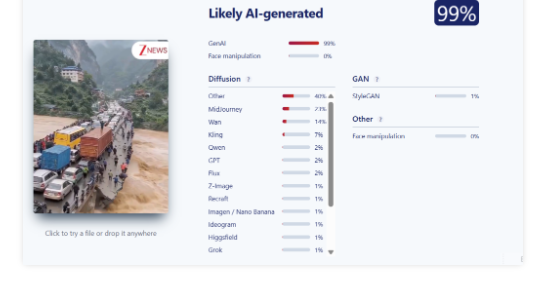
We scanned the viral video using the AI detection tool ‘WasItAI’, which identified it as 99 percent AI-generated.

Meanwhile, another AI detection tool, Sightengine, also identified the video as 99 percent AI-generated.
Conclusion:
A video being shared with the claim that it shows devastation caused by floods in Nepal is actually from the shooting of an Indonesian TV serial, while another viral video is AI-generated.

Related Blogs
.webp)
Introduction: The Internet’s Foundational Ideal of Openness
The Internet was built as a decentralised network to foster open communication and global collaboration. Unlike traditional media or state infrastructure, no single government, company, or institution controls the Internet. Instead, it has historically been governed by a consensus of the multiple communities, like universities, independent researchers, and engineers, who were involved in building it. This bottom-up, cooperative approach was the foundation of Internet governance and ensured that the Internet remained open, interoperable, and accessible to all. As the Internet began to influence every aspect of life, including commerce, culture, education, and politics, it required a more organised governance model. This compelled the rise of the multi-stakeholder internet governance model in the early 2000s.
The Rise of Multistakeholder Internet Governance
Representatives from governments, civil society, technical experts, and the private sector congregated at the United Nations World Summit on Information Society (WSIS), and adopted the Tunis Agenda for the Information Society. Per this Agenda, internet governance was defined as “… the development and application by governments, the private sector, and civil society in their respective roles of shared principles, norms, rules, decision-making procedures, and programmes that shape the evolution and use of the Internet.” Internet issues are cross-cutting across technical, political, economic, and social domains, and no one actor can manage them alone. Thus, stakeholders with varying interests are meant to come together to give direction to issues in the digital environment, like data privacy, child safety, cybersecurity, freedom of expression, and more, while upholding human rights.
Internet Governance in Practice: A History of Power Shifts
While the idea of democratizing Internet governance is a noble one, the Tunis Agenda has been criticised for reflecting geopolitical asymmetries and relegating the roles of technical communities and civil society to the sidelines. Throughout the history of the internet, certain players have wielded more power in shaping how it is managed. Accordingly, internet governance can be said to have undergone three broad phases.
In the first phase, the Internet was managed primarily by technical experts in universities and private companies, which contributed to building and scaling it up. The standards and protocols set during this phase are in use today and make the Internet function the way it does. This was the time when the Internet was a transformative invention and optimistically hailed as the harbinger of a utopian society, especially in the USA, where it was invented.
In the second phase, the ideal of multistakeholderism was promoted, in which all those who benefit from the Internet work together to create processes that will govern it democratically. This model also aims to reduce the Internet’s vulnerability to unilateral decision-making, an ideal that has been under threat because this phase has seen the growth of Big Tech. What started as platforms enabling access to information, free speech, and creativity has turned into a breeding ground for misinformation, hate speech, cybercrime, Child Sexual Abuse Material (CSAM), and privacy concerns. The rise of generative AI only compounds these challenges. Tech giants like Google, Meta, X (formerly Twitter), OpenAI, Microsoft, Apple, etc. have amassed vast financial capital, technological monopoly, and user datasets. This gives them unprecedented influence not only over communications but also culture, society, and technology governance.
The anxieties surrounding Big Tech have fed into the third phase, with increasing calls for government regulation and digital nationalism. Governments worldwide are scrambling to regulate AI, data privacy, and cybersecurity, often through processes that lack transparency. An example is India’s Information Technology (Intermediary Guidelines and Digital Media Ethics Code) Rules, 2021, which was passed without parliamentary debate. Governments are also pressuring platforms to take down content through opaque takedown orders. Laws like the UK’s Investigatory Powers Act, 2016, are criticised for giving the government the power to indirectly mandate encryption backdoors, compromising the strength of end-to-end encryption systems. Further, the internet itself is fragmenting into the “splinternet” amid rising geopolitical tensions, in the form of Russia’s “sovereign internet” or through China’s Great Firewall.
Conclusion
While multistakeholderism is an ideal, Internet governance is a playground of contesting power relations in practice. As governments assert digital sovereignty and Big Tech consolidates influence, the space for meaningful participation of other stakeholders has been negligible. Consultation processes have often been symbolic. The principles of openness, inclusivity, and networked decision-making are once again at risk of being sidelined in favour of nationalism or profit. The promise of a decentralised, rights-respecting, and interoperable internet will only be fulfilled if we recommit to the spirit of Multi-Stakeholder Internet Governance, not just its structure. Efficient internet governance requires that the multiple stakeholders be empowered to carry out their roles, not just talk about them.
References
- https://www.newyorker.com/magazine/2024/02/05/can-the-internet-be-governed
- https://www.internetsociety.org/wp-content/uploads/2017/09/ISOC-PolicyBrief-InternetGovernance-20151030-nb.pdf
- https://itp.cdn.icann.org/en/files/government-engagement-ge/multistakeholder-model-internet-governance-fact-sheet-05-09-2024-en.pdf\
- https://nrs.help/post/internet-governance-and-its-importance/
- https://daidac.thecjid.org/how-data-power-is-skewing-internet-governance-to-big-tech-companies-and-ai-tech-guys/
.jpeg)
Introduction and Brief Analysis
A movie named “The Artifice Girl” portrayed A law enforcement agency developing an AI-based personification of a 12-year-old girl who appears to be exactly like a real person. Believing her to be an actual girl, perpetrators of child sexual exploitation were caught attempting to seek sexual favours. The movie showed how AI aided law enforcement, but the reality is that the emergence of Artificial Intelligence has posed numerous challenges in multiple directions. This example illustrates both the promise and the complexity of using AI in sensitive areas like law enforcement, where technological innovation must be carefully balanced with ethical and legal considerations.
Detection and Protection tools are constantly competing with technologies that generate content, automate grooming and challenge legal boundaries. Such technological advancements have provided enough ground for the proliferation of Child Sexual Exploitation and Abuse Material (CSEAM). Also known as child pornography under Section 2 (da) of Protection of Children from Sexual Offences Act, 2012, it defined it as - “means any visual depiction of sexually explicit conduct involving a child which includes a photograph, video, digital or computer-generated image indistinguishable from an actual child and image created, adapted, or modified, but appears to depict a child.”
Artificial Intelligence is a category of technologies that attempt to shape human thoughts and behaviours using input algorithms and datasets. Two Primary applications can be considered in the context of CSEAM: classifiers and content generators. Classifiers are programs that learn from large data sets, which may be labelled or unlabelled and further classify what is restricted or illegal. Whereas generative AI is also trained on large datasets, it uses that knowledge to create new things. Majority of current AI research related to AI for CSEAM is done by the use of Artificial neural networks (ANNs), a type of AI that can be trained to identify unusual connections between items (classification) and to generate unique combinations of items (e.g., elements of a picture) based on the training data used.
Current Legal Landscape
The legal Landscape in terms of AI is yet unclear and evolving, with different nations trying to track the evolution of AI and develop laws. However, some laws directly address CSEAM. The International Centre for Missing and Exploited Children (ICMEC) combats Illegal sexual content involving children. They have a “Model Legislation” for setting recommended sanctions/sentencing. According to research performed in 2018, Illegal sexual content involving children is illegal in 118 of the 196 Interpol member states. This figure represents countries that have sufficient legislation in place to meet 4 or 5 of the 5 criteria defined by the ICMEC.
CSEAM in India can be reported on various portals like the ‘National Cyber Crime Reporting Portal’. Online crimes related to children, including CSEAM, can be reported to this portal by visiting cybercrime.gov.in. This portal allows anonymous reporting, automatic FIR registration and tracking of your complaint. ‘I4C Sahyog Portal’ is another platform managed by the Indian Cyber Crime Coordination Centre (I4C). This portal integrates with social media platforms.
The Indian legal front for AI is evolving and CSEAM is well addressed in Indian laws and through judicial pronouncements. The Supreme Court judgement on Alliance and Anr v S Harish and ors is a landmark in this regard. The following principles were highlighted in this judgment.
- The term “child pornography” should be substituted by “Child Sexual Exploitation and Abuse Material” (CSEAM) and shall not be used for any further judicial proceeding, order, or judgment. Also, parliament should amend the same in POCSO and instead, the term CSEAM should be endorsed.
- Parliament to consider amending Section 15 (1) of POCSO to make it more convenient for the general public to report by way of an online portal.
- Implementing sex education programs to give young people a clear understanding of consent and the consequences of exploitation. To help prevent Problematic sexual behaviour (PSB), schools should teach students about consent, healthy relationships and appropriate behaviour.
- Support services to the victims and rehabilitation programs for the offenders are essential.
- Early identification of at-risk individuals and implementation of intervention strategies for youth.
Distinctive Challenges
According to a report by the National Centre for Missing and Exploited Children (NCMEC), a significant number of reports about child sexual exploitation and abuse material (CSEAM) are linked to perpetrators based outside the country. This highlights major challenges related to jurisdiction and anonymity in addressing such crimes. Since the issue concerns children and considering the cross-border nature of the internet and the emergence of AI, Nations across the globe need to come together to solve this matter. Delays in the extradition procedure and irregular legal processes across the jurisdictions hinder the apprehension of offenders and the delivery of justice to victims.
CyberPeace Recommendations
For effective regulation of AI-generated CSEAM, laws are required to be strengthened for AI developers and trainers to prevent misuse of their tools. AI should be designed with its ethical considerations, ensuring respect for privacy, consent and child rights. There can be a self-regulation mechanism for AI models to recognise and restrict red flags related to CSEAM and indicate grooming or potential abuse.
A distinct Indian CSEAM reporting portal is urgently needed, as cybercrimes are increasing throughout the nation. Depending on the integrated portal may lead to ignorance of AI-based CSEAM cases. This would result in faster response and focused tracking. Since AI-generated content is detectable. The portal should also include an automated AI-content detection system linked directly to law enforcement for swift action.
Furthermore, International cooperation is of utmost importance to win the battle of AI-enabled challenges and to fill the jurisdictional gaps. A united global effort is required. Using a common technology and unified international laws is essential to tackle AI-driven child sexual exploitation across borders and protect children everywhere. CSEAM is an extremely serious issue. Children are among the most vulnerable to such harmful content. This threat must be addressed without delay, through stronger policies, dedicated reporting mechanisms and swift action to protect children from exploitation.
References:
- https://www.sciencedirect.com/science/article/pii/S2950193824000433?ref=pdf_download&fr=RR-2&rr=94efffff09e95975
- https://aasc.assam.gov.in/sites/default/files/swf_utility_folder/departments/aasc_webcomindia_org_oi d_4/portlet/level_2/pocso_act.pdf
- https://www.manupatracademy.com/assets/pdf/legalpost/just-rights-for-children-alliance-and-anr-vs-sharish-and-ors.pdfhttps://www.icmec.orghttps://www.missingkids.org/theissues/generative-ai

In an era defined by perpetual technological advancement, the hitherto uncharted territories of the human experience are progressively being illuminated by the luminous glow of innovation. The construct of privacy, once a straightforward concept involving personal secrets and solitude, has evolved into a complex web of data protection, consent, and digital rights. This notion of privacy, which often feels as though it elusively ebbs and flows like the ghost of a bygone epoch, is now confronted with a novel intruder – neurotechnology – which promises to redefine the very essence of individual sanctity.
Why Neuro Rights
At the forefront of this existential conversation lie ventures like Elon Musk's Neuralink. This company, which finds itself at the confluence of fantastical dreams and tangible reality, teases a future where the contents of our thoughts could be rendered as accessible as the words we speak. An existence where machines not only decipher our mental whispers but hold the potential to echo back, reshaping our cognitive landscapes. This startling innovation sets the stage for the emergence of 'neurorights' – a paradigm aimed at erecting a metaphorical firewall around the synapses and neurons that compose our innermost selves.
At institutions such as the University of California, Berkeley, researchers, under the aegis of cognitive scientists like Jack Gallant, are already drawing the map of once-inaccessible territories within the mind. Gallant's landmark study, which involved decoding the brain activity of volunteers as they absorbed visual stimuli, opened Pandora's box regarding the implications of mind-reading. The paper published a decade ago, was an inchoate step toward understanding the narrative woven within the cerebral cortex. Although his work yielded only a rough sketch of the observed video content, it heralded an era where thought could be translated into observable media.
The Growth
This rapid acceleration of neuro-technological prowess has not gone unnoticed on the sociopolitical stage. In a pioneering spirit reminiscent of the robust legislative eagerness of early democracies, Chile boldly stepped into the global spotlight in 2021 by legislating neurorights. The Chilean senate's decision to constitutionalize these rights sent ripples the world over, signalling an acknowledgement that the evolution of brain-computer interfaces was advancing at a daunting pace. The initiative was spearheaded by visionaries like Guido Girardi, a former senator whose legislative foresight drew clear parallels between the disruptive advent of social media and the potential upheaval posed by emergent neurotechnology.
Pursuit of Regulation
Yet the pursuit of regulation in such an embryonic field is riddled with intellectual quandaries and ethical mazes. Advocates like Allan McCay articulate the delicate tightrope that policy-makers must traverse. The perils of premature regulation are as formidable as the risks of a delayed response – the former potentially stifling innovation, the latter risking a landscape where technological advances could outpace societal control, engendering a future fraught with unforeseen backlashes.
Such is the dichotomy embodied in the story of Ian Burkhart, whose life was irrevocably altered by the intervention of neurotechnology. Burkhart's experience, transitioning from quadriplegia to digital dexterity through sheer force of thought, epitomizes the utopic potential of neuronal interfaces. Yet, McCay issues a solemn reminder that with great power comes great potential for misuse, highlighting contentious ethical issues such as the potential for the criminal justice system to over extend its reach into the neural recesses of the human psyche.
Firmly ensconced within this brave new world, the quest for prudence is of paramount importance. McCay advocates for a dyadic approach, where privacy is vehemently protected and the workings of technology proffered with crystal-clear transparency. The clandestine machinations of AI and the danger of algorithmic bias necessitate a vigorous, ethical architecture to govern this new frontier.
As legal frameworks around the globe wrestle with the implications of neurotechnology, countries like India, with their burgeoning jurisprudence regarding privacy, offer a vantage point into the potential shape of forthcoming legislation. Jurists and technology lawyers, including Jaideep Reddy, acknowledge ongoing protections yet underscore the imperativeness of continued discourse to gauge the adequacy of current laws in this nascent arena.
Conclusion
The dialogue surrounding neurorights emerges, not merely as another thread in our social fabric, but as a tapestry unto itself – intricately woven with the threads of autonomy, liberty, and privacy. As we hover at the edge of tomorrow, these conversations crystallize into an imperative collective undertaking, promising to define the sanctity of cognitive liberty. The issue at hand is nothing less than a societal reckoning with the final frontier – the safeguarding of the privacy of our thoughts.
References:
