
#FactCheck -Edited Jaishankar Video Falsely Links Him to ‘Cockroach Party’ Remarks; Fact Check Finds No Such Statement
Executive Summary
A video featuring India’s External Affairs Minister S. Jaishankar is being widely circulated on social media with the claim that he urged US Secretary of State Marco Rubio and US President Donald Trump to hand over the “handlers” of the so-called “Cockroach Janata Party” to India. The viral post further alleges that Jaishankar described the organisation as a “Pakistani and Iranian proxy group.” CyberPeace Research Wing research found the viral claim to be fake. External Affairs Minister S. Jaishankar did not make any statement regarding the “Cockroach Party” or its alleged handlers during the press conference. The viral video has been edited and is being shared with a misleading claim.
Claim
A verified X (formerly Twitter) user shared the viral clip and claimed that during a joint press conference, Jaishankar said:“I request Marco Rubio and Trump to hand over the handlers of the Cockroach Party because they are Pakistani and Iranian proxy groups.”
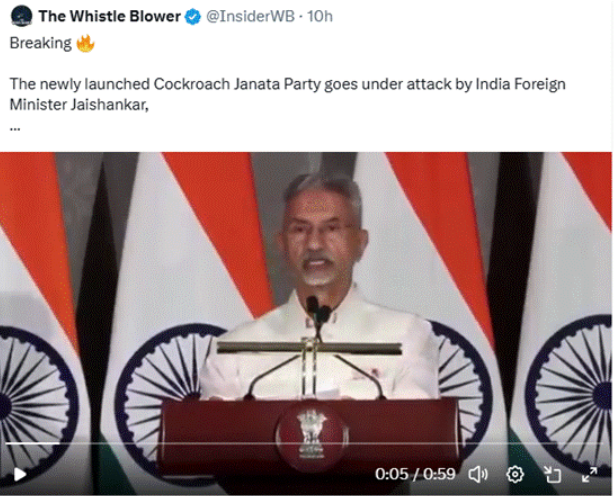
Fact Check
To verify the claim, we converted the viral clip into key frames and conducted a reverse image search. During the research, we found the original video uploaded on May 24, 2026, on the official YouTube channel of the Ministry of External Affairs.
The video was captioned:“Press conference of EAM Dr S Jaishankar and US Secretary of State Marco Rubio.”
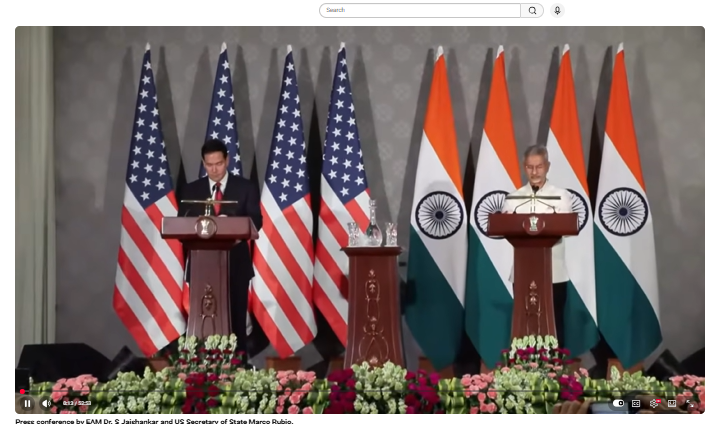
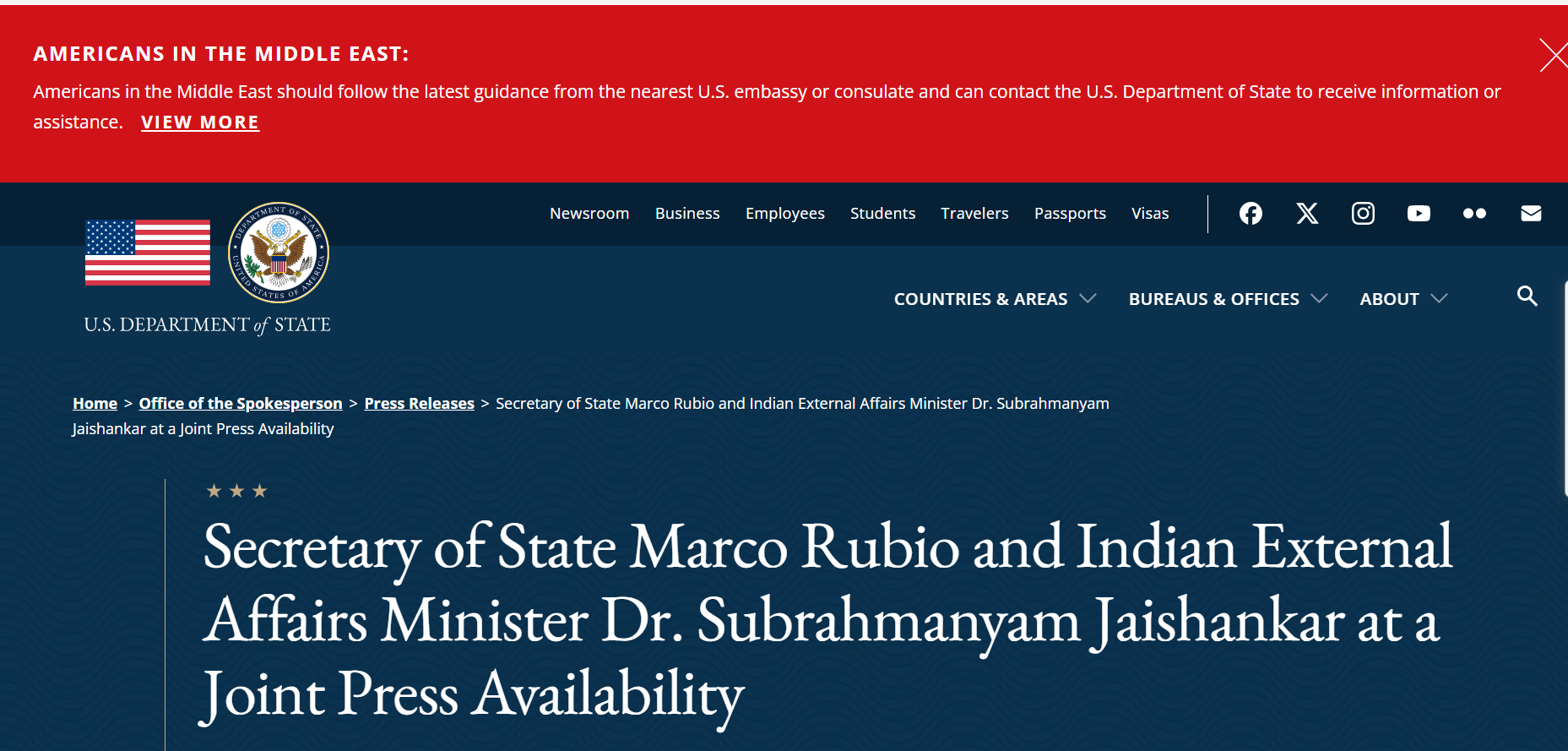
A review of the full press conference confirmed that Jaishankar made no mention of any “Cockroach Party,” its alleged handlers, or any Pakistani or Iranian proxy network. Further verification of the official transcripts published by both the Indian Ministry of External Affairs and the United States Department of State also found no references to the terms “Cockroach Party,” “handlers,” “Pakistani proxy,” or any statements matching the viral claim.
https://www.state.gov/releases/office-of-the-spokesperson/2026/05/secretary-of-state-marco-rubio-and-indian-external-affairs-minister-dr-subrahmanyam-jaishankar-at-a-joint-press-availability
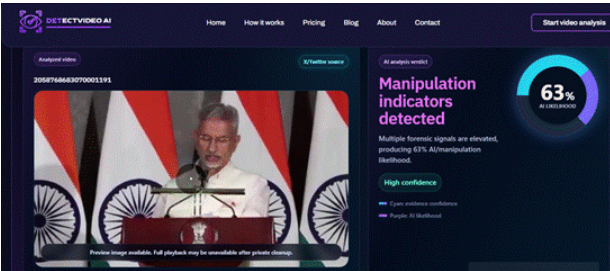
In the final stage of verification, the viral clip was analysed using an AI detection tool. The analysis suggested that the audio had been manipulated and that the video appeared to be edited. The tool indicated a 63 percent probability that the clip had been altered using AI-based editing techniques.
Conclusion
The research confirms that the viral claim is fake. S. Jaishankar did not make any statement regarding the “Cockroach Party” or its alleged handlers during the press conference. The viral clip has been edited and is being shared with misleading claims.

Related Blogs

Executive Summary
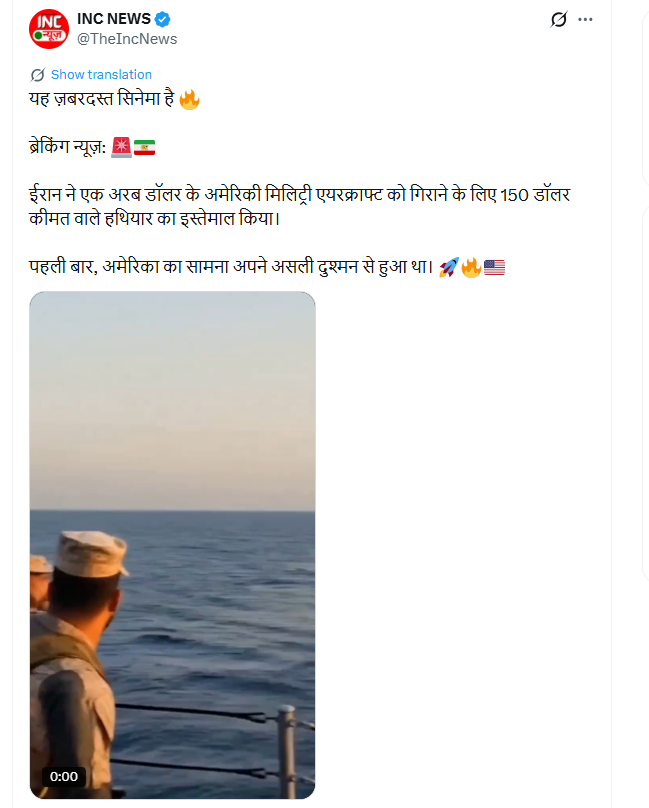
A video is being widely shared on social media showing armed personnel attacking a helicopter. The video is being circulated with the claim that Iranian soldiers shot down a US military helicopter near the Strait of Hormuz amid rising tensions between the United States and Iran. CyberPeace Research Wing research found the claim to be false. The viral video is AI-generated and is being shared with misleading context.
Claim:
An X (formerly Twitter) user shared the video on June 10, 2026, with the caption: “This is great cinema. Breaking News: Iran used a $150 weapon to bring down a $1 billion US military aircraft. For the first time, America has met its real enemy.”
Post link and archive link can be seen below:
https://x.com/TheIncNews/status/2064758088012607544?s=20
https://archive.ph/LUDUz
Fact-Check
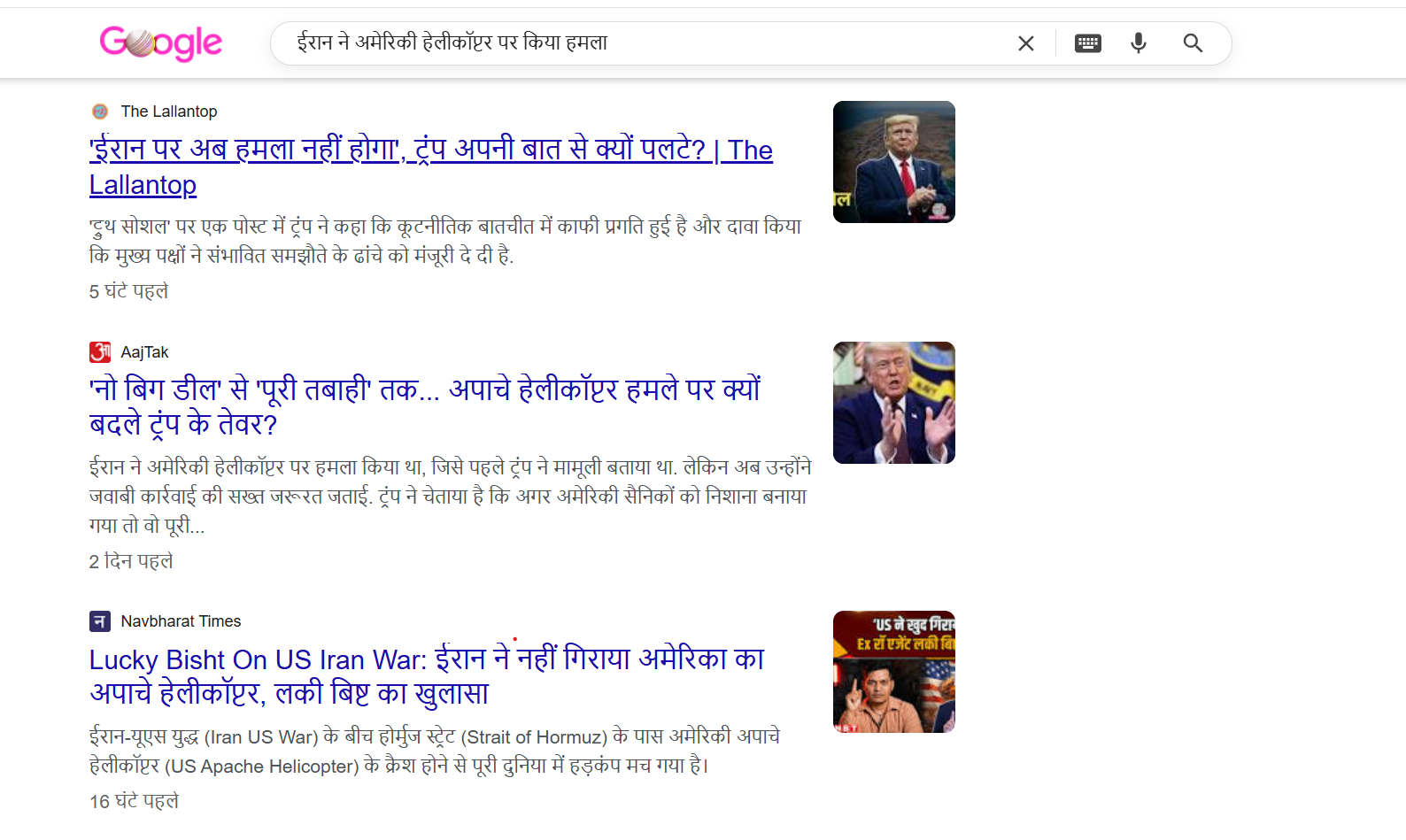
To verify the claim, we conducted a keyword search on Google. However, no credible media reports were found supporting this claim.
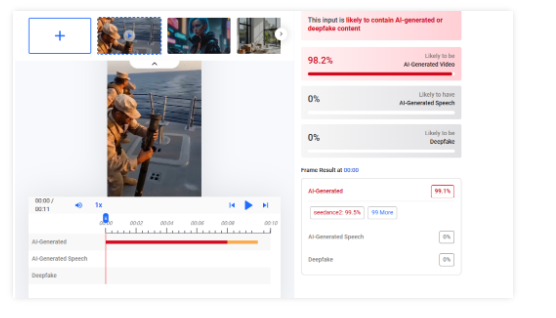
On closely examining the video, we suspected it to be AI-generated. We then analyzed it using the AI detection tool HIVE MODERATION. The results indicated that the video is 98% likely to be AI-generated.
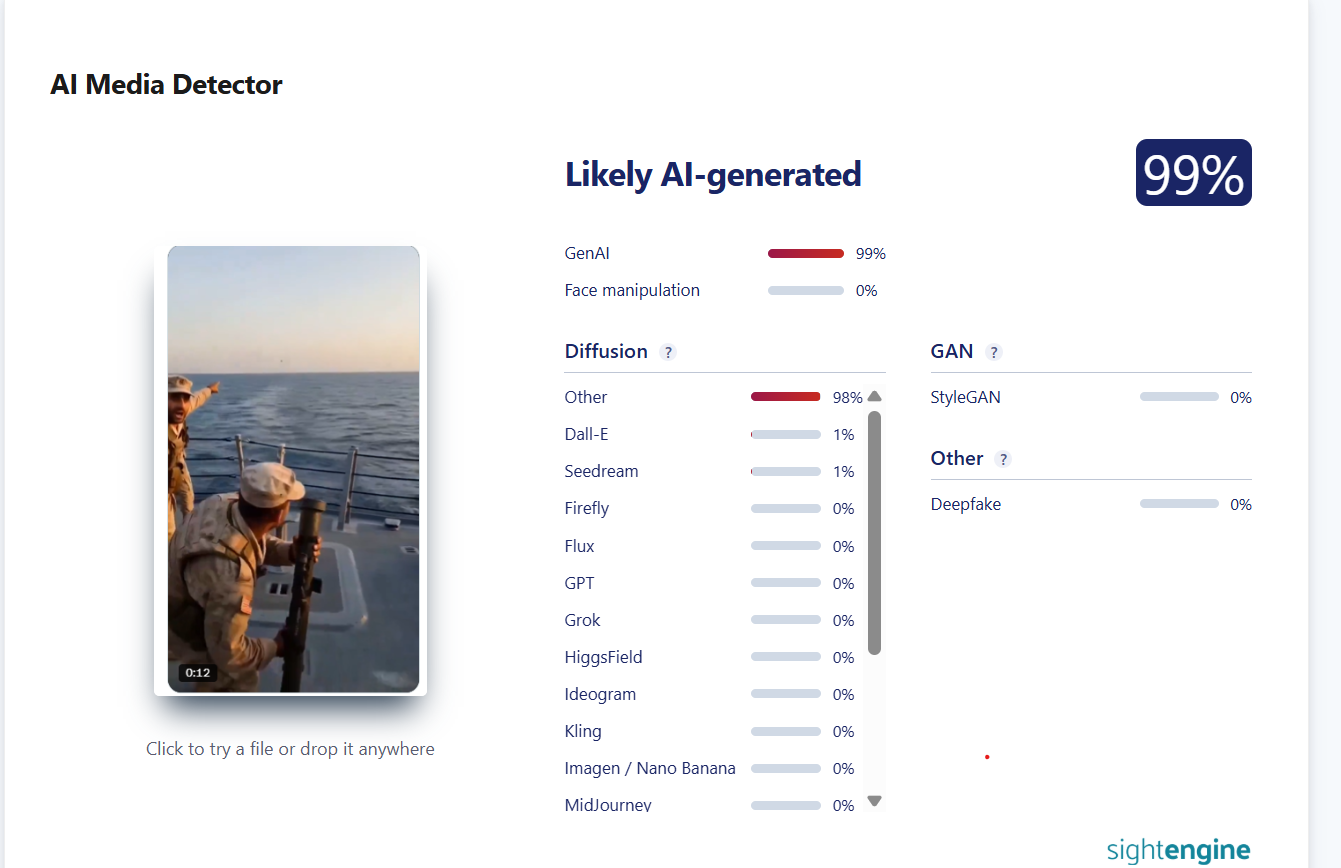
In the next step, we further analyzed the video using another AI detection tool, SIGHTENGINE. The results showed a 99% probability of the video being AI-generated.
Conclusion:
Our research confirms that the viral video is AI-generated and does not depict any real-world incident. The content is being circulated with a misleading and false narrative, falsely linking it to ongoing geopolitical tensions, despite there being no credible evidence or verified reports supporting such a claim.

Introduction
In today's relentless current of information, where social media is oftentimes both the stage and the playwright, the line between reality and spectacle can become distressingly blurry. In such a virtual Pantheon, the conflation of truth and fiction has recently surfaced in a particularly contentious instance. The central figure is Poonam Pandey, an entertainment personality known for transgressing traditional contours of celebrity boldness. Pandey found herself ensnared in a narrative of her own orchestration—a grim hoax purporting she had succumbed to cervical cancer. This deceptive foray, rather than awakening public consciousness as intended, spiralled into an ominous fable about the malignant spread of misinformation and the profound moral dilemmas it engenders.
The Deception
The tapestry of this event was woven with threads of tragedy and deception, framing Pandey both as the tragic hero and the ill-fated architect of a spectacle that unfolded with a haunting familiarity evocative of ancient Greek dramas. The monumental pillar of social media, on what seemed to be an ordinary day, was shattered by the startling declaration of Pandey's untimely passing. The statement, as bereft of nuance as it was devastating, proclaimed: 'We are deeply grieved to announce the loss of our cherished Poonam to cervical cancer.' The emotional pulse of the Indian Film Industry was jolted; waves of homage inundated the digital space, each tribute a poignant echo of the shock that rippled through her fanbase. Yet the crux of the matter had yet to be unveiled.
As the world grappled with this news, the scenario took an unforeseen detour. Poonam Pandey made a re-entrance onto the world stage, alive, revealing her alleged demise to be nothing more than a macabre masquerade. The public's reaction to this revelation was a stratified symphony of emotions—indignation mingled with disbelief, with an underlying crescendo of betrayal. Pandey's defense postured her act as a last resort to draw attention to the silent yet pervasive threat of cervical cancer. In the ensuing mire of reactions, an inescapable quandary emerged: is it ever permissible to employ deceit for the sake of presumed publicity?
The Chaos
Satyajeet Tambe, an esteemed Maharashtra legislator, emerged amidst the churning chaos as a paragon of principled reason. Advocating that such mendacious stunts, playing the chords of public emotion and adulterating truth, should be met with legal repercussions, Tambe called for judicious action against Pandey. His imploration resonated with the necessity of integrity in the public domain, stating, 'The announcement of an influencer/model succumbing to cervical cancer should not be wielded as a tool for awareness.' His pronouncement sent reverberations through the collective conscience, echoing the need for accountability in the face of such transgressions.
Repercussion
The All Indian Cine Workers Association, a custodian of the film industry's values, also voiced its reproach. They urged for an FIR to be lodged against Poonam Pandey, underlining their sentiments with disappointment and a keen sense of betrayal. Within their condemnation lay a profound recognition of the elevated emotional investment inherent in their industry—an industry where the reverence for life and the abhorrence of deceit intertwine, making the cultivation of such lowly stunts anathema.
This spectacle, while unique in the temerity of its execution, mirrors the broader pathological wave of misinformation that corrodes the foundations of our digital era: the malady of fake news. When delineated, fake news finds its essence as information chiselled specifically to deceive, a form of communication that is not merely slanted but entirely devoid of authenticity, manufactured with nefarious intent. A protean adversary, fake news adeptly masquerades as trustworthy news, ensnaring the unsuspecting in its tendrils. Its purveyors span a spectrum—from shadowy figures to ostensibly benign social media accounts—all contributing to a dystopian fabric where truth is persistently imperilled.
The conjurers of these illusions are, in a sense, cunning illusionists ensconced behind curtains of anonymity or masquerading under a cloak of transparency. They craft elaborate illusions devoid of truth, but dripping with sufficient plausibility to ensnare those who yearn for simplicity in an increasingly complex world. Destabilizing forces, such as hyper partisan media outlets, regurgitate a concoction of concocted 'facts' and distortions, deliberately smudging the once-clear line between empirical truth and partisan fabrication.
The Aftermath
The Poonam Pandey episode stands as a harrowing beacon of the ethical abyss we face. It compels us to confront the irony of utilising falsity to raise awareness for laudable causes and considers the ramifications for public figures influencing the dissemination of information. The tempest around this event demonstrates the potent gravitational pull of information and the overarching need for the conscientious stewardship of its power.
Yet, as we sail through the murky waters of the digital expanse, where the allure of sensationalism and clickbait headlines is ever-present, our vigilance must not wane. The imperative of truth cannot come at the altar of awareness or sensationalism. The sanctity of fact anchors our understanding of reality; devoid of it, we are adrift in an ocean of confusion and misinformation.
In the dust settled after the Poonam Pandey debacle, the contours of a new discourse have emerged, harboring vital interrogations. How do we balance the drive for poignant awareness initiatives against the cardinal principle of truth? What mechanisms can ensure that health campaigns and their noble aspirations are not tainted by the allure of deception? Addressing these queries is not a solitary task for policymakers or influencers but, indeed, a collective societal responsibility that will define our cultural ethics and the legacy we wish to preserve.
Conclusion
As we contemplate the broader implications of this incident, let us not allow its sensational nature to eclipse the very real and pressing issue of cervical cancer—a condition that, beyond the glare of controversy, continues to shadow lives with its lethal silence. Instead, let our focus pivot towards tangible, truth-driven efforts aimed at education and empowerment. Truth, after all, is the beacon that dispels the murky shadows of ignorance and guides us toward enlightenment and healing.
References
- https://www.hindustantimes.com/india-news/poonam-pandey-in-trouble-as-maharashtra-politician-seeks-case-for-faking-her-death-101707005742992.html
- https://www.nagpurtoday.in/state-mlc-tambe-demands-police-action-against-poonam-pandey-for-faking-her-death/02051417

Executive Summary
A misleading advertisement circulating in social media providing attractive offers like iPhone15, AirPods and Smartwatches from the Indian e-commerce platform ‘Myntra’. This “Myntra - Festival Gifts” scam aims to attract the unsuspecting users into a series of redirects and fake interactions to compromise their personal information and devices. It is important to stay vigilant to protect ourselves from misleading attractive offers. Through this report, the Research Wing of CyberPeace explains about a series of processes that happens when the link gets clicked. Through this knowledge, we aim to provide awareness and empower the users to guard themselves and not fall into deceptive offers that aim to scam them.
False Claim
The widely shared WhatsApp message claims that Myntra is offering a wide range of high-valued prizes including the latest iPhone 15, AirPods, various smartwatches among all as a Festival Gift promotion. The campaign invites the users to click on the link provided and take a short quiz to be eligible for the prize.

The Deceptive Scheme
- The link in the social media post is tailored to work only on mobile devices, users are taken through a chain of redirects.
- Users are greeted with the Myntra's "Big Fashion Festival" branding accompanied by Myntra’s logo once they reach the landing page, which gives an impression of authenticity.
- Next, a simple quiz asks basic questions about the user's shopping experience with Myntra, their age, and gender.
- On the bottom of the quiz, there is a comment section that shows the comments from users who are supposedly provided with the prizes to look real,
- After the completion of the quiz, users are presented with a Spin-to-Win mechanism, to win the prize.
- After winning, a congratulatory message is displayed which says that the user has won an iPhone 15.
- The final step requires the user to share the campaign over WhatsApp in order to claim the prize.
Analyzing the Fraudulent Campaign
- The use of Myntra's branding and the promise of exclusive, high-value prizes are designed to attract users' interest.
- The fake comments and social proof elements aim to create a false sense of legitimacy and widespread participation, making the offer seem more credible.
- The series of redirects, quizzes, and Spin-to-Win mechanics are tactics to keep users engaged and increase the likelihood of them falling for the scam.
- The final step of sharing the post on WhatsApp is a way for the scammers to further spread the campaign and compromise more victims. Through sharing the link over WhatsApp, users become unaware accomplices that are simply assisting the scammers to reach an even bigger audience and hence their popularity.
- The primary objectives of such scams are to gather users' personal information and potentially gain access to their devices. By luring users with the promise of exclusive gifts and creating a false sense of legitimacy, the scammers aim to exploit user trust and compromise their data, leading to potential identity theft, financial fraud, or the installation of potentially unwanted softwares.
- We have also cross-checked and as of now there is no well established and credible source or any official notification that has confirmed such an offer advertised by Myntra.
- Domain Analysis: If we closely look at the viral message, it is clearly visible that the scammers mentioned myntra.com in the url. However, the actual url takes the user to a different domain as the campaign is hosted on a third party domain instead of the official Website of Myntra, this raised suspicion. This is the common way to deceive users into falling for a Phishing scam. Whois information reveals that the domain has been registered not long ago i.e on 8th April 2024, just a few days back. Cybercriminals used Cloudflare technology to mask the actual IP address of the fraudulent website.

- Domain Name: MYTNRA.CYOU
- Registry Domain ID: D445770144-CNIC
- Registrar WHOIS Server: whois.hkdns.hk
- Registrar URL: http://www.hkdns.hk
- Updated Date: 2024-04-08T03:27:58.0Z
- Creation Date: 2024-04-08T02:58:14.0Z
- Registry Expiry Date: 2025-04-08T23:59:59.0Z
- Registrar: West263 International Limited
- Registrant State/Province: Delhi
- Registrant Country: IN
- Name Server: NORMAN.NS.CLOUDFLARE.COM
- Name Server: PAM.NS.CLOUDFLARE.COM
CyberPeace Advisory and Best Practices
- Do not open those messages received from social platforms in which you think that such messages are suspicious or unsolicited. In the beginning, your own discretion can become your best weapon.
- Falling prey to such scams could compromise your entire system, potentially granting unauthorized access to your microphone, camera, text messages, contacts, pictures, videos, banking applications, and more. Keep your cyber world safe against any attacks.
- Never, in any case, reveal such sensitive data as your login credentials and banking details to entities you haven't validated as reliable ones.
- Before sharing any content or clicking on links within messages, always verify the legitimacy of the source. Protect not only yourself but also those in your digital circle.
- For the sake of the truthfulness of offers and messages, find the official sources and companies directly. Verify the authenticity of alluring offers before taking any action.
Conclusion:
The “Myntra - Festival Gift” scam is a kind of manipulation in which the fraudsters exploit the trust of the users and take advantage of a popular e-commerce website. It is equally crucial to equip the users by imparting them knowledge on fraudulent behavior tactics like impersonating brands, creating fake social proof and application of different engagement strategies. We are required to remain alert and stand firm against cyber attacks. Be careful, make sure that information is verified and share awareness to help make a safe online environment for all users.
