
#FactCheck -AI-Altered Clip Falsely Attributes Taliban Comments to General Upendra Dwivedi
Executive Summary
A video clip of Indian Army Chief Upendra Dwivedi is being widely shared across social media platforms with the claim that he criticised the Indian government's policy towards Taliban-ruled Afghanistan. In the viral clip, the Army Chief is allegedly heard saying that India is doing nothing except sending money to the Taliban government due to the Centre’s failed policies.
However, CyberPeace Research Wing research found the claim to be false. The viral video is a deepfake. In the original footage, General Upendra Dwivedi was speaking about Operation Sindoor and the preparedness of the Indian Armed Forces for a possible “Operation Sindoor 2.0.” He made no remarks regarding the Taliban or the government’s Afghanistan policy.
Claim
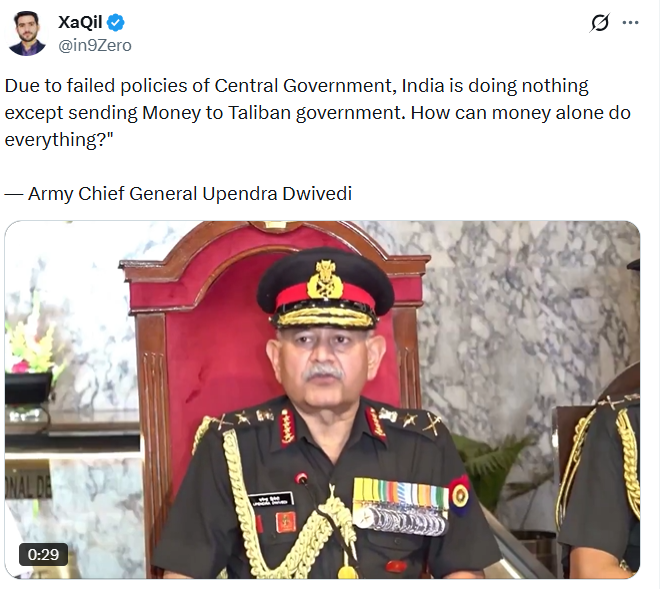
An X user named “XaQil” shared the viral video on May 31, 2026, with the caption:“Due to failed policies of the Central Government, India is doing nothing except sending Money to Taliban government. How can money alone do everything?” — Army Chief General Upendra Dwivedi.
Fact Check
In the viral video, General Dwivedi is purportedly heard making remarks about India’s Afghanistan policy, the Taliban, Pakistan, Iran, and India’s diplomatic position. To verify the claim, we searched for the original source of the video. A reverse image search of key frames led us to the authentic footage posted by news agency ANI on its official X account on May 30, 2026.
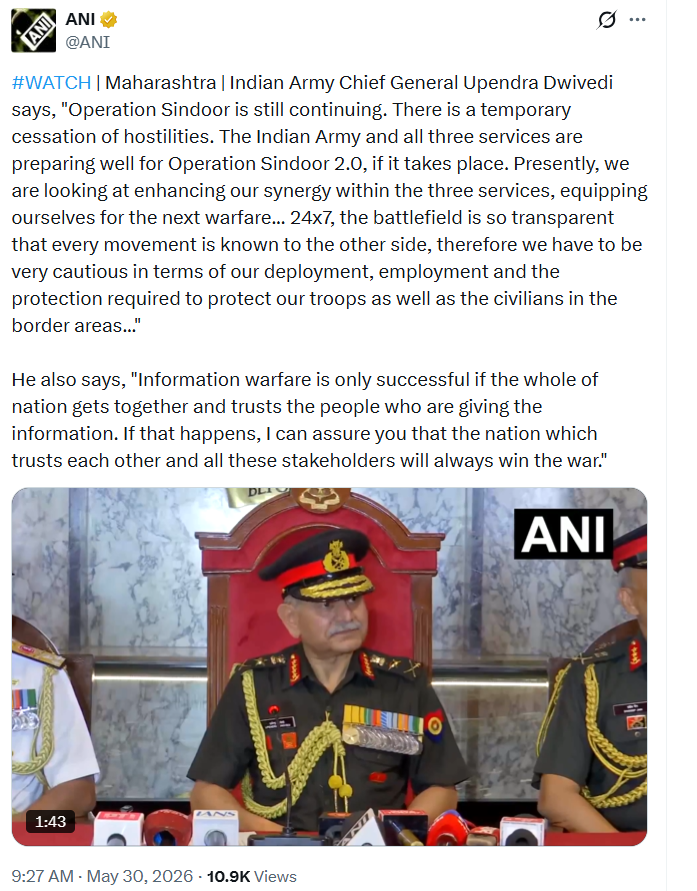
In the original video, General Dwivedi was responding to a question about Operation Sindoor. He stated that the operation was still ongoing, hostilities had only paused temporarily, and that the Indian Armed Forces were fully prepared if “Operation Sindoor 2.0” became necessary.
He also spoke about enhancing coordination among the three services and maintaining operational readiness.”
No part of his statement mentioned the Taliban, Afghanistan, Pakistan, Iran, or criticism of the Central Government.
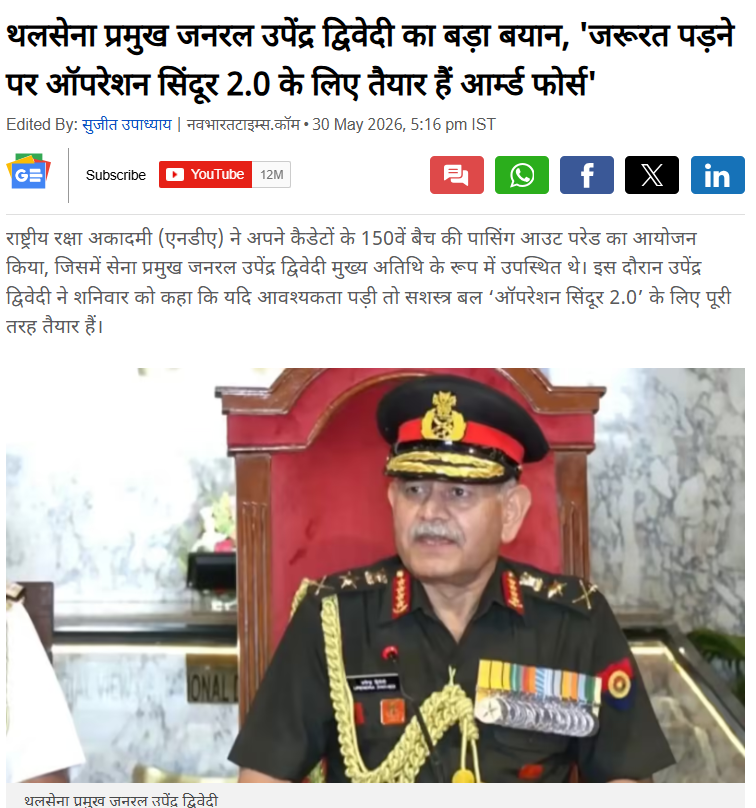
Further corroboration came from media reports covering the same event. According to a report published by Navbharat Times on May 30, 2026, General Dwivedi made the remarks during the passing-out parade of the 150th course of the National Defence Academy (NDA), where he attended as the chief guest. He reiterated that the armed forces were fully prepared for “Operation Sindoor 2.0” if required.
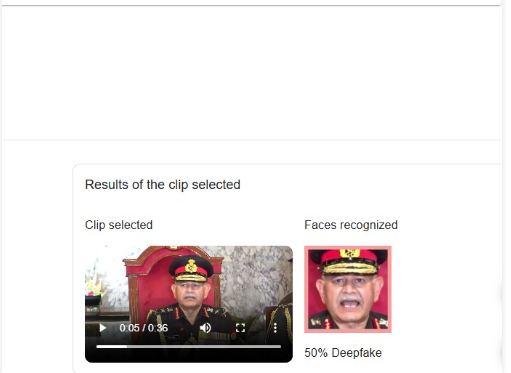
Since the content of the viral clip did not match the original statement, we examined it using InVID’s MeVer Deepfake Detector. The tool flagged signs of AI manipulation and indicated that the video had likely been altered.
Conclusion
Cyber Peace Foundation found that the viral video purportedly showing Army Chief General Upendra Dwivedi criticising the Indian government’s policy towards the Taliban is a deepfake. The Army Chief made no such remarks. The original video was recorded during an NDA event, where he spoke about Operation Sindoor and the preparedness of the Indian Armed Forces for a possible future operation. The viral clip has been manipulated using AI to spread a false narrative.

Related Blogs
Executive Summary
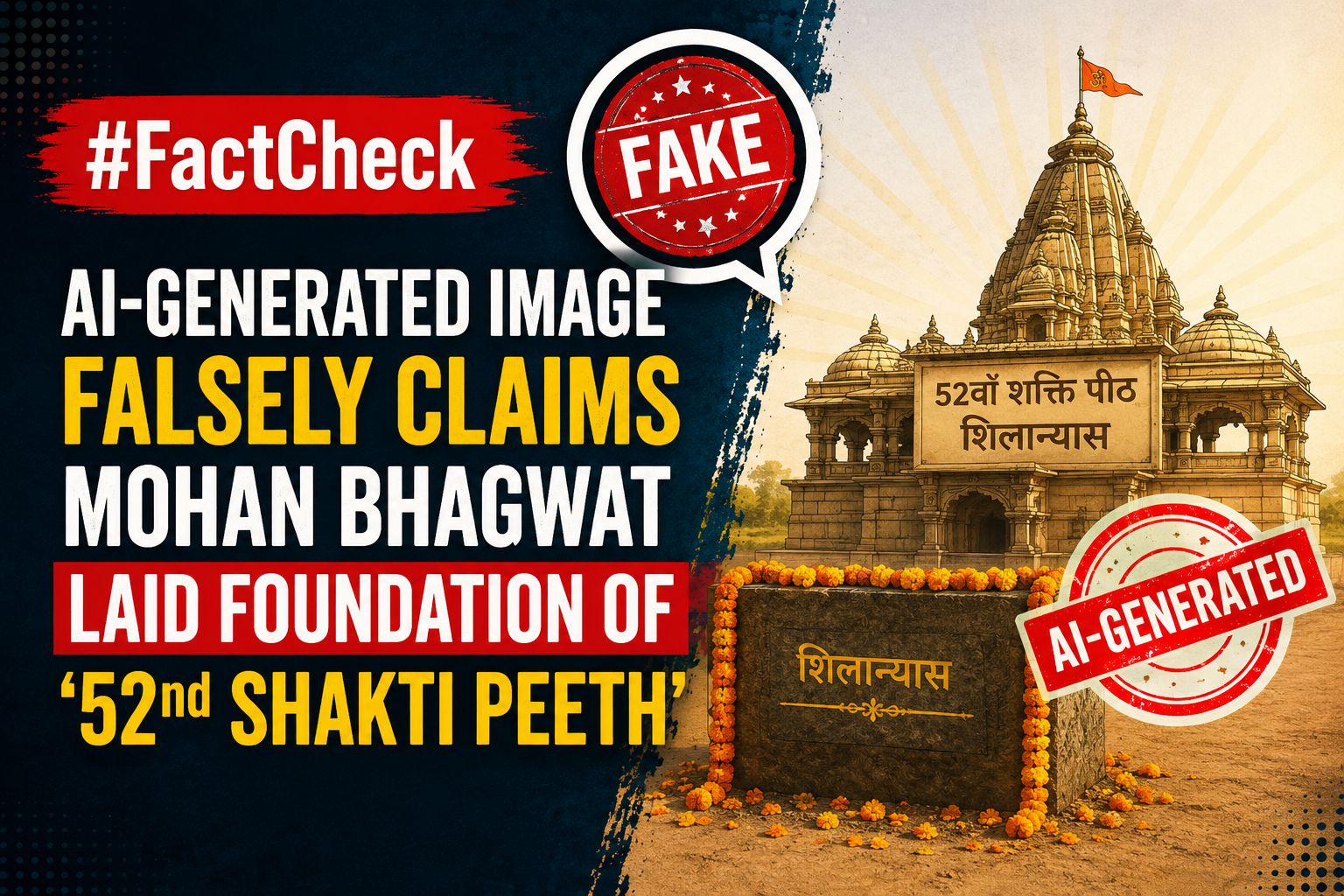
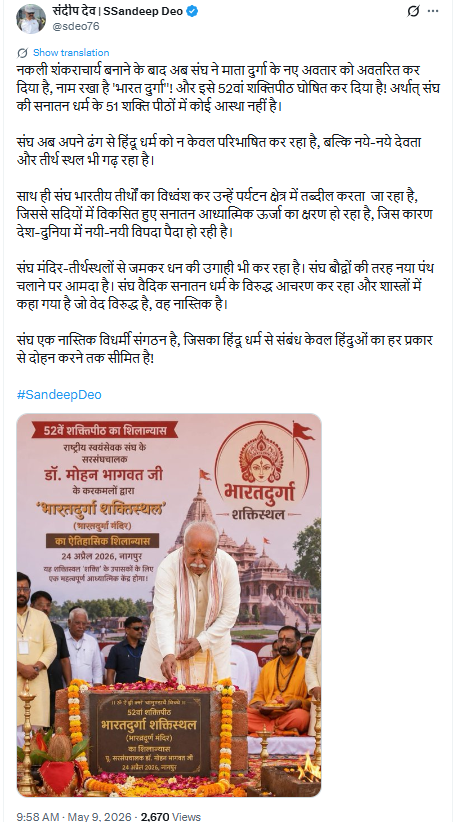
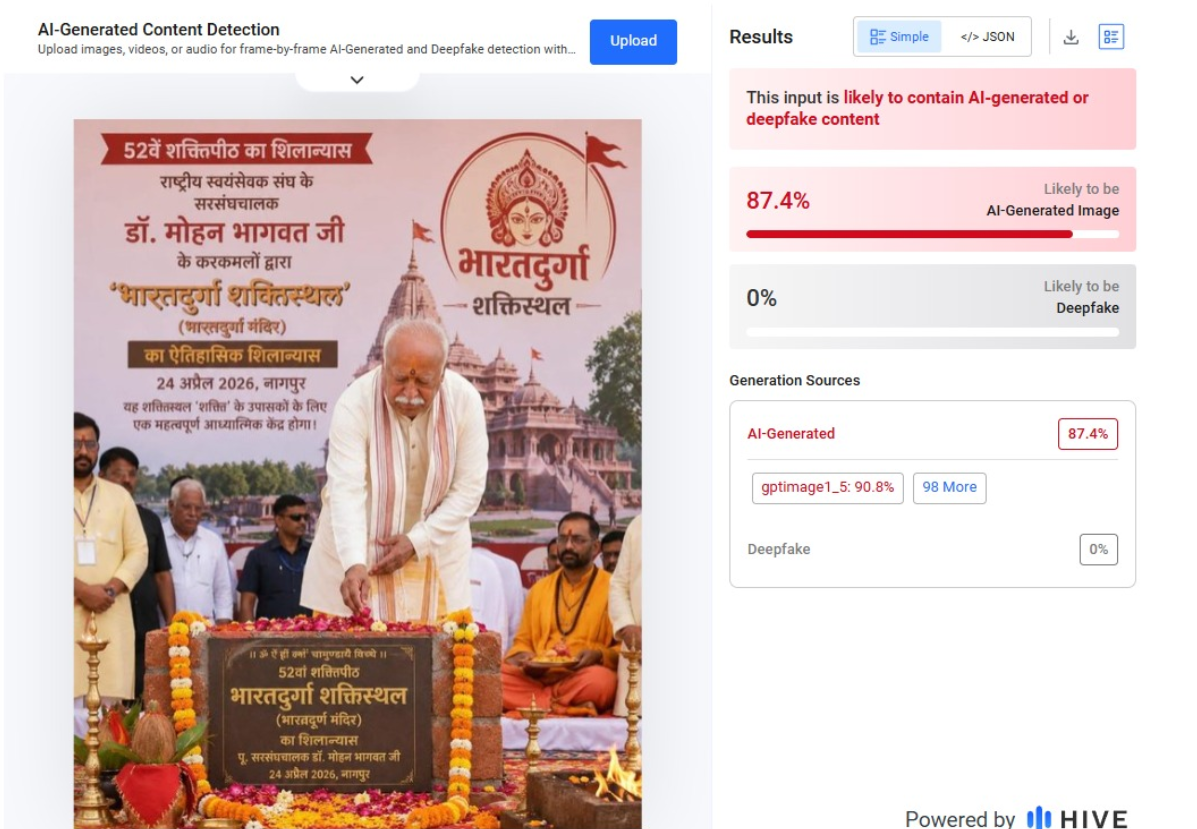
A picture of Mohan Bhagwat is going viral on social media, showing him allegedly laying the foundation stone of a so-called “52nd Shakti Peeth” named Bharatdurga. Users are claiming that the RSS chief insulted Sanatan Dharma by creating a new Shakti Peeth in Nagpur. Research by CyberPeace Research Wing found that the claim is false. The viral image is AI-generated, and Mohan Bhagwat did not inaugurate any “52nd Shakti Peeth.” In reality, he laid the foundation stone of the Bharatdurga Temple.
Claim
An X user named Sandeep Dev shared the viral image and alleged that after creating “fake Shankaracharyas,” the RSS had now introduced a new form of Goddess Durga called “Bharat Durga” and declared it the 52nd Shakti Peeth. The post further claimed that the RSS was redefining Hinduism and creating new religious sites.
Fact Check
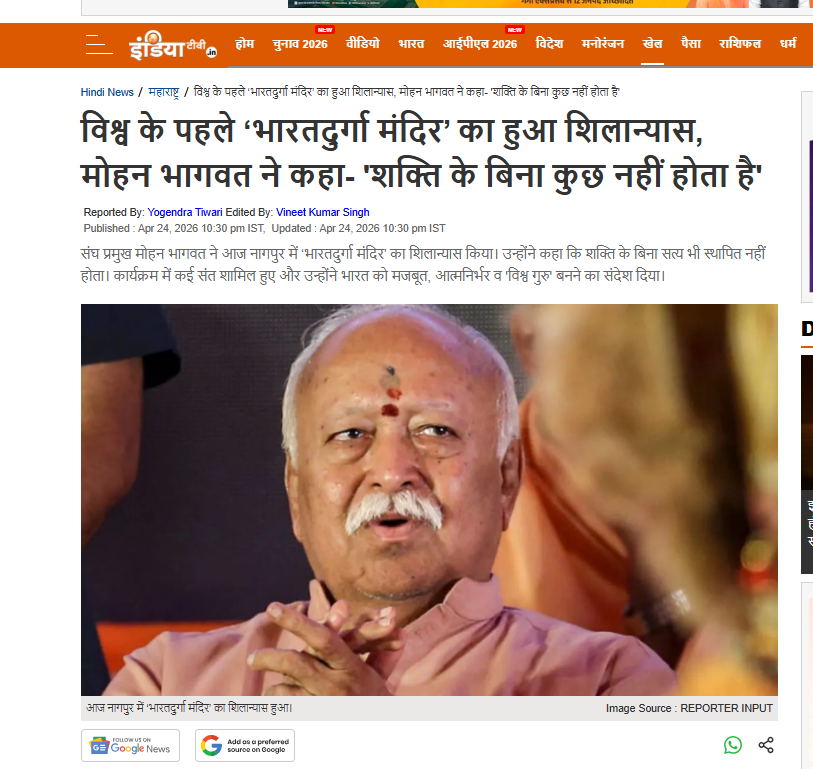
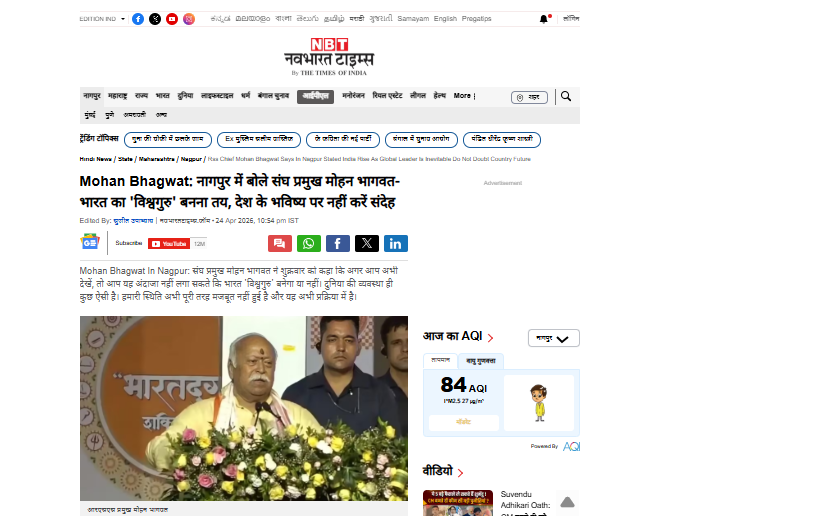
To verify the claim, we searched relevant keywords and found reports published on April 24, 2026, by India TV and Navbharat Times. According to these reports, Mohan Bhagwat laid the foundation stone of the world’s first Bharatdurga Temple in Nagpur during a ceremony organized at the Jamtha campus of Dr. Abaji Thatte Seva and Research Institute. Several prominent saints and religious leaders attended the event. Importantly, none of the reports described the temple as the “52nd Shakti Peeth.”
Further research led us to the full video of the foundation ceremony uploaded on the YouTube channel of Devendra Fadnavis. The stage backdrop and video thumbnail clearly mention “Bharatdurga Temple Foundation Ceremony.” However, the viral image frame was not visible anywhere in the authentic footage.

We also analyzed the viral image using AI detection tools, which indicated that the image was AI-generated.
Conclusion
Our research confirms that the claim about Mohan Bhagwat laying the foundation of a “52nd Shakti Peeth” is false. The viral image is AI-generated. In reality, he participated in the foundation ceremony of the Bharatdurga Temple in Nagpur.
%20(1).webp)
Introduction
The Central Electricity Authority (CEA) has released the Draft Central Electricity Authority (Cyber Security in Power Sector) Regulations, 2024, inviting ‘comments’ from stakeholders, including the general public, which are to be submitted by 10 September 2024. The new regulation is intended to make India’s power sector more cyber-resilient and responsive to counter emerging cyber threats and safeguard the nation's power infrastructure.
Key Highlights of the CEA’s New (Cyber Security in Power Sector) Regulations, 2024
- Central Electricity Authority has framed the ‘Cyber Security in Power Sector Regulations, 2024’ in the exercise of the powers conferred by sub-section (1) of 177 of the Electricity Act, 2003 in order to make regulations for measures relating to Cyber Security in the power sector.
- The scope of the regulation entails that these regulations will be applicable to all Responsible Entities, Regional Power Committees, Appropriate Commission, Appropriate Government and Associated Power Sector Government Organizations, and Training Institutes recognized by the Authority, Authority and Vendors.
- One key aspect of the proposed regulation is the establishment of a dedicated Computer Security Incident Response Team (CSIRT) for the power sector. This team will coordinate a unified cyber defense strategy throughout the sector, establishing security frameworks, and serving as the main agency for handling incident response and recovery. The CSIRT will also be responsible for creating/developing Standard Operating Procedures (SOPs), security policies, and best practices for incident response activities in consultation with CERT-In and NCIIPC. The detailed roles and responsibilities of CSIRT are outlined under Chapter 2 of the said regulations.
- All responsible entities in the power sector as mentioned under the scope of the regulation, are mandated to appoint a Chief Information Security Officer (CISO) and an alternate CISO, who need to be Indian nationals and who are senior management employees. The regulations specify that these officers must directly report to the CEO/Head of the Responsible Entity. Thus emphasizing the critical nature of CISO’s roles in safeguarding the nation’s power grid sector assets.
- All Responsible Entities shall establish an Information Security Division (ISD) dedicated to ensuring Cyber Security, headed by the CISO and remain operational around the clock. The schedule under regulation entails that the minimum workforce required for setting up an ISD is 04 (Four) officers including CISO and 04 officers/officials for shift operations. Sufficient workforce and infrastructure support shall be ensured for ISD. The detailed functions and responsibilities of ISD are outlined under Chapter 5 regulation 10. Furthermore, the ISD shall be manned by sufficient numbers of officers, having valid certificates of successful completion of domain-specific Cyber Security courses.
- The regulation obliged the entities to have a defined, documented and maintained Cyber Security Policy which is approved by the Board or Head of the entity. The regulation also obliged the entities to have a Cyber Crisis Management Plan (CCMP) approved by the higher management.
- As regards upskilling and empowerment the regulation advocates for organising or conducting periodic Cyber Security awareness programs and Cyber Security exercises including mock drills and tabletop exercises.
CyberPeace Policy Outlook
CyberPeace Policy & Advocacy Vertical has submitted its detailed recommendations on the proposed ‘Cyber Security in Power Sector Regulations, 2024’ to the Central Electricity Authority, Government of India. We have advised on various aspects within the regulation including harmonisation of these regulations with other rules as issued by CERT-In and NCIIPC, at present. As this needs to be clarified which set of guidelines will supersede in case of any discrepancy that may arise. Additionally, we advised on incorporating or making modifications to specific provisions under the regulation for a more robust framework. We have also emphasized legal mandates and penalties for non-compliance with cybersecurity, so as to make sure that these regulations do not only act as guiding principles but also provide stringent measures in case of non-compliance.
References:

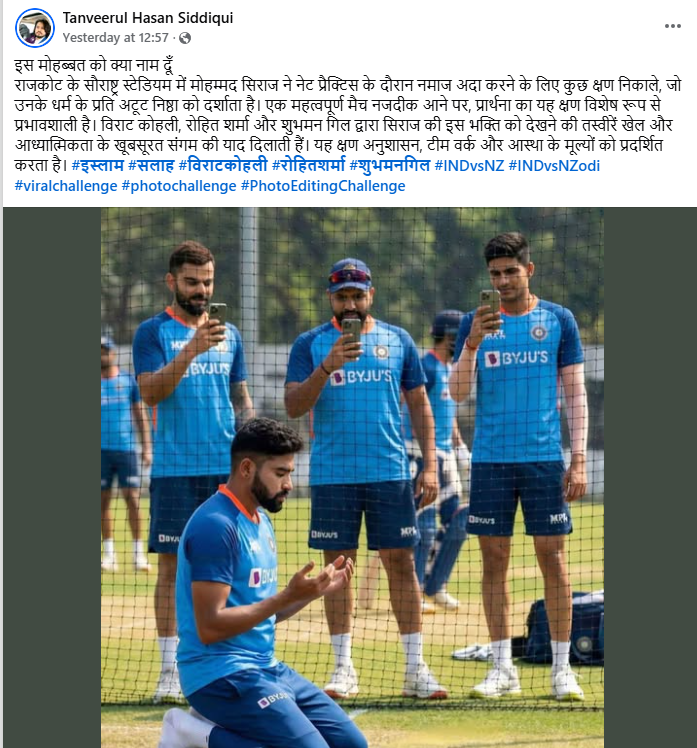
A photo circulating on social media claims to show Indian cricketer Mohammed Siraj offering namaz during net practice, while teammates Rohit Sharma, Virat Kohli and Shubman Gill are seen taking a selfie with him. Several users are sharing the image as a “beautiful moment,” portraying it as a symbol of faith, unity and sportsmanship. However, research by the Cyber Peace Foundation has found that the viral image is not genuine and has been AI-generated.
Claim
On January 14, 2026, multiple Facebook users shared the viral image with captions describing it as a touching scene from Rajkot’s Saurashtra Stadium. The posts claim that Mohammed Siraj took time out during net practice to offer prayers, reflecting his strong faith, while fellow cricketers Rohit Sharma, Virat Kohli and Shubman Gill respectfully captured the moment on camera.
Users praised the image as a rare blend of spirituality, discipline, teamwork and mutual respect, calling it a “beautiful confluence of sport and faith.”(Links to the post, archived version and screenshots are provided below.)
Fact Check:
On closely examining the viral image, several visual inconsistencies and unnatural elements were observed, raising suspicion that the picture may not be authentic.To verify this, the Cyber Peace Foundation analysed the image using the AI detection tool Hive Moderation. According to the tool’s assessment, the image showed a 99% likelihood of being AI-generated.

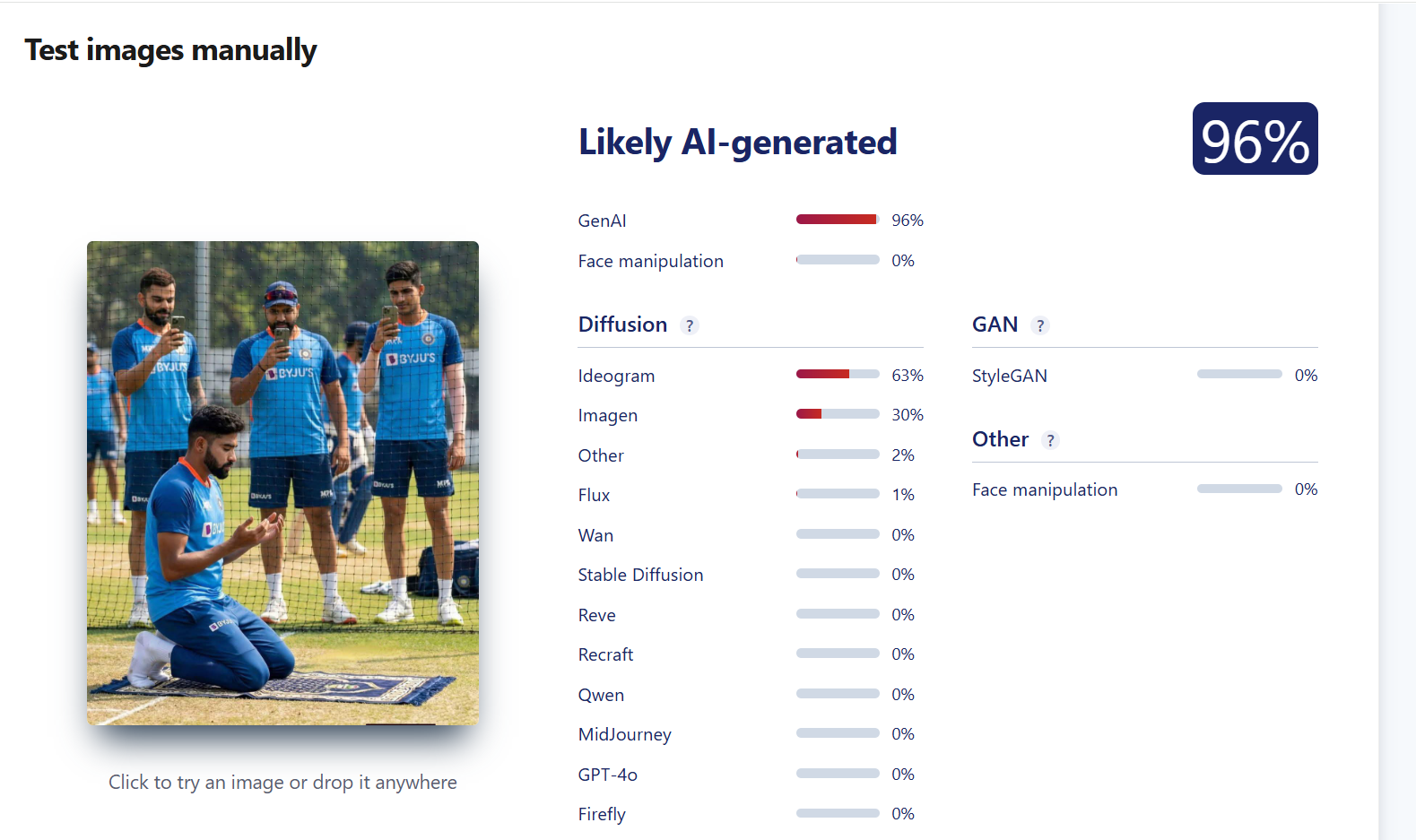
To further strengthen the verification, the image was also scanned using another AI detection platform, Sightengine. The results indicated a 96% probability that the image was generated using artificial intelligence.
Conclusion:
The research confirms that the viral image claiming to show Mohammed Siraj offering namaz during net practice, with Rohit Sharma, Virat Kohli and Shubman Gill taking a selfie, is not real.The photograph has been created using AI tools and falsely shared on social media, misleading users by presenting a fabricated scene as an authentic moment.
