
#FactCheck: AI-Generated Video Falsely Shared as Charkhi Dadri Firing Footage
Executive Summary
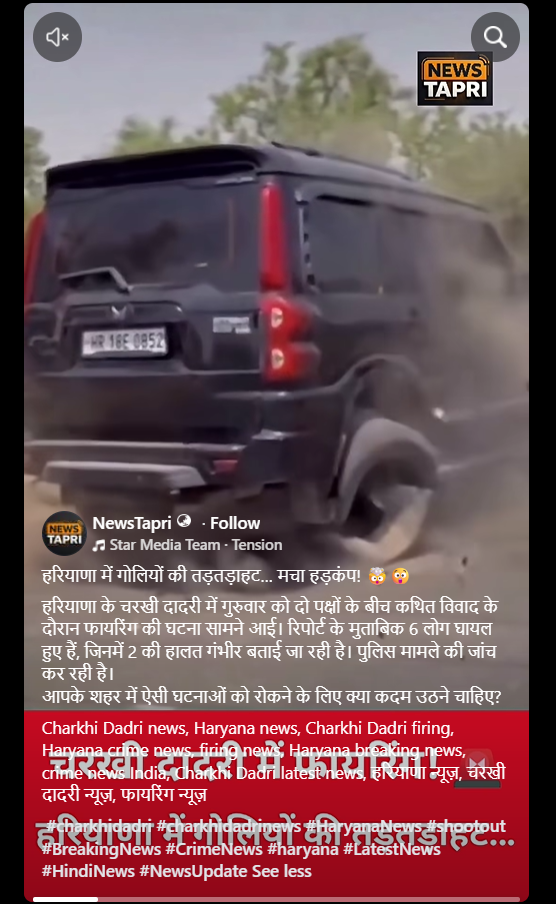
A video showing a black Scorpio being sprayed with bullets is being widely shared on social media.The video is being circulated with the claim that it shows the real footage of the firing incident in Haryana’s Charkhi Dadri on August 6, when around 30 rounds were allegedly fired at a Scorpio outside the City Police Station. The CyberPeace Research Wing found the claim to be false. The research established that the viral video is AI-generated and is being shared with a misleading claim.
Claim
A Facebook user shared the viral video with a caption stating, "Gunshots ring out in Haryana… panic grips the area! A firing incident reportedly took place in Charkhi Dadri, Haryana, during an alleged dispute between two groups on Thursday. According to reports, six people were injured, with two said to be in critical condition. Police are investigating the matter. What steps should be taken to prevent such incidents in your city?"
https://www.facebook.com/reel/991406893937983
FactCheck
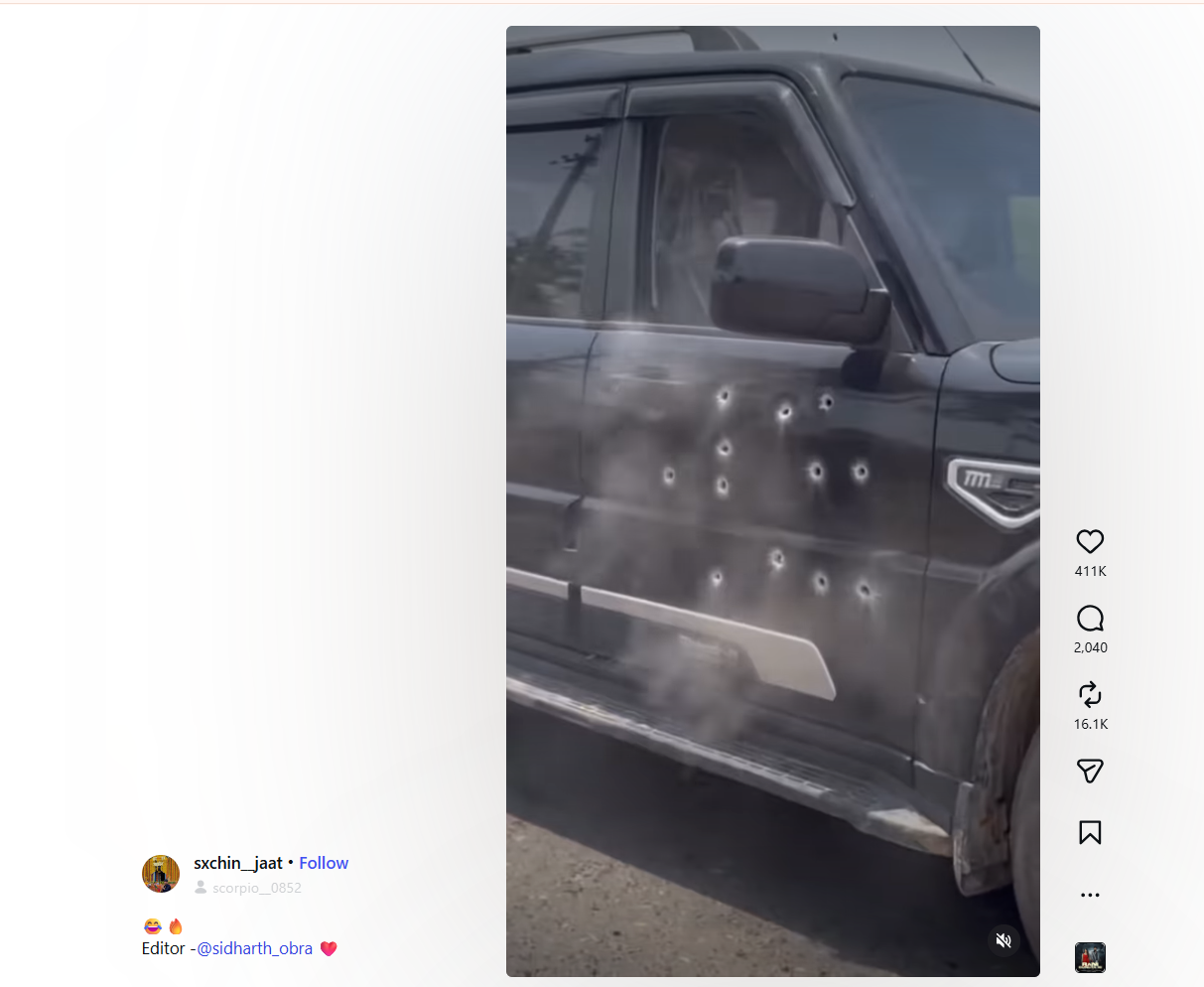
To verify the claim, we extracted keyframes from the viral clip and conducted a reverse image search. During the search, we found an older post containing the same video on an Instagram account named ‘sxchin_jaat’. The video was uploaded on May 12, well before the Charkhi Dadri firing incident of August 6.
The earlier upload establishes that the viral clip is unrelated to the firing incident in Charkhi Dadri.
https://www.instagram.com/reels/DYOOXiASH4h/
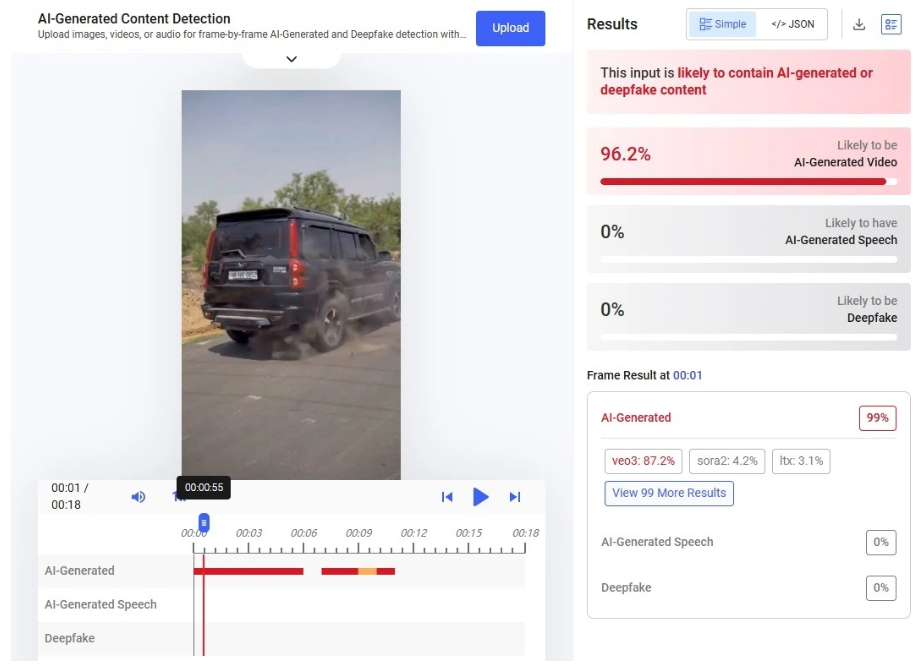
We then examined the viral video closely and noticed visual characteristics that raised suspicions that it could be AI-generated. The video was subsequently analysed using Hive Moderation, which indicated a 96 per cent probability of AI-generated content.
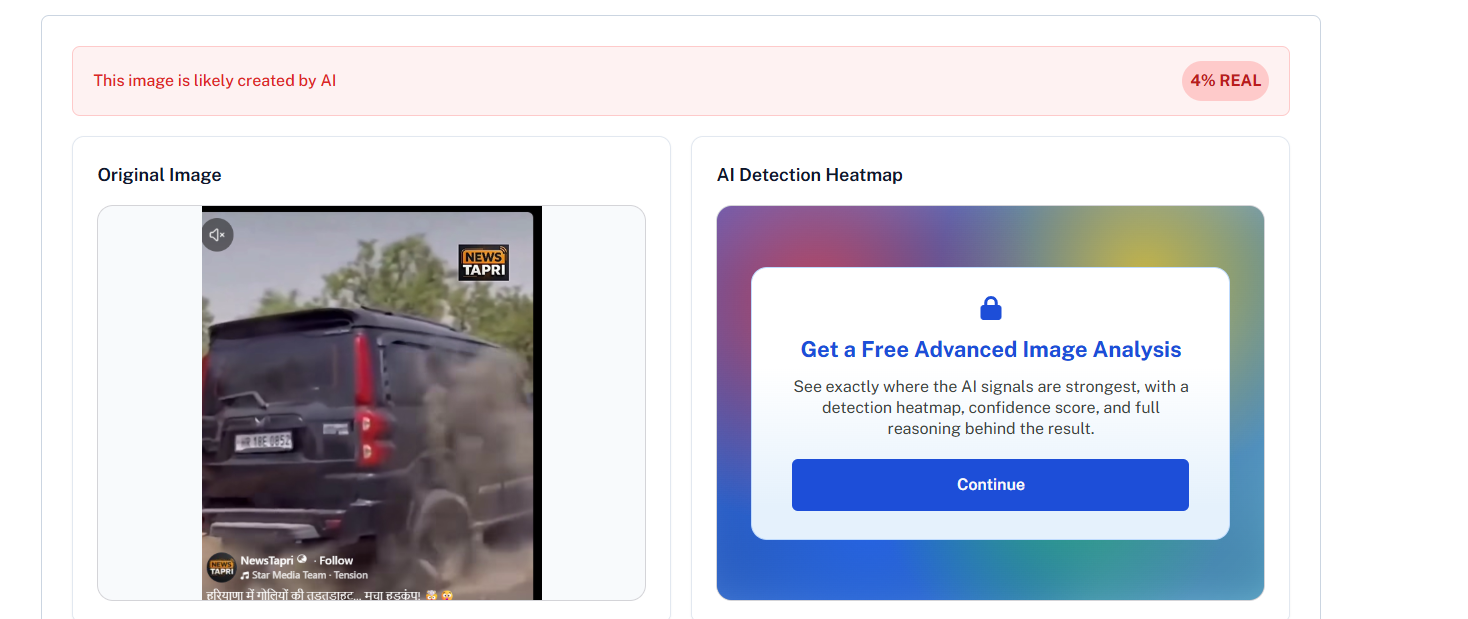
As part of the next stage of verification, we analysed the video using another AI detection tool, Undetectable AI. The tool also identified the viral video as AI-generated.
Conclusion
The viral claim is false. The video being shared as authentic footage of the August 6 firing incident in Charkhi Dadri is not genuine. The clip was posted online as early as May 12 and AI detection tools also identified it as AI-generated. The video is therefore being circulated with a misleading claim linking it to the Charkhi Dadri firing incident.

Related Blogs
Introduction
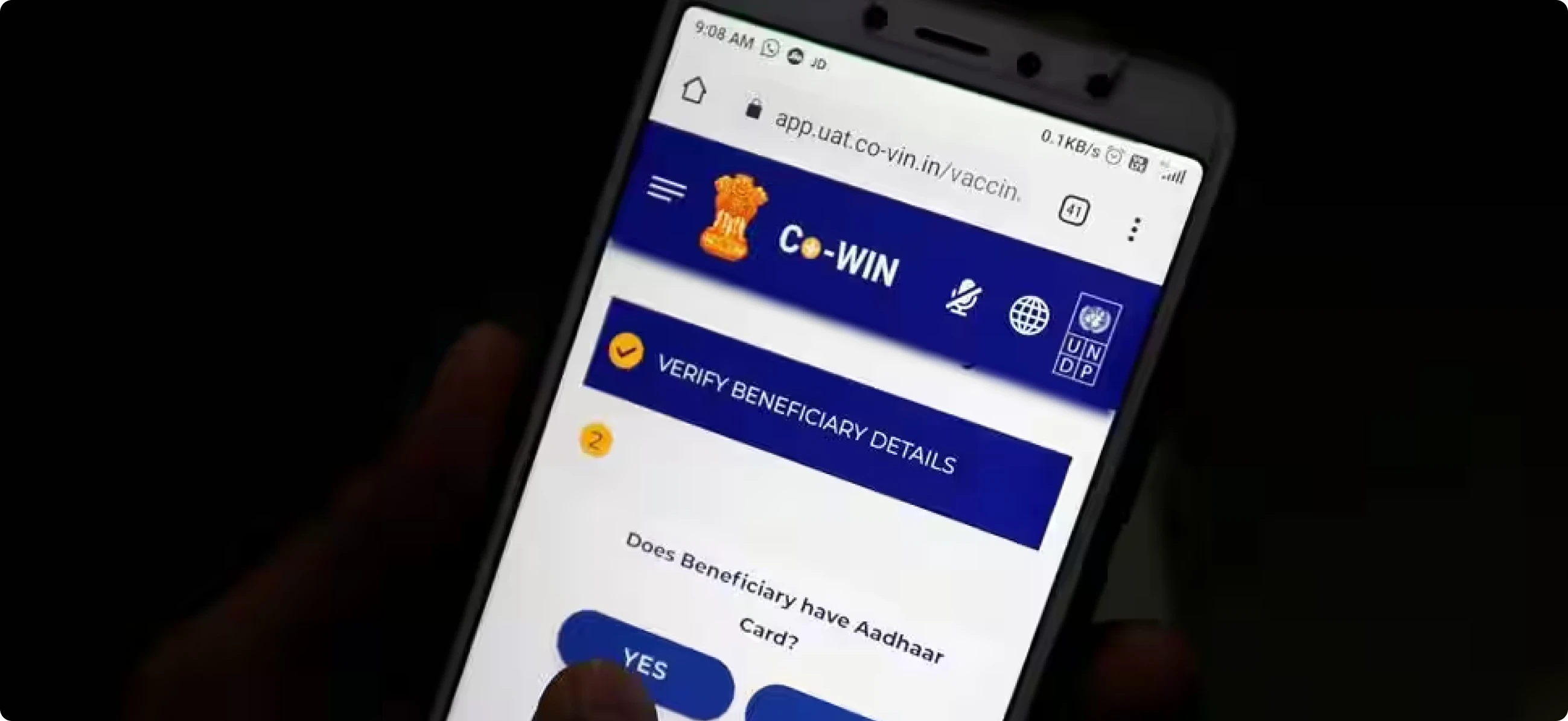
The information of hundreds of thousands of Indians who received the COVID vaccine was Leaked in a significant data breach and posted on a Telegram channel. Numerous reports claim that sensitive information, including a person’s phone number, gender, ID card details, and date of birth, leaked over Telegram. It could be obtained by typing a person’s name into a Telegram bot.
What really happened?
The records pertaining to the mobile number registered in the CoWin portal are accessible on the Malayalam news website channel. It is also feasible to determine which vaccination was given and where it was given.
According to The Report, the list of individuals whose data was exposed includes BJP Tamil Nadu president K Annamalai, Congress MP Karti Chidambaram, and former BJP union minister for health Harsh Vardhan. Telangana’s minister of information and communication technology, Kalvakuntla Taraka Rama Rao, is also on the list.
MEITY stated in response to the data leak, “It is old data, we are still confirming it. We have requested a report on the matter.
After the media Report, the bot was disabled, but experts said the incident raised severe issues because the information might be used for identity theft, phishing emails, con games, and extortion calls. The Indian Computer Emergency Response Team (CERT-In), the government’s nodal body, has opened an investigation into the situation
The central government declared the data breach reports regarding the repository of beneficiaries against Covid to be “mischievous in nature” on Monday and claimed the ‘bot’ that purportedly accessed the confidential data was not directly accessing the CoWIN database.
According to the first complaint by CERT-In, the government’s cybersecurity division, the government claimed the bot might be displaying information from “previously stolen data.” Reports.
The health ministry refuted the claim, asserting that no bots could access the information without first verifying with a one-time password.
“It is made clear that all of these rumours are false and malicious. The health ministry’s CoWIN interface is entirely secure and has sufficient data privacy protections. The security of the data on the CoWIN portal is being ensured in every way possible, according to a statement from the health ministry.
Meity said the CoWin program or database was not directly compromised, and the shared information appeared to be taken from a previous intrusion. But the hack again highlights the growing danger of cyber assaults, particularly on official websites.

Recent cases of data leak
Dominos India 2021– Dominos India, a division of Jubilant FoodWorks, faced a cyberattack on May 22, 2021, which led to the disclosure of information from 180 million orders. The breach exposed order information, email addresses, phone numbers, and credit card information. Although Jubilant FoodWorks acknowledged a security breach, it refuted any illegal access to financial data.
Air India – A cyberattack that affected Air India in May 2021 exposed the personal information of about 4.5 million customers globally. Personal information recorded between August 26, 2011, and February 3, 2021, including names, dates of birth, contact information, passport information, ticket details, frequent flyer information from Star Alliance and Air India, and credit card information, were exposed in the breach.
Bigbasket – BigBasket, an online supermarket, had a data breach in November 2020, compromising the personal information of approximately 20 million consumers. Email IDs, password hashes, PINs, phone numbers, addresses, dates of birth, localities, and IP addresses were among the information released from an insecure database containing over 15 GB of customer data. BigBasket admitted to the incident and reported it to the Bengaluru Cyber Crime Department.
Unacademy – Unacademy, an online learning platform, experienced a data breach in May 2020, compromising the email addresses of approximately 11 million subscribers. While no sensitive information, such as financial data or passwords, was compromised, user data, including IDs, passwords, date joined, last login date, email IDs, names, and user credentials, was. The breach was detected when user accounts were uncovered for sale on the dark web.
2022 Card Data- Cybersecurity researchers from AI-driven Singapore-based CloudSEK found a threat actor offering a database of 1.2 million cards for free on a Dark Web forum for crimes on October 12, 2022. This came after a second problem involving 7.9 million cardholder records that were reported on the BidenCash website. This comprised information pertaining to State Bank of India (SBI) clients. And other well-known companies were among those targeted in high-profile data breach cases that have surfaced in recent years.

Conclusion
Data breach cases are increasing daily, and attackers are mainly attacking the healthcare sectors and health details as they can easily find personal details. This recent CoWIN case has compromised thousands of people’s data. The All-India Institute of Medical Sciences’ systems were compromised by hackers a few months ago. Over 95% of adults have had their vaccinations, according to the most recent data, even if the precise number of persons impacted by the CoWin privacy breach could not be determined.

Executive Summary:
A morphed video of the actor Anup Soni popular on social media promoting IPL betting Telegram channel is found to be fake. The audio in the morphed video is produced through AI voice cloning. AI manipulation was identified by AI detection tools and deepfake analysis tools. In the original footage Mr Soni explains a case of crime, a part of the popular show Crime Patrol which is unrelated to betting. Therefore, it is important to draw the conclusion that Anup Soni is in no way associated with the betting channel.

Claims:
The facebook post claims the IPL betting Telegram channel which belongs to Rohit Khattar is promoted by Actor Anup Soni.

Fact Check:
Upon receiving the post, the CyberPeace Research Team closely analyzed the video and found major discrepancies which are mostly seen in AI-manipulated videos. The lip sync of the video does not match the audio. Taking a cue from this we analyzed using a Deepfake detection tool by True Media. It is found that the voice of the video is 100% AI-generated.


We then extracted the audio and checked in an audio Deepfake detection tool named Hive Moderation. Hive moderation found the audio to be 99.9% AI-Generated.

We then divided the video into keyframes and reverse searched one of the keyframes and found the original video uploaded by the YouTube channel named LIV Crime.
Upon analyzing we found that in the 3:18 time frame the video was edited, and altered with an AI voice.

Hence, the viral video is an AI manipulated video and it’s not real. We have previously debunked such AI voice manipulation with different celebrities and politicians to misrepresent the actual context. Netizens must be careful while believing in such AI manipulation videos.
Conclusion:
In conclusion, the viral video claiming that IPL betting Telegram channel promotion by actor Anup Soni is false. The video has been manipulated using AI voice cloning technology, as confirmed by both the Hive Moderation AI detector and the True Media AI detection tool. Therefore, the claim is baseless and misleading.
- Claim: An IPL betting Telegram channel belonging to Rohit Khattar promoted by Actor Anup Soni.
- Claimed on: Facebook
- Fact Check: Fake & Misleading

Introduction
Digital Arrests are a form of scam that involves the digital restraint of individuals. These restraints can vary from restricting access to the account(s), and digital platforms, to implementing measures to prevent further digital activities or being restrained on video calling or being monitored through video calling. Typically, these scams target vulnerable individuals who are unfamiliar with digital fraud tactics, making them more susceptible to manipulation. These scams often target the victims on allegations of drug trafficking, money laundering, falsified documents, etc. These are serious crimes and these scammers scare the victim into thinking that either their identities were used to commit these crimes or they have committed these crimes. Recently there has been an uptick in the digital fraud scams in India highlighting the growing concerns.
The Legality of Digital Arrests in India
There is no legal provision for law enforcement to conduct ‘arrests’ via video calls or online monitoring. If you receive such calls, it is a clear scam. In fact, recently enacted new criminal laws do not provide for any provision for law enforcement agencies conducting a digital arrest. The law only provides for service of the summons and the proceedings in an electronic mode.
The Bhartiya Nagrik Suraksha Sanhita (BNSS), 2023 provides for the summons to be served electronically under section 63. The section defines the form of summons. It states that every summons served electronically shall be encrypted and bear the image of the seal of the Court or digital signature. Further, according to section 532 of the BNSS, the trial and proceedings may be held in electronic mode, by use of electronic communication or by the use of audio-video electronic means.
Modus Operandi
Under digital arrest scams, the scammer makes a connection via video calls (WhatsApp calls, skype, etc) with the victim over their alleged involvement in crimes (financial, drug trafficking, etc) in bogus charges. The victims are intimidated that the arrest will take place soon and till the time the arresting officers do not reach the victim they are to remain on the call and be under digital surveillance and not contact anyone during the ongoing investigation.
During this period, the scammers start collecting information from the victim to confirm their identity and create an atmosphere in which multiple senior officials are on the victim’s case and they are investigating the case thoroughly. By this time, the victim, scared out of their wits, sits through this arrest and it is then that the scammers posing as law enforcement officials make comments that they can avoid arrest by paying a certain amount of the fines to the accounts that they specify. This monitoring/ surveillance continues till the time the victim makes the transfers to the accounts provided by the scammers. These are the common manipulation tactics used by scammers in digital arrest fraud.
Recent Cyber Arrest Cases
- Recently a 35-year-old NBCC official was duped of Rs 55 lakh in a 'digital arrest' scam. Posing as customs officials, fraudsters claimed her details were linked to intercepted illegal items and a pending arrest. They kept her on video calls, convincing her to transfer Rs 55 lakh to avoid money laundering charges. After the transfer, the scammers vanished. A police investigation traced the funds to a fake company, leading to the arrest of suspects.
- Another recent case involved a neurologist who was duped Rs 2.81 crores in a ‘digital arrest’ scam. Fraudsters claimed her phone number and Aadhaar was linked to accounts transferring funds to an Individual. Under pressure, she was convinced to undergo “verification” and made multiple transactions over two days. The scammers threatened legal consequences for money laundering if she didn’t comply. Now a police investigation is ongoing, and her immense financial loss highlights the severity of this cybercrime.
- One another case took place where the victim was duped of Rs 7.67 crores in a prolonged ‘digital arrest’ scam over three months. Fraudsters posing as TRAI officials claimed complaints against her phone number and threatened to suspend it, alleging illegal use of another number linked to her Aadhaar. Pressured and manipulated through video calls, the victim was coerced into transferring large sums, even taking an Rs 80 lakh loan. The case is under investigation as authorities pursue the cybercriminals behind the massive fraud.
Best Practices
- Do not panic when you get any calls where sudden unexpected news is shared with you. Scammers thrive on the panic that they create.
- Do not share personal details such as Aadhaar number, PAN number etc with unknown or suspect entities. Be cautious of your personal and financial information such as credit card numbers, OTPs, or any other passwords with anyone.
- If individuals contact, claiming to be government officials, always verify their identities by contacting the entity through the proper channels.
- Report and block any fraudulent communications that are received and mark them as Spam. This would further inform other users if they see the caller ID being marked as fraud or spam.
- If you have been defrauded then report about the same to the authorities so that action can be taken and authorities can arrest the fraudsters.
- Do not transfer any money as part of ‘fines’ or ‘dues’ to the accounts that these calls or messages link to.
- In case of any threat, issue or discrepancy, file a complaint at cybercrime.gov.in or helpline number 1930. You can also seek assistance from the CyberPeace helpline at +91 9570000066.
References:
- https://www.cyberpeace.org/resources/blogs/digital-arrest-fraud
- https://www.business-standard.com/india-news/what-is-digital-house-arrest-find-out-how-to-avoid-this-new-scam-124052400799_1.html
- https://www.the420.in/ias-ips-officers-major-generals-doctors-and-professors-fall-victim-to-digital-arrest-losing-crores-stay-alert-read-5-real-cases-inside/
- https://indianexpress.com/article/cities/delhi/senior-nbcc-official-duped-in-case-of-digital-arrest-3-arrested-delhi-police-9588418/#:~:text=Of%20the%20duped%20amount%2C%20Rs,a%20Delhi%20police%20officer%20said (case study 1)
- https://timesofindia.indiatimes.com/city/lucknow/lucknow-sgpgims-professor-duped-of-rs-2-81-crore-in-digital-arrest-scam/articleshow/112521530.cms (case study 2)
- https://timesofindia.indiatimes.com/city/jaipur/bits-prof-duped-of-7-67cr-cops-want-cbi-probe-in-case/articleshow/109514200.cms (case study 3)
