
#FactCheck -Viral Claim That Yogi Adityanath Urged People Not to Watch Shah Rukh Khan’s Films Is Misleading
Executive Summary
A video circulating on social media allegedly shows Uttar Pradesh Chief Minister Yogi Adityanath criticizing Bollywood actor Shah Rukh Khan and asking people not to watch his films. Users sharing the clip claim that these statements are recent. CyberPeace’s research has found the claim to be misleading. research revealed that the video is from 2015, long before Yogi Adityanath became the Chief Minister of Uttar Pradesh. At that time, he was serving as a Member of Parliament from Gorakhpur.
Claim
On January 13, 2026, a Facebook user shared the video with the caption: "A clear message from the Hon’ble Chief Minister of Uttar Pradesh, Param Pujya Mahant Yogi Adityanath, urging people not to watch Shah Rukh Khan’s movie. Share this message widely, send it to all groups you are part of, and inform the youth in your family."

Fact Check:
To verify the claim, keyframes from the viral video were extracted and reverse-searched using Google Lens. The same video was found in a Facebook post dated March 28, 2022, where it was shared with the caption: "Baba Ji’s message to not watch Shah Rukh Khan’s ‘Pathaan’ movie."

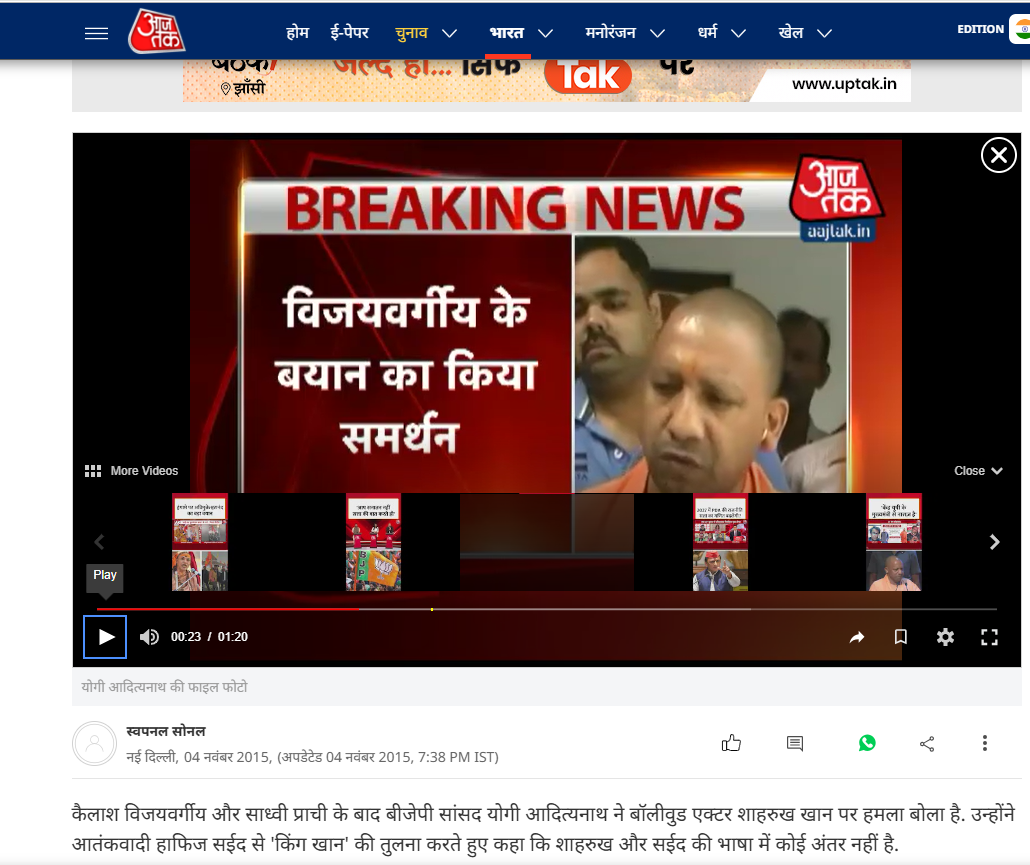
Further research traced the video to Aaj Tak’s website, which reported on November 4, 2015, that then-BJP MP Yogi Adityanath criticized Shah Rukh Khan, comparing his language to that of terrorist Hafiz Saeed, stating that there was no difference in their statements.
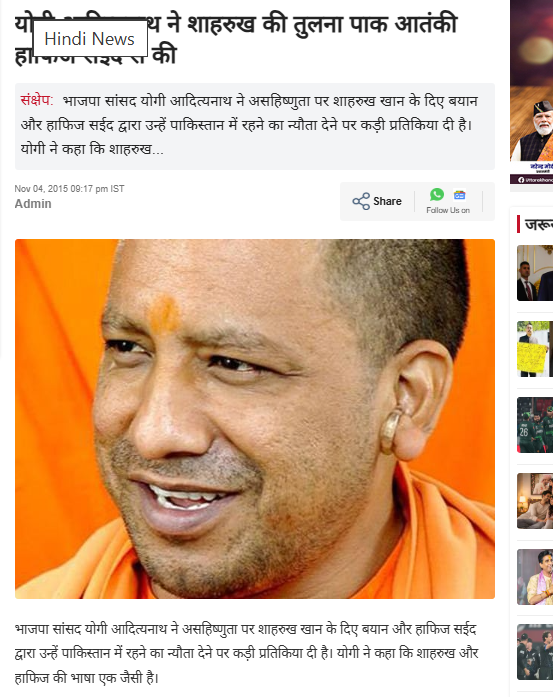
A Live Hindustan report from the same date confirmed that Yogi Adityanath had strongly reacted to Shah Rukh Khan’s comments on rising intolerance in India and Hafiz Saeed’s invitation for him to stay in Pakistan. The reports make it clear that Yogi Adityanath criticized Shah Rukh Khan in 2015 by highlighting the similarity between his statements and those of Hafiz Saeed. At the same time, Shah Rukh Khan had highlighted growing intolerance in the country, citing incidents where filmmakers, scientists, and authors were returning awards, describing it as a sign of “deep intolerance” in India.
Conclusion:
Our research found that the statement attributed to Chief Minister Yogi Adityanath circulating on social media is not recent. The video dates back to 2015, a time when Yogi Adityanath was not yet the Chief Minister of Uttar Pradesh.

Related Blogs

Executive Summary
A video clip of Indian Army Chief Upendra Dwivedi is being widely shared across social media platforms with the claim that he criticised the Indian government's policy towards Taliban-ruled Afghanistan. In the viral clip, the Army Chief is allegedly heard saying that India is doing nothing except sending money to the Taliban government due to the Centre’s failed policies.
However, CyberPeace Research Wing research found the claim to be false. The viral video is a deepfake. In the original footage, General Upendra Dwivedi was speaking about Operation Sindoor and the preparedness of the Indian Armed Forces for a possible “Operation Sindoor 2.0.” He made no remarks regarding the Taliban or the government’s Afghanistan policy.
Claim
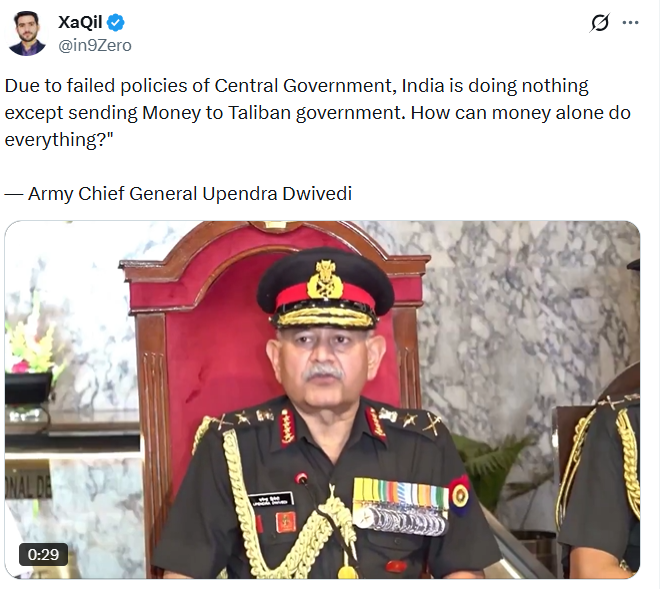
An X user named “XaQil” shared the viral video on May 31, 2026, with the caption:“Due to failed policies of the Central Government, India is doing nothing except sending Money to Taliban government. How can money alone do everything?” — Army Chief General Upendra Dwivedi.
Fact Check
In the viral video, General Dwivedi is purportedly heard making remarks about India’s Afghanistan policy, the Taliban, Pakistan, Iran, and India’s diplomatic position. To verify the claim, we searched for the original source of the video. A reverse image search of key frames led us to the authentic footage posted by news agency ANI on its official X account on May 30, 2026.

In the original video, General Dwivedi was responding to a question about Operation Sindoor. He stated that the operation was still ongoing, hostilities had only paused temporarily, and that the Indian Armed Forces were fully prepared if “Operation Sindoor 2.0” became necessary.
He also spoke about enhancing coordination among the three services and maintaining operational readiness.”
No part of his statement mentioned the Taliban, Afghanistan, Pakistan, Iran, or criticism of the Central Government.
Further corroboration came from media reports covering the same event. According to a report published by Navbharat Times on May 30, 2026, General Dwivedi made the remarks during the passing-out parade of the 150th course of the National Defence Academy (NDA), where he attended as the chief guest. He reiterated that the armed forces were fully prepared for “Operation Sindoor 2.0” if required.

Since the content of the viral clip did not match the original statement, we examined it using InVID’s MeVer Deepfake Detector. The tool flagged signs of AI manipulation and indicated that the video had likely been altered.

Conclusion
Cyber Peace Foundation found that the viral video purportedly showing Army Chief General Upendra Dwivedi criticising the Indian government’s policy towards the Taliban is a deepfake. The Army Chief made no such remarks. The original video was recorded during an NDA event, where he spoke about Operation Sindoor and the preparedness of the Indian Armed Forces for a possible future operation. The viral clip has been manipulated using AI to spread a false narrative.

On June 5th, the world comes together to reflect on how the way we live impacts the environment. We discuss conserving water, cutting back on plastic, and planting trees, but how often do we think about the environmental impact of our digital lives?
The internet is ubiquitous but invisible in a world that is becoming more interconnected by the day. It drives our communications, meetings, and recollections. However, there is a price for this digital convenience: carbon emissions.
A Digital Carbon Footprint: What Is It?
Electricity is necessary for every video we stream, email we send, and file we store on the cloud. But almost 60% of the electricity produced today is generated from burning fossil fuels. The digital world uses an incredible amount of energy, from the energy-hungry data centres that house our information to the networks that send it. Thus, the greenhouse gas emissions produced by our use of digital tools and services are referred to as our "digital carbon footprint."
To put it in perspective:
- Up to 150–200 grams of CO₂ can be produced by streaming an hour-long HD video on your phone.
- A typical email sent can release about 4 grams of CO₂, and more if it contains attachments.
- Comparable to the airline industry, the internet as a whole accounts for 1.5% to 4% of global greenhouse gas emissions.
Why It Matters
Ironically, despite the fact that digital life frequently feels "clean" and weightless, it is backed by enormous, power-hungry infrastructures. Additionally, our online activity is growing at a rapid pace as digital penetration increases. Plus, with the advent of AI and big data, the demand for energy is only going to rise. The harms of air, water, and soil degradation, and biodiversity loss are already upon us. It's high time we reconsider how we use technology on World Environment Day.
What Can You Do?
The good news is that even minor adjustments to our online conduct can have an impact.
🗑️ Clear out your digital clutter by getting rid of unnecessary emails, apps, and files.
📥 Unsubscribe from mailing lists that you no longer use.
📉 When HD is not required, stream videos with lower quality.
⚡ Make use of energy-saving gadgets and disconnect them when not in use.
🌐 Make the move to renewable energy-powered, environmentally friendly cloud providers.
🗳️ Support informed policy by engaging with your elected representatives and advocating for greener tech policies. Knowing your digital rights and responsibilities can help shape smarter policies and a healthier planet.
We at the CyberPeace Foundation think that cyberspace needs to be sustainable. An eco-friendly digital world is also a safer one, where all communities can thrive in harmony. We must promote digital responsibility, including its environmental component, as we work towards digital equity and resilience.
On this World Environment Day, let's go one step further and work towards a greener internet as well as a greener planet.

In an era defined by perpetual technological advancement, the hitherto uncharted territories of the human experience are progressively being illuminated by the luminous glow of innovation. The construct of privacy, once a straightforward concept involving personal secrets and solitude, has evolved into a complex web of data protection, consent, and digital rights. This notion of privacy, which often feels as though it elusively ebbs and flows like the ghost of a bygone epoch, is now confronted with a novel intruder – neurotechnology – which promises to redefine the very essence of individual sanctity.
Why Neuro Rights
At the forefront of this existential conversation lie ventures like Elon Musk's Neuralink. This company, which finds itself at the confluence of fantastical dreams and tangible reality, teases a future where the contents of our thoughts could be rendered as accessible as the words we speak. An existence where machines not only decipher our mental whispers but hold the potential to echo back, reshaping our cognitive landscapes. This startling innovation sets the stage for the emergence of 'neurorights' – a paradigm aimed at erecting a metaphorical firewall around the synapses and neurons that compose our innermost selves.
At institutions such as the University of California, Berkeley, researchers, under the aegis of cognitive scientists like Jack Gallant, are already drawing the map of once-inaccessible territories within the mind. Gallant's landmark study, which involved decoding the brain activity of volunteers as they absorbed visual stimuli, opened Pandora's box regarding the implications of mind-reading. The paper published a decade ago, was an inchoate step toward understanding the narrative woven within the cerebral cortex. Although his work yielded only a rough sketch of the observed video content, it heralded an era where thought could be translated into observable media.
The Growth
This rapid acceleration of neuro-technological prowess has not gone unnoticed on the sociopolitical stage. In a pioneering spirit reminiscent of the robust legislative eagerness of early democracies, Chile boldly stepped into the global spotlight in 2021 by legislating neurorights. The Chilean senate's decision to constitutionalize these rights sent ripples the world over, signalling an acknowledgement that the evolution of brain-computer interfaces was advancing at a daunting pace. The initiative was spearheaded by visionaries like Guido Girardi, a former senator whose legislative foresight drew clear parallels between the disruptive advent of social media and the potential upheaval posed by emergent neurotechnology.
Pursuit of Regulation
Yet the pursuit of regulation in such an embryonic field is riddled with intellectual quandaries and ethical mazes. Advocates like Allan McCay articulate the delicate tightrope that policy-makers must traverse. The perils of premature regulation are as formidable as the risks of a delayed response – the former potentially stifling innovation, the latter risking a landscape where technological advances could outpace societal control, engendering a future fraught with unforeseen backlashes.
Such is the dichotomy embodied in the story of Ian Burkhart, whose life was irrevocably altered by the intervention of neurotechnology. Burkhart's experience, transitioning from quadriplegia to digital dexterity through sheer force of thought, epitomizes the utopic potential of neuronal interfaces. Yet, McCay issues a solemn reminder that with great power comes great potential for misuse, highlighting contentious ethical issues such as the potential for the criminal justice system to over extend its reach into the neural recesses of the human psyche.
Firmly ensconced within this brave new world, the quest for prudence is of paramount importance. McCay advocates for a dyadic approach, where privacy is vehemently protected and the workings of technology proffered with crystal-clear transparency. The clandestine machinations of AI and the danger of algorithmic bias necessitate a vigorous, ethical architecture to govern this new frontier.
As legal frameworks around the globe wrestle with the implications of neurotechnology, countries like India, with their burgeoning jurisprudence regarding privacy, offer a vantage point into the potential shape of forthcoming legislation. Jurists and technology lawyers, including Jaideep Reddy, acknowledge ongoing protections yet underscore the imperativeness of continued discourse to gauge the adequacy of current laws in this nascent arena.
Conclusion
The dialogue surrounding neurorights emerges, not merely as another thread in our social fabric, but as a tapestry unto itself – intricately woven with the threads of autonomy, liberty, and privacy. As we hover at the edge of tomorrow, these conversations crystallize into an imperative collective undertaking, promising to define the sanctity of cognitive liberty. The issue at hand is nothing less than a societal reckoning with the final frontier – the safeguarding of the privacy of our thoughts.
References:
