
#FactCheck: AI-Generated Video Falsely Shared as CCTV Footage of Seemapuri Building Collapse in Delhi
Executive Summary
A four-storey building collapsed in Seemapuri, Delhi, on October 7, 2026, killing five people. A video of a building collapsing is being widely shared on social media as CCTV footage of the incident. Some users are claiming that the video shows the building collapse in Seemapuri. CyberPeace Research found that the viral video was AI-generated. However, it is true that five people died after a building collapsed in Seemapuri, Delhi.
Claim
On October 8, 2026, Instagram user ‘allindiyanews’ posted a video (archive link) with the caption: “A multi-storey building collapsed in Seemapuri, Delhi. The horrifying moment of the accident has emerged in a CCTV-like video. On October 7, a portion of a multi-storey building suddenly collapsed in the Seemapuri area. According to initial reports, at least five people were injured, while two to three people were feared trapped under the debris. Rescue operations are underway. The cause of the incident has not yet been officially established. In your opinion, how important is it to inspect old and dilapidated buildings?”
https://www.instagram.com/allindiyanews/reel/DePIdTApNZw

Fact Check:
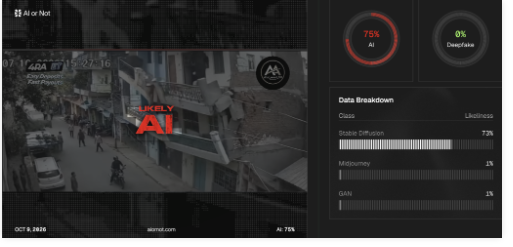
During our research, we closely examined the visuals and movements in the viral video and noticed several inconsistencies. The timer displayed in the video jumps from 15:27:16 to 15:27:12 and then changes to 15:27:18. Additionally, a motorcyclist who appears to be moving forward suddenly starts moving backward as the building collapses. These visual inconsistencies raised suspicions that the video could be AI-generated. We subsequently scanned the viral video using the AI detection tool AI or Not. According to the results, the video was identified as AI-generated.
Conclusion:
CyberPeace Research found that the viral video is AI-generated and does not show the actual building collapse in Seemapuri, Delhi. While the video is fabricated, the incident itself is real, as five people lost their lives in the collapse of a four-storey building in the area.

Related Blogs

Executive Summary
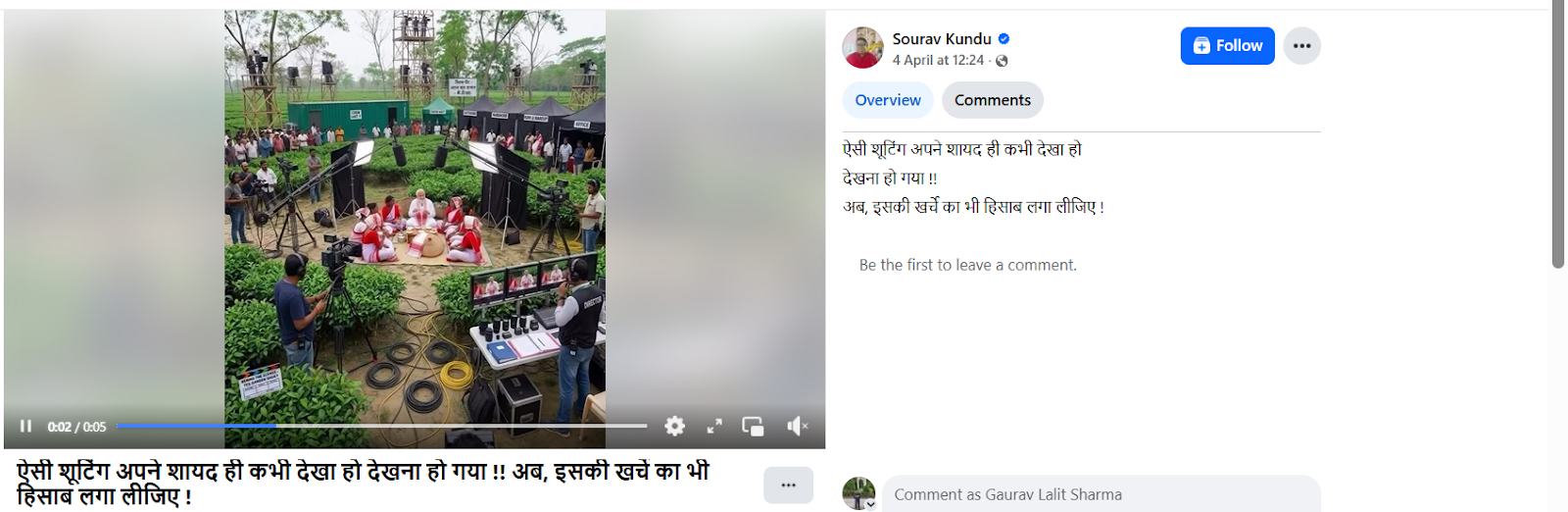
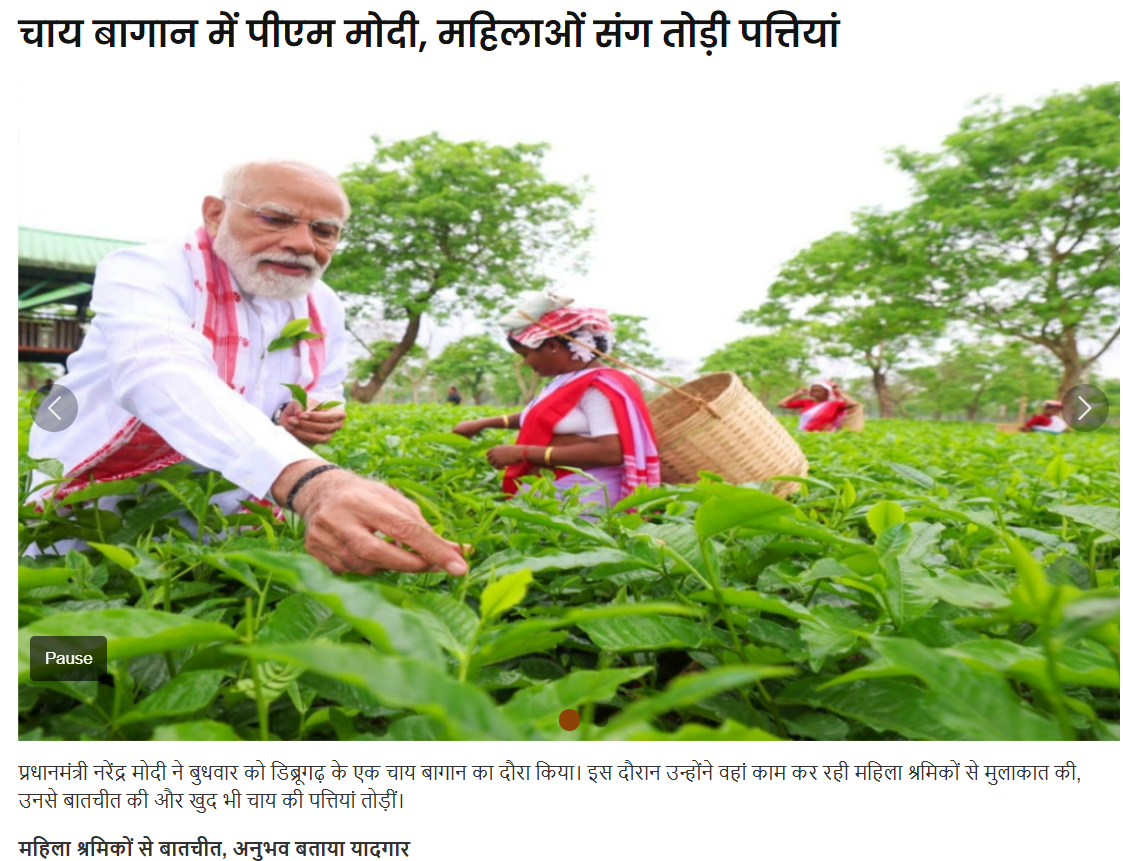
An image of Prime Minister Narendra Modi is being widely circulated on social media. The picture is being shared with the claim that during an election campaign in Assam, a full-fledged shooting set was arranged in a tea garden where Modi interacted with women workers, complete with cameras, microphones, lights, and a director-led production team. However, research by the CyberPeace has found the claim to be false. Our research reveals that the viral image is AI-generated and is being shared with a misleading narrative.
Claim
An Instagram user shared the viral image with the caption suggesting that such a large-scale “shoot” setup had been arranged and questioned the cost involved.
Post link:
Fact Check
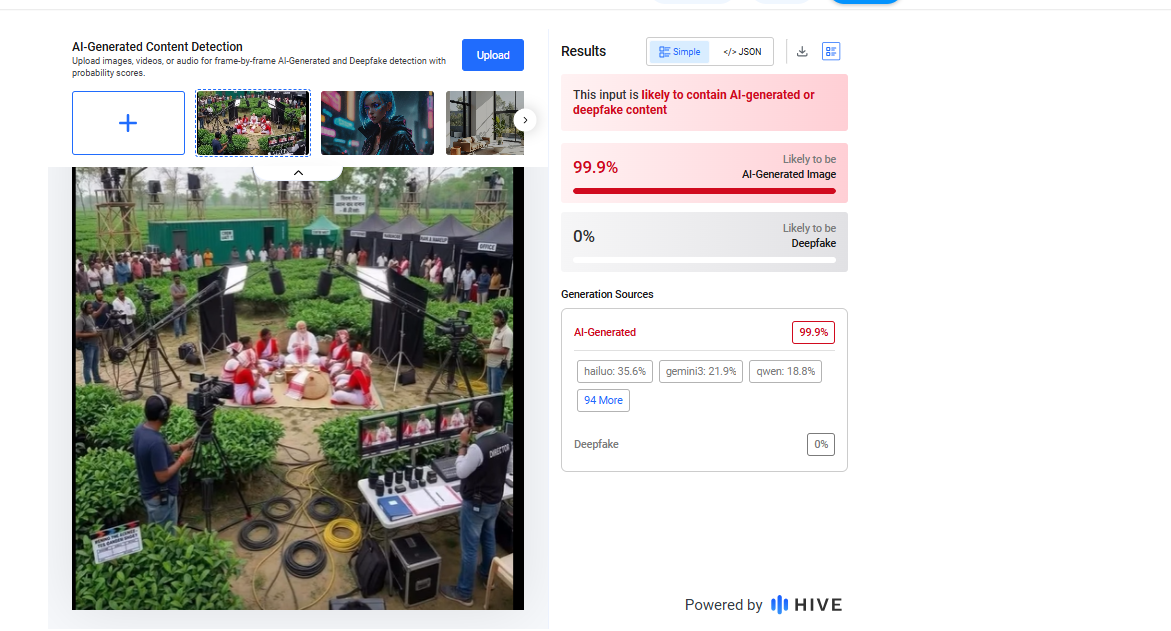
To verify the claim, we conducted a keyword-based search on Google. However, we did not find any credible media reports supporting the claim that such a shooting setup was arranged during Prime Minister Modi’s visit to Assam. Upon closely examining the viral image, we noticed several visual inconsistencies that raised suspicion about it being artificially generated. To confirm this, we analyzed the image using the AI detection tool Hive Moderation, which indicated that the image is approximately 99% AI-generated.
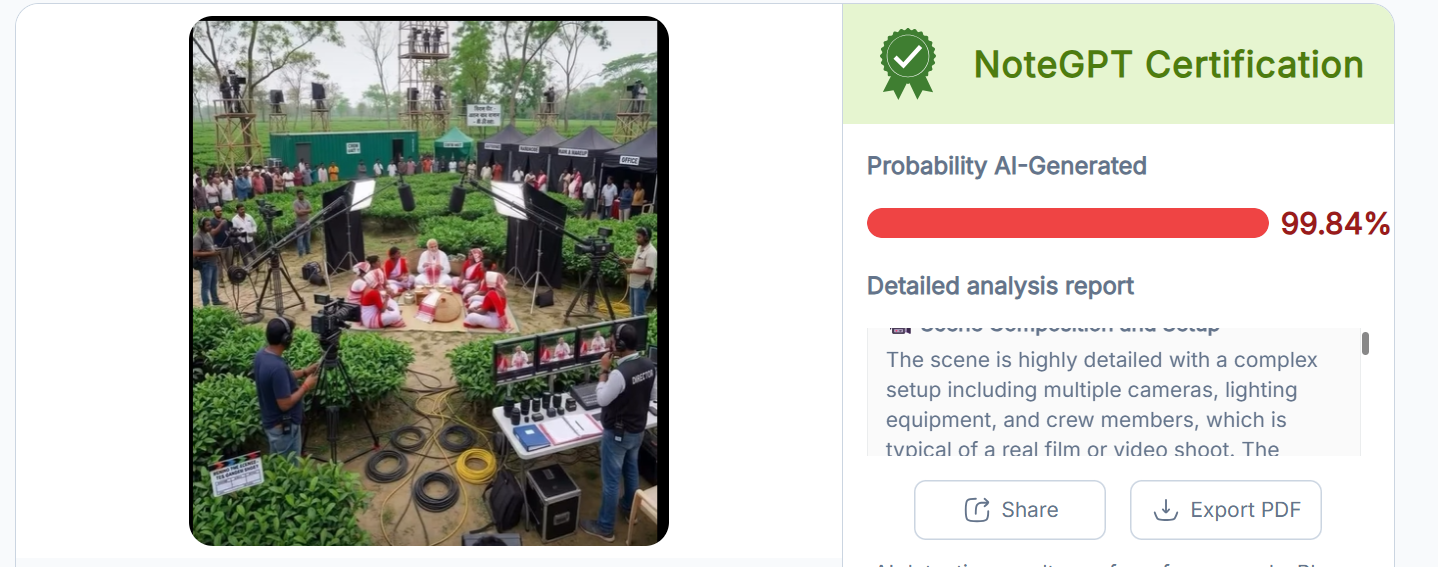
To further validate the findings, we also tested the image using another AI detection tool, NoteGPT, which similarly classified the image as 99% AI-generated.
For context, ahead of the 2026 Assam Assembly elections, Prime Minister Narendra Modi has been on a campaign visit to the state. According to a report by DD News, he visited a tea garden in Dibrugarh, where he interacted with women workers and even plucked tea leaves himself.
Conclusion
Our research clearly establishes that the viral image of Prime Minister Narendra Modi is not authentic and has been digitally created using AI tools. There is no evidence to support the claim that a staged shooting setup involving cameras, lights, and a production crew was arranged during his visit. The image is being circulated with a misleading narrative to create a false impression. This case highlights how AI-generated visuals can be used to distort real events and spread misinformation.

Before you take that next sip of your chai latte at Starbucks, you're about to see Artificial Intelligence (AI) in your tea. Yes you heard it right, but relax, you don't need to put the cup down, because it's not blended in like a new masala and nobody's adding AI as an ingredient. But AI will be deciding how much stock gets ordered, when the machine needs a service call, how the whole backend of your favourite coffee chain runs.
Here's what's actually going on. Starbucks has been quietly building its own AI to replace the systems Oracle, Microsoft, and IBM used to run for it, for the services such as inventory, equipment management, even the point-of-sale software every outlet depends on. In short: Starbucks decided it does not want to outsource its backend anymore. It wants to build the brain itself.
Sounds fascinating on the surface. A coffee company doing its own AI R&D, right? Except dig one layer deeper, and it stops being cool and starts being a conundrum. Here's the actual link: companies like Starbucks are Indian IT's bread and butter. This is literally the business model, global companies pay Indian IT firms like TCS, HCL, Infosys, Wipro to run exactly this kind of backend work: inventory systems, equipment management, point-of-sale software, IT infrastructure. That's what pays the salaries of roughly 6 million people employed by India's outsourcing industry.
However, recently, this workforce has been shrinking rather than growing. TCS, the largest player in the industry, reported just 0.4 percent revenue growth in the quarter after stripping out currency fluctuations, its slowest expansion in a year, while its workforce shrank by around 3 percent over the past year to about 594,000 employees. At smaller rival HCL Technologies, sales actually slipped 0.5 percent quarter on quarter. Company wide, TCS let go of over 23,000 employees in FY26 alone, citing its pivot toward an AI first services model and reduced bench requirements per client engagement, with a steep net decline of over 11,000 employees in the most recent quarter alone.
AI's impact on India's IT industry and workforce
India's IT sector employs close to 6 million people, and a large share of that workforce has built careers around exactly the kind of work now being absorbed by AI: inventory systems, equipment monitoring, point of sale software, and other repetitive backend operations. As more global clients explore building these capabilities in house, the demand for large teams doing routine maintenance work is likely to shrink. This does not mean mass job losses overnight, but it does suggest a shift in what kind of talent gets hired and retained. Entry level, process driven roles may see slower growth, while demand rises for professionals who can design, audit, and govern AI systems rather than simply maintain legacy software. For India's IT workforce, the challenge is less about competing with AI and more about repositioning around it, moving up the value chain before the shift forces the decision.
Beyond One Coffee Chain ~ The Real Shift in Global Outsourcing
Starbucks isn't an isolated case; it's a visible example of a much wider recalibration. For two decades, the operating assumption in enterprise software was that building complex, mission-critical systems in-house was too slow, too risky, and too expensive compared to buying from established vendors. AI-assisted coding is chipping away at that assumption. What used to require large, specialised engineering teams and years of development can now be prototyped and iterated on far faster enough that even a company whose core business is coffee, not code, can seriously consider building its own enterprise software stack.
However it is also worth noting that this transition isn't frictionless. Starbucks itself had to walk back an AI-powered inventory-counting tool earlier this year after it produced inaccurate counts, reverting stores to manual counting. Building in-house AI systems is not automatically smoother or more reliable than buying proven software; it just shifts the risk and the learning curve onto the company doing the building.
Disruption and Opportunity, Side by Side
None of this means Indian IT companies can afford to sit still. The Starbucks example offers a legitimate signal that repetitive, well defined, automatable work, especially when powered by in house built AI, genuinely poses some risk or not. But it cannot be seen only through the lens of the industry's obituary. It would be premature to call this a broader decline in terms of IT professionals, companies, or jobs.
The same earnings season also brought TCS's expanded AI mandate with ABB and HCL's $1.14 billion AI driven contract in Europe. Demand has not disappeared, it appears to be evolving from routine maintenance work toward AI native, higher value engagement.
Whether this becomes a meaningful structural shift or simply another cycle the industry eventually absorbs remains to be seen. What seems clear for now is that the path forward depends less on resisting the shift and more on how quickly the industry chooses to embrace it.
Conclusion
AI is a double-edged sword. While it challenges the old model of outsourcing via a maintenance and staff augmentation play, it also provides new, high-value services opportunities around AI integration, data infrastructure, and governance-areas where the scale, domain expertise, and global delivery experience that Indian IT has amassed over three decades is essential. Whether India's IT majors will move fast enough to upskill, re-skill, and reposition to ride this wave before the opportunity heads somewhere else, is the question to watch, rather than the survival of one vendor or contract.
Sources
- Bloomberg Opinion - Andy Mukherjee, "You Can't Spell Chai Latte Without AI, and That Will Hurt India.” bloomberg.com/opinion/articles/2026-07-14/you-can-t-spell-chai-latte-without-ai-that-will-hurt-india
- Yahoo Finance / Vlad Schepkov, "Starbucks Working on AI Tools to Replace Microsoft and IBM Software – Report," July 9, 2026. finance.yahoo.com/technology/ai/articles/starbucks-working-ai-tools-replace-105954159.html
- Livemint - Andy Mukherjee, "As Starbucks Mixes AI in Chai Latte, What Must IT Players Do?" Mint Curator.
livemint.com/opinion/online-views/andy-mukherjee-india-it-industry-starbucks-ai-tc-hcl-tech-artificial-intelligence-oracle-microsoft-ibm-11784118723454.html - Metaintro, "TCS and Infosys Face an AI Reckoning" https://www.metaintro.com/blog/tcs-infosys-ai-reckoning-millions-it-jobs-2026
- LayoffTrends, "IT Layoffs India 2026 — TCS, Infosys, Wipro, GCC Jobs" https://layofftrends.com/india.html
- NiftyTrader, "Hiring Slows at India's Top IT Firms — Net Headcount Falls in 9MFY26" https://www.niftytrader.in/markets/hiring-slows-at-indias-top-it-firms-net-headcount-falls-in-9mfy26-what-it-signals-for-the-sector/
- TCS official newsroom, "TCS and ABB Sign Multi-Million, Multi-Year Deal to Transform Global Network Operations with AI," tcs.com/who-we-are/newsroom/press-release/tcs-and-abb-sign-multi-million-multi-year-deal-to-transform-global-network-operations-with-ai

Introduction
Cyber financial offences in India have experienced an alarming surge both in terms of frequency and complexity. Be it phishing attacks or organised fraud syndicates, the nation has been facing a spurt in online financial threats, which leave the victims at their mercy because of procedural lags on the part of law enforcement agencies. To counter this, the Government of India has stepped up measures to create a Cyber-Secure Bharat, focusing on speedy resolution, accountability, and digital empowerment. A key move in this direction is the introduction of the e-Zero FIR initiative, brought forth by the Ministry of Home Affairs (MHA) with Union Home Minister Amit Shah at the helm. This newly developed digital-first system is expected to revolutionise the way cyber financial crimes, particularly those that result in high monetary losses, are handled and investigated.
What Is the e-Zero FIR Initiative?
The e-Zero FIR program is a technology-based platform that enables the automated registration of Zero FIRs for value cyber financial crimes. Led by the Indian Cybercrime Coordination Centre (I4C), Ministry of Home Affairs, the programme is now piloted in Delhi and aims to fill a pressing lacuna: the time lag involved in transitioning cybercrime complaints to First Information Reports (FIRs).
Complaints of financial frauds worth more than ₹10 lakh, reported through the National Cybercrime Reporting Portal (NCRP) or helpline number 1930, will be automatically turned into e-Zero FIRs under this scheme. Such electronic FIRs are directed to the e-Crime Police Station in Delhi, regardless of jurisdiction, and then relayed to the corresponding territorial cybercrime unit. Complainants can visit the cybercrime Police Station within 3 days and get the Zero FIR converted into a regular FIR.
Key Features of the Initiative
- Pilot Implementation in Delhi
Launched as a pilot project in Delhi, it will later serve as the first use case for the national rollout. The success of the pilot will determine its implementation in other states and Union Territories.
- Seamless Digital Integration
The project provides strong back-end integration between:
- NCRP (National Cybercrime Reporting Portal)
- e-FIR System (Delhi Police)
- CCTNS (Crime and Criminal Tracking Network & Systems – NCRB)
This integrated model enables complaints to pass smoothly between platforms and agencies.
- Zero FIR Auto-Registration and Routing
Now, for complaints lodged through 1930 or the National Cyber Crime Reporting Portal related to financial losses exceeding the threshold of ₹10 lakh, the system will automatically register a Zero FIR to the e-Crime Police Station of Delhi and then route it to the concerned territorial cybercrime police station, triggering immediate case processing.
- Victim-Centric Conversion Mechanism
Complainants are given 3 days from the time of filing to physically report to the police station and transform the e-Zero FIR into a conventional regular FIR under Section 173 (1) and 1(ii) of the newly enacted Bhartiya Nagrik Suraksha Sanhita (BNSS). This ensures legal redress is quicker and easier.
Impact and Significance: The CyberPeace View
The e-Zero FIR system is a significant change in India's cybercrime enforcement, offering quicker response times and improved recovery opportunities. Cyber fraud reported within the "golden hour" can boost recovery levels of financial fraud. The system also eliminates jurisdictional barriers and procedural bottlenecks, making it more victim-friendly. Union Home Minister Amit Shah emphasised the initiative's alignment with Prime Minister Narendra Modi's vision of a digitally resilient India. The system is a scalable national model of tech-based policing supported by organised digital workflows. The initiative allows for real-time analysis of fraud graphs and detection of fraud syndicates through identification and device-based clustering. This is a step towards more automated, context-aware cyber policing, focusing on AI, identity graphs, and velocity to prevent crimes. The system is a step towards a next-generation cyber law enforcement strategy, focusing on AI, identity graphs, and velocity.
Conclusion
The roll-out of the e-Zero FIR program is a turning point in India's battle against cybercrime. By marrying automation with inter-agency coordination and easy-to-use mechanisms, the government has eradicated one of the major stumbling blocks for victims, the delay in taking legal action. Though its pilot phase targets high-value financial frauds in Delhi, its potential for having a countrywide impact is vast. With digital transactions on the upswing and frauds getting more cunning, efforts like these are the key to making a safe, responsive, and victim-centric cyber environment. CyberPeace commends and welcomes this important move towards establishing a Cyber-Secure Bharat, wherein all citizens can make digital transactions with confidence.
References
- https://www.pib.gov.in/PressReleasePage.aspx?PRID=2129715
- https://www.mha.gov.in/en
- https://cybercrime.gov.in/
- https://www.ncrb.gov.in/
- https://economictimes.indiatimes.com/wealth/save/new-e-zero-fir-govt-launches-pilot-for-swift-action-against-cybercrimes-how-it-can-help-you/articleshow/121314437.cms?from=mdr
