
#FactCheck-Video of Police Lathi-Charging Workers in Bangladesh Falsely Shared as Tripura Police Beating Accused in BSF Attack
Executive Summary
A video is being shared on social media claiming to be from Tripura. It is claimed that police chased and thrashed those accused of attacking BSF personnel. The video shows police personnel chasing and beating a group of people. During the incident, a young man falls onto the road. CyberPeace Research found the viral claim to be misleading. Our research revealed that the video is not from Tripura but from Bangladesh.
Claim
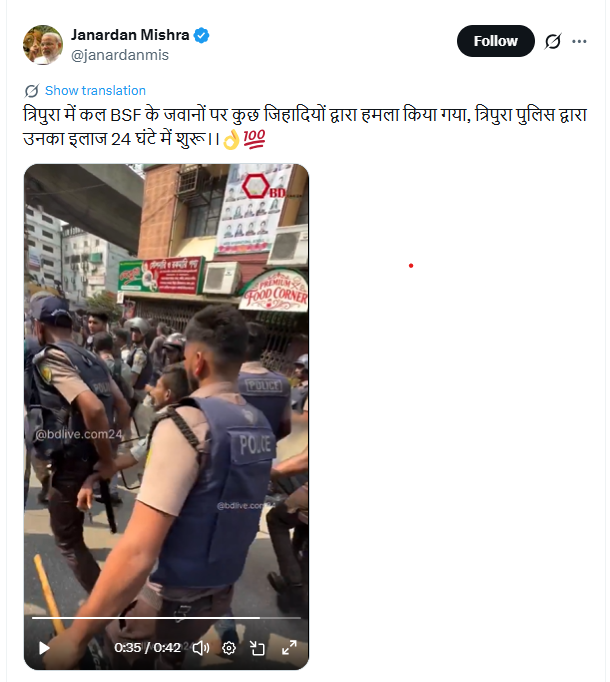
A user on social media platform X shared the viral video on November 4, 2026, with the caption: “Some jihadis attacked BSF personnel in Tripura yesterday, and the Tripura Police began treating them within 24 hours.” The post link, archive link and screenshot are provided below.
https://x.com/janardanmis/status/2117985963519693257
Fact Check
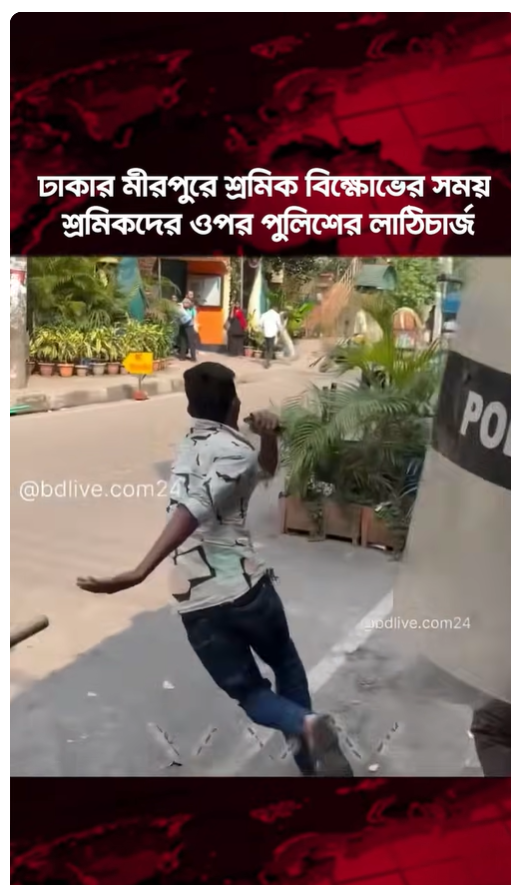
To verify the authenticity of the viral claim, we conducted a reverse image search of the video. During the search, we found the video on a YouTube channel named ‘bbpatrikabd’, where it was identified as being from Dhaka.According to the video caption, it shows police baton-charging workers during a protest in Mirpur, Dhaka. The video captures the tense situation at the protest site and the police action against the demonstrators.
https://www.youtube.com/shorts/1GN_0naBhuM
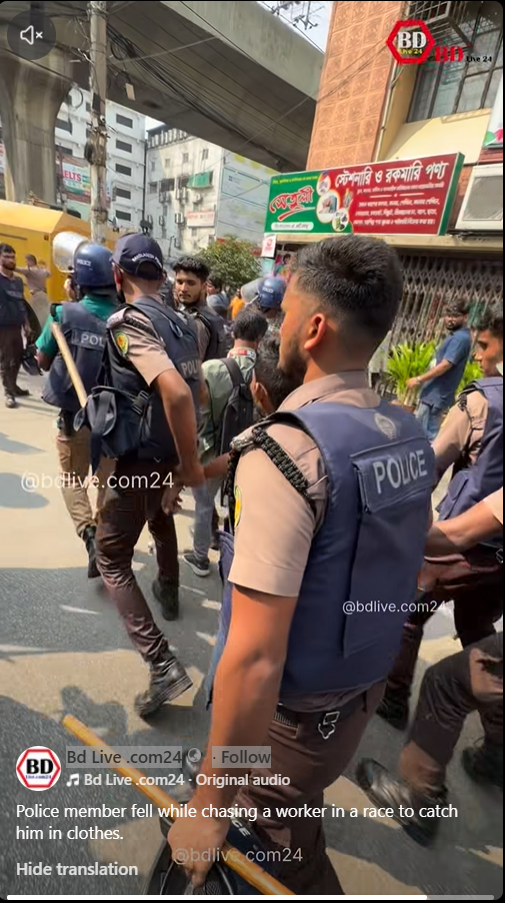
Further research led us to the same video on a Facebook page named ‘Bd Live .com24’, where it was also identified as being from Dhaka.
https://www.facebook.com/reel/39671225852493290
Conclusion
Our research established that the viral video is not related to any incident in Tripura involving an attack on BSF personnel. The video actually shows police baton-charging workers during a protest in Mirpur, Dhaka, Bangladesh. Therefore, the video is being shared with a misleading claim linking it to the alleged attack on BSF personnel in Tripura.

Related Blogs

Introduction
Delhi is Delhi-ing these days — whether it's the protest, the monsoon weather, the ongoing Monsoon Session of Parliament, metro disruptions, or just the general chaos of it all. Amid everything else, it's been over 30 days, starting from late June 2026, since the large public march organised in part by the group known as the Cockroach Janta Party (CJP) converged near Parliament and on Jantar Mantar, and the city hasn't quite exhaled since. Like every large, fast-moving public event, it's come with a parallel flood online: photos, video clips, injury claims, and hot takes pouring in from participants, bystanders, and news outlets alike, all competing for your instagram scroll.
CyberPeace is a non-partisan digital trust and safety organisation, and what we do care about is the online information environment building up around the event — helping people spot misinformation and manipulated media, and encouraging a bit more caution before hitting "share" while rumours are moving faster than facts.
Delhi Police has already made a public appeal along similar lines, asking citizens against online spread of unverified rumours, noting that misinformation could make an already tense situation worse. This advisory builds on that, with some practical guidance for everyday citizens navigating the protest in light of social media.
Why This Matters Right Now
30 plus days in, the story has layers: the original hunger strike, the march itself, police action, viral clips, and now a second wave of commentary reacting to the reactions. Old footage resurfaces relabelled as "live." Numbers get inflated or deflated depending on who's sharing them. Screenshots go around stripped of context. The longer a protest runs, the murkier the timeline gets for anyone just scrolling past — which is exactly when misinformation finds the most room to spread.
The internet access was also restricted in parts of the city during the march, which has itself become a point of attention.
Given how much unverified information is already circulating, it's worth treating any single account of "what actually happened". The full picture will likely take time to emerge through credible reporting and scrutiny.
Why This Moment Is Especially Prone to Misinformation
A few things are working together here to make mis-information spread faster than usual: Emotions are running high. Clashes, injuries, and confrontations naturally provoke strong reactions, and content that makes people angry or afraid tends to get shared quickly, with far less scrutiny than a calm, verified report would get.
There are information gaps. Reports of internet restrictions in parts of the city leave holes that get filled with speculation or worse, old footage recycled and passed off as live updates.
The event is politically charged, which means competing narratives are synthetically being pushed from multiple directions, sometimes deliberately, making it harder to find neutral ground.
There's simply a huge volume of content. Thousands of clips and photos are being posted from one event, which makes it easy for unrelated or out-of-context material to slip in alongside the real thing. And then there's satire. Part of this movement has roots in political satire, so parody posts and meme accounts can easily be mistaken for genuine news if they're shared without context.
Common Types of Misleading Content to Watch For
A few patterns tend to show up again and again during events like this:
- Old footage getting relabelled - Photos or videos from a completely different protest, city, or even country, re-shared with a caption claiming it's from this event.
- Clips taken out of context - A short moment, like a scuffle, shown without what happened right before or after it, changing how it reads.
- Doctored images - Photos edited to add, remove, or exaggerate people, banners, injuries, or crowd size.
- Fake official statements - Screenshots or graphics designed to look like they came from Delhi Police or a government department, but never actually issued.
- Made-up casualty numbers - Figures shared with no real source, often vaguely attributed to "eyewitnesses."
- Impersonation accounts - Handles designed to look like an official police or organiser account, sometimes just one letter off from the real one.
- AI-generated visuals - Fully or partly synthetic images and videos showing scenes or crowds that never actually happened.
- Rumours about shutdowns - Unverified claims about internet blackouts, road closures, or metro shutdowns that may be old, exaggerated, or simply untrue.
What Citizens Should Do:
- Pause before you forward. If a clip or claim makes you feel an instant, strong reaction, that's often the moment to slow down, not speed up.
- Check the timestamp and source. A five-day-old protest generates a lot of recycled footage. Reverse image/video search before assuming something is "breaking."
- Cross-check with more than one outlet. If only one account or page is reporting something dramatic, wait for corroboration.
- Be wary of numbers without sources. Injury counts, crowd sizes, and arrest figures are easy to exaggerate in either direction.
- Don't share unverified visuals of injuries or violence. Beyond accuracy concerns, this can also cause real harm to the people shown.
- When in doubt, don't repost — verify first, or simply sit it out.
How to Check a Claim Before You Share It:
A checklist goes a long way here:
- Pause for a second. Content built to provoke a strong reaction is often designed to get past your defenses before you think twice. Just slowing down is itself protective.
- Ask where it actually came from. Is this from a named journalist or outlet you can verify, or an anonymous forward with no clear origin? Messages that have clearly been passed around many times deserve extra suspicion.
- Look for more than one source. If something significant is genuinely true, you'll usually find several independent, reputable outlets reporting it not just one channel or account.
- Check the date and place. A quick reverse image or video search can tell you if a photo or clip has shown up online before, and what it was originally about.
- Wait for official confirmation. For anything involving police action, injuries, or arrests, check verified accounts like Delhi Police, PIB, established news wires before treating a claim as settled fact.
- Be suspicious of absolute language. Words like "confirmed," "breaking," or "exposed," used without naming any actual source, are a classic misinformation tell.
- Look at the account, not just the post. New accounts with no history, or ones that only ever post about this one topic, deserve a second look.
- Notice when something feels too satisfying. If a claim perfectly confirms what you already believed, that's exactly when you should slow down and check it; it's the content you're least likely to question on your own.
Reliable Fact-Checking Platforms and AI Detection Tools:
These resources can help you check specific claims, images, or videos:
- For fact-checking: PIB Fact Check (factcheck.pib.gov.in) for anything involving government statements or orders; Alt News (altnews.in) and BOOM Live (boomlive.in), two independent Indian outlets that regularly cover protest- and politics-related claims.
- For reverse image and video searches: Google Images, Google Lens, and TinEye can show you where a photo first appeared and in what context. InVID-WeVerify is a free browser plugin built for journalists that breaks videos into keyframes and lets you reverse-search individual frames.
- For AI and synthetic media detection: Hive Moderation and Sensity AI offer public tools for checking images and video. Deepware Scanner focuses specifically on deepfake video. And most major platforms like Meta, YouTube, X are now labeling some AI-generated content automatically, though the absence of a label doesn't mean something's real.
- A few terms worth knowing: A cheapfake is misleading media made with simple editing, cropping, slowing down, re-captioning rather than AI. These are still far more common than actual AI deepfakes. A deepfake is synthetic audio, video, or image content made with AI to convincingly show someone saying or doing something they didn't. Synthetic media is the broader umbrella term for any AI-generated content, whether or not it's being used to deceive.
Reporting Mechanism ~ If You Come Across Suspected Misinformation
Don't share it further, even to mock or correct it any engagement can boost its reach. Check it against the fact-checking tools above before deciding what you think is true. Report it directly on the platform. If it falls under the category of ‘Unlawful Content’ as per IT Rules, you can reach out to the grievance officer of the platform for removal of such content.
If it involves a government statement or order, send it to PIB Fact Check. If it looks like incitement, impersonation, extortion, or another cybercrime, report it to the National Cyber Crime Reporting Portal (cybercrime.gov.in) or call 1930.
Further Steps & helplines
- To file a cybercrime complaint: National Cyber Crime Reporting Portal - 1930 or cybercrime.gov.in
- To flag a fake government-related claim: PIB Fact Check - factcheck.pib.gov.in
- For an on-ground emergency: dial 100 / 112
- CyberPeace Helpline: +91 9570000066 or helpline@cyberpeace.net
- For fact check and debunking of any suspicious viral information, you can reach out to cyberpeace at helpline@cyberpeace.net
- If this advisory feels useful, consider sharing it in family WhatsApp groups, community networks, or student and youth organisations as it helps slow the spread of unverified content when more people are thinking about it.
CyberPeace's Message to Citizens
Being first to share something isn't the same as being right. In moments like this, the most useful thing any of us can do is slow down, verify before sharing, be a little suspicious of content that confirms exactly what we already believed, and trust named, accountable sources over anonymous forwards. Misinformation during civic unrest doesn't just mislead people; it can raise tensions, put individuals at risk, and chip away at trust in both the media and the institutions meant to maintain public order.Our goal is simply to help people navigate the information around it a little more safely and critically.
Conclusion
Protests and public unrest always generate a flood of information, and not all of it will be accurate. What keeps that information environment healthy isn't any single authority or platform, it's the everyday habits of the people deciding, one post at a time, whether to check something or just pass it along. Delhi's news cycle will keep moving, and this advisory isn't asking anyone to disengage from it. It's just a nudge to stay a little more careful with what you believe and what you pass on in this social media age. Pause. Verify. Scroll healthy. Stay CyberPeaceful.
References
- https://rajkaran.in/delhi-police-urges-calm-amid-cjp-protest-warns-against-rumours-as-clashes-erupt-during-chalo-sansad-march
- https://www.youtube.com/shorts/0kkSCYrjRGc
- https://factcheck.pib.gov.in/
- https://www.altnews.in/
- https://www.boomlive.in/
- https://www.vishvasnews.com/
- https://www.factcrescendo.com/
- https://cybercrime.gov.in/
Contributors
- Neeraj Soni, Sr. Research Analyst, Policy & Advocacy, CyberPeace
- Ritika Goswami, Intern - Policy & Advocacy, CyberPeace

Executive Summary:
A viral online image claims to show Arvind Kejriwal, Chief Minister of Delhi, welcoming Elon Musk during his visit to India to discuss Delhi’s administrative policies. However, the CyberPeace Research Team has confirmed that the image is a deep fake, created using AI technology. The assertion that Elon Musk visited India to discuss Delhi’s administrative policies is false and misleading.


Claim
A viral image claims that Arvind Kejriwal welcomed Elon Musk during his visit to India to discuss Delhi’s administrative policies.


Fact Check:
Upon receiving the viral posts, we conducted a reverse image search using InVid Reverse Image searching tool. The search traced the image back to different unrelated sources featuring both Arvind Kejriwal and Elon Musk, but none of the sources depicted them together or involved any such event. The viral image displayed visible inconsistencies, such as lighting disparities and unnatural blending, which prompted further investigation.
Using advanced AI detection tools like TrueMedia.org and Hive AI Detection tool, we analyzed the image. The analysis confirmed with 97.5% confidence that the image was a deepfake. The tools identified “substantial evidence of manipulation,” particularly in the merging of facial features and the alignment of clothes and background, which were artificially generated.


Moreover, a review of official statements and credible reports revealed no record of Elon Musk visiting India to discuss Delhi’s administrative policies. Neither Arvind Kejriwal’s office nor Tesla or SpaceX made any announcement regarding such an event, further debunking the viral claim.
Conclusion:
The viral image claiming that Arvind Kejriwal welcomed Elon Musk during his visit to India to discuss Delhi’s administrative policies is a deep fake. Tools like Reverse Image search and AI detection confirm the image’s manipulation through AI technology. Additionally, there is no supporting evidence from any credible sources. The CyberPeace Research Team confirms the claim is false and misleading.
- Claim: Arvind Kejriwal welcomed Elon Musk to India to discuss Delhi’s administrative policies, viral on social media.
- Claimed on: Facebook and X(Formerly Twitter)
- Fact Check: False & Misleading

Executive Summary
A video showing a building engulfed in flames is going viral on social media, with users claiming it depicts an attack by Hezbollah on Israel’s military headquarters. The clip is being shared with assertions that several Israeli soldiers were killed and many remain trapped inside the burning structure. However, a research by the CyberPeace Research Wing found that the claim is false. The viral video is not from Israel but from New York City in the Manhattan area, where a residential building caught fire.
Claim
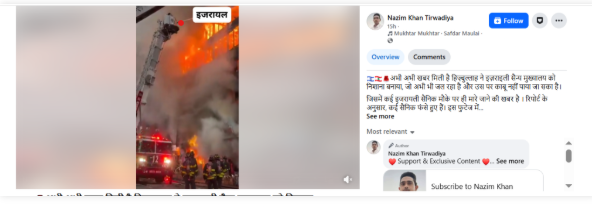
A Facebook user, ‘Nazim Khan Tirwadiya’, shared the video on April 15, 2026, claiming that Hezbollah had targeted an Israeli military headquarters, resulting in heavy casualties and ongoing fire.
Fact Check
To verify the claim, we extracted keyframes from the viral video and conducted a reverse image search. This led us to a longer version of the same clip uploaded on the YouTube channel “FDNY Response Videos” on April 12, 2026. The video description identified the location as Manhattan, New York City.
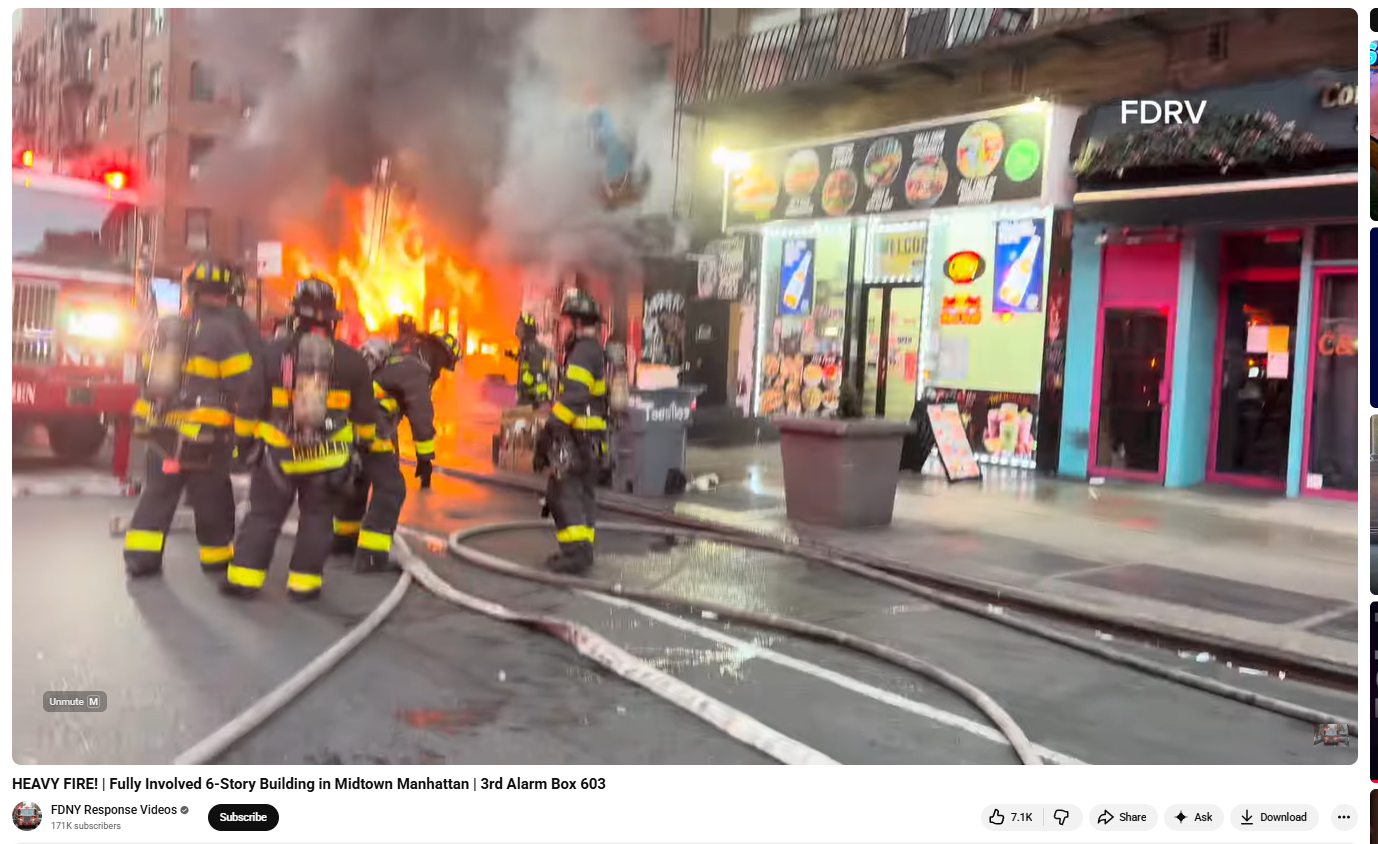
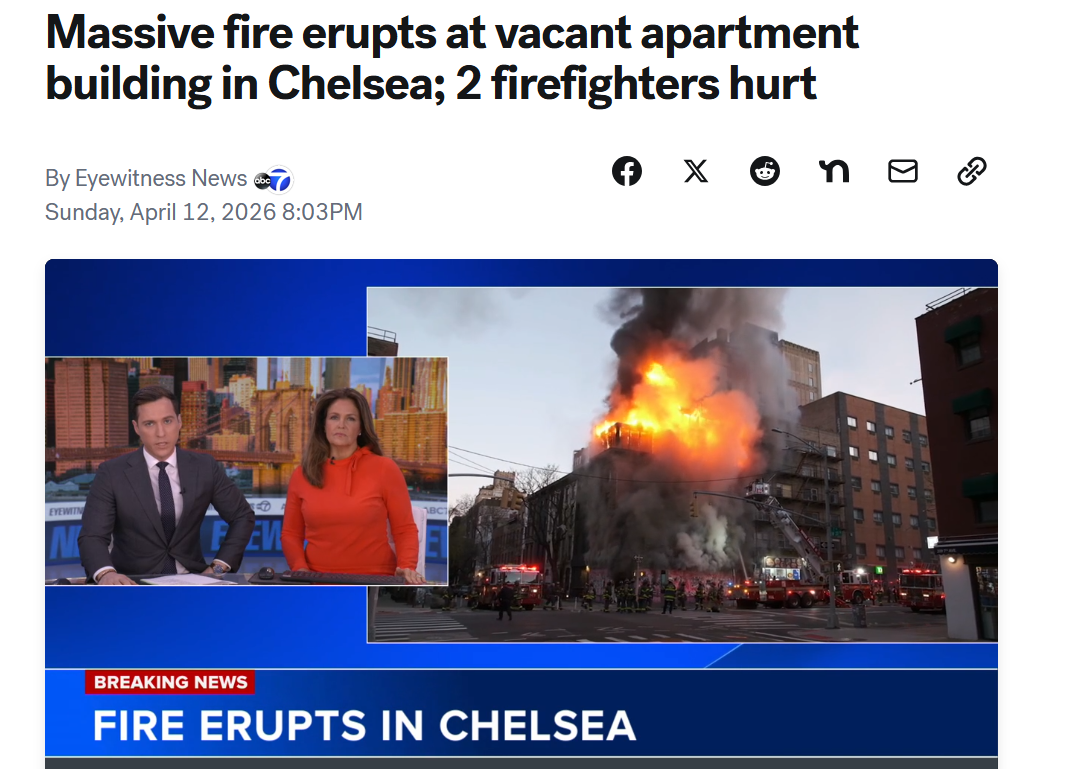
Further keyword searches led us to a report published by ABC7NY on April 12, 2026. According to the report, a massive fire broke out in a six-storey apartment building in Manhattan’s Midtown area around 6 a.m. Firefighters worked extensively to control the blaze, and two firefighters sustained minor injuries. No fatalities were reported.
Conclusion
The viral claim is false. The video does not show an attack on Israel by Hezbollah. Instead, it captures a fire incident in a residential building in Manhattan, New York City. The clip has been shared with a misleading narrative unrelated to the actual event.

