
#FactCheck - Deepfake Video Falsely Shows Aaj Tak Reporting BJP Defeat in Assam Elections
Assembly elections are due to be held in Assam later this year, with polling likely in April or May. Ahead of the elections, a video claiming to be an Aaj Tak news bulletin is being widely circulated on social media.
In the viral video, Aaj Tak anchor Rajiv Dhoundiyal is allegedly seen stating that a leaked intelligence report has issued a warning for the ruling Bharatiya Janata Party (BJP) in Assam. The clip claims that according to this purported report, the BJP may suffer significant losses in the upcoming Assembly elections. Several social media users sharing the video have also claimed that the alleged intelligence report signals the possible removal of Assam Chief Minister Himanta Biswa Sarma from office.
However, an investigation by the Cyber Peace Foundation found the viral claim to be false. Our probe clearly established that no leaked intelligence report related to the Assam Assembly elections exists.
Further, Aaj Tak has neither published nor broadcast any such report on its official television channel, website, or social media platforms. The investigation also revealed that the viral video itself is not authentic and has been created using deepfake technology.
Claim
On social media platform Facebook, a user shared the viral video claiming that the BJP has been pushed on the back foot following organisational changes in the Congress—appointing Priyanka Gandhi Vadra as chairperson of the election screening committee and Gaurav Gogoi as the Assam Pradesh Congress Committee president. The post further claims that an Intelligence Bureau report predicts that the current Assam government will not return to power.
(Link to the post, archive link, and screenshots are available.)
FactCheck:
To verify the claim, we first searched for reports related to any alleged leaked intelligence assessment concerning the Assam Assembly elections using relevant keywords. However, no credible or reliable reports supporting the claim were found. We then reviewed Aaj Tak’s official website, social media pages, and YouTube channel. Our examination confirmed that no such news bulletin has been published or broadcast by the network on any of its official platforms.
- https://www.facebook.com/aajtak/?locale=hi_IN
- https://www.instagram.com/aajtak/
- https://x.com/aajtak
- https://www.youtube.com/channel/UCt4t-jeY85JegMlZ-E5UWtA
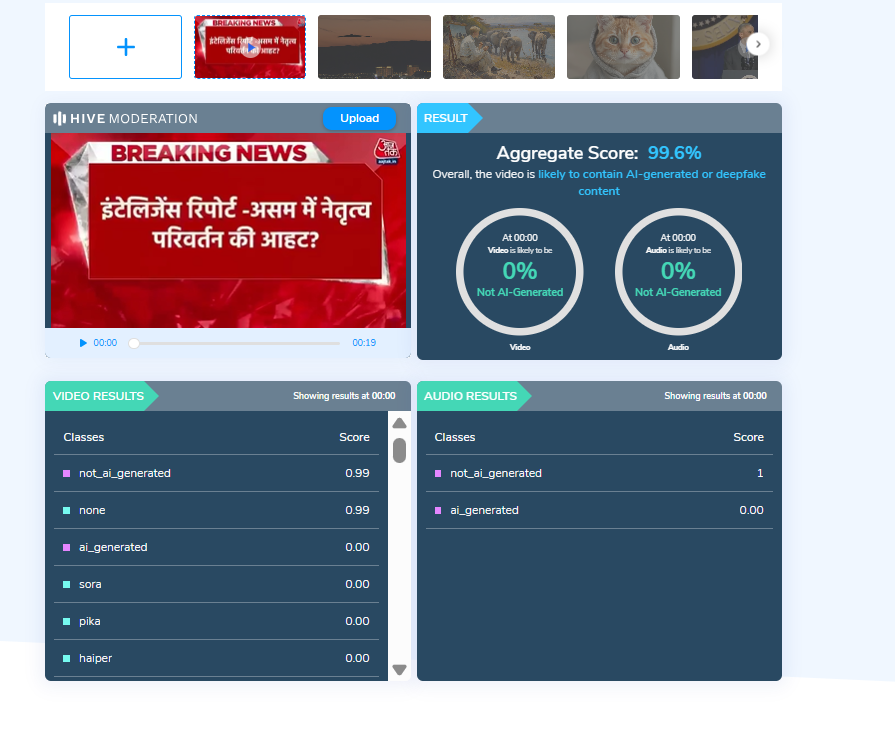
To further verify the authenticity of the video, its audio was scanned using the deepfake voice detection tool HIVE Moderation.
The analysis revealed that the voice heard in the video is 99 per cent AI-generated, clearly indicating that the audio is not genuine and has been artificially created using artificial intelligence.
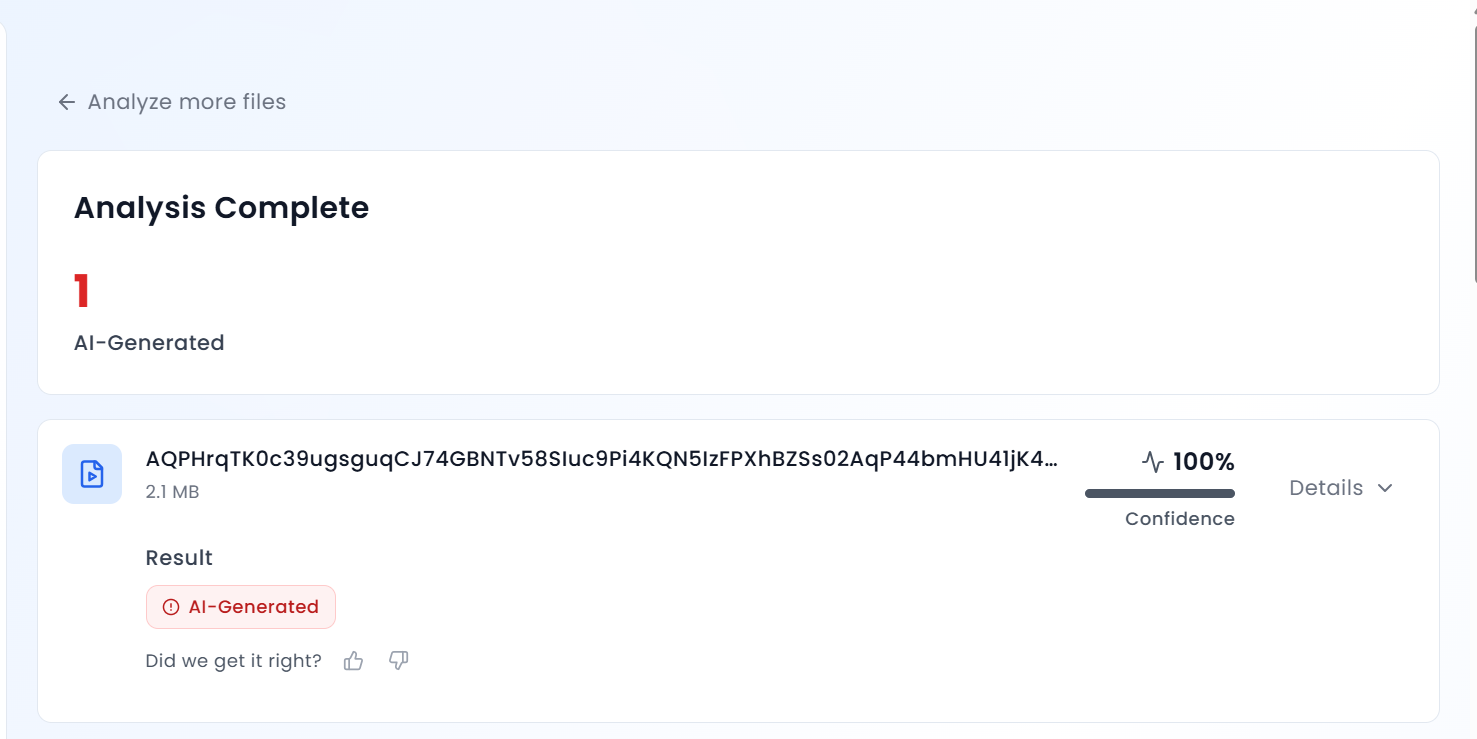
Additionally, the video was analysed using another AI detection tool, Aurigin AI, which also identified the viral clip as AI-generated.
Conclusion:
The investigation clearly establishes that there is no leaked intelligence report predicting BJP’s defeat in the Assam Assembly elections. Aaj Tak has not published or broadcast any such content on its official platforms. The video circulating on social media is not authentic and has been created using deepfake technology to mislead viewers.

Related Blogs
.webp)
Introduction
The recent events in Mira Road, a bustling suburb on the outskirts of Mumbai, India, unfold like a modern-day parable, cautioning us against the perils of unverified digital content. The Mira Road incident, a communal clash that erupted into the physical realm, has been mirrored and magnified through the prism of social media. The Maharashtra Police, in a concerted effort to quell the spread of discord, issued stern warnings against the dissemination of rumours and fake messages. These digital phantoms, they stressed, have the potential to ignite law and order conflagrations, threatening the delicate tapestry of peace.
The police's clarion call came in the wake of a video, mischievously edited, that falsely claimed anti-social elements had set the Mira Road railway station ablaze. This digital doppelgänger of reality swiftly went viral, its tendrils reaching into the ubiquitous realm of WhatsApp, ensnaring the unsuspecting in its web of deceit.
In this age of information overload, where the line between fact and fabrication blurs, the police urged citizens to exercise discernment. The note they issued was not merely an advisory but a plea for vigilance, a reminder that the act of sharing unauthenticated messages is not a passive one; it is an act that can disturb the peace and unravel the fabric of society.
The Massacre
The police's response to this crisis was multifaceted. Administrators and members of social media groups found to be the harbingers of such falsehoods would face legal repercussions. The Thane District, a mosaic of cultural and religious significance, has been marred by a series of violent incidents, casting a shadow over its storied history. The police, in their role as guardians of order, have detained individuals, scoured social media for inauthentic posts, and maintained a vigilant presence in the region.
The Maharashtra cyber cell, a digital sentinel, has unearthed approximately 15 posts laden with videos and messages designed to sow discord among the masses. These findings were shared with the Mira-Bhayandar, Vasai-Virar (MBVV) police, who stand ready to take appropriate action. Inspector General Yashasvi Yadav of the Maharashtra cyber cell issued an appeal to the public, urging them to refrain from circulating such unverified messages, reinforcing the notion that the propagation of inauthentic information is, in itself, a crime.
The MBVV police, in their zero-tolerance stance, have formed a team dedicated to scrutinizing social media posts. The message is clear: fake news will be met with strict action. The right to free speech on social media comes with the responsibility not to share information that could incite mischief. The Indian Penal Code and Information Technology Act serve as the bulwarks against such transgressions.
The Aftermath
In the aftermath of the clashes, the police have worked tirelessly to restore calm. A young man, whose video replete with harsh and obscene language went viral, was apprehended and has since apologised for his actions. The MBVV police have also taken to social media to reassure the public that the situation is under control, urging them to avoid circulating messages that could exacerbate tensions.
The Thane district has witnessed acts of vandalism targeting shops, further escalating tensions. In response, the police have apprehended individuals linked to these acts, hoping that such measures will expedite the return of peace. Advisories have been issued, warning against the dissemination of provocative messages and rumours.
In total, 19 individuals have been taken into custody in relation to numerous incidents of violence. The Mira-Bhayandar and Vasai-Virar police have underscored their commitment to legal action against those who spread rumours through fake messages. The authorities have also highlighted the importance of brotherhood and unity, reminding citizens that above all, they are Indians first.
Conclusion
In a world where old videos, stripped of context, can fuel tensions, the police have issued a note referring to the aforementioned fake video message. They urge citizens to exercise caution, to neither believe nor circulate such messages. Police Authorities have assured that no one involved in the violence will be spared, and peace committees are being convened to restore harmony. The Mira Road incident serves as a sign of the prowess of information and responsibility that comes with it. In the digital age, where the ephemeral and the eternal collide, we must navigate the waters of truth with care. Ultimately, it is not just the image of a locality that is at stake, but the essence of our collective humanity.
References
- https://youtu.be/gK2Ac1qP-nE?feature=shared
- https://www.mid-day.com/mumbai/mumbai-crime-news/article/mira-road-communal-clash-those-spreading-fake-messages-to-face-strict-action-say-mira-bhayandar-vasai-virar-cops-23331572
- https://www.mid-day.com/mumbai/mumbai-news/article/mira-road-communal-clash-cybercops-on-alert-for-fake-clips-23331653
- https://www.theweek.in/wire-updates/national/2024/01/24/bom43-mh-shops-3rdld-vandalism.html

A video is being shared on social media, falsely attributing it to Australian Prime Minister Anthony Albanese. The video claims that following the Bondi Beach attack, he decided to cancel the visas of Pakistani citizens.
An investigation by the Cyber Peace Foundation revealed that the viral video was created using AI. In the original video, Anthony Albanese was answering questions related to the Climate Change Bill during a press conference. It is important to note that in the attack that took place last Sunday (14 December) at Bondi Beach in Sydney, New South Wales, Australia, 15 people were killed. According to Australian police, the attack targeted the Jewish community. New South Wales Police Commissioner Mal Lanyon stated that the two accused involved in the attack were father and son—one aged 50 and the other 24. Media reports identified them as Sajid and Naved Akram.
Claim:
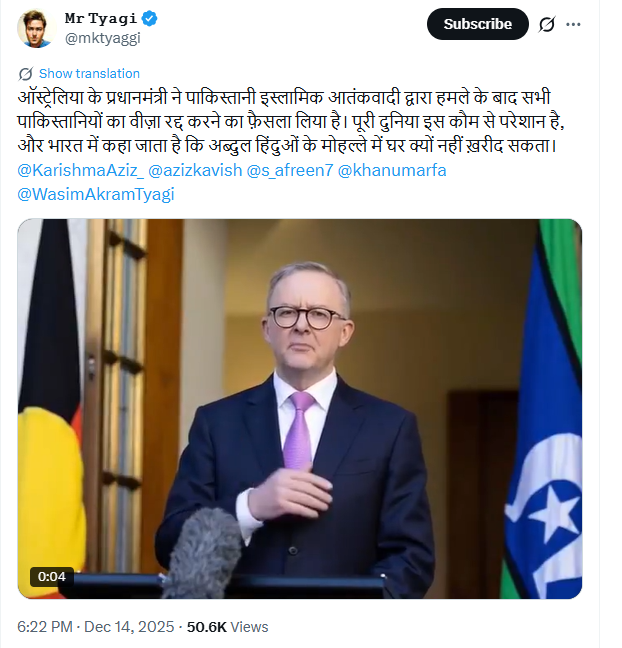
On 14 December 2025, a user on the social media platform X shared a video claiming, “After the attack by a Pakistani Islamic terrorist, the Australian Prime Minister has decided to cancel the visas of all Pakistanis. The whole world is troubled by this community, and in India it is said that Abdul cannot buy a house in a Hindu neighbourhood.”
The link to the related post, its archived version, and screenshots can be seen below:
Investigation:Upon closely examining the viral video, we suspected it to be AI-generated. Subsequently, we scanned the video using the AI detection tool aurigin.ai. According to the results provided by the tool, the video was found to be AI-generated.

Executive Summary
A video allegedly showing India’s Defence Secretary Rajesh Kumar Singh making remarks about Pakistan’s cyber capabilities is being widely shared on social media. The clip claims that Singh admitted Pakistan had “jammed Indian systems” on May 10 and described Pakistan’s cyber and electronic warfare capabilities as a major challenge for India. Research by CyberPeace Research Wing found that the viral clip is an AI-generated deepfake being circulated to spread misinformation. Rajesh Kumar Singh never made any such statement.
Claim
An X user shared the viral video claiming that India’s Defence Secretary had acknowledged Pakistan’s technological superiority. The post alleged that Singh admitted Pakistan successfully jammed Indian systems and claimed that India was lagging behind in cyber and electronic warfare technology.

Fact Check
To verify the claim, we searched relevant keywords on Google but found no credible media reports carrying such a statement from the Defence Secretary. We then extracted keyframes from the viral clip and conducted a reverse image search. During the research, we found the original video uploaded on the YouTube channel of ANI on April 30, 2026.

A review of the full video confirmed that Rajesh Kumar Singh never made the remarks heard in the viral clip. The original footage had been manipulated and altered using AI-generated audio techniques.
Conclusion
Our research confirms that the viral video is fake and AI-manipulated. The statement attributed to India’s Defence Secretary Rajesh Kumar Singh is fabricated, and the deepfake clip is being shared with misleading claims to spread disinformation.
