#FactCheck- Old CCTV Video Falsely Shared as Killing of LeT’s Amir Hamza
Executive Summary
A CCTV video showing a man being shot is being widely circulated on social media with the claim that it depicts the killing of Lashkar-e-Taiba terrorist Amir Hamza in Pakistan. However, research by the CyberPeace Research Wing found that the claim is misleading. The viral video existed online even before the reported attack on Amir Hamza.
Claim
Social media users are sharing a CCTV clip claiming that Lashkar-e-Taiba terrorist Amir Hamza was shot dead in Pakistan.
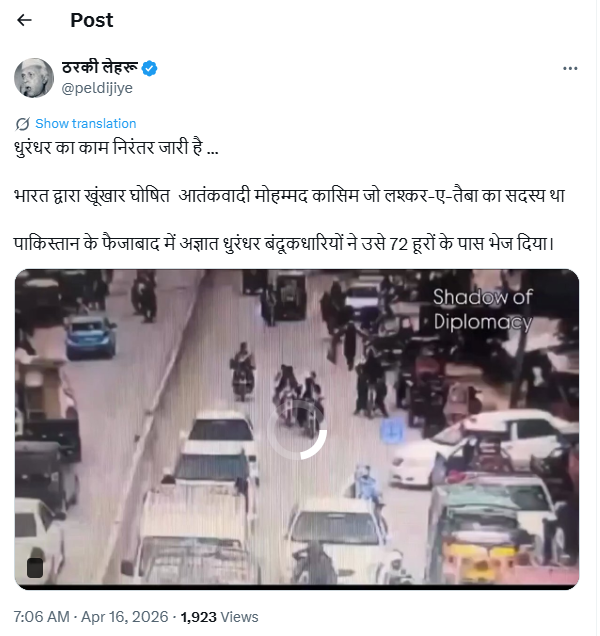
Fact Check
To verify the claim, we first searched relevant keywords such as “Maulana Amir Hamza firing Lahore.” This led us to a report published on April 17, 2026, by The Hindu. Citing Pakistani channel 24 News HD TV, the report stated that unidentified attackers opened fire on the car of TV host Justice Nazir Ahmed Ghazi. Amir Hamza was injured in the incident, not killed.

We also reviewed the official social media accounts of 24 News HD TV. A post on its X handle (@24NewsHD) confirmed that Justice Ghazi was safe, while Amir Hamza sustained injuries in the firing incident in Lahore.

For further verification, we extracted keyframes from the viral video and performed a reverse image search. The same clip was found uploaded on March 28, 2026, on a Pakistani Facebook page. According to the post, the CCTV footage was linked to the killing of an individual named Saifullah Malakhel.
Although we could not independently verify the exact origin of the video, our findings clearly indicate that the footage predates the recent attack on Amir Hamza and is unrelated to the incident.
Conclusion
The viral claim is false. Amir Hamza was not killed but reportedly injured in the firing incident, as per credible media reports. The CCTV video being shared in this context is old and unrelated, and has been circulated with a misleading narrative.
Related Blogs

Introduction
In this age, when our data stands as the key to all resources, espionage has moved from dark alleys and trench coats to keyboards and code. In this era of active digital espionage, where intelligence is stolen through invisible cyberattacks that target computer networks. Cyber espionage and spying have become the most critical threat in the hyper-connected world of today. As governments, corporations, and individuals store an immense amount of confidential information online, the grounds of espionage have shifted from land and sea to the silent realm of cyberspace.
What is Cyber Espionage?
Cyber espionage refers to the unauthorised access of confidential data for strategic, political, military, and financial gain, unlike cybercrime, which is mostly about money. Cyber espionage is about gaining information power. The very first documented case dates back to 1986-87, when a group of German hackers breached the US military establishment and the defence systems and sold that stolen data to the Soviets and the KGB. This was the beginning of a new era where classified intelligence could be gathered even without entering a building.
Cyber espionage is mostly carried out by trained espionage professionals, elite hackers, and corporate spies whose sole purpose is to target the government, research organisations, military establishments, and other critical infrastructures.
The Objective
The act of Cyber Espionage is being driven by three major objectives, such as;
- Stealing of Intellectual Property- Starting from information and data related to military establishments to pharmaceutical patents, stealing innovation is cheaper than funding R&D.
- Political and Diplomatic Advantage- As government networks are hacked to access state secrets, negotiation strategies, and classified communications.
- Military Intelligence- Cyber spies also work to steal data on weapons troop movements, defence systems, and war systems, often years before conflict breaks out.
In a world being shaped by digital power, information is not just about knowledge. Rather, it is all about ensuring dominance.
The arsenal of modern digital spies is more sophisticated, and most importantly, they are used covertly rather than the spy gadgets that are shown in spy movies. Some of the tactics resorted to by the cyber spies can be recognised as;
- Phishing Attacks through fake emails that lure victims to click on malicious links or sharing of passwords.
- Persisting Advanced Threats through long-term stealth attacks in a network for more than a month or a year.
- Malware and Spyware are invisible software that logs keystrokes, records screens, or steals files silently.
- Deepfake Manipulations by creating AI-generated fake videos that can influence political developments in the country.
Anything that makes cyber espionage terrifying is not just the theft, but the fact that it goes undetected.
What Differentiates Cyber Espionage and Cyber Warfare
Cyber espionage is a silent and stealthy tactic that is carried out with utmost secrecy, being a long-term effort for intelligence gathering. It mostly focuses on the stealing of data, whereas Cyber warfare is an open and destructive tactic that is used to create an immediate and visible impact to create disruption. However, espionage is an act that prepares the battlefield for the warfare of the future.
Taking instances of real instances of cyber espionage, we can refer to examples such as;
- Operation Aurora was conducted in 2010, where Chinese Hackers based in Beijing tried to steal IP data from Google and American tech giants.
- The Stuxnet attack in 2010 was another cyber weapon that was developed to sabotage Iran’s nuclear centrifuges.
- SolarWinds Attack of 2020 was an instance of cyber espionage where a supply chain hack was carried out to target multiple US federal government agencies.
As most of these instances reflect that they were battles without guns, but with the use of codes. Several sources raise the question of whether cyber-attacks can be stopped. The answer lies in the fact that they cannot be stopped completely, but can be minimised to some extent, by developing capabilities to counter and deter cyber-attacks with the help of equal cyber defence capabilities.
Conclusion
From the Cold War era to the present Code War, espionage has evolved with technology. An effort that was once taken solely by spies and human assets, with the passing of time enhancement of technologies it is now expanded to malware, phishing, social engineering, and remote digital inflation. In this age of information warfare, espionage is faster, cheaper, and harder to trace than ever before. The enemies of a nation may never cross its borders, but they may already be inside its systems. However, the world has now officially entered a new battlefield, without boundaries, uniforms, and bombs. It is now being fought through bytes, breaches, and invisible enemies.
References
- https://www.sentinelone.com/cybersecurity-101/threat-intelligence/cyber-espionage/
- https://www.espiamos.com/en/content/espionage-in-the-digital-world-threats-and-opportunities.html
- https://www.apu.apus.edu/area-of-study/information-technology/resources/what-is-cyber-warfare/
- https://pride-security.co.uk/the-rise-of-digital-warfare-understanding-the-evolution-of-cyber-espionage/

The global race for Artificial Intelligence is heating up, and India has become one of its most important battlegrounds. Over the past few months, tech giants like OpenAI (ChatGPT), Google (Gemini), X (Grok), Meta (Llama), and Perplexity AI have stepped up their presence in the country, not by selling their AI tools, but by offering them free or at deep discounts.
At first, it feels like a huge win for India’s digital generation. Students, professionals, and entrepreneurs today can tap into some of the world’s most powerful AI tools without paying a rupee. It feels like a digital revolution unfolding in real time. Yet, beneath this generosity lies a more complicated truth. Experts caution that this wave of “free” AI access isn’t without strings attached. This offering impacts how India handles data privacy, the fairness of competition, and the pace of the development of homegrown AI innovation that the country is focusing on.
The Market Strategy: Free Now, Pay Later
The choice of global AI companies to offer free access in India is a calculated business strategy. With one of the world’s largest and fastest-growing digital populations, India is a market no tech giant wants to miss. By giving away their AI tools for free, these firms are playing a long game:
- Securing market share early: Flooding the market with free access helps them quickly attract millions of users before Indian startups have a chance to catch up. Recent examples are Perplexity, ChatGPT Go and Gemini AI which are offering free subscriptions to Indian users.
- Gathering local data: Every interaction, every prompt, question, or language pattern, helps these models learn from larger datasets to improve their product offerings in India and the rest of the world. Nothing is free in the world - as the popular saying goes, “if something is free, means you are the product. The same goes for these AI platforms: they monetise user data by analysing chats and their behaviour to refine their model and build paid products. This creates the privacy risk as India currently lacks specific laws to govern how such data is stored, processed or used for AI training.
- Create user dependency: Once users grow accustomed to the quality and convenience of these global models, shifting to Indian alternatives, even when they become paid, will be difficult. This approach mirrors the “freemium” model used in other tech sectors, where users are first attracted through free access and later monetised through subscriptions or premium features, raising ethical concerns.
Impact on Indian Users
For most Indians, the short-term impact of free AI access feels overwhelmingly positive. Tools like ChatGPT and Gemini are breaking down barriers by democratising knowledge and making advanced technology available to everyone, from students, professionals, to small businesses. It’s changing how people learn, think and do - all without spending a single rupee.But the long-term picture isn’t quite as simple. Beneath the convenience lies a set of growing concerns:
- Data privacy risks: Many users don’t realise that their chats, prompts, or queries might be stored and used to train global AI models. Without strong data protection laws in action, sensitive Indian data could easily find its way into foreign systems.
- Overdependence on foreign technology: Once these AI tools become part of people’s daily lives, moving away from them gets harder — especially if free access later turns into paid plans or comes with restrictive conditions.
- Language and cultural bias: Most large AI models are still built mainly around English and Western data. Without enough Indian language content and cultural representation, the technology risks overlooking the very diversity that defines India
Impact on India’s AI Ecosystem
India’s Generative AI market, valued at USD $ 1.30 billion in 2024, is projected to reach 5.40 billion by 2033. Yet, this growth story may become uneven if global players dominate early.
Domestic AI startups face multiple hurdles — limited funding, high compute costs, and difficulty in accessing large, diverse datasets. The arrival of free, GPT-4-level models sharpens these challenges by raising user expectations and increasing customer acquisition costs.
As AI analyst Kashyap Kompella notes, “If users can access GPT-4-level quality at zero cost, their incentive to try local models that still need refinement will be low.” This could stifle innovation at home, resulting in a shallow domestic AI ecosystem where India consumes global technology but contributes little to its creation.
CCI’s Intervention: Guarding Fair Competition
The Competition Commission of India (CCI) has started taking note of how global AI companies are shaping India’s digital market. In a recent report, it cautioned that AI-driven pricing strategies such as offering free or heavily subsidised access could distort healthy competition and create an uneven playing field for smaller Indian developers.
The CCI’s decision to step in is both timely and necessary. Without proper oversight, such tactics could gradually push homegrown AI startups to the sidelines and allow a few foreign tech giants to gain disproportionate influence over India’s emerging AI economy.
What the Indian Government Should Do
To ensure India’s AI landscape remains competitive, inclusive, and innovation-driven, the government must adopt a balanced strategy that safeguards users while empowering local developers.
1. Promote Fair Competition
The government should mandate transparency in free access offers, including their duration, renewal terms, and data-use policies. Exclusivity deals between foreign AI firms and telecom or device companies must be closely monitored to prevent monopolistic practices.
2. Strengthen Data Protection
Under the Digital Personal Data Protection (DPDP) Act, companies should be required to obtain explicit consent from users before using data for model training. Encourage data localisation, ensuring that sensitive Indian data remains stored within India’s borders.
3. Support Domestic AI Innovation
Accelerate the implementation of the IndiaAI Mission to provide public compute infrastructure, open datasets, and research funding to local AI developers like Sarvam AI, an Indian company chosen by the government to build the country's first homegrown large language model (LLM) under IndianAI Mission.
4. Create an Open AI Ecosystem
India should develop national AI benchmarks to evaluate all models, foreign or domestic, on performance, fairness, and linguistic diversity. And at the same time, they have their own national data Centre to train their indigenous AI models.
5. Encourage Responsible Global Collaboration
Speaking at the AI Action Summit 2025, the Prime Minister highlighted that governance should go beyond managing risks and should also promote innovation for the global good. Building on this idea, India should encourage global AI companies to invest meaningfully in the country’s ecosystem through research labs, data centres, and AI education programmes. Such collaborations will ensure that these partnerships not only expand markets but also create value, jobs and knowledge within India.
Conclusion
The surge of free AI access across India represents a defining moment in the nation’s digital journey. On one hand, it’s empowering millions of people and accelerating AI awareness like never before. On the other hand, it poses serious challenges from over-reliance on foreign platforms to potential risks around data privacy and the slow growth of local innovation. India’s real test will be finding the right balance between access and autonomy, allowing global AI leaders to innovate and operate here, but within a framework that protects the interests of Indian users, startups, and data ecosystems. With strong and timely action under the Digital Personal Data Protection (DPDP) Act, the IndiaAI Mission, and the Competition Commission of India’s (CCI) active oversight, India can make sure this AI revolution isn’t just something that happens to the country, but for it.
References
- https://www.moneycontrol.com/artificial-intelligence/cci-study-flags-steep-barriers-for-indian-ai-startups-calls-for-open-data-and-compute-access-to-level-playing-field-article-13600606.html#
- https://www.imarcgroup.com/india-generative-ai-market
- https://www.mea.gov.in/Speeches-Statements.htm?dtl/39020/Opening_Address_by_Prime_Minister_Shri_Narendra_Modi_at_the_AI_Action_Summit_Paris_February_11_2025
- https://m.economictimes.com/tech/artificial-intelligence/nasscom-planning-local-benchmarks-for-indic-ai-models/articleshow/124218208.cms
- https://indianexpress.com/article/business/centre-selects-start-up-sarvam-to-build-country-first-homegrown-ai-model-9967243/#

The Ghibli trend has been in the news for the past couple of weeks for multiple reasons, be it good or bad. The nostalgia that everyone has for the art form has made people turn a blind eye to what the trend means to the artists who painstakingly create the art. The open-source platforms may be trained on artistic material without the artist's ‘explicit permission’ making it so that the rights of the artists are downgraded. The artistic community has reached a level where they are questioning their ability to create, which can be recreated by this software in a couple of seconds and without any thought as to what it is doing. OpenAI’s update on ChatGPT makes it simple for users to create illustrations that are like the style created by Hayao Miyazaki and made into anything from personal pictures to movie scenes and making them into Ghibli-style art. The updates in AI to generate art, including Ghibli-style, may raise critical questions about artistic integrity, intellectual property, and data privacy risks.
AI and the Democratization of Creativity
AI-powered tools have lowered barriers and enable more people to engage with artistic expression. AI allows people to create appealing content in the form of art regardless of their artistic capabilities. The update of ChatGPT has made it so that art has been democratized, and the abilities of the user don't matter. It makes art accessible, efficient and a creative experiment to many.
Unfortunately, these developments also pose challenges for the original artistry and the labour of human creators. The concern doesn't just stop at AI replacing artists, but also about the potential misuse it can lead to. This includes unauthorized replication of distinct styles or deepfake applications. When it is used ethically, AI can enhance artistic processes. It can assist with repetitive tasks, improving efficiency, and enabling creative experimentation.
However, its ability to mimic existing styles raises concerns. The potential that AI-generated content has could lead to a devaluation of human artists' work, potential copyright issues, and even data privacy risks. Unauthorized training of AI models that create art can be exploited for misinformation and deepfakes, making human oversight essential. Few artists believe that AI artworks are disrupting the accepted norms of the art world. Additionally, AI can misinterpret prompts, producing distorted or unethical imagery that contradicts artistic intent and cultural values, highlighting the critical need for human oversight.
The Ethical and Legal Dilemmas
The main dilemma that surrounds trends such as the Ghibli trend is whether it compromises human efforts by blurring the line between inspiration and infringement of artistic freedom. Further, an issue that is not considered by most users is whether the personal content (personal pictures in this case) uploaded on AI models is posing a risk to their privacy. This leads to the issue where the potential misuse of AI-generated content can be used to spread misinformation through misleading or inappropriate visuals.
The negative effects can only be balanced if a policy framework is created that can ensure the fair use of AI in Art. Further, this should ensure that the training of AI models is done in a manner that is fair to the artists who are the original creators of a style. Human oversight is needed to moderate the AI-generated content. This oversight can be created by creating ethical AI usage guidelines for platforms that host AI-generated art.
Conclusion: What Can Potentially Be Done?
AI is not a replacement for human effort, it is to ease human effort. We need to promote a balanced AI approach that protects the integrity of artists and, at the same time, continues to foster innovation. And finally, strengthening copyright laws to address AI-generated content. Labelling AI content and ensuring that this content is disclosed as AI-generated is the first step. Furthermore, there should be fair compensation made to the human artists based on whose work the AI model is trained. There is an increasing need to create global AI ethics guidelines to ensure that there is transparency, ethical use and human oversight in AI-driven art. The need of the hour is that industries should work collaboratively with regulators to ensure that there is responsible use of AI.
References
- https://medium.com/@haileyq/my-experience-with-studio-ghibli-style-ai-art-ethical-debates-in-the-gpt-4o-era-b84e5a24cb60
- https://www.bbc.com/future/article/20241018-ai-art-the-end-of-creativity-or-a-new-movement