
#FactCheck-AI-Generated Image of Virat Kohli and Anushka Sharma Falsely Shared as a Real Candid Moment
Executive Summary
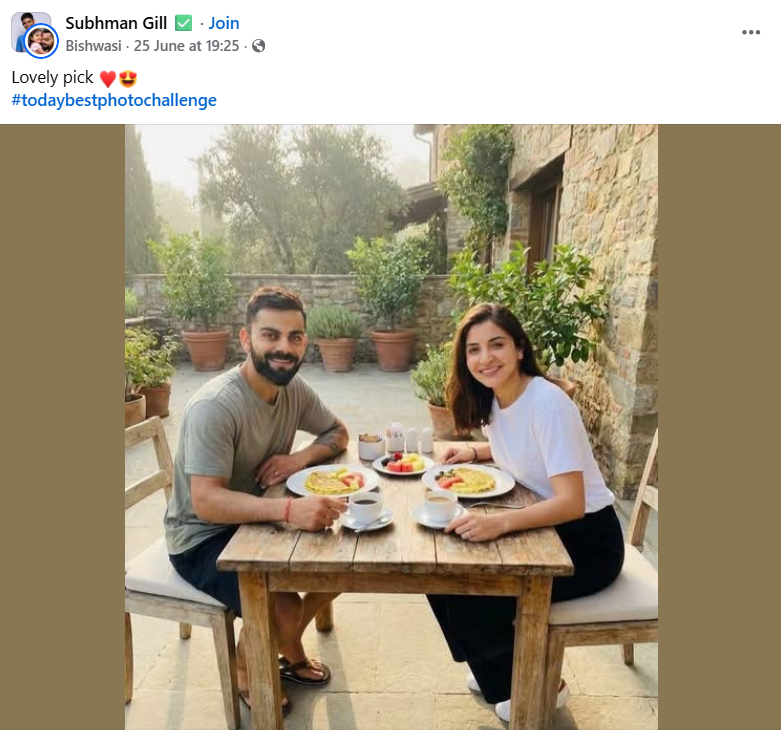
A picture is rapidly going viral on social media, showing Indian cricketer Virat Kohli and actor Anushka Sharma having breakfast together. Users are sharing this photo, presenting it as a "candid" (real) moment. Research by the CyberPeace Research Wing revealed that the photo of Virat Kohli and Anushka Sharma having breakfast is completely fake. This image does not depict a real moment, but has been created using Artificial Intelligence (AI).
Claim
A picture is rapidly going viral on social media, showing Indian cricketer Virat Kohli and actor Anushka Sharma having breakfast together. Users are sharing this photo, presenting it as a "candid" (real) moment.
https://www.facebook.com/groups/1132434027856845/posts/1677540760012833/
Fact Check
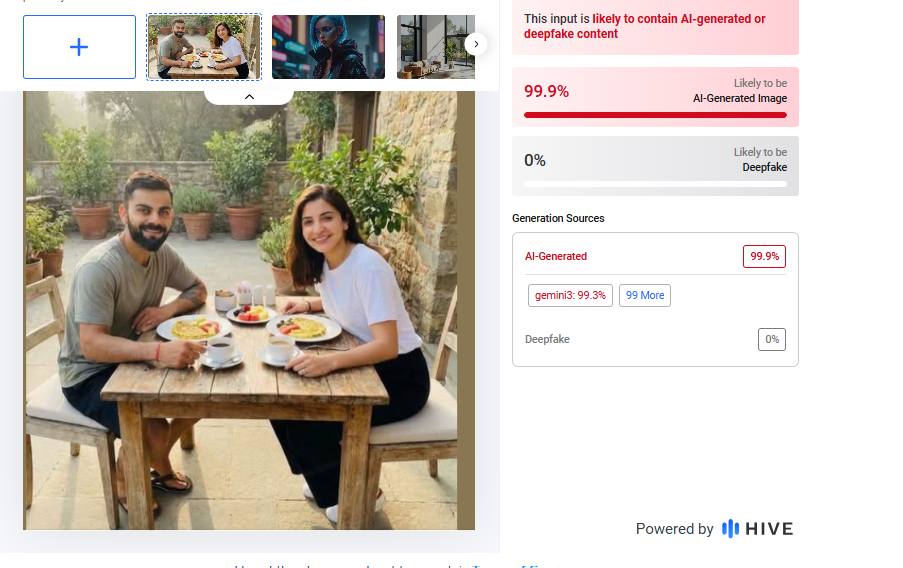
In our research, this image was found to be 'AI-generated'. When a reverse image search and keyword scan were conducted to verify this viral photo, no credible media reports, official photographs, or any such posts on the celebrity couple's official social media handles were found.
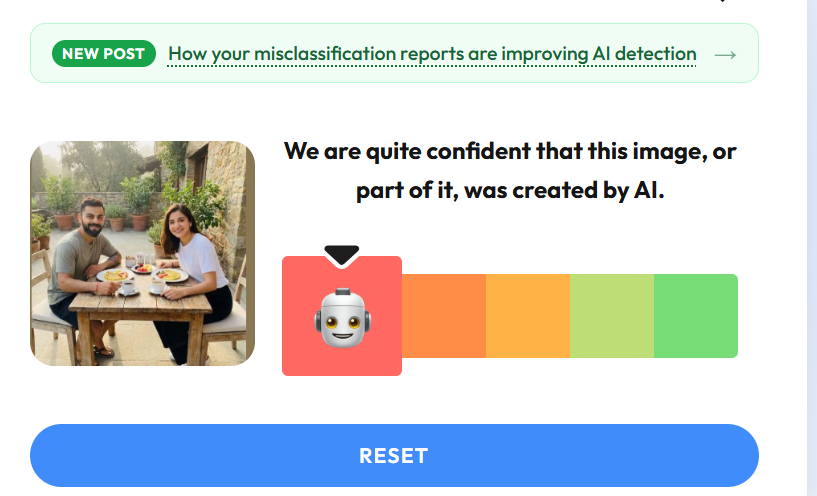
WASIT also confirmed that the image is 'AI-generated'.
Conclusion
Our research revealed that the photo of Virat Kohli and Anushka Sharma having breakfast is completely fake. This image does not depict a real moment, but has been created using Artificial Intelligence (AI).

Related Blogs

Executive Summary
A video showing people installing fencing along a border has gone viral on social media. In the clip, several individuals along with security personnel can be seen laying barbed wire fencing near a border area. The video is being shared with the claim that it shows fencing work underway on the India-Bangladesh border in West Bengal after the Bharatiya Janata Party (BJP) allegedly came to power in the state.
However, CyberPeace Research Wing investigation found the viral claim to be false. The video is not from a real incident and has been created using Artificial Intelligence (AI).
Claim
An X user named “Gopal Sanatani” shared the viral video on May 26, 2026, with the caption:“Voting in the right place keeps the country secure. Now no outsider will be able to snatch the rights of Indian citizens.”The archived link to the post is provided below.

Fact Check
To verify the authenticity of the viral claim, we extracted several key frames from the video and conducted reverse image searches using Google. However, we could not find any credible information or authentic reports related to the visuals shown in the clip. We also searched using relevant keywords on Google, but no trustworthy news reports connected to the claim were found.
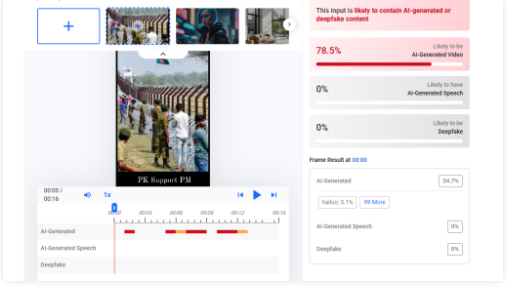
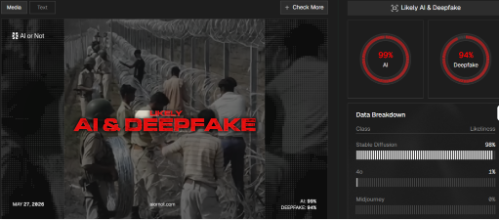
Upon closely examining the video, several visual inconsistencies became noticeable. At one point, an object resembling a piece of paper suddenly appears in a soldier’s hand and then disappears moments later. In another scene, a man installing the fencing appears to pass directly through the barbed wire and emerges unharmed, despite the sharp wires visible in the video. These irregularities raised suspicion that the clip had been artificially generated. To further investigate, we analysed the video using AI detection tools. The analysis conducted through Hive Moderation indicated a high probability — around 80 percent — that the video was AI-generated.
Additionally, the video was examined using another AI detection platform, “AI or Not,” which indicated nearly a 99 percent likelihood that the clip had been created using artificial intelligence.
Conclusion
Our investigation found that the viral video claiming to show fencing work along the West Bengal-Bangladesh border is fake. The footage does not depict a real incident and was generated using Artificial Intelligence (AI).
Introduction
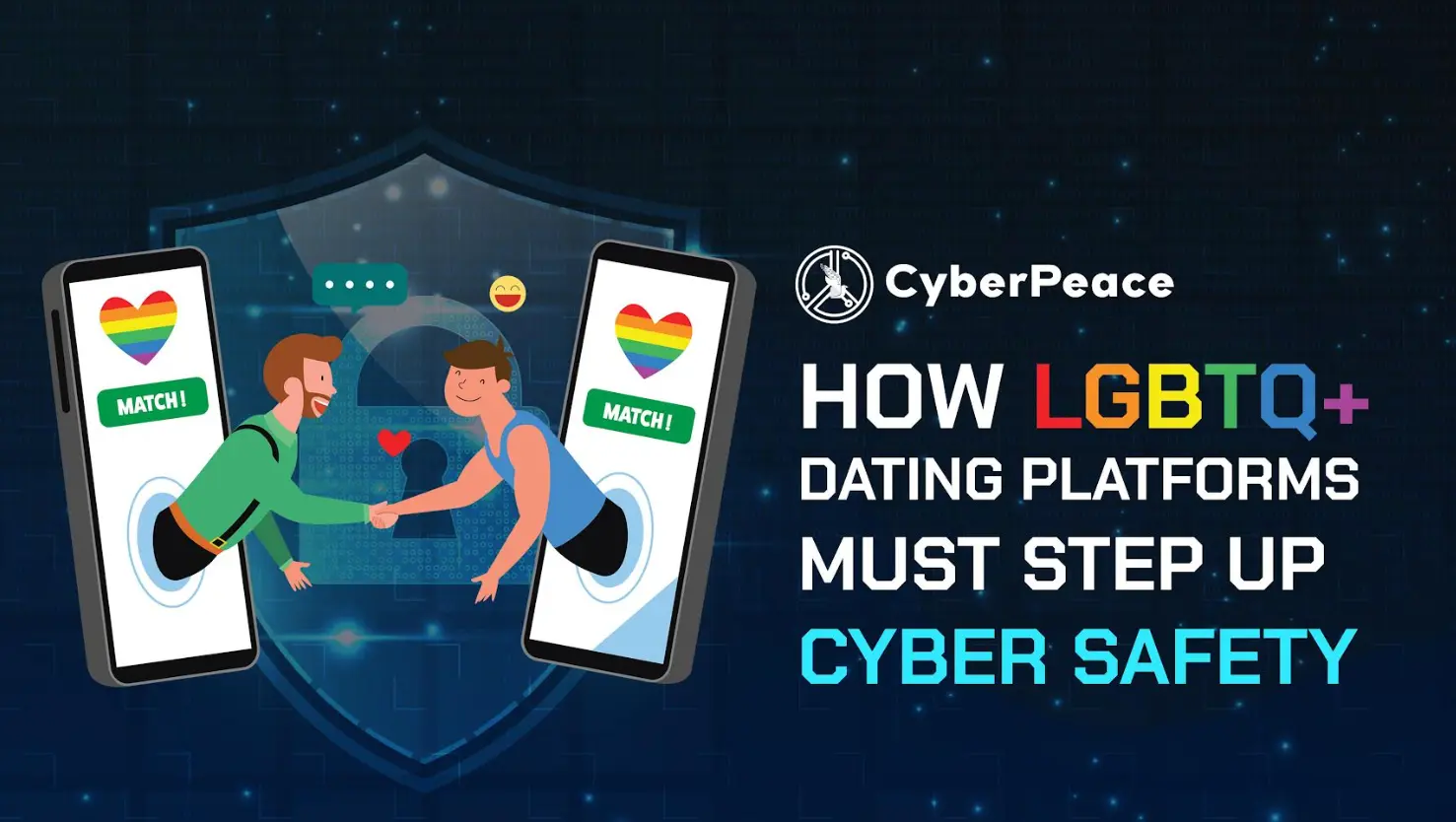
Online dating platforms have become a common way for individuals to connect in today’s digital age. For many in the LGBTQ+ community, especially in environments where offline meeting spaces are limited, these platforms offer a way to find companionship and support. However, alongside these opportunities come serious risks. Users are increasingly being targeted by cybercrimes such as blackmail, sextortion, identity theft, and online harassment. These incidents often go unreported due to stigma and concerns about privacy. The impact of such crimes can be both emotional and financial, highlighting the need for greater awareness and digital safety.
Cybercrime On LGBTQ+ Dating Apps: A Threat Landscape
According to the NCRB 2022 report, there has been a 24.4% increase in cybercrimes. But unfortunately, the queer community-specific data is not available. Cybercrimes that target LGBTQ+ users in very organised and predatory. In several Indian cities, gangs actively monitor dating platforms to the point that potential victims, especially young queers and those who seem discreet about their identity, become targets. Once the contact is established, perpetrators use a standard operating process, building false trust, forcing private exchanges, and then gradually starting blackmail and financial exploitation. Many queer victims are blackmailed with threats of exposure to families or workplaces, often by fake police demanding bribes. Fear of stigma and insensitive policing discourages reporting. Cyber criminal gangs exploit these gaps on dating apps. Despite some arrests, under-reporting persists, and activists call for stronger platform safety.
Types of Cyber Crimes against Queer Community on Dating Apps
- Romance scam or “Lonely hearts scam”: Scammers build trust with false stories (military, doctors, NGO workers) and quickly express strong romantic interest. They later request money, claiming emergencies. They often try to create multiple accounts to avoid profile bans.
- Sugar daddy scam: In this type of scam, the fraudster offers money or allowance in exchange for things like chatting, sending photos, or other interactions. They usually offer a specific amount and want to use some uncommon payment gateways. After telling you they will send you a lot of money, they often make up a story like: “My last sugar baby cheated me, so now you must first send me a small amount to prove you are trustworthy.” This is just a trick to make you send them money first.
- Sextortion / Blackmail scam: Scammers record explicit chats or pretend to be underage, then threaten exposure unless you pay. Some target discreet users. Never send explicit content or pay blackmailers.
- Investment Scams: Scammers posing as traders or bankers convince victims to invest in fake opportunities. Some "flip" small amounts to build trust, then disappear with larger sums. Real investors won’t approach you on dating apps. Don’t share financial info or transfer money.
- Pay-Before-You-Meet scam: Scammer demands upfront payment (gift cards, gas money, membership fees) before meeting, then vanishes. Never pay anyone before meeting in person.
- Security app registration scam: Scammers ask you to register on fake "security apps" to steal your info, claiming it ensures your safety. Research apps before registering. Be wary of quick link requests.
- The Verification code scam: Scammers trick you into giving them SMS verification codes, allowing them to hijack your accounts. Never share verification codes with anyone.
- Third-party app links: Mass spam messages with suspicious links that steal info or infect devices. Don’t click suspicious links or “Google me” messages.
- Support message scam: Messages pretending to be from application support, offering prizes or fake shows to lure you to malicious sites.
Platform Accountability & Challenges
The issue of online dating platforms in India is characterised by weak grievance redressal, poor takedown of abusive profiles, and limited moderation practices. Most platforms appoint grievance officers or offer an in-app complaint portal, but complaints are often unanswered or receive only automated and AI-generated responses. This highlights the gap between policy and enforcement on the ground.
Abusive or fake profiles, often used for scams, hate crimes, and outing LGBTQ+ individuals, remain active long after being reported. In India, organised extortion gangs have exploited such profiles to lure, assault, rob, and blackmail queer men. Moderation teams often struggle with backlogs and lack the resources needed to handle even the most serious complaints.
Despite offering privacy settings and restricting profile visibility, moderation practices in India are still weak, leaving large segments of users vulnerable to impersonation, catfishing, and fraud. The concept of pseudonymisation can help protect vulnerable communities, but it is difficult to distinguish authentic users from malicious actors without robust, privacy-respecting verification systems.
Since many LGBTQ+ individuals prefer to maintain their confidentiality, while others are more vocal about their identities, in either case, the data shared by an individual with an online dating platform must be vigilantly protected. The Digital Personal Data Protection Act, 2023, mandates the protection of personal data. Section 8(4) provides: “A Data Fiduciary shall implement appropriate technical and organisational measures to ensure effective observance of the provisions of this Act and the rules made thereunder.” Accordingly, digital platforms collecting such data should adopt the necessary technical and organisational measures to comply with data protection laws.
Recommendations
The Supreme Court has been proactive in this regard, through decisions like Navtej Singh Johar v. Union of India, which decriminalised same-sex relationships. Justice K.S. Puttaswamy (Retd.) v. Union of India and Ors., acknowledged the right to privacy as a fundamental right, and, most recently, the 2025 affirmation of the right to digital access. However, to protect LGBTQ+ people online, more robust legal frameworks are still required.
There is a requirement for a dedicated commission or an empowered LGBTQ+ cell. Like the National Commission for Women (NCW), which works to safeguard the rights of women, a similar commission would address community-specific issues, including cybercrime, privacy violations, and discrimination on digital platforms. It may serve as an institutional link between the victim, the digital platforms, the government, and the police. Dating Platforms must enhance their security features and grievance mechanisms to safeguard the users.
Best Practices
Scammers use data sets and plans to target individuals seeking specific interests, such as love, sex, money, or association. Do not make financial transactions, such as signing up for third-party platforms or services. Scammers may attempt to create accounts for others, which can be used to access dating platforms and harm legitimate users. Users should be vigilant about sharing sensitive information, such as private images, contact information, or addresses, as scammers can use this information to threaten users. Stay smart, stay cyber safe.
References
- https://www.hindustantimes.com/htcity/cinema/16yearold-queer-child-pranshu-dies-by-suicide-due-to-bullying-did-we-fail-as-a-society-mental-health-expert-opines-101701172202794.html#google_vignette
- https://www.ijsr.net/archive/v11i6/SR22617213031.pdf
- https://help.grindr.com/hc/en-us/articles/1500009328241-Scam-awareness-guide
- http://meity.gov.in/static/uploads/2024/06/2bf1f0e9f04e6fb4f8fef35e82c42aa5.pdf
- https://mib.gov.in/sites/default/files/2024-02/IT%28Intermediary%20Guidelines%20and%20Digital%20Media%20Ethics%20Code%29%20Rules%2C%202021%20English.pdf

Executive Summary:
CVE 2024-3094 is a backdoor vulnerability recently found in Kali Linux installations that happened between March 26th to 29th. This vulnerability was found in XZ package version 5.6.0 to 5.6.1. It could allow the malicious actor to compromise SSHD authentication, and grant unauthorized access to the entire system remotely. The users who have installed or updated Kali Linux during the said time are advised to update their system to safeguard against this vulnerability.
The Dangerous Backdoor
The use of the malicious implant found in XZ Utils as a remote code execution tool makes it more dangerous, because of its ability to compromise the affected systems. Initially, researchers believed the vulnerability enabled an authentication bypass for the OpenSSH server (SSHD) process. However, further analysis revealed it is better characterized as a remote code execution (RCE) vulnerability.
The backdoor intercepts the RSA_public_decrypt function, verifies the host's signature using a fixed Ed448 key, and if successful, executes malicious code passed by the attacker via the system() function. This leaves no trace in SSHD logs and makes it difficult to detect the vulnerability.
Impacted Linux Distributions
The compromised versions of XZ Utils have been found in the following Linux distributions released in March 2024:
- Kali Linux (between March 26 and March 29)
- openSUSE Tumbleweed and openSUSE MicroOS (March 7 to March 28)
- Fedora 41, Fedora Rawhide, and Fedora Linux 40 beta
- Debian (testing, unstable, and experimental distributions only)
- Arch Linux container images (February 29 to March 29)
- Meanwhile, distributions such as Red Hat Enterprise Linux (RHEL), SUSE Linux Enterprise, openSUSE Leap, and Debian Stable are not believed to be affected.
How Did This Happen?
The malicious code appears to have been inserted by taking advantage of a typical control transfer vulnerability. The original maintainer of the XZ Libs project on GitHub handed over control of the repository to an account that had been contributing to various data compression-related projects for several years. It was at this point that the backdoor was implanted in the project code.
Fortunately, the Potential Disaster Was Averted
As per Igor Kuznetsov, head of Kaspersky's Global Research and Analysis Team (GReAT), the vulnerability CVE-2024-3094 is considered as the largest scale attack that has happened in the Linux ecosystem history. Because it targeted the primary remote management tool for Linux servers on the internet which is SSH servers.
As this vulnerability was detected in the testing and rolling distributions in the short period of time, where the latest software packages are used. This results to the minimum damage to the linux users and so far no case of CVE-2024-3094 being actively exploited have been detected.
Staying Safe
The U.S. Cybersecurity and Infrastructure Security Agency (CISA) advises that users who installed or updated the affected operating systems in March immediately roll back to XZ Utils 5.4.6 version and be on alert for any malicious activity. It is recommended to change the passwords in the case of a distribution where a weak version of XZ Utils has been installed.
The Yara rule has been released to detect any infected systems by CVE-2024-3094 Vulnerability.
Conclusion
The discovery of the XZ Utils backdoor provides a reminder to be vigilant in the open source software environment. This supply chain attack highlights the importance of strong security measures, elaborate code reviews, and regular distribution of security updates to provide shield against such vulnerabilities. Always staying informed and taking the necessary precautions, Linux users can mitigate the potential impact of this vulnerability to keep their systems safe.
References :
- https://thehackernews.com/2024/03/urgent-secret-backdoor-found-in-xz.html
- https://www.helpnetsecurity.com/2024/03/29/cve-2024-3094-linux-backdoor/
- https://www.kali.org/blog/about-the-xz-backdoor/
- https://www.kaspersky.com/blog/cve-2024-3094-vulnerability-backdoor/50873/
- https://www.rapid7.com/blog/post/2024/04/01/etr-backdoored-xz-utils-cve-2024-3094/
