
#FactCheck - AI-Generated Image Falsely Shows Mohammed Siraj Offering Namaz During Net Practice
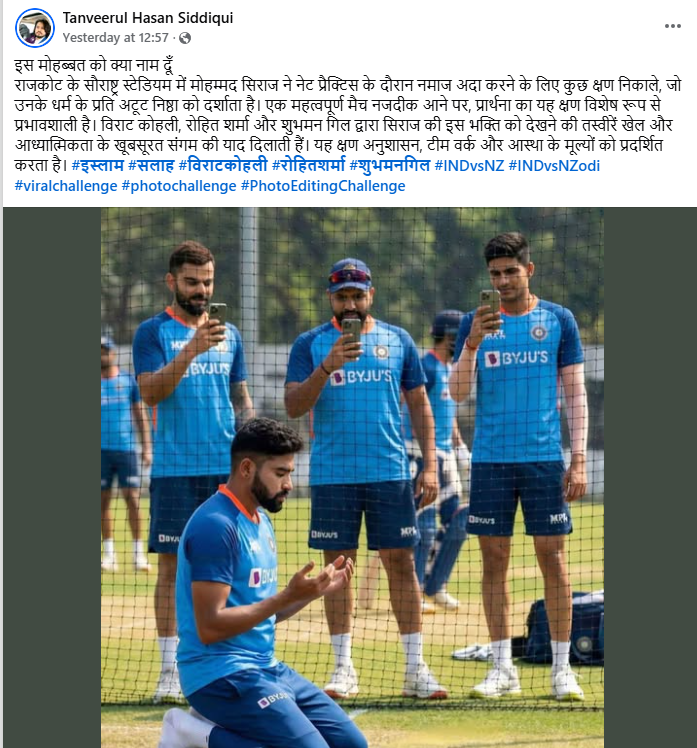
A photo circulating on social media claims to show Indian cricketer Mohammed Siraj offering namaz during net practice, while teammates Rohit Sharma, Virat Kohli and Shubman Gill are seen taking a selfie with him. Several users are sharing the image as a “beautiful moment,” portraying it as a symbol of faith, unity and sportsmanship. However, research by the Cyber Peace Foundation has found that the viral image is not genuine and has been AI-generated.
Claim
On January 14, 2026, multiple Facebook users shared the viral image with captions describing it as a touching scene from Rajkot’s Saurashtra Stadium. The posts claim that Mohammed Siraj took time out during net practice to offer prayers, reflecting his strong faith, while fellow cricketers Rohit Sharma, Virat Kohli and Shubman Gill respectfully captured the moment on camera.
Users praised the image as a rare blend of spirituality, discipline, teamwork and mutual respect, calling it a “beautiful confluence of sport and faith.”(Links to the post, archived version and screenshots are provided below.)
Fact Check:
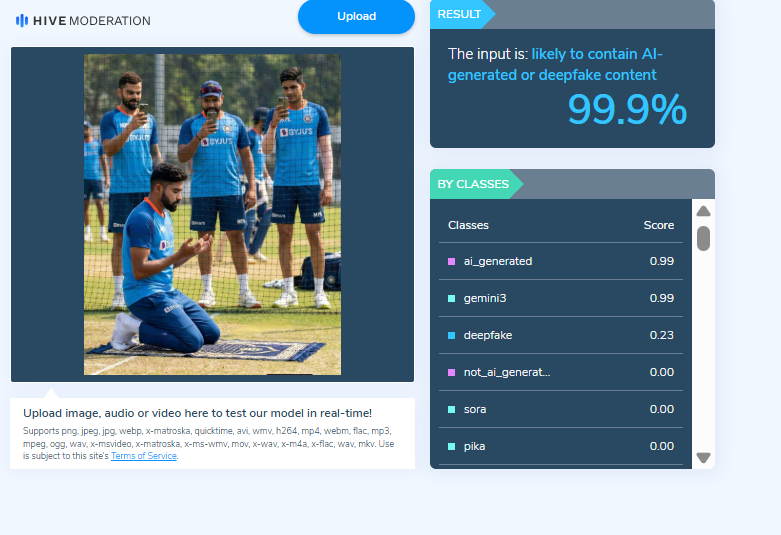
On closely examining the viral image, several visual inconsistencies and unnatural elements were observed, raising suspicion that the picture may not be authentic.To verify this, the Cyber Peace Foundation analysed the image using the AI detection tool Hive Moderation. According to the tool’s assessment, the image showed a 99% likelihood of being AI-generated.
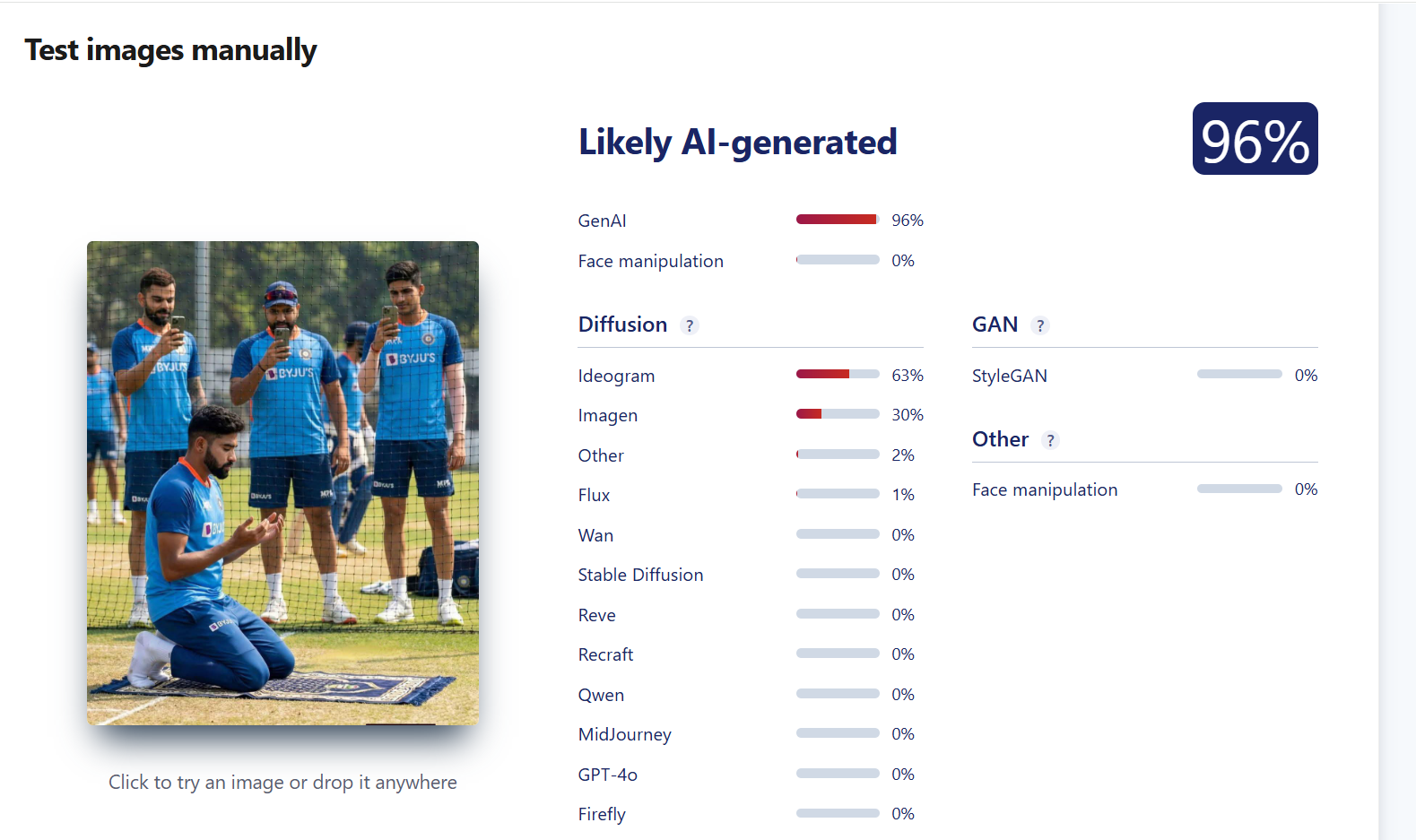
To further strengthen the verification, the image was also scanned using another AI detection platform, Sightengine. The results indicated a 96% probability that the image was generated using artificial intelligence.
Conclusion:
The research confirms that the viral image claiming to show Mohammed Siraj offering namaz during net practice, with Rohit Sharma, Virat Kohli and Shubman Gill taking a selfie, is not real.The photograph has been created using AI tools and falsely shared on social media, misleading users by presenting a fabricated scene as an authentic moment.

Related Blogs

Executive Summary:
An image has been spread on social media about the truck carrying money and gold coins impounded by Jharkhand Police that also during lok sabha elections in 2024. The Research Wing, CyberPeace has verified the image and found it to be generated using artificial intelligence. There are no credible news articles supporting claims about the police having made such a seizure in Jharkhand. The images were checked using AI image detection tools and proved to be AI made. It is advised to share any image or content after verifying its authenticity.

Claims:
The viral social media post depicts a truck intercepted by the Jharkhand Police during the 2024 Lok Sabha elections. It was claimed that the truck was filled with large amounts of cash and gold coins.


Fact Check:
On receiving the posts, we started with keyword-search to find any relevant news articles related to this post. If such a big incident really happened it would have been covered by most of the media houses. We found no such similar articles. We have closely analysed the image to find any anomalies that are usually found in AI generated images. And found the same.

The texture of the tree in the image is found to be blended. Also, the shadow of the people seems to be odd, which makes it more suspicious and is a common mistake in most of the AI generated images. If we closely look at the right hand of the old man wearing white attire, it is clearly visible that the thumb finger is blended with his apparel.
We then analysed the image in an AI image detection tool named ‘Hive Detector’. Hive Detector found the image to be AI-generated.

To validate the AI fabrication, we checked with another AI image detection tool named ‘ContentAtScale AI detection’ and it detected the image as 82% AI. Generated.

After validation of the viral post using AI detection tools, it is apparent that the claim is misleading and fake.
Conclusion:
The viral image of the truck impounded by Jharkhand Police is found to be fake and misleading. The viral image is found to be AI-generated. There has been no credible source that can support the claim made. Hence, the claim made is false and misleading. The Research Wing, CyberPeace previously debunked such AI-generated images with misleading claims. Netizens must verify such news that circulates in Social Media with bogus claims before sharing it further.
- Claim: The photograph shows a truck intercepted by Jharkhand Police during the 2024 Lok Sabha elections, which was allegedly loaded with huge amounts of cash and gold coins.
- Claimed on: Facebook, Instagram, X (Formerly known as Twitter)
- Fact Check: Fake & Misleading

Introduction
In July 2025, the Digital Trust & Safety Partnership (DTSP) achieved a significant milestone with the formal acceptance of its Safe Framework Specification as an international standard, ISO/IEC 25389. This is the first globally recognised standard that is exclusively concerned with guaranteeing a secure online experience for the general public's use of digital goods and services.
Significance of the New Framework
Fundamentally, ISO/IEC 25389 provides organisations with an organised framework for recognising, controlling, and reducing risks associated with conduct or content. This standard, which was created under the direction of ISO/IEC's Joint Technical Committee 1 (JTC 1), integrates the best practices of DTSP and offers a precise way to evaluate organisational maturity in terms of safety and trust. Crucially, it offers the first unified international benchmark, allowing organisations globally to coordinate on common safety pledges and regularly assess progress.
Other Noteworthy Standards and Frameworks
While ISO/IEC 25389 is pioneering, it’s not the only framework shaping digital trust and safety:
- One of the main outcomes of the United Nations’ 2024 Summit for the Future was the UN's Global Digital Compact, which describes cross-border cooperation on secure and reliable digital environments with an emphasis on countering harmful content, upholding online human rights, and creating accountability standards.
- The World Economic Forum’s Digital Trust Framework defines the goals and values, such as cybersecurity, privacy, transparency, redressability, auditability, fairness, interoperability and safety, implicit to the concept of digital trust. It also provides a roadmap to digital trustworthiness that imbibes these dimensions.
- The Framework for Integrity, Security and Trust (FIST) launched at the Cybereace Summit 2023 at USI of India in New Delhi, calls for a multistakeholder approach to co-create solutions and best practices for digital trust and safety.
- While still in the finalisation stage for implementation rollout, India's Digital Personal Data Protection Act, 2023 (DPDP Act) and its Rules (2025) aim to strike a balance between individual rights and data processing needs by establishing a groundwork for data security and privacy.
- India is developing frameworks in cutting-edge technologies like artificial intelligence. Using a hub-and-spoke model under the IndiaAI Mission, the AI Safety Institute was established in early 2025 with the goal of creating standards for trustworthy, moral, and safe AI systems. Furthermore, AI standards with an emphasis on safety and dependability are being drafted by the Bureau of Indian Standards (BIS).
- Google's DigiKavach program (2023) and Google Safety Engineering Centre (GSEC) in Hyderabad are concrete efforts to support digital safety and fraud prevention in India's tech sector.
What It Means for India
India is already claiming its place in discussions about safety and trust around the world. Google's June 2025 safety charter for India, for example, highlights how India's distinct digital scale, diversity, and vast threat landscape provide insights that inform global cybersecurity strategies.
For India's digital ecosystem, ISO/IEC 25389 comes at a critical juncture. Global best practices in safety and trust are desperately needed as a result of the rapid adoption of digital technologies, including the growth of digital payments, e-governance, and artificial intelligence and a concomitant rise in instances of digital harms. Through its guidelines, ISO/IEC 25389 provides a reference benchmark that Indian startups, government agencies, and tech companies can use to improve their safety standards.
Conclusion
A global trust-and-safety standard like ISO/IEC 25389 is essential for making technology safer for people, even as we discuss the broader adoption of security and safety-by-design principles integrated into the processes of technological product development. India can improve user protection, build its reputation globally, and solidify its position as a key player in the creation of a safer, more resilient digital future by implementing this framework in tandem with its growing domestic regulatory framework (such as the DPDP Act and AI Safety policies).
References
- https://dtspartnership.org/the-safe-framework-specification/
- https://dtspartnership.org/press-releases/dtsps-safe-framework-published-as-an-international-standard/?
- https://www.weforum.org/stories/2024/04/united-nations-global-digital-compact-trust-security/?
- https://economictimes.indiatimes.com/tech/technology/google-releases-safety-charter-for-india-senior-exec-details-top-cyber-threat-actors-in-the-country/articleshow/121903651.cms?
- https://initiatives.weforum.org/digital-trust/framework
- https://government.economictimes.indiatimes.com/news/secure-india/the-launch-of-fist-framework-for-integrity-security-and-trust/103302090
Introduction
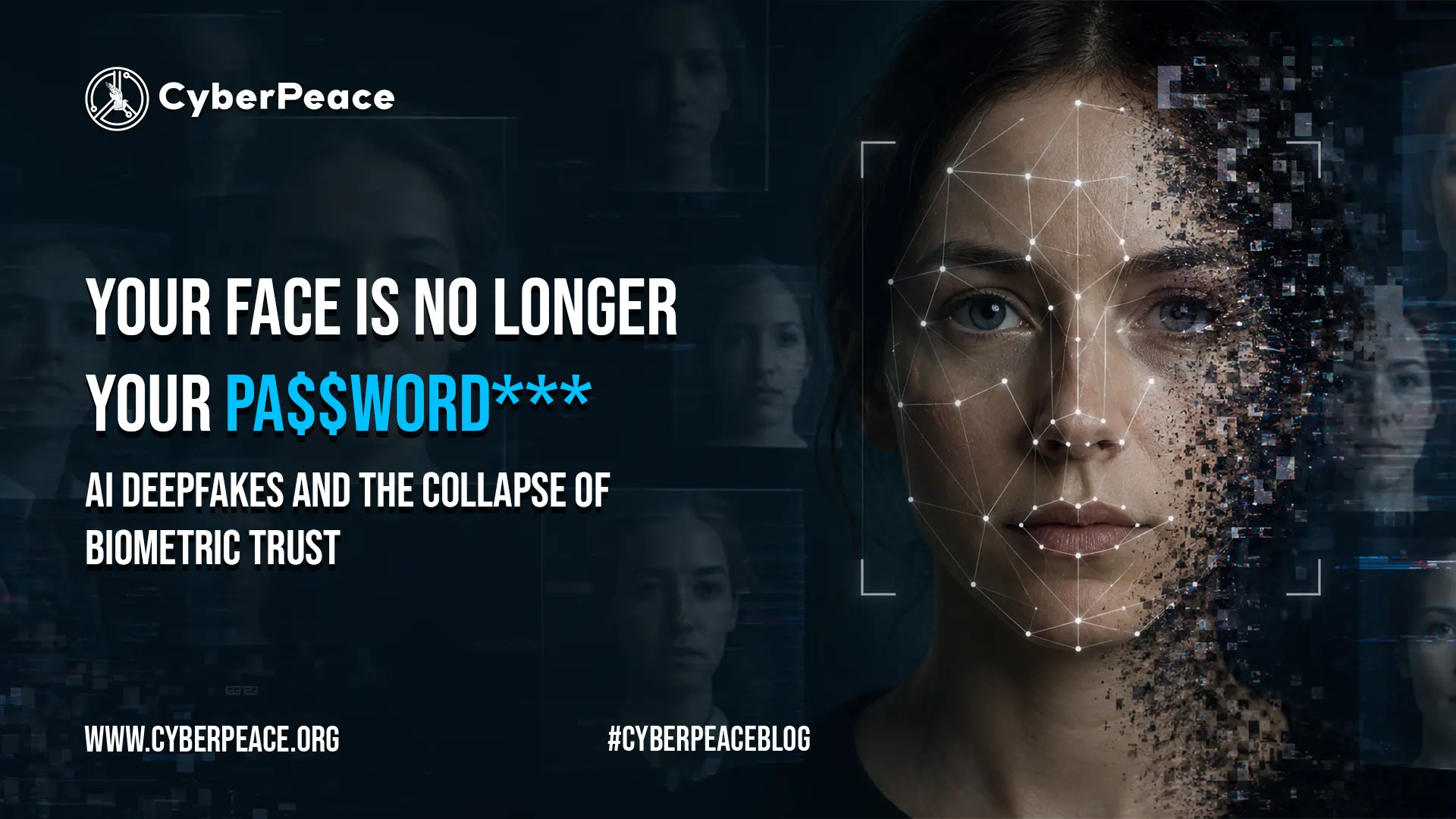
On June 11, 2026, the Ministry of Home Affairs (MHA) India released one of the most critical Indian government advisories concerning cybersecurity by the Indian Cyber Crime Coordination Centre (I4C) under the National Cybercrime Threat Analytics Unit (NCTAU) concerning the immediate and escalating threat posed by the weaponization of generative artificial intelligence to forge synthetic biometric identities capable of bypassing the existing facial verification mechanisms in India. This advisory is arguably one of the most explicit Indian government recognitions of the deep-seated threats associated with AI-generated deepfakes in the country’s digital financial infrastructure. As many Indian financial service providers embrace facial recognition and biometric verification systems for customer onboarding and authentications, the myth that biometric traits are in themselves secure is slowly unraveling.
The advisory states that cybercriminals are deploying sophisticated AI tools to forge such credible digital simulacrums that exhibit such a precise similarity of facial expressions, eye movements, eye blinks, head movements, and voice patterns that they are virtually indistinguishable from the originals for identity verification mechanisms. Such a confluence of easy AI technology, mass onboarding of digital identities, and underdeveloped infrastructure to detect these synthetics requires urgent regulatory, institutional, and technological intervention.
The I4C Advisory: Core Findings and Threat Architecture
In its advisory, NCTAU describes a complex, multi-step attack chain used by scammers to capture biometric information and perpetrate fraud using everyday social interactions. The attackers typically use social media accounts, chat messengers, online job applications, dating applications, or direct phone calls to reach their targets. These interactions are presented as innocuous, such as for video calls, job interviews, identity checks, or just normal conversation with the intention of recording facial and vocal data.
During these interactions, victims may be asked to perform gestures commonly seen in legitimate video calls, such as look directly at the camera, blink, turn their head, or say specific phrases. However, the perpetrators record this video feed without the victim's knowledge and then use deep learning generative AI technologies to process it. Through methods such as Generative Adversarial Networks (GANs) and diffusion models, the scammers create photorealistic synthetic duplicates of the target, capable of mirroring all physical and vocal attributes, such as facial expressions, blinking patterns, head movements, and even voice tones.
The advisory explicitly states that these synthetic identities can be used for a variety of fraudulent activities, such as spoofing face authentication systems, circumventing liveness detection checks, successfully completing video KYC, enabling fraudulent account recovery processes, and illegally accessing bank and financial services. NCTAU also cautions that these voice deepfakes may be paired with facial deepfakes in an attempt to undermine multi-modal authentication methods, and the occurrence of related SIM-swap attacks can eliminate the last layer of security in OTP verification and facilitate a complete account compromise.
The scale of India's Digital Financial Ecosystem
The scale of I4C's detected threat can be better understood by considering India's entire digital financial landscape. In 2025 India has witnessed over 228 billion UPI transactions, with 21.63 billion in December alone, an annual growth rate of 29% from 2024, and an active user base of over 500 million by the beginning of 2026. Furthermore, total e-KYC transactions by April 2025 have exceeded 2,393 crore, and thus, it can be seen the extent to which these aspects of finance (banking, insurance, and credit) are now conducted via remote digital verification. The transformation, although instrumental in increasing financial inclusion, has, according to some analysts, created an attack surface of historic scale. As hundreds of millions more become financially integrated via the very same channels that now form the country's infrastructure and systems of identity, the threat from identity-based fraud becomes astronomically large.
Indian government data further illustrates the extent to which such frauds are a growing concern. Cybercrime cases jumped 42% year-on-year to 2.27 million in 2024, resulting in losses amounting to nearly 228.45 billion. Within that, 1.34 million UPI cases, worth 1,087 crore, occurred in FY2024 alone, while cybercrimes in general soared from 260,000 cases in 2021 to nearly 2.8 million by 2025, totaling cybercrime losses of 22,931 crore.
How Do Deepfakes Defeat Biometric Systems?
Deepfake fraud, in particular, is extremely difficult to counteract due to the direct attack it poses on the assumptions underlying traditional verification systems. Passive techniques for verifying a live person from a static photo or video existed that primarily looked for similarities in textures, lighting, and geometrical properties or challenged subjects to perform an action in real-time. But the generation of real-time face swapping that contains blinks, head motion, and speaking can now be produced on even cheap machines. Cybercriminals can exploit these by using virtual camera drivers to "inject" the false image feed into the live verification session, nullifying any passive liveness checks. Data from the industry clearly shows the extent of this problem: iProov, a leading authenticator, documented a 7.8-fold rise in injection attacks in 2024; Jumio noted an 88% increase in deepfake-induced fraud in 2025; and voice-deepfake attacks on financial call centres saw a 6.8-fold increase in 2024.
Gartner had also predicted that 30% of organizations would have lost trust in facial verification alone by 2026, and work by Kubam (2024) confirmed a lack of multi-factor authentication such as cross-validation of biometric, document, and device integrity signals used within KYC platforms. Such fears have been corroborated by FATF's 2025 Horizon Scan, which classified deepfakes as an emerging threat to the AML/CDD framework and digital identity verification.
Recommendations by I4C
I4C's advisory goes beyond merely warning about threats and lists actionable recommendations to both institutions and citizens. Banks, NBFCs, fintech companies, and onboarding platforms have been advised to incorporate advanced deepfake and synthetic content detection techniques into their verification flows, given that first-generation liveness checks are not enough. They should employ a multi-modal strategy that considers face features along with the device, network signals, behavioral biometrics, and alignment of face and voice. They also have been advised to make a more robust upgrade of their onboarding and verification platforms, as much of the current remote verification architecture was built in a less sophisticated threat context. This aligns with the KYC Master Direction of the RBI that specifies end-to-end encryption, IP-based access controls, geotagging, and technology platforms and systems are to be upgraded frequently. Citizens are advised by I4C to keep their biometric information secure; be careful of unsolicited video calls and online interviews; keep an eye on transaction-related SMS and emails; and report suspicious instances through the National Cybercrime Reporting Portal and through the telephone number 1930. It is clarified that this advisory aims to create awareness of developing AI-based identity fraud schemes, and it is not a declaration that any specific organization, platform, or service is vulnerable.
The Legislative Dimension: India's Evolving Response to Synthetic Media
The problem highlighted by I4C is evolving in a heavily legislated environment, not a legal void. The first-ever legal definition of "synthetic media" in India came into force in the Information Technology Amendment Rules 2026 on February 20, 2026. These rules oblige significant platforms to remove deepfakes and non-consensual intimate media within three hours and two hours, respectively, or lose their safe harbor protection under Section 79 of the IT Act. While the provision focuses on harm stemming from content, this creates a new legal and normative precedent on dealing with AI-induced deception. However, financial frauds facilitated through deepfakes are not content but involve the use of remote identity verification and customer onboarding systems, which require specific technical standards. The overall policy environment when viewed in light of the FATF Horizon Scan, RBI KYC rules, and recent I4C advisory already offers significant scope to define and introduce mandatory deepfake detection and identity assurance standards even before these are explicitly legislated.
Institutional and Technical Recommendations
- For Financial Institutions and Fintech platforms: The existing verification systems (liveness detection) must be replaced with multi-layered deep-fake detection processes, including injection attack detection, behavioral biometrics, cross-modal facial and voice verification, device integrity check, and hardware attestation during onboarding itself.
- For Regulators: The RBI and Ministry of Home Affairs should work together to release technical standards that specify minimum deepfake-detection requirements for video-KYC and remote onboarding systems in line with FATF digital identity guidance and the upcoming EU AI Act.
- For researchers and academia: Dedicated studies on deepfake detection performance across varied demographic, linguistic, and regional populations of India should be prioritized. Current models are mostly trained on Western data.
- For citizens: Face recordings and other biometric information should be treated with the same caution as sensitive financial details. Be wary of unsolicited video calls, remote interviews, or verification requests from unknown people, and report suspicious activities on any account immediately via the National Cybercrime Helpline (1930) or cybercrime.gov.in.
Conclusion
The I4C advisory of June 2026 marks a critical recognition that advances in generative AI have fundamentally challenged the reliability of facial biometric authentication. For a country whose digital financial ecosystem relies heavily on remote identity verification, the implications are significant. The integrity of India's financial inclusion framework now depends on rapidly strengthening identity assurance mechanisms. Addressing this threat will require coordinated action by regulators, financial institutions, technology developers, researchers, and citizens to develop robust technical standards, enhance detection capabilities, and build public awareness at a pace matching the evolution of AI-enabled fraud.
References and Sources
- I4C / NCTAU Advisory, June 2026 — National Cybercrime Threat Analytics Unit, Indian Cyber Crime Coordination Centre, Ministry of Home Affairs, Government of India. Advisory on AI-Enabled Deepfake Identity Fraud. Issued 11 June 2026.
- shuftipro.com/blog/key-takeaways-from-fatf-horizon-scan-report-on-deepfakes
- https://timesofindia.indiatimes.com/india/fraudsters-creating-deepfakes-to-bypass-facial-authentication-i4c/articleshow/131668958.cms
- hyperverge.co/blog/what-is-a-deepfake
- iproov.com/reports/threat-intelligence-report-2026
- arxiv.org/pdf/2601.06241
