
#FactCheck:Viral Video Does Not Show Congress Workers Protesting Against Rahul Gandhi
Executive Summary:
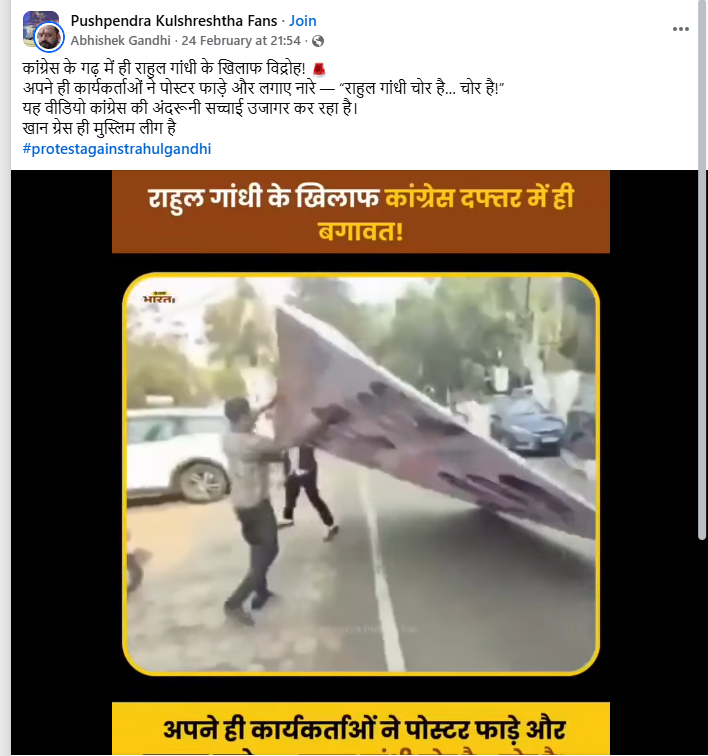
A video circulating on social media shows a group of people tearing Congress posters and raising controversial slogans. The clip is being shared with the claim that the individuals seen in the video are workers of the Congress party who were protesting against Rahul Gandhi and raising slogans against him. However, research by the CyberPeace found the viral claim to be misleading. Our research revealed that the video dates back to February 21, 2026. On that day, members of the Bharatiya Janata Yuva Morcha (BJYM) staged a protest outside a Congress office. During the demonstration, they raised slogans and tore Congress posters. The same video is now being circulated with a false narrative.
Claim
On February 24, 2026, a Facebook user shared the viral video with the caption:“Rebellion against Rahul Gandhi in Congress’ own stronghold! Party workers themselves tore posters and raised slogans — ‘Rahul Gandhi is a thief… a thief!’ This video exposes the internal truth of Congress. Congress itself is Muslim League.”
Fact Check
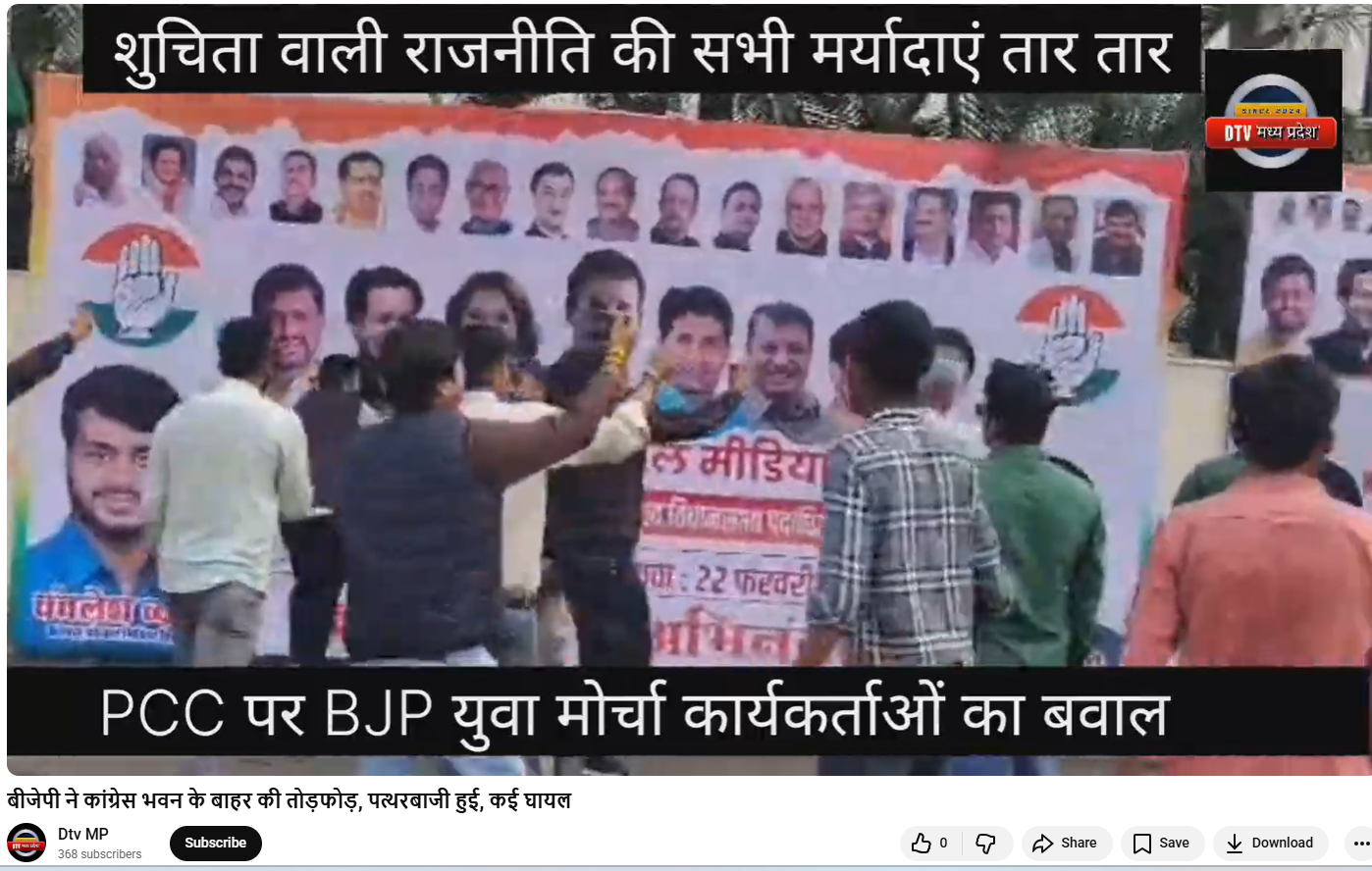
To verify the claim, we extracted key frames from the viral video and conducted a reverse image search using Google Lens. During the search, we found the same video uploaded on YouTube on February 21, 2026.
According to the description accompanying the video, BJP workers had staged a protest outside a Congress building. The report mentioned vandalism and stone-pelting during the protest, resulting in injuries to several individuals
- https://www.youtube.com/watch?v=pW-13mSvJ2c
Using this lead, we conducted a keyword search on Google and found a report published on February 21, 2026, by the Hindi news website Raj Express. The visuals in the report closely matched those seen in the viral clip.
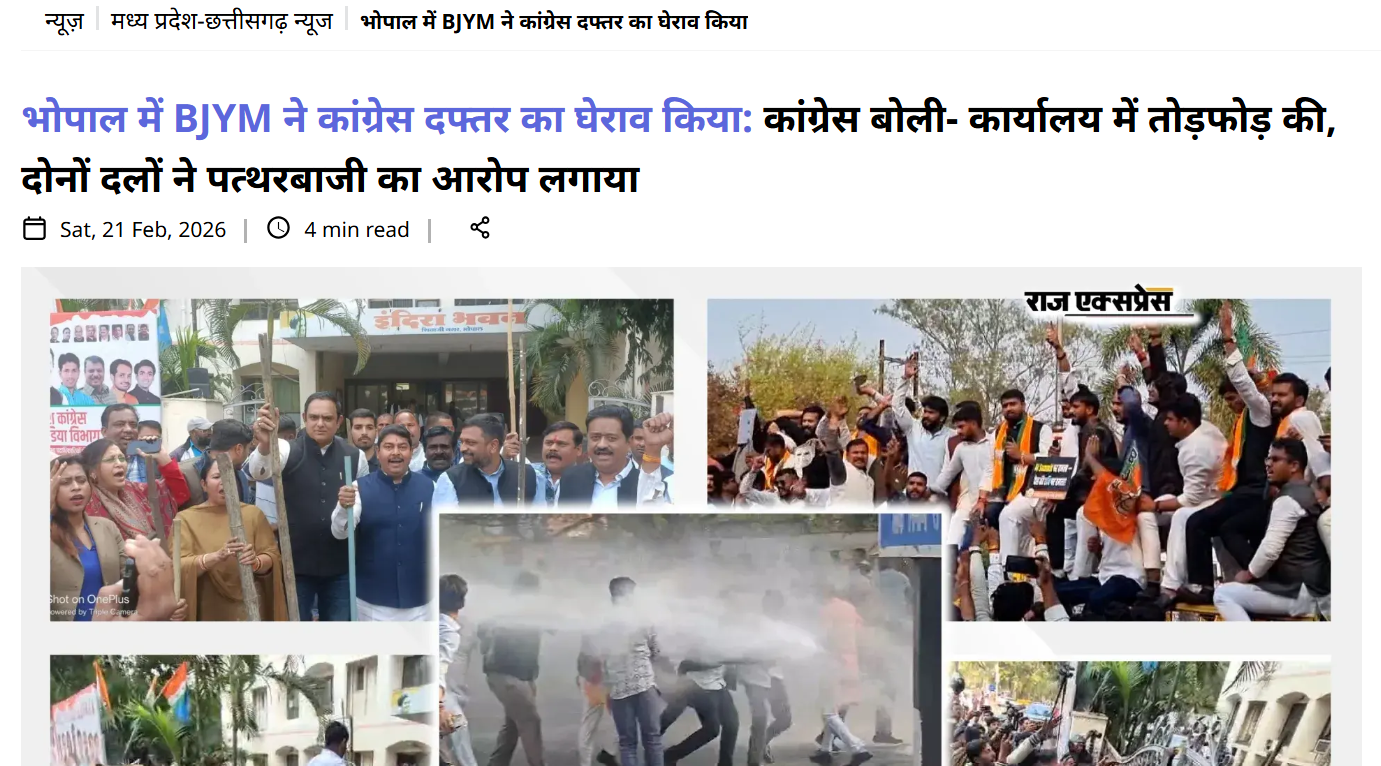
According to the report, the protest in Bhopal was organized by the Bharatiya Janata Yuva Morcha in response to a T-shirt protest staged by the Youth Congress during an AI Summit held at Bharat Mandapam in New Delhi. The situation escalated when protesters marched toward the state Congress office in Shivaji Nagar. Police attempted to disperse the crowd using water cannons, but some protesters reportedly entered the Congress office premises, leading to tension.
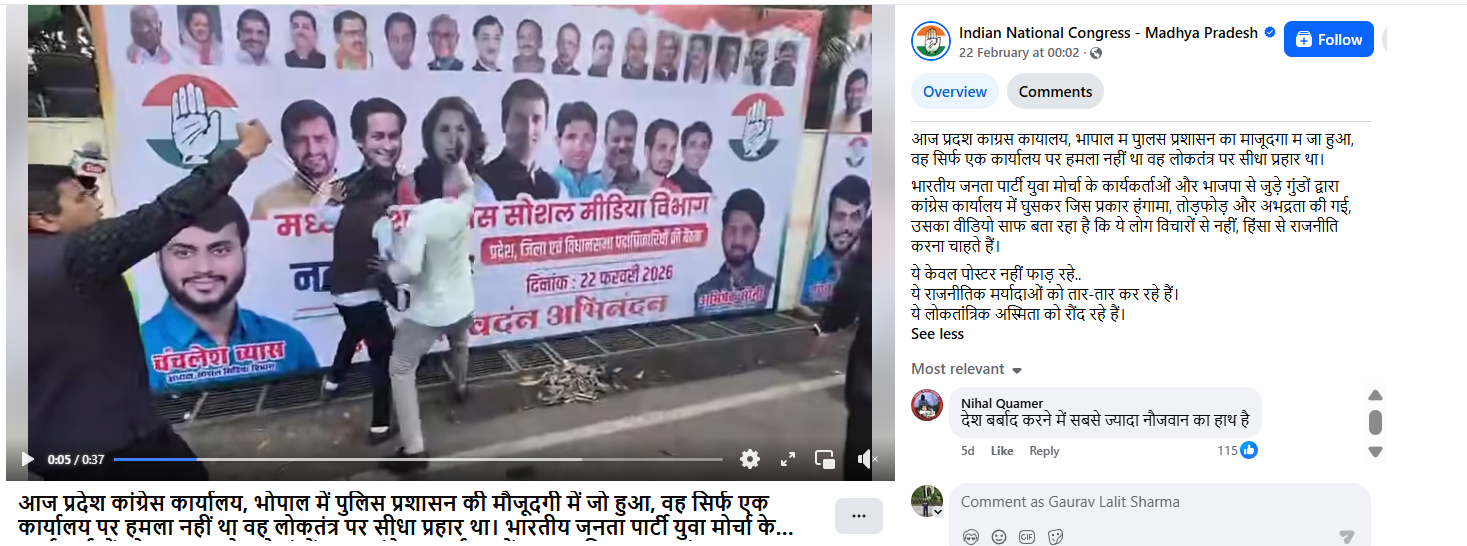
Further, we found the same viral video on the official Facebook page of Indian National Congress - Madhya Pradesh, where it was posted on February 26, 2026. In the post, the Congress unit alleged that BJYM workers and BJP-affiliated individuals had entered the Congress office, vandalized property, and created chaos in the presence of police officials.
Conclusion
Our research found that the viral claim is misleading. The video is from February 21, 2026, when BJYM workers protested outside a Congress office and engaged in vandalism. The footage is now being falsely shared as evidence of an internal rebellion by Congress workers against Rahul Gandhi.

Related Blogs

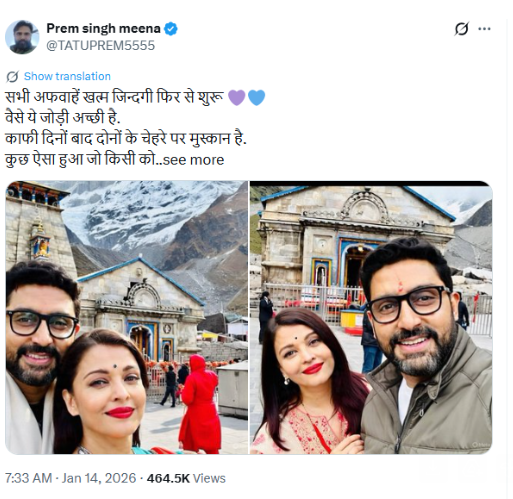
A photo featuring Bollywood actor Abhishek Bachchan and actress Aishwarya Rai is being widely shared on social media. In the image, the Kedarnath Temple is clearly visible in the background. Users are claiming that the couple recently visited the Kedarnath shrine for darshan.
Cyber Peace Foundation’s research found the viral claim to be false. Our research revealed that the image of Abhishek Bachchan and Aishwarya Rai is not real, but AI-generated, and is being misleadingly shared as a genuine photograph.
Claim
On January 14, 2026, a user on X (formerly Twitter) shared the viral image with a caption suggesting that all rumours had ended and that the couple had restarted their life together. The post further claimed that both actors were seen smiling after a long time, implying that the image was taken during their visit to Kedarnath Temple.
The post has since been widely circulated on social media platforms
Fact Check:
To verify the claim, we first conducted a keyword search on Google related to Abhishek Bachchan, Aishwarya Rai, and a Kedarnath visit. However, we did not find any credible media reports confirming such a visit.
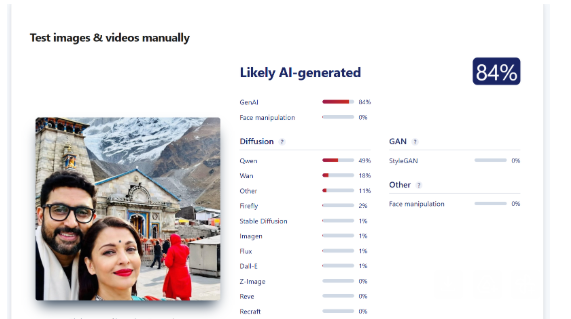
On closely examining the viral image, several visual inconsistencies raised suspicion about it being artificially generated. To confirm this, we scanned the image using the AI detection tool Sightengine. According to the tool’s analysis, the image was found to be 84 percent AI-generated.
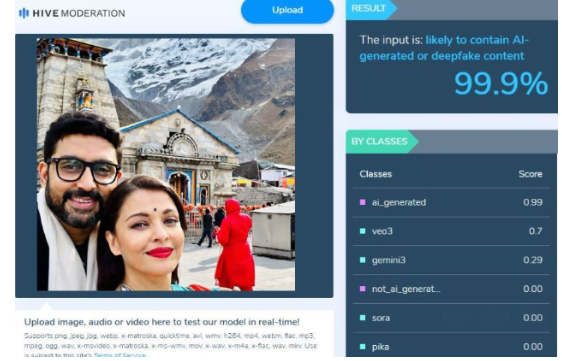
Additionally, we scanned the same image using another AI detection tool, HIVE Moderation. The results showed an even stronger indication, classifying the image as 99 percent AI-generated.
Conclusion
Our research confirms that the viral image showing Abhishek Bachchan and Aishwarya Rai at Kedarnath Temple is not authentic. The picture is AI-generated and is being falsely shared on social media to mislead users.

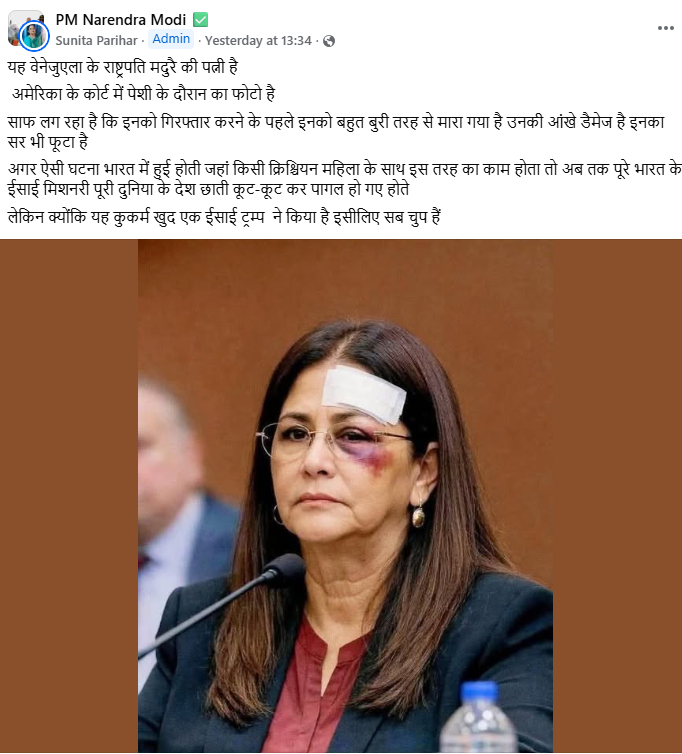
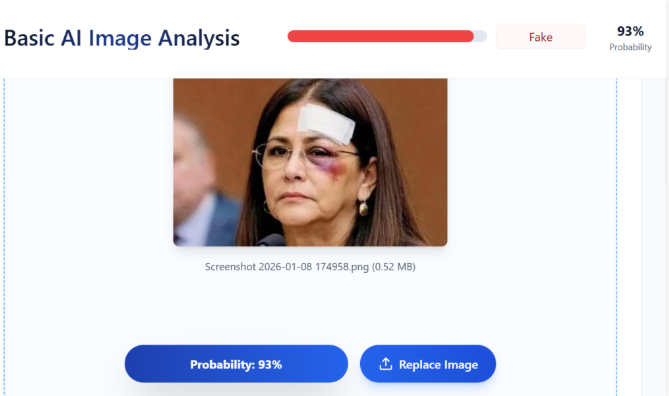
A photo showing Cilia Flores, wife of Venezuelan President Nicolás Maduro, with visible injuries on her face is being widely shared on social media. Users claim the image was taken during her court appearance in the United States on January 5, alleging that she was beaten before being produced before a judge. Cyber Peace Foundation’s research found that the viral image was created using AI tools and is not real.
Claim:
A Facebook user shared the image claiming it shows Venezuelan President Maduro’s wife during her US court appearance, alleging physical assault prior to her arrest. The post also makes political and religious allegations in connection with the incident.Link, archive link and screenshot
Fact Check:
The viral image appeared suspicious due to unnatural facial details and injury patterns. Given the increasing use of artificial intelligence to generate fake visuals, Vishvas News analysed the image using AI image detection tools.TruthScan assessed the image as 93% likely to be AI-generated.
Sightengine flagged the image as 77% likely to be AI-generated.
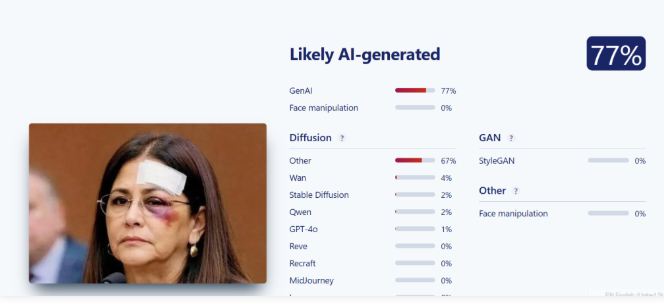
The results indicate that the image is not authentic and has been created using AI tools.
What Official Reports Say
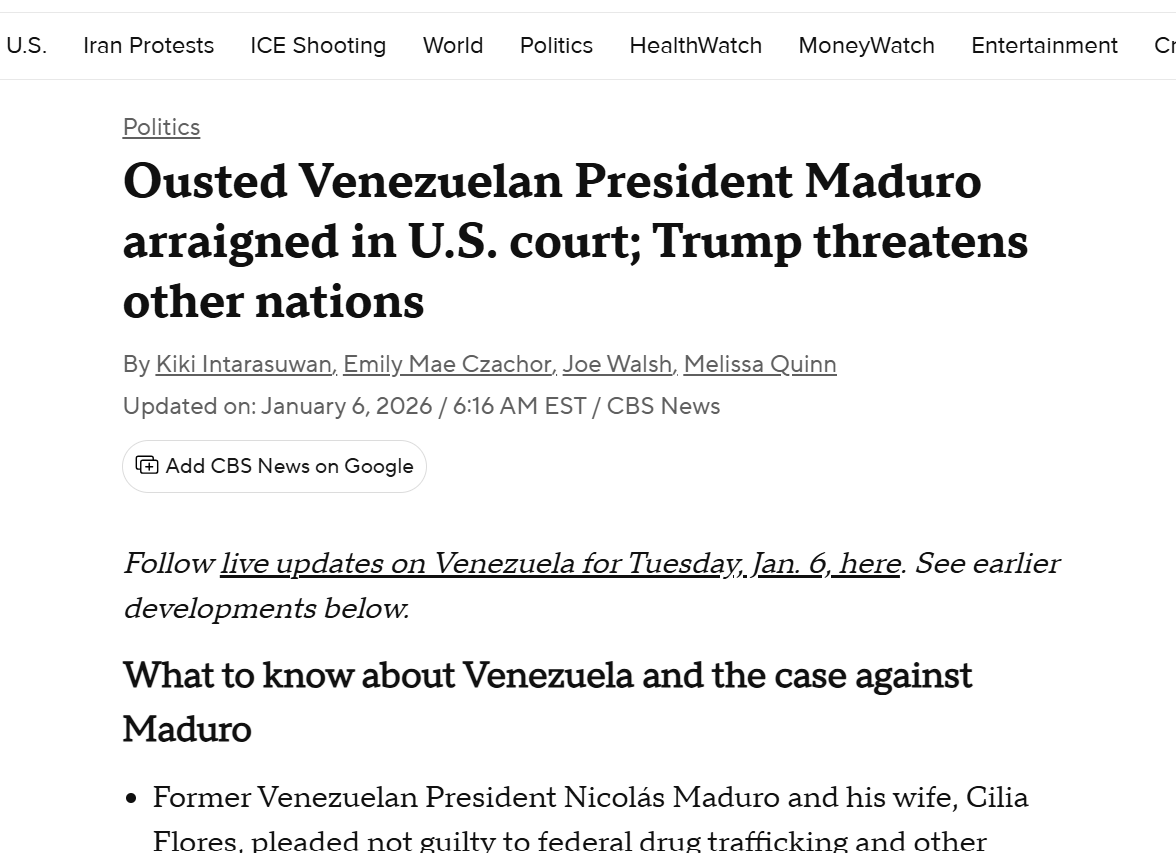
According to a CBS News report published on January 6, Nicolás Maduro and his wife Cilia Flores were produced before a federal court in Lower Manhattan, where they pleaded not guilty to drug trafficking and other charges. They are currently lodged at the Metropolitan Detention Center in Brooklyn The report states that the couple was detained during a US military operation. Following this, Venezuela’s Vice President Delcy Rodríguez was sworn in as the acting president. While Cilia Flores did appear before a Manhattan court, there is no authentic image showing her with injuries during the court proceedings. Link and Screenshot
https://www.cbsnews.com/live-updates/venezuela-trump-maduro-charges/
Conclusion:
The image being circulated as a photo of Cilia Flores during her US court appearance is AI-generated and fake. The claim that it shows injuries inflicted on her before being produced in court is false and misleading. The viral image has no connection with real court visuals.
.webp)
Introduction
Cybersecurity remains a crucial component in the modern digital era, considering the growing threat landscape caused by our increased reliance on technology and the internet. The Karnataka Government introduced a new ‘Cyber Security Policy 2024’ to address increasing cybercrimes and enhance protection measures for the State's digital infrastructure through awareness, skill development, public-private collaborations, and technology integration. Officials stated that the policy highlights various important aspects including raising awareness and providing education, developing skills, supporting the industry and start-ups, as well as forming partnerships and collaborations for enhancing capacity.
Key Highlights
- The policy consists of two components. The initial segment emphasizes creating a robust cyber security environment involving various sectors such as the public, academia, industry, start-ups, and government. The second aspect of the policy aims to enhance the cybersecurity status of the State's IT resources. Although the initial section will be accessible to the public, the second portion will be restricted to the state's IT teams and departments for their IT implementation.
- The Department of Electronics, IT, BT and S&T, the Department of Personnel and Administrative Reforms (e-Governance),and the Home Department, in collaboration with stakeholders from government and private sectors, have collectively formulated this policy. The Indian Institute of Science, the main institute for the state's K-tech Centre of Excellence for Cyber Security (CySecK), also examined the policy.
- The Department of Electronics, IT, BT and S&T, the Department of Personnel and Administrative Reforms (e-Governance),and the Home Department, in collaboration with stakeholders from government and private sectors, have collectively formulated this policy. The Indian Institute of Science, the main institute for the state's K-tech Centre of Excellence for Cyber Security (CySecK), also examined the policy.
- Approximately ₹103.87 crore will be spent over five years to implement the policy, which would be fulfilled from the budget allocated to the Department of Information Technology and Biotechnology and Science & Technology. A total of ₹23.74 crore would be allocated for offering incentives and concessions.
- The policy focuses on key pillars of building awareness and skills, promoting research and innovation, promoting industry and start-ups, partnerships and collaborations for capacity building.
- Karnataka-based undergraduate and postgraduate interns will receive a monthly stipend of INR 10,000- Rs15,000 fora maximum duration of three months under the internship program. The goal is to support 600 interns at the undergraduate level and 120 interns at the post-graduate level within the policy timeframe.
- Karnataka-based start-ups collaborating with academic institutes can receive matching grants of up to 50% of the total R&D cost for cybersecurity projects, or a maximum of ₹50 lakh.
- Reimbursement will be provided for expenses up to a maximum of INR 1 Lakh for start-ups registered with Karnataka Start-up Cell who engage CERT-In empanelled service providers from Karnataka for cyber security audit.
- The Karnataka government has partnered with Meta to raise awareness on cyber security. By reaching out to educational institutions, schools and colleges, it is piloted to provide training to 1 lakh teachers and educate 1 million children on online safety.
CyberPeace Policy Wing Outlook
The Cyber Security Policy, 2024 launched by the Karnataka government is a testament to the state government's commitment to strengthening the cyber security posture and establishing cyber resilience. By promoting and supporting research and development projects, supporting startups, and providing skill training internships, and capacity building at a larger scale, the policy will serve asa positive step in countering the growing cyber threats and establishing a peaceful digital environment for all. The partnership and collaboration with tech companies will be instrumental in implementing the capacity-building initiatives aimed at building cognitive and skill defenses while navigating the digital world. The policy will inspire other state governments in their policy initiatives for building safe and secure cyber-infrastructure in the states by implementing strategies tailored to the specific needs and demands of each state in building safe digital infrastructure and environment.
References:
- https://www.hindustantimes.com/cities/bengaluru-news/karnataka-govt-launches-new-cyber-security-policy-amid-frequent-scams-101722598078117.html
- https://ciso.economictimes.indiatimes.com/amp/news/grc/karnataka-govt-launches-new-cyber-security-policy/112214121
- https://cybermithra.in/2024/08/09/karnataka-cyber-security-policy/
