
#FactCheck: AI-Generated Image Falsely Linked to Protest Against CEC Gyanesh Kumar in London
Executive Summary
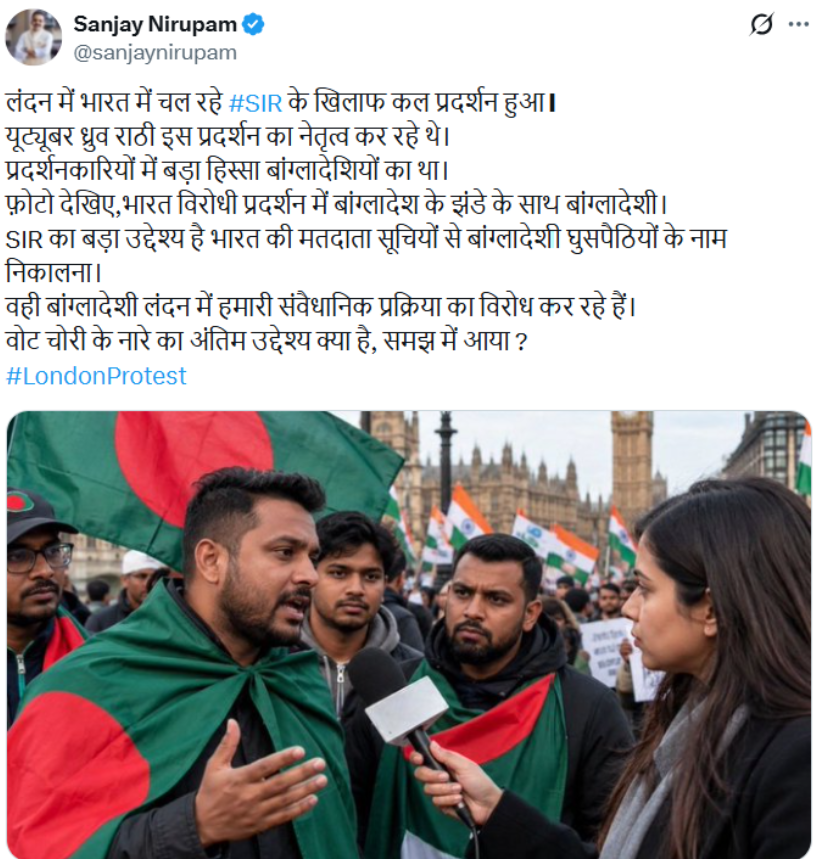
A photo of a Bangladeshi national holding the Bangladesh flag during a protest against Chief Election Commissioner Gyanesh Kumar in London is going viral on social media. The image is being shared with the claim that it was taken during the protest. CyberPeace Research found the viral claim to be false. The image is not authentic and is AI-generated.
Claim:
A photo of a Bangladeshi national holding the Bangladesh flag during a protest against Chief Election Commissioner Gyanesh Kumar in London.
Fact Check
To verify the authenticity of the viral image claiming to show a Bangladeshi man holding the Bangladesh flag during a protest against Chief Election Commissioner Gyanesh Kumar in London, we conducted a reverse image search using Google Lens. However, we could not find the image in any credible media reports.
Upon closely examining the image, we noticed several inconsistencies. For instance, the text on the posters held by people in the image is not clearly legible, and the reporter's microphone does not bear the logo of any media organisation. Such inconsistencies are commonly observed in AI-generated images.
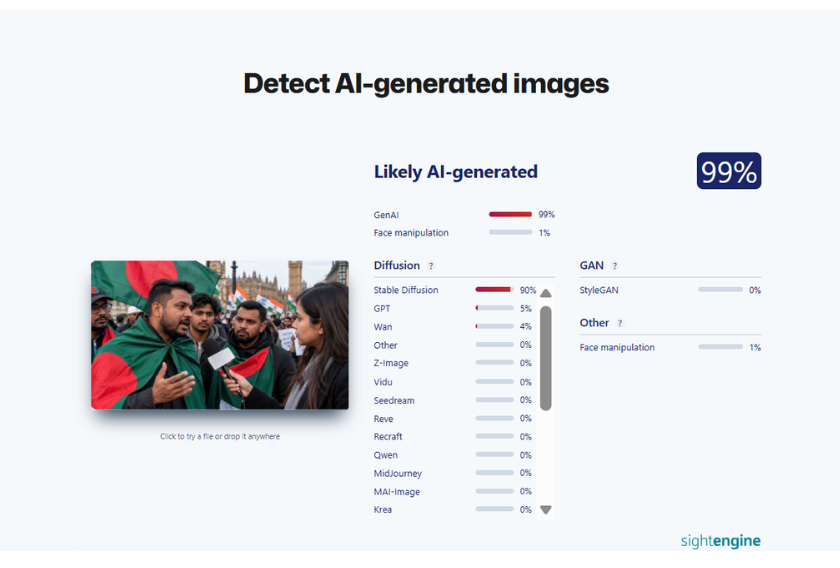
To further examine the image, we analysed it using the AI detection tool Sightengine. The tool indicated a 99.2 per cent probability that the image was AI-generated.
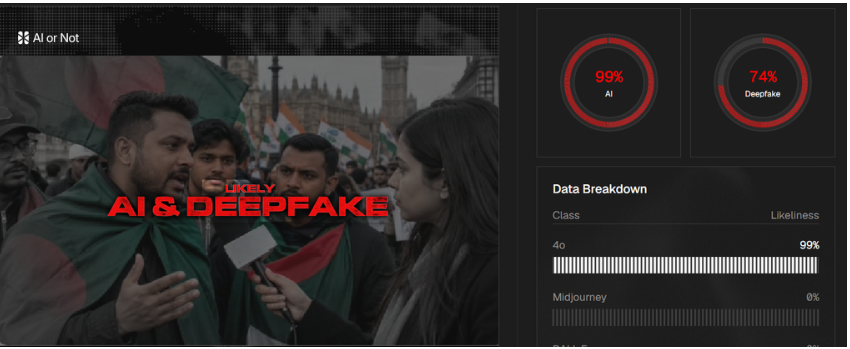
Another AI detection platform, AI or Not, also identified the image as highly likely to be AI-generated.
Conclusion
The evidence gathered during CyberPeace Research confirms that the image circulating with the claim that it shows a Bangladeshi national holding the Bangladesh flag during a protest against Chief Election Commissioner Gyanesh Kumar in London is AI-generated.

Related Blogs

Executive Summary:
The rise in cybercrime targeting vulnerable individuals, particularly students and their families, has reached alarming levels. Impersonation scams, where fraudsters pose as Law Enforcement Officers, have become increasingly sophisticated, exploiting fear, urgency, and social stigma. This report delves into recent incidents of ransom scams involving fake CBI officers, highlighting the execution methods, psychological impact on victims, and preventive measures. The goal is to raise public awareness and equip individuals with the knowledge needed to protect themselves from such fraudulent activities.
Introduction:
Cybercriminals are evolving their tactics, with impersonation and social engineering at the forefront. Scams involving fake law enforcement officers have become rampant, preying on the fear of legal repercussions and the desire to protect loved ones. This report examines incidents where scammers impersonated CBI officers to extort money from families of students, emphasizing the urgent need for awareness, verification, and preventive measures.
Case Study:
This case study explains how the scammers impersonate themselves for the money targeting students' families.
Targets receive calls from scammers posing as CBI officers. Mostly the families of students are targeted by the fraudsters using sophisticated impersonation and emotional manipulation tactics. In our case study, the targets received calls from unknown international numbers, falsely claiming that the students, along with their friends, were involved in a fabricated rape case. The parents get calls during school or college hours, a time when it is particularly difficult and chaotic for parents to reach their children, adding to the panic and sense of urgency. The scammers manipulate the parents by stating that, due to the students' clean records, they are not officially arrested but would face severe legal consequences unless a sum of money is paid immediately.
Although in these specific cases, the parents did not pay the money, many parents in our country fall victim to such scams, paying large sums out of fear and desperation to protect their children’s futures. The fear of legal repercussions, social stigma, and the potential damage to the students' reputations, the scammers used high-pressure tactics to force compliance.
These incidents may result in significant financial losses, emotional trauma, and a profound loss of trust in communication channels and authorities. This underscores the urgent need for awareness, verification of authority, and prompt reporting of such scams to prevent further victimisation
Modus Operandi:
- Caller ID Spoofing: The scammer used a unknown number and spoofing techniques to mimic a legitimate law enforcement authority.
- Fear Induction: The fraudster played on the family's fear of social stigma, manipulating them into compliance through emotional blackmail.
Analysis:
Our research found that the unknown international numbers used in these scams are not real but are puppet numbers often used for prank calls and fraudulent activities. This incident also raises concerns about data breaches, as the scammers accurately recited students' details, including names and their parents' information, adding a layer of credibility and increasing the pressure on the victims. These incidents result in significant financial losses, emotional trauma, and a profound loss of trust in communication channels and authorities.
Impact on Victims:
- Financial and Psychological Losses: The family may face substantial financial losses, coupled with emotional and psychological distress.
- Loss of Trust in Authorities: Such scams undermine trust in official communication and law enforcement channels.
- Exploitation of Fear and Urgency: Scammers prey on emotions such as fear, urgency, and social stigma to manipulate victims.
- Sophisticated Impersonation Techniques: Using caller ID spoofing, Virtual/Temporary numbers and impersonation of Law Enforcement Officers adds credibility to the scam.
- Lack of Verification: Victims often do not verify the caller's identity, leading to successful scams.
- Significant Psychological Impact: Beyond financial losses, these scams cause lasting emotional trauma and distrust in institutions.
Recommendations:
- Cross-Verification: Always cross-verify with official sources before acting on such claims. Always contact official numbers listed on trusted Government websites to verify any claims made by callers posing as law enforcement.
- Promote Awareness: Educational institutions should conduct regular awareness programs to help students and families recognize and respond to scams.
- Encourage Prompt Reporting: Reporting such incidents to authorities can help track scammers and prevent future cases. Encourage victims to report incidents promptly to local authorities and cybercrime units.
- Enhance Public Awareness: Continuous public awareness campaigns are essential to educate people about the risks and signs of impersonation scams.
- Educational Outreach: Schools and colleges should include Cybersecurity awareness as part of their curriculum, focusing on identifying and responding to scams.
- Parental Guidance and Support: Parents should be encouraged to discuss online safety and scam tactics with their children regularly, fostering a vigilant mindset.
Conclusion:
The rise of impersonation scams targeting students and their families is a growing concern that demands immediate attention. By raising awareness, encouraging verification of claims, and promoting proactive reporting, we can protect vulnerable individuals from falling victim to these manipulative and harmful tactics. It is high time for the authorities, educational institutions, and the public to collaborate in combating these scams and safeguarding our communities. Strengthening data protection measures and enhancing public education on the importance of verifying claims can significantly reduce the impact of these fraudulent schemes and prevent further victimisation.
"India’s digital public infrastructure promises inclusion and efficiency. But when essential services depend on handing over data, children become legible to the state long before anyone listens to them."
India’s digital transformation deserves much of the praise it gets. Digital Public Infrastructure (DPI) has taken public services to people at a scale few countries have managed. Still, one question gets less attention than it should: what happens when the state’s wish for a neatly administered citizen starts to override the rights of a child?
Aditi Pillai takes this up in From Principle(al) to Practice: The Child as a Datafied Digital Citizen in India’s Digital Public Infrastructure. She doesn’t argue against digital infrastructure. Her point is that its claim to serve the public can’t be separated from the power it holds over the people enrolled in it. The most obvious example is children. When they are persons with rights today, they run the risk of being reduced to administrative categories, data points and future projections. A child’s citizenship is suspended until adulthood. These days, identity, privacy and agency are important but digital governance frequently views childhood as something that needs to be tracked, controlled and maximised.
Protection without participation
Pillai’s sharpest idea is what she calls “double paternalism.” She uses 49-story completion responses from parents who completed brief hypothetical situations regarding enrolling a child in a computerised system, as well as expert interviews. Her focus is on how parental and institutional power reinforce one another and prevent kids from making decisions about their own online life.
Consider the Automated Permanent Academic Account Registry (APAAR), which provides a permanent academic identification for every student. Consolidating records may well help administrators. The harder questions are whether enrolment is truly voluntary, whether refusing carries a penalty, and whether a family can question how data is collected and linked without risking the child’s schooling.
The answers weren’t encouraging. Many parents either accepted enrolment despite their reservations or viewed it as a requirement that wasn’t worth challenging. Out of the 48, only four exhibited aggressive resistance and just one admitted that the adolescent in the scenario might have a voice. It is not appropriate to interpret this little qualitative study as a statistical representation of Indian parents. Nevertheless, it implies that there was never a choice and that obedience may be mistaken for informed agreement.
That is the double edge. The state compels, or strongly nudges, parents to enrol their children. Parents then decide on the child’s behalf without involving them. Both layers claim to protect the child’s interests, and the child’s own voice is missing from both.
When convenience becomes compulsion
It is easy to treat digital systems as neutral tools. They aren’t. Every system embodies decisions about what is collected, which records are linked, who can see them, and what happens to someone who can’t or won’t comply.
Pillai points to what can follow when educational records are tied to identity systems. Persistent data trails can expose children to long-term profiling. Rigid identification rules can shut out those whose lives don’t fit the institutional template: children without reliable documents, those who have left abusive homes, those who can’t provide valid biometrics.
There is an irony here. A system built to make citizens more visible to the state can make its most vulnerable citizens less visible as people. When a child can’t meet the system’s requirements, the result is often exclusion, not accommodation.
All of this does not imply that India should abandon digital infrastructure.The true debate is whether people’s freedom of choice, privacy and equitable access should be sacrificed for efficiency. A system can’t call itself inclusive if participation is compulsory in practice and the exceptions are badly designed.
Parents can’t carry this alone
Pillai also names “potentiality risk,” the worry that data gathered in childhood will quietly shape future opportunities, reputation or identity. A school record can outlast the circumstances that produced it. A bad year, once logged, may follow a student if institutions come to read them through a permanent digital profile.
Parents are left in an impossible spot. They are expected to guard their children against risks they may not fully understand and have little power to control. Responsibility slides from the institutions that build and run these systems to the families who must live with them. That is a weak form of accountability. Parental consent can’t justify every kind of data processing involving a child, and parents shouldn’t have to bargain one by one with schools or authorities when the alternative is losing an essential service.
The Digital Personal Data Protection Act, 2023, treats children as a distinct category of data principals and requires verifiable parental consent, subject to its provisions and rules. That is a start. The deeper question remains: does a child-focused data regime only regulate what adults decide about children, or does it also leave room for children’s own evolving views and abilities? Protection without participation can turn into control by another name.
From data subjects to digital citizens
Pillai’s strategy is built on two interconnected concepts: a rights-based perspective of data justice rooted in the UN Convention on the Rights of the Child (UNCRC) and participatory digital citizenship.
In actuality, this entails consulting kids before systems are developed rather than after. Parents need clear information and practical options to raise concerns about enrolment. Accessible grievance procedures, real alternatives when necessary and safeguards against exclusion are all necessary for institutions. Collection and linking of data should be proportionate to a legitimate purpose with clear accountability for how it is used later. Above all, the child’s best interests should be a standard that actually governs decisions, not a phrase invoked to excuse administrative convenience.
India’s digital ambitions and children’s rights don’t have to collide. A public system is best judged by how it treats the people least able to challenge it. The real test of a digital state is not how many people it can enrol or connect, but whether they keep their dignity and agency once inside. Children should not end up as records to be maintained or risks to be managed. They are citizens now, and their rights matter now.
References
- Aditi Pillai, ‘From Principle(al) to Practice: The Child as a Datafied Digital Citizen in India’s Digital Public Infrastructure’ (2026) 22(2) Indian Journal of Law and Technology, Article 3. DOI: 10.55496/NFYV5618.
- Digital Personal Data Protection Act 2023, s 9.
- United Nations Convention on the Rights of the Child (adopted 20 November 1989, entered into force 2 September 1990) 1577 UNTS 3.
- Government of India, ‘G20 New Delhi Leaders’ Declaration’ (2023).

Introduction
Established in the US, one of the world’s largest cab networks came into existence in 2010 and, since its inception, has expanded all over the globe with operations in 10,000 cities across 71 countries. It made a remarkable start in India in 2017 and, since then, has seen a rise in the customers and drivers for the company. India is among the largest markets for Uber, with 600,000 monthly drivers and 8.5 million monthly riders.
GeM
Government e-Marketplace (GeM) is a one-stop portal to facilitate online procurement of common-use Goods & Services required by various Government Departments / Organizations / PSUs. GeM aims to enhance transparency, efficiency and speed in public procurement. It provides the tools of e-bidding, reverses e-auction and demand aggregation to facilitate government users achieve the best value for their money. Government e-Marketplace owes its genesis to the recommendations of two Groups of Secretaries to the Prime Minister in January 2016. They recommended setting up a dedicated e-market for different goods & services procured or sold by Government/PSUs besides reforming DGS&D. Subsequently, the Finance Minister, in his Budget speech for FY 2016-17, announced setting up of a technology-driven platform to facilitate procurement of goods and services by various Ministries and agencies of the Government. The portal was launched on 9th August 2016 by the Commerce & Industry Minister.
Uber-GeM collaboration
The cab network giant has registered on the portal of the Government E-marketplace and has declared that it will offer its services to Government officials from Ministries and PSUs. The project is currently in its pilot phase and shall be executed systematically to cover all the ministries and PSUs in the nation. The officials can book cabs at a fixed price with no cancellation or surge fees on the rides. The authorised officials will be able to book a cab from the portal and select from the list of drivers available. It will be a cashless/cardless ride for the officials; additional vehicle categories for government riders have been added, namely, GeM Yatraa Hatch and GeM Yatraa Sedan, and there will be hourly rentals for multiple-stops, allowing the government officials to enjoy the flexible and easily accessible network of cabs in major cities.
Advantages
Such collaboration between Government institutions and corporates will go a long way to secure a stable equilibrium in the market. Uber, a US-based company, enjoys a vast user base in India and has created new job avenues. The advantages of the collaboration between GeM and Uber are as follows-
Easy accessibility
This will undoubtedly provide ease in accessibility in terms of being in a new place, and language barriers will no longer exist with such options for Government officials.
Increased jobs for drivers
With more cabs being engaged with ministries and PSUs, it is pertinent that the requirement for drivers will grow, thus increasing the employability rate in India and allowing the user to have an uninterrupted experience.
Ease of travel and commuting
This move will provide flexibility, thus leading to more ease in travel in cases of emergencies or places inaccessible by trains or other modes of transport.
Rise in travel and tourism
Coupled with the other factors, the opportunities for the users to visit different places will be an added advantage which will help boost the tourism industry, thus creating a balance in the market.
Sustainable Government corporate relationship

Such collaborations between the government and corporates will be substantial, signifying the ease of doing business in India. They will also act as a beacon of example for compliance with opportunities for the other companies and stakeholders.
Opportunities for collaboration with ingenious start-ups
With such major corporate joining hands with the government, the indigenous start-ups will have various opportunities to engage with companies and recreate similar businesses rooted in India, thus transforming the economy.
Conclusion
Transportation and communication play a vital role in our lives, thus, such collaboration will go a long way in creating a better and more uniform user experience in the country. This also goes a long way to showcase that the Governmental platforms also offer services of a global standard. Such portals exist in South Korea, Singapore, the US and Europe. The network of cabs can only be sustained using the locals as drivers, hence these collaborations are win-win for all as the market dynamics are improving, employability will increase, and improved user experience will be seen.
