
#FactCheck -AI-Generated Clip Misleads Users as Monkey ‘Saves’ Child Under Falling Tree Branch
Executive Summary
A video showing a monkey allegedly saving the life of a sleeping child is rapidly going viral on social media. In the clip, a monkey can be seen picking up a child sleeping on a mat under a tree and moving the child away moments before a heavy tree branch falls at the same spot. Social media users are sharing the video as a “miracle of nature” and praising the emotional sensitivity and instincts of animals. However, research conducted by CyberPeace Research Wing found that the viral video is not real and was created using artificial intelligence tools.
Claim
The caption accompanying the viral post states:“In a shocking incident, a monkey was seen stepping in to save an innocent child sleeping under a tree from imminent danger. People nearby were stunned by the scene. It is being claimed that the monkey sensed the danger around the child and tried to protect him. The unusual incident has now gone viral on social media, with many saying that emotions and compassion are not limited to humans, animals can also understand feelings.”
The video has been widely shared across social media platforms
- https://www.instagram.com/reels/DYMvhRPTcCA/
- https://archive.ph/https://www.instagram.com/reels/DYMvhRPTcCA/

Fact Check
To verify the authenticity of the video, we extracted keyframes from the clip and conducted a reverse image search. During the research, we found the same video uploaded on May 8, 2026, on an Instagram page named Instagram user “mojilo_vandro.” The caption of the original upload did not provide any factual context and presented the video in a dramatic, miracle-like manner.

We further examined the Instagram account and found that it regularly posts several AI-generated videos featuring monkeys performing heroic or emotional acts. Importantly, the account owner has also identified themselves as an “AI video creator” in the bio section.
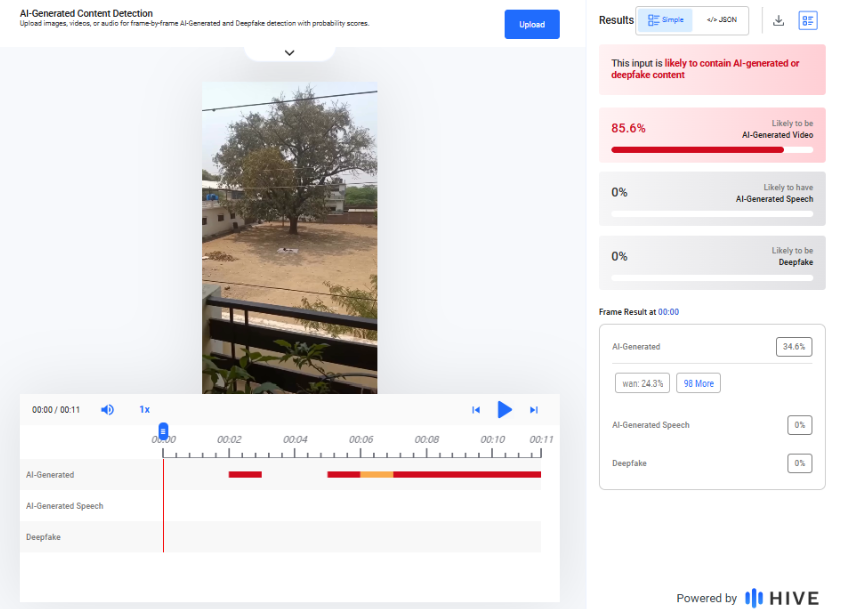
To further analyze the clip, we tested it using the AI detection tool Hive Moderation. The tool’s analysis classified the viral video as 85.6% likely to be AI-generated. We also checked the clip using another AI detection platform, Deepfake-o-meter. Its AVSRDD (2025) detection model flagged the video as potentially AI-generated with a 100% confidence score.

Conclusion
The evidence gathered during our research clearly shows that the viral video claiming to show a monkey saving a sleeping child from a falling tree branch is not authentic. The clip was created using AI-generated visual techniques and does not depict a real incident.

Related Blogs

Introduction
A bill requiring social media companies, providers of encrypted communications, and other online services to report drug activity on their platforms to the U.S. The Drug Enforcement Administration (DEA) advanced to the Senate floor, alarming privacy advocates who claim the legislation transforms businesses into de facto drug enforcement agents and exposes many of them to liability for providing end-to-end encryption.
Why is there a requirement for online companies to report drug activity?
The reason behind the bill is that there was a Kansas teenager died after unknowingly taking a fentanyl-laced pill he purchased on Snapchat. The bill requires social media companies and other web communication providers to provide the DEA with users’ names and other information when the companies have “actual knowledge” that illicit drugs are being distributed on their platforms.
There is an urgent need to look into this matter as platforms like Snapchat and Instagram are the constant applications that netizens use. If these kinds of apps promote the selling of drugs, then it will result in major drug-selling vehicles and become drug-selling platforms.
Threat to end to end encryption
End-to-end encryption has long been criticised by law enforcement for creating a “lawless space” that criminals, terrorists, and other bad actors can exploit for their illicit purposes. End- to end encryption is important for privacy, but it has been criticised as criminals also use it for bad purposes that result in cyber fraud and cybercrimes.
Cases of drug peddling on social media platforms
It is very easy to get drugs on social media, just like calling an Uber. It is that simple to get the drugs. The survey discovered that access to illegal drugs is “staggering” on social media applications, which has contributed to the rising number of fentanyl overdoses, which has resulted in suicide, gun violence, and accidents.
According to another survey, drug dealers use slang, emoticons, QR codes, and disappearing messages to reach customers while avoiding content monitoring measures on social networking platforms. Drug dealers are frequently active on numerous social media platforms, advertising their products on Instagram while providing their WhatApps or Snapchat names for queries, making it difficult for law officials to crack down on the transactions.
There is a need for social media platforms to report these kinds of drug-selling activity on specific platforms to the Drug enforcement administration. The bill requires online companies to report drug cases going on websites, such as the above-mentioned Snapchat case. There are so many other cases where drug dealers sell the drug through Instagram, Snapchat etc. Usually, if Instagram blocks one account, they create another account for the drug selling. Just by only blocking the account does not help to stop drug trafficking on social media platforms.
Will this put the privacy of users at risk?
It is important to report the cybercrime activities of selling drugs on social media platforms. The companies will only detect the activity regarding the drugs which are being sold through social media platforms which are able to detect bad actors and cyber criminals. The detection will be on the particular activities on the applications where it is happening because the social media platforms lack regulations to govern them, and their convenience becomes the major vehicle for the drugs sale.
Conclusion
Social media companies are required to report these kinds of activities happening on their platforms immediately to the Drugs enforcement Administration so that the DEA will take the required steps instead of just blocking the account. Because just blocking does not stop these drug markets from happening online. There must be proper reporting for that. And there is a need for social media regulations. Social media platforms mostly influence people.

Introduction
Ministry of Electronics and Information Technology released draft plans for advancing indigenous research and development in cyber forensics, quantum computing technologies, mobile security, cryptography, and Internet of Things (IoT) security. These roadmaps, crafted by the Centre for Development of Advanced Computing, outline strategic approaches to address various challenges over different timeframes leading up to 2047, marking the centenary of Indian independence. These roadmaps provide valuable insights into the nation's commitment to achieving technical autonomy and bolstering resilience in critical areas of cybersecurity and emerging technologies.
Cybersecurity Roadmap
The cybersecurity strategy serves as a lighthouse for strengthening India's digital defenses. With an eye on the immediate future, the plan seeks to create "Social Media Analytics" by 2026, reflecting the rising relevance of extracting insights from the immense ocean of social media data. Furthermore, the emphasis on "Dark Web Forensics" by 2030 demonstrates an understanding of the shifting danger scenario. Ongoing attempts to detect child abuse and human trafficking reflect a dedication to using technology to address social concerns. The timescale beyond 2047 underscores the lasting nature of these difficulties and the necessity for ongoing innovation. Furthermore, the roadmap highlights plans for GPS and car forensics by 2027 and 2029, respectively, demonstrating a comprehensive approach to cybersecurity that spans numerous technologies.
India's quantum computing strategy outlines considerable research and development plans till 2034. Quantum computing represents the boundary of processing power, and India intends to make major progress in this area. The extended time scale reflects the inherent complexity and limitations of applying quantum physics to practical applications.
The Mobile Security Roadmap prioritises "enterprise-grade" security measures to protect critical business and government data. Furthermore, the plan emphasises the importance of an "indigenous system for secure [operating systems] and mobile device hardware," allowing India to lessen its reliance on foreign technology in the mobile ecosystem.
Cryptography Roadmap
Cryptography is the foundation of secure digital communication, and India's strategy for this sector outlines specific and time-bound objectives. The focus on 'asymmetric cryptography' and safeguarding IoT devices by 2028-33 is consistent with worldwide initiatives to improve digital security. The emphasis on "quantum-resistant cryptography," which indicates a forward-thinking approach to encryption technologies that may endure the arrival of quantum computing, which poses a possible danger to current cryptographic systems, is particularly noteworthy.
Challenges and opportunities
While these roadmaps set a visionary route for India's technologically advanced future, such ambitious undertakings bring both problems and possibilities. The intricacy of quantum computing, as well as the ever-changing nature of cyber threats, needs ongoing adaptation and engagement with the international academic community. Furthermore, establishing self-sufficiency in vital technologies necessitates significant research, development, and talent acquisition investments.
Collaboration and Global Perspectives
In an interconnected society, the success of these roadmaps is dependent on collaboration with the global community. The sharing of information, best practices, and joint research efforts can help India advance and strengthen its capacities in these transformational technologies. Building strong international collaborations would not only boost India's position but also help to progress science and technology throughout the world.
Conclusion
India's proposed roadmaps for cybersecurity, quantum computing, mobile security, encryption, and IoT security offer a strategic and forward-thinking outlook on the country's technological future. These roadmaps, which continue well beyond 2047, the centennial of Indian independence, demonstrate India's commitment to long-term resilience and innovation in the face of growing digital problems. The effective implementation of these roadmaps would safeguard India's digital environment and position the country as a worldwide leader in cutting-edge technology, helping to improve society and expand human understanding.
Reference:

Executive Summary:
A viral claim circulated in social media that Anant Ambani and Radhika Merchant wore clothes made of pure gold during their pre-wedding cruise party in Europe. Thorough analysis revealed abnormalities in image quality, particularly between the face, neck, and hands compared to the claimed gold clothing, leads to possible AI manipulation. A keyword search found no credible news reports or authentic images supporting this claim. Further analysis using AI detection tools, TrueMedia and Hive Moderator, confirmed substantial evidence of AI fabrication, with a high probability of the image being AI-generated or a deep fake. Additionally, a photo from a previous event at Jio World Plaza matched with the pose of the manipulated image, further denying the claim and indicating that the image of Anant Ambani and Radhika Merchant wearing golden outfit during their pre-wedding cruise was digitally altered.

Claims:
Anant Ambani and Radhika Merchant wore clothes made of pure gold during their pre-wedding cruise party in Europe.


Fact Check:
When we received the posts, we found anomalies that were usually found in edited images or AI manipulated images, particularly between the face, neck, and hands.

It’s very unusual in any image. So we then checked in AI Image detection software named Hive Moderation detection tool and found it to be 95.9% AI manipulated.

We also checked with another widely used AI detection tool named True Media. True Media also found it to be 100% to be made using AI.


This implies that the image is AI-generated. To find the original image that has been edited, we did keyword search. We found an image with the same pose as in the manipulated image, with the title "Radhika Merchant, Anant Ambani pose with Mukesh Ambani at Jio World Plaza opening”. The two images can be compared to verify that the digitally altered image is the same.

Hence, it’s confirmed that the viral image is digitally altered and has no connection with the 2nd Pre-wedding cruise party in Europe. Thus the viral image is fake and misleading.
Conclusion:
The claim that Anant Ambani and Radhika Merchant wore clothes made of pure gold at their pre-wedding cruise party in Europe is false. The analysis of the image showed signs of manipulation, and a lack of credible news reports or authentic photos supports that it was likely digitally altered. AI detection tools confirmed a high probability that the image was fake, and a comparison with a genuine photo from another event revealed that the image had been edited. Therefore, the claim is false and misleading.
- Claim: Anant Ambani and Radhika Merchant wore clothes made of pure gold during their pre-wedding cruise party in Europe.
- Claimed on: YouTube, LinkedIn, Instagram
- Fact Check: Fake & Misleading
